IHUB
IHUB
 Private Briefings (Webinars)


 LeaderSpeak Podcast
  Global Entertainment Digest (Newsletter)
  Premium Lists
 Membership Benefits
 About Vitrina
 Our Story
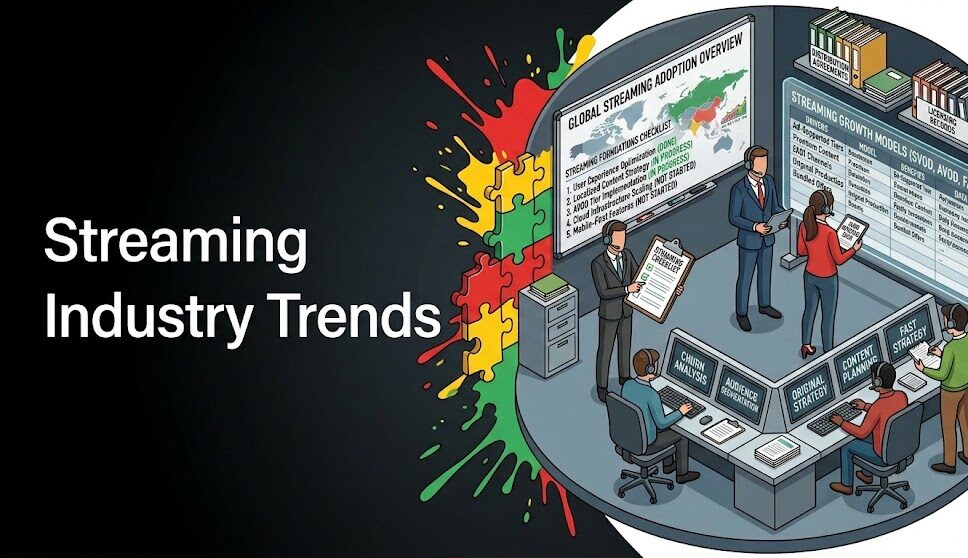
The streaming industry in 2026 looks nothing like anyone predicted five years ago. It’s not the death of linear TV (linear is stubborn). It’s not the end of theatrical (theatrical is quietly recovering). And it’s definitely not a world of infinite subscriber growth—because that model broke around 2022 and nobody’s pretending otherwise anymore.
What we’re actually seeing is a fundamental restructuring: from growth-at-all-costs to sustainable unit economics, from Western-first content strategies to genuinely global production, from subscription purity to layered monetization models that blend ads, bundles, FAST channels, and live events. The latest streaming platform trends reshaping the entertainment industry in 2026 aren’t incremental. They’re the industry figuring out what sustainable actually looks like after a decade of subsidy-driven expansion.
Here’s what’s actually moving the needle—and what the implications are for everyone from indie producers to institutional investors.
Table of Contents
- The Shift from Subscriber Growth to Profitability
- Ad-Supported Streaming: The New Default Tier
- Password Crackdowns Are Quietly Rebuilding Subscriber Bases
- Regional Content Is No Longer Optional — It’s the Growth Strategy
- The FAST Channel Explosion and What It Means for Distributors
- Streaming vs Theatrical: Why the Lines Are Blurring Again
- Bundling and Consolidation Are Accelerating
- AI Is Reshaping What Gets Greenlit (and What Doesn’t)
- FAQ
- Conclusion
Ask VIQI: Which Streaming Trends Apply to Your Content Strategy?
VIQI is Vitrina’s AI assistant—trained on 1.6 million titles, 300,000+ companies, and 5 million entertainment professionals. Ask it how 2026 streaming trends affect your genre, territory, or content type specifically.
✓ Included with 200 free credits | ✓ No credit card needed
The Shift from Subscriber Growth to Profitability
The decade-long era of “grow subscribers at any cost” is structurally over. What replaced it is something the industry hadn’t properly thought through: streaming profitability. How do you make money when consumers have been trained to expect unlimited content for $8–$15 per month?
The answer, it turns out, involves a lot of things that pure subscribers didn’t want. Ads. Bundle packages that lock them into multiple services. Live events with premium pricing. Tiered access that makes the bottom tier less desirable than it used to be.
Netflix’s Q3 2025 results illustrated the shift clearly: the company posted record revenue of over $9.8 billion in a single quarter, not because it had dramatically more subscribers, but because average revenue per user climbed as ad-tier and premium-tier adoption both grew. The subscriber growth story has been quietly replaced by the monetization-per-subscriber story—and every major platform is now running that playbook.
What this means for the supply chain is significant. When platforms optimized for subscriber growth, volume mattered—they needed content libraries wide enough to justify the subscription for as many people as possible. When they optimize for revenue per user, quality and engagement matter more than breadth. That’s a meaningful shift in what gets commissioned, what gets renewed, and what gets licensed.
Independent producers who understand this are pitching differently. Not “we have a compelling story” but “here are the viewership-equivalent data points from comparable titles, and here’s why this project over-indexes on the demographics that drive your ad revenue.” That’s a different conversation than the one indie film had been having with streamers five years ago. For a deeper look at how the broader evolution of streaming services arrived at this point, the arc from disruption to monetization discipline is one of the defining business stories of the decade.
Ad-Supported Streaming: The New Default Tier
Here’s something worth saying directly: AVOD and FAST channels are no longer the backup option for viewers who can’t afford a subscription. They’re becoming the default entry point for most new streaming consumers—particularly in markets outside North America and Western Europe where $15/month is a significant spend relative to local income.
The numbers bear this out. According to Variety, Netflix’s ad-supported tier crossed 40 million monthly active users globally in 2024 and continues to grow at rates significantly outpacing the ad-free tier. Peacock, Disney+, and HBO Max (now Max) have all seen their ad-tier adoption accelerate as price increases push cost-sensitive subscribers down the tier ladder.
The FAST channel dimension is separate and equally important. Free ad-supported streaming television—think Pluto TV, Tubi, The Roku Channel, Samsung TV Plus—generated roughly $6 billion in global advertising revenue in 2024, up from under $2 billion just four years earlier. This isn’t niche. It’s becoming the dominant model for casual viewing consumption.
What’s driving FAST adoption specifically:
- Zero friction. No account creation, no payment required—just open the app and watch. That frictionless entry converts curious viewers that subscription models can’t reach.
- Linear-like behavior. FAST channels replicate the lean-back experience of traditional TV. Viewers don’t have to choose what to watch—the channel chooses for them. That suits audiences who are genuinely fatigued by infinite choice.
- Library monetization for rights holders. Content libraries that would otherwise sit unlicensed can generate real advertising revenue through FAST distribution without cannibalizing premium subscription audiences.
For distributors and producers, the FAST question isn’t whether to participate—it’s how to value your content appropriately for FAST deals versus SVOD deals, and how to structure windowing to maximize the revenue from both. The mechanics of FAST channel monetization involve metadata, thumbnail optimization, and scheduling strategy that most indie producers haven’t invested in building—and that’s a competitive disadvantage they’re starting to close.
Track What Every Streamer Is Acquiring Right Now
Trusted by Netflix, Warner Bros, and Paramount. Join 300,000+ companies using Vitrina to track streaming acquisitions, greenlit projects, and content demand signals globally—before they hit the trades.
✓ 200 free credits | ✓ No credit card required | ✓ Full platform access
Password Crackdowns Are Quietly Rebuilding Subscriber Bases
Netflix’s password-sharing crackdown—widely predicted to cause subscriber exodus when it rolled out in 2023—turned out to be one of the most effective subscriber growth strategies in the company’s history. The lesson wasn’t lost on the rest of the industry. Disney+, Peacock, and Max have all moved toward household-based subscription models at varying speeds since.
The math was always straightforward: approximately 100 million households were using Netflix via shared credentials without paying, according to estimates Netflix itself cited during its enforcement rollout. Converting even 20–30% of those into paying accounts—whether into ad-supported tiers or standard subscriptions—represented enormous incremental revenue from an existing engaged audience.
But the more interesting effect was behavioral. The crackdown forced casual viewers to confront a choice: pay or leave. Most paid. That revealed something important about perceived value—the content libraries were valuable enough to convert non-payers into subscribers. That’s a stronger product signal than subscriber counts alone ever communicated.
And here’s the downstream effect on the supply chain: as password crackdowns drive more legitimate subscribers into the funnel—particularly into ad-supported tiers—platforms have more user data on actual consumption patterns. That data increasingly influences commissioning decisions. What genres are ad-tier subscribers watching? What content retains them through ad breaks? These are questions that shape greenlight decisions in ways that weren’t visible when consumption data was mixed with password-shared households. The shift toward clean, verified viewership data is making content acquisition both more data-driven and more honest about what audiences actually want.

Your AI Assistant, Agent, and Analyst for the Business of Entertainment
VIQI AI helps you plan content acquisitions, raise production financing, and find and connect with the right partners worldwide.
- List the top commissioners at the BBC
- List the post-production and VFX decision-makers at Netflix
- List the development leaders at Sony Pictures
- List the scripted programming heads at HBO
- Find active co-producers and financiers for scripted projects
- Find equity and gap financing companies in North America
- Find top film financiers in Europe
- Find production houses that can co-produce or finance unscripted series
- Who is backing animation projects in Europe right now
- Who is Netflix’s top production partners for Sports Docs
- Who is Commissioning factual content in the NORDICS
- Who is acquiring unscripted formats for the North American market
- Show me recent drama projects available for pre-buy
- Show me Japanese Anime Distributors
- Show me true-crime buyers from Asia
- Show me documentary pre-buyers
- I am looking for production partners for a YA drama set in Brazil
- I am looking for producers with proven track record in mid-budget features
- I am looking for Turkish distributors with successful international sales
- I am looking for OTT platforms actively acquiring finished series for the LATAM region
- I am seeking localization companies offer subtitling services in multiple Asian languages
- I am seeking partners in animation production for children's content
- I am seeking USA based post-production companies with sound facilities
- I am seeking VFX partners to composite background images and AI generated content
Regional Content Is No Longer Optional — It’s the Growth Strategy
Ask yourself: where does Netflix’s next 100 million subscribers come from? Not from North America or Western Europe—those markets are mature and approaching saturation. It comes from Southeast Asia, the Middle East, Africa, Latin America, and South Asia. And winning those markets requires content those audiences care about—which means regional, local-language programming.
This isn’t a new insight. What’s new is how aggressively platforms are acting on it. Netflix announced a $1 billion investment in Mexico through 2028. It opened a technology and creative hub in Hyderabad specifically for Indian content production. Prime Video’s co-production strategy now explicitly includes Southeast Asian studios as strategic partners, not just service providers.
Meanwhile in MENA—a region that Western platforms historically treated as secondary—the dynamics are shifting fast. Rolla Karam, SVP of Content Acquisition at OSN (a premium streaming and pay-TV platform covering 23 countries across the Middle East and North Africa), describes the strategic direction clearly: “From the region for the region—we’re trying to enhance our Arabic catalog.” OSN’s platform currently sits at roughly 90% Western content, but the mandate is moving. Turkish content, she notes, “does amazingly well on our platform”—demonstrating that audiences in the region are hungry for culturally proximate storytelling, not just Hollywood imports.
The broader pattern is what Vitrina’s analysis of 62 expert interviews describes as Sovereign Content Hubs—government-backed production ecosystems in Saudi Arabia, UAE, South Korea, India, and Brazil that are building the infrastructure to supply regional streaming demand at scale. Saudi Arabia’s Vision 2030 has allocated over $4 billion to film and television infrastructure, including 17 operational studios. These aren’t vanity projects. They’re strategic investments in becoming content exporters—not just domestic broadcasters.
For global streamers, this creates a structural opportunity: regional sovereign hubs reduce the cost of local content production while the platform provides the distribution reach and the brand. It’s a co-production model with government-scale backing on the supply side. For independent producers, it means genuine opportunities to co-produce with regional partners and access streaming distribution that wasn’t available five years ago. The regional streaming content competition is intensifying—platforms that don’t invest locally are conceding markets to those that do.
Gianluca Chakra (CEO, Front Row) on the MENA content market shift—from DVD to SVOD, local Arabic production investment, and what the maturing Saudi market means for streaming strategy:
The FAST Channel Explosion and What It Means for Distributors
The FAST channel market grew from a curiosity to a genuine distribution category in roughly four years. What’s driving it isn’t just consumer demand—it’s rights holders looking at catalog libraries and asking whether there’s a better monetization model than leaving rights unexercised.
The answer, for a lot of catalog content, is yes. A documentary series that has already run its SVOD window and sits in a library generating nothing can be relaunched as a dedicated FAST channel—”True Crime 24/7,” “Classic Horror Nights”—and generate consistent advertising revenue without cannibalizing premium subscription audiences who are watching new content anyway. That’s found money from existing inventory.
Fremantle, one of the world’s largest independent TV producers and distributors, launched 19 FAST channels across European markets in 2025, covering properties from Baywatch to classic game show formats. It’s a template other major rights holders are following: take known IP, build FAST channels around it, monetize through advertising with minimal additional production cost.
The challenge for independent distributors is metadata and scheduling. FAST platforms are algorithm-driven—how your content is tagged, how it’s programmed, and how thumbnails and titles are optimized determines whether it surfaces organically or gets buried. Distributors who’ve invested in rich content metadata and experienced FAST operations teams are outperforming those treating it as a low-effort catalog dump. This is exactly where the streaming consolidation and hybrid model dynamic plays out—the winners in FAST aren’t the largest rights holders, they’re the best operators.
Streaming vs Theatrical: Why the Lines Are Blurring Again
COVID accelerated the streaming-first narrative so aggressively that theatrical was widely treated as a legacy format in terminal decline. That turned out to be wrong. And in 2026, the evidence that theatrical is resilient—and that the film industry is restructuring around a hybrid model rather than a streaming-only one—is accumulating.
Joshua Harris, President of Peachtree Media Partners—a film finance lender that has backed dozens of independent productions—describes the market signal at the 2025 American Film Market: “The entire base is really seeing the swing back to theatrical being the future of our business. Most distributors now are looking for films that can play theatrically as well as then go to a home entertainment streaming video-on-demand model.”
That’s a meaningful data point from a lender whose business depends on accurately assessing distribution value. If theatrical is coming back as a signal of commercial viability—not as the primary revenue channel, but as a quality indicator that improves a film’s entire revenue trajectory—then production strategies and financing structures need to reflect that.
The window dynamics are still in flux. Streamers who acquired pay-one rights can block theatrical releases in ways that frustrate distributors. But deals are evolving—platforms are increasingly willing to allow day-and-date or short-window theatrical runs for prestige titles because theatrical performance improves streaming subscriber engagement when those titles arrive on platform. The marketing value of a box office story can’t be replicated by a streaming launch alone. That’s something the industry is relearning, commercially, after a few years of pure platform thinking.
Bundling and Consolidation Are Accelerating
The streaming consolidation wave that industry observers have predicted since 2021 is now visibly underway—and taking forms nobody quite anticipated. Mergers, acquisitions, content licensing between competitors, and bundle packaging are all moving simultaneously. The most dramatic signal: Netflix’s reported pursuit of Warner Bros assets, including a rumored $25 billion financing package for WBD content. Whether that deal closes in its current form or not, the direction is clear. The streaming era is entering its consolidation phase.
The economics behind consolidation are straightforward. Consumer churn is a real problem—subscribers who sign up, watch the show they wanted, and cancel are expensive. Bundles reduce churn because the value proposition expands. You don’t cancel Disney+ when you’re also getting ESPN and Hulu for a marginal incremental cost. You don’t cancel Apple when the bundle includes TV+, Music, iCloud, and Arcade.
The Peacock–Apple TV+ bundle in the US, the Shahid–Disney–MBC–OSN bundle emerging in MENA, the Bell Media–Tubi FAST integration in Canada—these aren’t anomalies. They’re the distribution architecture of the next phase of streaming. Standalone platforms in mid-tier positions—strong enough to survive but not dominant enough to resist churn—are the ones most likely to seek bundle arrangements or acquisition in the next 24–36 months.
For content producers and rights holders, consolidation has a specific implication: the negotiating landscape is concentrating. As fewer buyers control more distribution reach, pricing power shifts further toward the platforms. The strategic response—as producers like A24, XYZ Films, and MK2 have demonstrated—is vertical integration of ownership: retain IP, license strategically to multiple buyers rather than selling exclusivity outright, and build library value that compounds over time rather than converting it to upfront production fees.
The concept of streaming platform financing is evolving in parallel—platforms are increasingly becoming co-investors in content rather than pure licensors, which changes the deal structure available to producers who understand how to negotiate it.
AI Is Reshaping What Gets Greenlit (and What Doesn’t)
Artificial intelligence in the streaming industry is frequently discussed at the production level—AI-generated scripts, AI visual effects, AI voice dubbing. But the less-discussed and arguably more consequential application is at the content acquisition and greenlight level.
Platforms with large subscriber bases are sitting on enormous consumption datasets. Which genres retain ad-tier subscribers through ad breaks? What thumbnail designs drive click-through on which demographic segments? Which international titles over-perform in unexpected markets? These questions are being answered with machine learning systems that influence acquisition budgets, commissioning decisions, and title prioritization in ways that aren’t publicly visible but are structurally significant.
The practical effect on the supply chain: data-driven content acquisition is increasingly favoring proposals that come with consumption proxies. Comparable title performance, audience demographic data, engagement metrics from short-form previews, social listening signals—all of this is feeding into greenlight conversations that used to be driven primarily by relationships and creative judgment. According to The Hollywood Reporter, major streamers have invested significantly in proprietary content intelligence platforms that feed directly into their acquisition pipelines.
AI’s impact on localization is equally transformative. OSN’s Rolla Karam notes that the platform is actively investing in AI subtitling tools, with English-language accuracy already at production-ready quality—though Arabic translation remains technically challenging given dialect complexity across 23 markets. The cost reduction in localization from AI tools is making regional content distribution viable at volume that wasn’t economically possible three years ago. That directly enables the regional content strategies discussed earlier.
The authorized AI question—which IP was used to train which models, and who owns the rights—remains legally unresolved but commercially urgent. Studios and streamers are increasingly requiring content providers to certify that AI tools used in production have licensed training data, because unresolved IP liability creates completion bond and distribution deal complications. That’s a real constraint, not a theoretical one, and it’s reshaping production workflows now. The AI-driven content discovery and recommendation layer is becoming a genuine competitive moat for platforms that invest in it early.
Need Direct Introductions to the Right Streaming Buyers?
Vitrina Concierge doesn’t give you a list—we make warm introductions directly to decision-makers at the platforms and distributors actively seeking your content type.
- Korean animation studio → Netflix Adult Animation (week one)
- LA producer → Netflix UK, Fifth Season, Fox Entertainment (48 hours)
- Middle Eastern studio → Legendary Pictures (direct access)
Frequently Asked Questions
What is the biggest streaming industry trend in 2026?
The most structurally significant streaming industry trend in 2026 is the shift from subscriber growth to revenue-per-user optimization. Platforms are no longer competing primarily on subscriber count—they’re competing on how much revenue each subscriber generates through ad tier adoption, premium tier upsells, live event add-ons, and bundle pricing. This changes everything from greenlight decisions to content acquisition strategy.
Is FAST channel streaming growing in 2026?
Significantly. FAST channels generated roughly $6 billion in global advertising revenue in 2024 and growth has continued into 2025–2026, driven by major rights holders launching branded channels, smart TV manufacturers expanding free content offerings, and consumer preference for lean-back viewing experiences. For distributors with catalog libraries, FAST has shifted from an afterthought to a meaningful revenue line.
How is regional content changing streaming strategies in 2026?
Regional and local-language content has moved from a nice-to-have to a strategic growth imperative. Major platforms are investing billions in MENA, Southeast Asia, India, and Latin America—not because Western content fails there, but because local content dramatically improves subscriber retention, average revenue per user, and market penetration in growing economies. Saudi Arabia, UAE, South Korea, and India are building sovereign content hub infrastructure to supply this demand at scale.
Will streaming consolidation continue in 2026 and beyond?
Almost certainly. The economics favor consolidation: bundling reduces subscriber churn, shared infrastructure reduces cost per title, and negotiating leverage concentrates with fewer, larger entities. Mid-tier platforms in particular—those with strong content libraries but insufficient scale to compete with Netflix or Disney—are the most likely candidates for acquisition, merger, or bundle agreements over the next 24–36 months. The WBD-Netflix licensing dynamic is one of many signals pointing in this direction.
Is theatrical coming back as a meaningful distribution window?
Yes—not to pre-2020 dominance, but to a meaningful role in the revenue and marketing ecosystem. Major distributors are now requiring projects to have theatrical viability as a condition of acquisition, because theatrical performance generates press coverage and word-of-mouth that streaming launches can’t replicate organically. The window is shorter—often 30–45 days before streaming—but the presence of theatrical in the release plan meaningfully improves a title’s overall revenue trajectory.
How is AI affecting content acquisition decisions at streaming platforms?
Significantly and increasingly. Platforms with large subscriber bases are using machine learning systems to analyze consumption patterns, thumbnail performance, retention metrics, and demographic engagement data—all of which feed into greenlight and acquisition decisions. Producers who pitch with comparable title data, engagement proxies, and audience demographic evidence are increasingly more successful than those relying on creative pitch alone. The shift toward data-informed acquisition is structural, not cyclical.
What do the latest streaming trends mean for independent producers?
The implications are mixed. On one hand, consolidation reduces the number of buyers and concentrates negotiating power with platforms. On the other hand, regional content investment, FAST channel distribution, and the return of theatrical viability as a deal signal all open new pathways that didn’t exist at the same scale five years ago. The producers navigating 2026 most successfully are those treating streaming as one window among several—not the only destination—and building IP that retains value across multiple distribution models.
Which streaming platforms are growing fastest globally in 2026?
Netflix remains the dominant global platform by subscriber count, with strong Q3 and Q4 2025 results driven by ad-tier adoption and password enforcement. But growth rate leaders are regional platforms and FAST services: Tubi, Pluto TV, and Samsung TV Plus are growing fastest in ad-supported volume; regional platforms like Viu (Southeast Asia), OSN (MENA), and JioCinema (India) are growing fastest in geographic footprint and local content investment. The global streaming landscape is becoming multipolar—Netflix is everywhere, but regional platforms are winning specific markets.
Conclusion: The Streaming Industry Isn’t Slowing Down — It’s Restructuring
The latest streaming platform trends reshaping the entertainment industry in 2026 share a common thread: the era of “build it and they’ll subscribe” is over. What’s replacing it is more complex, more regional, more multi-layered, and frankly more interesting than the original disruption narrative suggested.
Key Takeaways:
- Revenue per user is the new subscriber count: Platforms are optimizing for monetization depth, not headcount—which changes what content gets commissioned and how deals are structured.
- Ad-supported tiers are the new default entry point: AVOD and FAST are mainstream, generating billions in advertising revenue and reshaping how catalog libraries are monetized.
- Regional content is a growth strategy, not a concession: Sovereign content hubs in MENA, APAC, and LATAM are supplying genuinely local programming at scale—and global platforms are paying for it.
- Consolidation concentrates buyer power: The streaming landscape is entering its consolidation phase—producers who retain IP ownership are better positioned than those selling exclusivity outright.
- Theatrical is back as a quality signal: The hybrid model—theatrical plus streaming—is reasserting itself as the commercial template for ambitious independent and mid-budget films.
- AI is in the greenlight room: Data-driven acquisition is structural, and producers who pitch with consumption proxies and demographic evidence have a meaningful advantage over those relying on creative pitch alone.
The entertainment industry doesn’t get simpler from here. But the producers, distributors, and investors who understand where the structural shifts are happening—and position their content and capital accordingly—will be the ones who benefit from the restructuring rather than being squeezed by it.
Stay Ahead of Every Streaming Shift Before It Hits the Trades
Trusted by Netflix, Warner Bros, Paramount, and Google TV. Track 159,223 projects, 3 million verified executives, and streaming acquisition signals across 100+ countries—with VIQI’s AI intelligence built in.
✓ 200 free credits | ✓ No credit card required | ✓ Cancel anytime
Need direct introductions to streaming buyers? Explore Concierge Service →