IHUB
IHUB
 Private Briefings (Webinars)


 LeaderSpeak Podcast
  Global Entertainment Digest (Newsletter)
  Premium Lists
 Membership Benefits
 About Vitrina
 Our Story
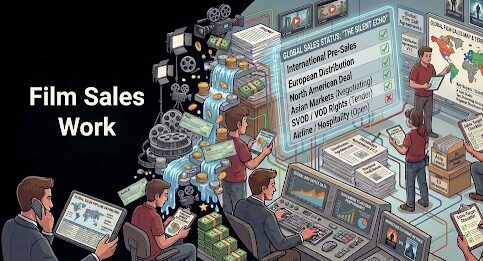
International sales are not a distribution afterthought. They are a financing mechanism. In independent film, the money that buyers in different countries pay for the right to show a film in their market — territory by territory, in advance of release — is often what makes the entire production budget possible. Based on Vitrina’s LeaderSpeak Podcast conversations with senior practitioners from Myriad Pictures, HeadGear Films, and 91 Film Studios, and drawing on the Vitrina Financing Playbook’s structural analysis, this article explains how international film sales work and why they sit at the centre of most independent financing plans.
Author:
Kunal Barai leads Global Markets at Vitrina.AI, working with producers and financiers across 100+ countries to facilitate content financing and co-production matchmaking. He recently hosted a roundtable on AI for Film Financing: Unlocking Smarter Global Matchmaking and Funding Strategies at MIP London 2026. Earlier, he spent 12+ years at Nielsen/Gracenote and completed MIT Sloan’s executive program on AI strategy.
Most producers think of film sales as something that happens after a film is made: the process of finding distributors, getting the film to festivals, and negotiating deals in different markets. That understanding is not wrong, but it describes only part of the picture. In independent film, sales also happen before production begins, and those early sales agreements are often what makes financing possible in the first place.
The mechanism works like this. A sales agent — a company that represents the film in international markets — approaches buyers in different territories, which are simply the different countries or regions where a film will be sold and distributed. Those buyers — broadcasters, streaming platforms, theatrical distributors, and others — assess the project and decide whether to commit to a pre-sale, which is an advance payment against the right to distribute the film in their territory once it is completed. Those pre-sale agreements become collateral, meaning they can be used to secure a loan against the expected revenue. The loan covers production costs. The film gets made.
This is the core of how independent film financing works in practice: the future value of the film in international markets is converted into present capital. Understanding this mechanism — what drives it, what limits it, and how different practitioners use it — is fundamental to building a financing plan that actually holds together.
This article covers: How territory sales function as a financing tool · How Myriad Pictures uses territory sales to build financing · How HeadGear Films reads the sales market to shape financing · How 91 Film Studios approaches sales in a regional market · How territory sales fit into the capital stack · What producers need to understand about international sales
Table of Contents
- How Territory Sales Function as a Financing Tool
- How Myriad Pictures Uses Territory Sales to Build Financing
- How HeadGear Films Reads the Sales Market to Shape Financing
- How 91 Film Studios Approaches Sales in a Regional Market
- How Territory Sales Fit into the Capital Stack
- What Producers Need to Understand About International Sales
How Territory Sales Function as a Financing Tool
When a sales agent takes a pre-sale agreement to a lender, the lender evaluates it as collateral in the same way a bank evaluates any asset used to secure a loan: is it real? Is it assignable? And is the counterparty — the buyer who signed it — credible?
Pre-sales from established distributors in major markets carry significant weight. Pre-sales from buyers with uncertain track records or from minor markets carry less. The aggregate of credible pre-sales, combined with tax incentives and equity, is what forms the capital stack that finances the production.
Not all territory sales are treated equally by lenders. Different markets carry different risk profiles, and lenders discount the value of pre-sales from markets they consider less reliable or harder to enforce. The strength of the sales agent matters too, because their relationships with buyers, their track record of closing deals, and their ability to collect on agreements all influence how a lender evaluates the collateral. A pre-sale facilitated by a well-regarded agent with long-standing buyer relationships is worth more to a financing plan than the same pre-sale from an agent without that track record.
1. How Myriad Pictures Uses Territory Sales to Build Financing
Kirk D’Amico founded Myriad Pictures as a sales company, and that identity shapes everything about how he thinks about film financing. In the Myriad model, the sales question comes first, because the answer to it determines whether there is a financing conversation at all.
The central question from Myriad’s perspective is this: can this film realistically be sold, territory by territory, at numbers that support its cost? If the answer is uncertain, financing becomes unstable because the pre-sales that would anchor the capital stack cannot be reliably projected. If the answer is confident, the rest of the financing structure can be built around those sales projections.
| “I would say the one thing we don’t do is equity.”
— Kirk D’Amico, Myriad Pictures, Vitrina LeaderSpeak Podcast |
Myriad’s financing involvement is limited to minimum guarantees, which are upfront payments against distribution rights in specific territories. When Myriad commits a minimum guarantee, they are effectively providing a form of financing by advancing money against the sales value they believe the film will generate in their territory. They have worked with specialist lenders, including BondIt and Three Point Capital, to finance those minimum guarantees for productions they believe in. But whether Myriad provides a minimum guarantee at all depends entirely on their assessment of the project’s sales credibility.
Kirk D’Amico’s practical range for independently financeable films sits between five and fifteen million dollars. Below five million, the financing is easier to assemble but the sales returns are modest. Above thirty million, pre-sales alone are rarely sufficient to anchor the capital stack — that budget level typically requires studio involvement or a much more complex multi-territory co-production structure. Within his range, territory sales can genuinely drive the financing architecture when the project is packaged correctly.
Co-production, where two or more production entities in different countries formally share the cost and rights of a film, can extend what is achievable within a given budget by unlocking access to multiple national incentive programmes simultaneously, sharing production costs across the partners, and broadening the film’s territorial identity in ways that can increase buyer interest in specific markets. The complexity it adds in rights allocation, revenue sharing, and legal governance must be managed carefully from the beginning, rather than resolved later when the film is already in production.
2. How HeadGear Films Reads the Sales Market to Shape Financing
HeadGear Films finances around 35 to 40 films a year, which means Phil Hunt has a consistently updated view of what is selling in international markets and what is not. That market knowledge shapes every aspect of how HeadGear approaches project development and financing.
His observation about genre is grounded in what buyers consistently do across major territories: action, thriller, and horror films travel reliably, meaning buyers across multiple markets understand them well enough to position them for their own audiences and can model the revenue with some confidence. Drama is harder, not because it is a lesser form, but because it requires exceptional packaging to generate the same level of buyer confidence. An independent drama needs a more compelling case in every territory because the default response from a buyer who cannot position it clearly is to pass. Uncertainty about how to sell a film reduces its value to every party in the financing structure.
| “Cut the budget before you compromise on cast.”
— Phil Hunt, HeadGear Films, Vitrina LeaderSpeak Podcast |
Cast is the other major variable that Phil Hunt returns to consistently. In international markets, a recognisable actor is one of the few signals that gives buyers confidence they can anchor their own marketing to something the audience will respond to. The dynamic is not primarily about star power for its own sake. It is about the buyer’s ability to sell the film to their audience once they have acquired the rights. A film with known names is easier to sell at the point of territory acquisition, which means those names generate pre-sale commitments that a film without them will struggle to match.
HeadGear’s budget average of around eight to nine million dollars, with most projects under ten million, reflects the practical ceiling that territory sales can typically support for independently packaged films at standard cast levels. When budget and packaging are in alignment, the financing structure is manageable. When the budget assumes a level of sales revenue that the cast and genre cannot realistically generate, the structure weakens at its base.
3. How 91 Film Studios Approaches Sales in a Regional Market
Naveen Chandra at 91 Film Studios operates within a specific market — Indian regional language cinema — and his approach to sales and distribution illustrates a principle that applies broadly: sales and distribution are part of the financing plan, not an afterthought to it.
His observation that fifty percent of completed films never reach theatres properly is not a comment about the creative quality of those films. It is a structural observation about what happens when financing plans treat production as the endpoint. A film that is produced but never properly distributed has failed to convert its budget into the returns that investors were expecting when they committed. The capital that went in never comes back in the way the structure anticipated.
| “Films is the most risky business. I want somebody else to also love the story and put in money. I divide the risk and I divide the spoils.”
— Naveen Chandra, 91 Film Studios, Vitrina LeaderSpeak Podcast |
91 Film Studios is built around the Indian regional language market specifically because of the sales and IP dynamics it offers. Naveen deliberately avoids Hindi cinema in favour of Tamil, Telugu, Marathi, Malayalam, Punjabi, Bengali, and other regional languages. This is not a concession to lower ambition. Tamil and Telugu industries each produce around three hundred and fifty to four hundred films a year and are technically sophisticated markets. The strategic rationale is about the originality and diversity of stories available in those markets, combined with the IP ownership model the fund uses — where the intellectual property of the films remains with the fund and generates revenue across satellite rights, digital rights, and subsequent windows beyond the first theatrical run.
For producers thinking about sales in regional markets anywhere in the world, the 91 Film Studios model illustrates the importance of treating the distribution pathway as part of the financing calculation from the start. Theatrical release, satellite rights, digital rights, and the long-term IP value of a completed film all contribute to the revenue picture that investors rely on. Planning for each of those revenue streams before production rather than hoping they materialise afterward is what separates a structurally complete financing plan from an incomplete one.
4. How Territory Sales Fit into the Capital Stack
The Vitrina Financing Playbook’s structural analysis is direct about how territory sales function within the overall capital stack. Most independent financing structures include three layers: senior debt at the top, which is secured against predictable revenue sources like confirmed pre-sales and tax incentives and is repaid first; gap financing in the middle, which sits behind senior debt and is based on projected but as yet unsold territories; and equity at the bottom, which carries the highest risk and is repaid only after all debt has cleared.
| PRODUCER TAKEAWAY
→ Territory sales feed primarily into the senior debt layer — credible pre-sale agreements in major markets can be used as collateral to support a loan from a specialist lender → The stronger the sales position, the more of the budget can be covered by senior debt, which reduces the equity the producer needs to raise and lowers the overall risk profile → Gap financing covers the difference between confirmed pre-sales and the full budget — lenders charge more for it because it relies on projected rather than confirmed revenue → The earlier a producer secures credible territory pre-sales, the stronger the financing position — confirmed sales reduce the gap, lower the cost of debt, and give equity investors a clearer picture of the return environment |
Territory sales feed primarily into the senior debt layer. When a sales agent has secured credible pre-sale agreements in major markets, those agreements can be used as collateral to support a loan from a specialist lender. The stronger the sales position, the more of the budget can be covered by senior debt, which reduces the amount of equity the producer needs to raise and lowers the overall risk profile of the deal.
Gap financing, which covers the difference between confirmed pre-sales and the full budget, carries higher risk because it is based on projected rather than confirmed revenue from territories that have not yet committed. Lenders who provide gap financing charge more for it to reflect that higher risk. When the gap is large — meaning confirmed sales cover only a small fraction of the budget — the project becomes harder to finance because more of the structure depends on projections that may not materialise.
The practical lesson from the Playbook’s analysis is clear: the earlier a producer can secure credible territory pre-sales, the stronger their financing position becomes. Confirmed sales reduce the gap, lower the cost of debt, and give equity investors a clearer picture of the return environment they are entering. Projects that arrive at financing conversations without any pre-sales in place are asking every participant in the capital stack to take on more risk than a project that has already demonstrated market interest from credible buyers.
What Producers Need to Understand About International Sales
International film sales are not a separate process from film financing. In independent production, they are the foundation of it. The money that buyers pay for territory rights — whether as upfront pre-sales or as minimum guarantees from sales companies — is what makes the rest of the capital stack possible. A producer who understands this approaches packaging, genre, and cast decisions with a different calculation: not just what does this film need creatively, but what does this film need to generate the sales commitments that will allow it to be financed.
The practitioners in the Vitrina LeaderSpeak series are consistent on this point across very different business models. Kirk D’Amico at Myriad operates as a sales company and builds financing around sales projections. Phil Hunt at HeadGear shapes project development around what the international market will realistically support. Naveen Chandra at 91 Film Studios treats distribution as an integral part of the investment thesis rather than a post-production hope. In each case, the sales question comes before the financing question, because the answer to the first one determines what is possible in the second.
Producers who treat sales as something that happens after the film is made will find financing conversations harder than they need to be. The ones who understand how territory sales feed the capital stack, what makes pre-sales credible enough to use as collateral, and how the gap between confirmed sales and total budget shapes the risk profile for every investor in the deal — those producers are in a fundamentally stronger position to build a financing plan that holds together.
| “The sales question comes before the financing question, because the answer to the first one determines what is possible in the second.”
— Vitrina Financing Playbook |
About This Article
This article is part of Vitrina’s LeaderSpeak Podcast programme, where senior practitioners across the entertainment supply chain share the structural realities of how their part of the business works. The voices in this article are drawn from LeaderSpeak Podcast conversations with Kirk D’Amico of Myriad Pictures, Phil Hunt of HeadGear Films, and Naveen Chandra of 91 Film Studios. The section on territory sales and the capital stack draws on the structural analysis in the Vitrina Financing Playbook, which represents Vitrina’s own synthesis from its Live Session and market tracking. The Vitrina Film Financing Playbook is available for download.
Related reading: