IHUB
IHUB
 Private Briefings (Webinars)


 LeaderSpeak Podcast
  Global Entertainment Digest (Newsletter)
  About Vitrina
 About VIQI
 Our Story
 Our Solutions 🔥
 Film+TV Projects Tracker 🚀
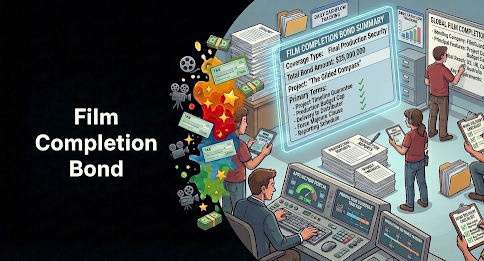
A plain-English guide to the completion guarantee: what it does, who provides it, and why no institutional lender will commit to a film without one. Based on Vitrina’s LeaderSpeak Podcast conversations with senior practitioners from Peachtree Media Partners and 91 Film Studios.
Author:
Kunal Barai leads Global Markets at Vitrina.AI, working with producers and financiers across 100+ countries to facilitate content financing and co-production matchmaking. He recently hosted a roundtable on AI for Film Financing: Unlocking Smarter Global Matchmaking and Funding Strategies at MIP London 2026. Earlier, he spent 12+ years at Nielsen/Gracenote and completed MIT Sloan’s executive program on AI strategy.
Independent film financing has a hidden prerequisite. Before a lender will put a single dollar into production, before contracts are countersigned, before money moves — they want to know that the film will actually be finished.
That sounds obvious. It isn’t always. Because finishing a film is harder than starting one. Budgets overrun. Schedules collapse. Producers run out of money partway through. And when that happens, everyone who has put money in loses.
The completion bond exists to solve that problem. For institutional lenders who sit at the top of the film’s repayment queue, it is not optional. It is a hard requirement. If you are approaching a lender like Peachtree Media Partners without a completion bond in place or actively being arranged, that conversation will be a short one.
This article explains what a completion bond is, why lenders require it, which companies provide it, and what it means for your financing plan.
Table of Contents
What a Completion Bond Actually Is
A completion bond, also called a completion guarantee, is an insurance policy issued by a specialist third-party company at the start of production. The bond company reviews the script, budget, schedule, and key crew. If satisfied, they guarantee the film will be completed on time and on budget. If the production runs into serious trouble, the bond company steps in. They may take over the production, inject funds, or convert their obligation into an insurance claim.
This is not the same as general production insurance, which covers specific risks like equipment damage or a cast member falling ill. A completion bond covers the whole production promise: the film will be finished, or the bond company bears the cost of that failure.
The three most active completion bond providers in the independent film market are Film Finances, Unifi, and Media Guarantors. These are specialist firms. They assess productions the way a lender assesses collateral — carefully, methodically, and with a clear view of where the risks are.
1. The Structural Problem the Bond Is Designed to Fix
To understand why lenders insist on completion bonds, you need to understand the scale of the problem they are solving.
Naveen Chandra is the founder of 91 Film Studios — a SEBI-registered Category 2 Alternate Investment Fund (a regulated, institutional fund structure under Indian securities law) focused on Indian regional cinema. Before launching, he spent two years talking to producers, investors, and industry participants across the country. One finding stood out above everything else.
| “50 percent of the films that get out to get made don’t get completed. Whatever conversations I was having with people, they all said, you know, I’ve got a film, I’m stuck with a little finance, I can’t seem to finish the film. And I need a little bit of bridge financing to finish the film.”
— Naveen Chandra, 91 Film Studios, Vitrina LeaderSpeak Podcast |
That is not a niche problem. That is a structural failure in independent production. Half of all films that enter production never reach completion. The money invested in those films — by producers, equity investors, lenders — is largely unrecoverable once a production collapses halfway through.
For a lender, that risk is existential. If the film does not get finished, there is no revenue. If there is no revenue, there is nothing to repay the loan with. The collateral — the pre-sale agreements, the distribution contracts, the tax incentives — loses most of its value if there is no finished film to deliver.
The completion bond transfers that risk to an institutional insurer. It does not guarantee a film will perform well commercially. It guarantees a film will exist — which is the minimum requirement for everything else.
2. Why Peachtree Will Not Commit Without One
Peachtree Media Partners is one of the most active independent film lenders in the US, Canada, UK, and Australia. They lend against identifiable assets in a project, pre-sale agreements, distribution contracts, tax incentives, assigned rights and their transactions typically run between $3 million and $35 million.
Joshua Harris, president and managing partner of Peachtree, is direct about the biggest single risk in film lending. It is not a creative risk. It is not market risk. It is the risk that a film goes into production and never comes out the other side.
That is why Peachtree’s completion bond requirement is not a preference; it is a condition of lending. A completion guarantee must be in place before Peachtree commits capital. The production must be bondable, and the bond must be issued or actively in progress before the loan moves forward.
The logic is clean. Peachtree lends against collateral. That collateral — the distribution rights, the pre-sale agreements, the tax credits — only has real value when there is a finished film to deliver. If there is no finished film, the collateral is compromised. The completion bond protects the collateral by guaranteeing the film gets made.
| PRODUCER TAKEAWAY→ A completion bond is a condition of lending for institutional lenders like Peachtree — not a preference
→ Once a bond is in place, Peachtree’s risk shifts from whether they get repaid to when — a fundamentally more manageable risk profile → Timing risk is a financing problem. Completion risk is an existential one |
As the Vitrina Film Financing Playbook summarises from Peachtree’s model: once a completion bond is in place, Peachtree’s risk shifts from whether they get repaid to when. That is a fundamentally different and much more manageable risk profile. Timing risk is a financing problem. Completion risk is an existential one.
3. The $5M Floor — And What That Means for Smaller Projects
There is a practical threshold producers need to understand. Below approximately $5 million in production budget, the cost of bonding can make the entire financing structure unworkable.
Bond companies charge a fee, typically a percentage of the total production budget, for providing the guarantee. On a very low-budget film, that fee becomes a disproportionate burden on the financing plan. It eats into the budget in a way that can undermine the viability of the project itself.
That is partly why Peachtree’s lending activity sits comfortably in the $5 million and above range. Below that floor, the economics of bonded lending do not work for either side.
This does not mean films under $5 million are unfinanceable. It means they are typically financed through different structures — equity investment, informal arrangements, or grant funding that do not carry the institutional debt requirements that a completion bond serves. If your project is in that lower range and you are approaching an equity investor rather than a lender, the bonding conversation is different.
If your project sits in the $5M–30M range and you are approaching a structured lender, the completion bond is not a technicality to sort out later. It is the entry point.
4. What Bond Companies Actually Look At
Getting a completion bond is not automatic. Bond companies do their own underwriting — a careful review of the production — before they agree to guarantee it. They assess:
- The script and schedule: Is the production plan realistic for the budget and timeline?
- The budget: Is there enough contingency built in? Bond companies look hard at where the money is allocated and where it might run short.
- Key personnel: Does the director have a track record of bringing productions in on time? Is the production company reliable?
- The legal structure: Are the rights clear? Are the contracts properly in place? Is the production properly set up?
If the bond company is not satisfied with what they see, they will either decline to bond the production or require changes before they commit. That pushback is actually useful. A production that cannot get bonded is a production that a lender cannot finance — and a production that a lender cannot finance has structural problems worth knowing about before money is spent.
In practice, the process of getting a completion bond and the process of structuring financing often happen in parallel. Producers who treat bonding as part of the financing build — not an afterthought — move through both processes more smoothly.
5. What This Means for Your Financing Plan
From Vitrina’s tracking of active independent financing structures, one pattern is consistent across markets: completion bonds appear early in the financing stack, not late. They are arranged during the financing build, not added at the last minute before production begins.
The reason is practical. Lenders and co-investors want to see that a bond is in place — or that a bond company is actively engaged — before they commit capital. A bond “being arranged” carries uncertainty. A bond that is issued carries certainty. The earlier the bonding conversation starts, the more cleanly the rest of the financing structure closes around it.
Understanding where a completion bond sits in the overall capital stack — the layered order in which different investors put money in and get paid back — matters for how you sequence your financing conversations. Senior debt, the portion that sits at the top of the repayment queue, only flows once the lender is satisfied that the film will be finished. The completion bond is what provides that satisfaction.
A producer who arrives at a financing conversation with a bond in place, or with a bond company actively engaged, signals something important: they understand how institutional money works. That changes the quality of the conversation they have.
The Bottom Line
A completion bond is not a formality. It is not an administrative box to tick once the real financing work is done. It is the mechanism through which institutional capital manages its most fundamental risk: that the thing they are financing never gets finished.
The 50 percent completion failure rate that Naveen Chandra identified through his conversations across the Indian film market is not a uniquely Indian problem. It reflects a structural reality in independent production globally. Capital that goes into a film that stalls halfway through is capital that does not return.
For lenders like Peachtree, requiring a completion bond is not about distrust of producers. It is about having a structure that can withstand the things that go wrong. And in independent production, things go wrong with enough regularity that the structure matters.
Producers who understand that — and who arrive at financing conversations with a bond in place — are having a different conversation than those who don’t. Not a harder conversation. A better one.
| “Producers who understand that — and who arrive at financing conversations with a bond in place — are having a different conversation than those who don’t. Not a harder conversation. A better one.” |
About This Article
This article is part of Vitrina’s LeaderSpeak Podcast programme, where senior practitioners across the entertainment supply chain share the structural realities of how their part of the business works. The voices in this article are drawn from LeaderSpeak Podcast conversations with Joshua Harris of Peachtree Media Partners and Naveen Chandra of 91 Film Studios. The Vitrina Film Financing Playbook is the structured companion to these conversations, available for download.
Related reading: