IHUB
IHUB
 Private Briefings (Webinars)


 LeaderSpeak Podcast
  Global Entertainment Digest (Newsletter)
  Premium Lists
 Membership Benefits
 About Vitrina
 Our Story
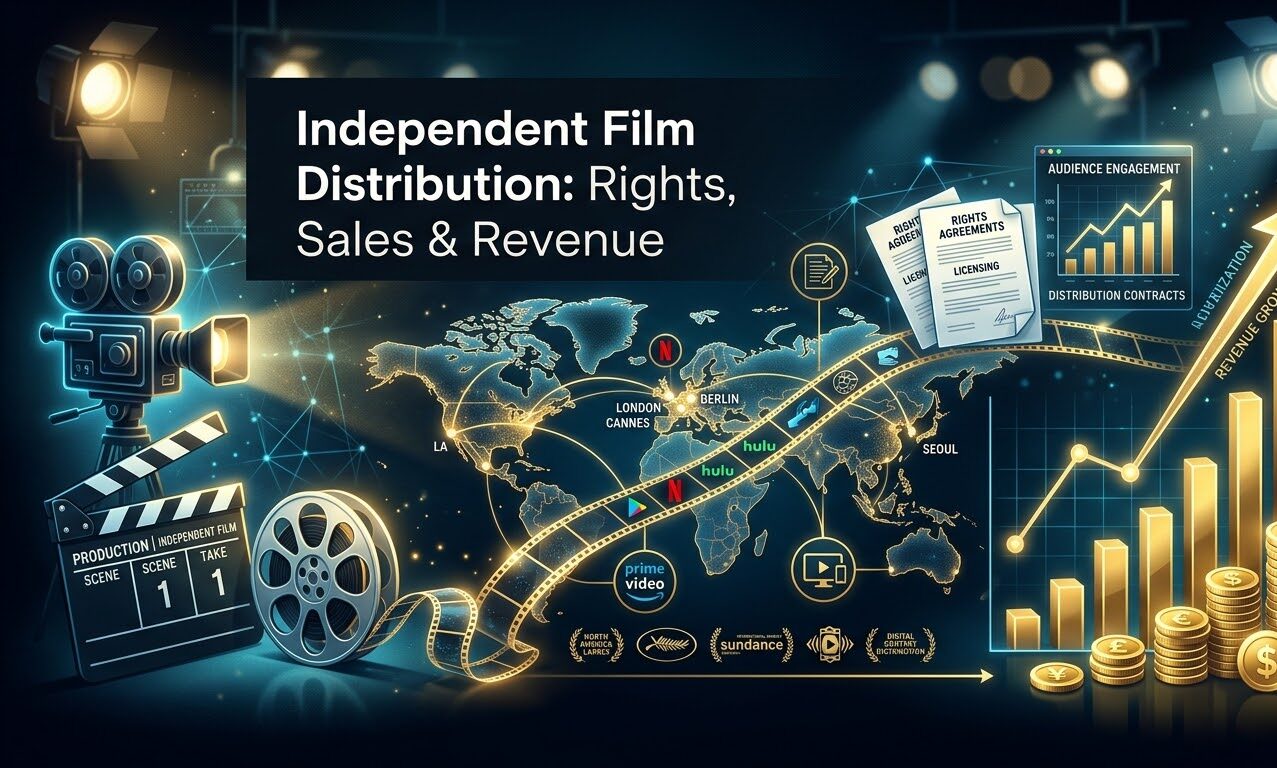
A complete guide to independent film distribution for producers and investors — how territory sales work, what minimum guarantees are worth, how distribution rights connect to film financing, and why 50% of completed films never reach their audience. Drawn from direct conversations with Myriad Pictures, HeadGear Films, and 91 Film Studios.
- 1. How Independent Film Distribution Rights Work
- 2. Minimum Guarantees in Film Distribution: How the Financing Connection Works
- 3. How International Film Sales Determine Your Budget
- 4. Sales Agents in Independent Film Distribution: Their Role and Limits
- 5. Co-Production as an Independent Film Distribution Strategy
- 6. The Independent Film Distribution Failure Rate: What the Numbers Say
- 7. Indian Regional Film Distribution: The 91 Film Studios Model
- 8. How Distribution Rights Connect to the Film Financing Capital Stack
- 9. Building Distribution into Your Film Financing Plan: A Producer Checklist
Distribution is where film financing and film revenue finally meet. It is also where most independent films lose the thread.
A film can be well-made, well-financed, and well-cast — and still fail to reach an audience at scale, because the distribution strategy was treated as something to figure out after production rather than something to build into the financing structure from day one.
This guide explains how independent film distribution actually works: how rights are structured and sold, what minimum guarantees are worth and how they connect to financing, how international territory sales determine what a film can cost, and what the distribution failure rate means for producers and investors. The content is drawn directly from Kirk D’Amico at Myriad Pictures, Phil Hunt at HeadGear Films, and Naveen Chandra at 91 Film Studios.
The central argument of this guide: distribution is not an afterthought. It is a financing instrument, a risk variable, and a revenue mechanism all at once. Understanding it is not optional for any producer who wants to raise independent film finance in 2026.
“Projects stall not because creativity is weak, but because structure is unclear.”
— Vitrina LeaderSpeak, 2026 Financing Playbook
This guide covers: How independent film distribution rights work · Territory-by-territory sales explained · Minimum guarantees as financing tools · How international film sales drive budget decisions · The 50% distribution failure rate · Sales agents and their role · Indian regional distribution as a case study · How to build distribution into your financing plan
1. How Independent Film Distribution Rights Work
An independent film’s distribution rights are not sold as a single block. They are carved up and sold territory by territory, platform by platform, window by window. Each rights sale is a separate transaction, negotiated separately, valued differently by different buyers in different markets.
This is the foundation of the independent film distribution model — and it is also the foundation of independent film financing. The value of those territorial rights, before and after the film is made, determines how much money a producer can raise and from whom.
Types of Independent Film Distribution Rights
Theatrical rights cover the right to exhibit the film in cinemas in a given territory. Broadcast rights cover television — free-to-air, pay TV, and streaming platforms. Home entertainment covers digital download, streaming rental, and physical media. Each of these can be sold separately, or bundled together in an all-rights deal depending on the buyer and the territory.
The order in which these rights are exploited is called the release window strategy. Traditionally, theatrical comes first, followed by premium digital, then broadcast, then other platforms. This sequence matters for revenue timing — and revenue timing matters for the financing structure that underpins the film.
Territory Sales in Independent Film Distribution
In the independent model, the world is divided into sales territories. The major territories include North America, the UK, Germany, France, Benelux, Scandinavia, Australia, Japan, South Korea, and various regional groupings across Latin America, Eastern Europe, and the Middle East and Africa.
Each territory is sold separately to a local distributor who acquires the rights for that market. The distributor pays a minimum guarantee upfront — a contracted payment that the producer receives regardless of how the film performs. Above the MG, the producer may receive a share of revenues from the distributor’s exploitation of the rights.
Understanding the structure is the start. Knowing who to take it to is where it gets harder.
Vitrina Concierge works through that with you, one-to-one — from positioning your project to finding the right financier or commissioner.
Talk to Our Solutions Expert 1:1 →2. Minimum Guarantees in Film Distribution: How the Financing Connection Works
Minimum guarantees are one of the most important instruments in independent film financing — and one of the least understood by producers who have not done a deal backed by them.
Kirk D’Amico at Myriad Pictures has structured territory sales for decades. His model is built on the MG: a payment from a distributor to acquire the rights to a film in their territory, paid upfront before the film is released. That contracted payment is then used as collateral for a bank loan or specialty lender, converting a future revenue stream into present-day production financing.
How Minimum Guarantees Become Film Financing
When a distributor signs an MG agreement, the producer holds a legally binding commitment from a buyer. That commitment can be taken to a lender — BondIt, Three Point Capital, and others have worked with Myriad to finance MGs in this way — who advances a portion of the MG value to the production as a loan. The distributor’s eventual payment repays the lender.
This structure is called pre-sales financing or sales-backed lending. It is one of the primary mechanisms by which independent films access senior debt. The quality of the MG — the financial standing of the distributor, the clarity of the rights assignment, the enforceability of the contract — determines how much a lender will advance against it.
What Affects the Value of a Minimum Guarantee
Not every MG is worth the same. The value depends on several factors: the territory and its market size, the distributor’s financial standing and track record, the genre and cast of the film, and current market conditions for that type of content. A strong MG from a well-capitalised distributor in a major territory is a reliable financing asset. A weak MG from a small distributor in a minor territory has limited financing utility.
Myriad does not provide equity financing — this point is worth being clear on. Their involvement is limited to MGs and sales. A producer approaching Myriad for equity has misread the model.
DISTRIBUTION FINANCING TAKEAWAY
- Pre-sales and MGs convert future revenue into present-day financing collateral
- The quality of an MG depends on the distributor’s standing, the territory, and the genre
- MG-backed financing requires clean rights assignment and legally enforceable contracts
- Myriad and other sales companies provide MGs and sales services — not equity investment
3. How International Film Sales Determine Your Budget
The budget of an independent film is not set in isolation. It is set in relation to what the international market will realistically pay for it. This connection — between what a film costs and what it can earn in territory sales — is one of the most important principles in independent film financing.
Phil Hunt at HeadGear Films makes this explicit. His starting point for evaluating any project is not creative quality. It is whether the budget is supported by what the market will actually pay. The financing structure becomes fragile the moment the budget exceeds what territory sales can realistically support.
How Genre Affects International Film Sales Value
Genre is one of the primary variables in international film sales. Action, thriller, and horror consistently travel across territories. Buyers in multiple markets understand these genres, can position them clearly to their audiences, and are willing to pay MGs to acquire them. Revenue from these genres is more predictable.
Drama — especially pure drama without strong genre elements — is harder to sell internationally. It requires exceptional packaging to compensate. That is not a creative judgement. It is a market observation from a company that finances 35–40 projects per year and sees, year after year, what sells and what struggles.
How Cast Affects International Film Sales Value
Cast is the other primary variable. Phil Hunt’s stated position: cut the budget before you compromise on cast. Without the right names attached, the film will not sell in the key territories that underpin the financing structure. The test is not whether audiences recognise the cast member globally. It is whether that specific cast attachment translates into measurable MGs in the specific territories that matter for this film’s financing plan.
The Budget-to-Sales Alignment Problem in Independent Film
Kirk D’Amico identifies $5–15 million as the budget range where MG-supported financing structures work most reliably. Below $5 million, MGs tend to be too small to anchor a financing plan. Above $30 million, pre-sales alone become insufficient and additional equity or studio involvement becomes necessary.
HeadGear’s slate averages $8–9 million per project, with most sitting below $10 million. Kirsty Bell at Goldfinch applies a 60% discount to projected sales when evaluating any project — a useful discipline for any producer building a budget around distribution revenue projections.
“One question remains central: can this film realistically be sold, territory by territory, at numbers that support its cost? If the answer is uncertain, financing becomes unstable.”
— Vitrina synthesis, Myriad Pictures chapter
● VITRINA CONCIERGE
Right Company. Right Decision-Maker. Right Message.
Vitrina Concierge reaches matched financiers on your behalf, every month — built around your project’s structure and stage.
Explore Vitrina Concierge Outreach Solutions4. Sales Agents in Independent Film Distribution: Their Role and Limits
A sales agent is a company that represents an independent film in the international marketplace, licensing the film’s rights to distributors in each territory on behalf of the producer. They are not distributors themselves — they are intermediaries between the producer and the buyers.
Sales agents like Myriad Pictures attend the major markets — Cannes, AFM, Berlin, EFM — where territory buyers make acquisition decisions. They pitch the film to appropriate buyers in each market, negotiate deal terms, and close MG agreements. In return, they take a commission on the sales they generate. The exact rate varies by agent, territory, and deal structure.
What Sales Agents Look for Before Representing a Film
Sales agents are selective. They only take on films they believe they can sell. The factors they evaluate are the same factors buyers evaluate: genre, cast, budget alignment, and the quality of the materials available — script, trailer, finished film or key talent attachments.
Myriad’s model provides a useful benchmark for what sales agents require. The project must sit within a budget range where MGs can realistically support the financing structure. The cast must be demonstrably bankable in the territories that matter. The genre must travel. Without these foundations, a sales agent will struggle to generate meaningful MGs regardless of creative quality.
When Sales Agents Provide Minimum Guarantees Directly
In some cases, a sales agent will provide an MG directly against the distribution rights, rather than simply facilitating a sale to a third-party distributor. Myriad does this selectively — when the project meets their criteria and when they are confident in their ability to recoup the MG through territory sales. This converts the sales agent into a financing partner as well as a distribution intermediary.
Whether a sales agent will provide an MG depends on their assessment of the project and their relationship with the producer. It is a contextual decision, not a rules-based checklist.
5. Co-Production as an Independent Film Distribution Strategy
Co-production — where a film is produced jointly by entities in two or more countries — is one of the most effective strategies for expanding the distribution and financing reach of an independent film. It is also one of the most complex to execute.
How Co-Production Strengthens Film Distribution
A co-production structure unlocks access to multiple national incentives, shares production costs across jurisdictions, and broadens the territory base from which MGs can be drawn. A UK-German co-production, for example, may access both UK tax relief and the German film fund, while also qualifying as a domestic film in both territories for broadcast purposes.
From a distribution perspective, co-production can also increase the film’s visibility in the co-producing territory’s market — a genuinely local partner brings local distribution relationships, local cast awareness, and local media coverage that a purely foreign production cannot replicate.
The Legal and Operational Complexity of Co-Production
Co-production adds complexity. Rights allocation between co-producing entities must be agreed clearly from the start. Revenue sharing arrangements must be documented. Legal frameworks differ between jurisdictions. The financing structure that works for a domestic production may not translate directly into a co-production context without significant restructuring.
Kirk D’Amico at Myriad has worked with co-production structures across multiple markets. His consistent point: the complexity must be managed from day one, not retrofitted once the deal is structured. A co-production that has not properly documented its rights allocation and revenue sharing is a dispute waiting to happen.
6. The Independent Film Distribution Failure Rate: What the Numbers Say
The most sobering data point in independent film distribution comes from 91 Film Studios. Naveen Chandra, who has conducted extensive research across the Indian film market, identified two structural failures that apply well beyond India.
of completed independent films never reach proper distribution. Financing a film through production is not the same as financing it through to revenue.
The first failure: 50% of films that begin production never complete — financing runs short midway. The second failure: 50% of films that do complete never reach proper distribution. They are finished but never properly released.
These are not creative failures. They are structural ones. Films fail to complete because financing plans did not account for production contingencies and cost overruns. Films fail to distribute because the distribution strategy was not built into the financing plan from the start — it was treated as something to figure out after the film was made.
Why Distribution Must Be Part of the Film Financing Plan
Phil Hunt at HeadGear frames this as a market reality that producers consistently underestimate. International buyers make acquisition decisions based on what they see at markets — which means the film needs a sales agent, market-ready materials, and a clear positioning strategy before it can generate distribution revenue.
Naveen Chandra built the 91 Film Studios fund model specifically to address this gap. Their financing extends beyond production to include theatrical release strategy, satellite and digital rights, and the IP value that persists after the first run. Capital planning that treats distribution as an afterthought is capital planning that has not been completed.
DISTRIBUTION PLANNING TAKEAWAY
- Build distribution strategy into the financing plan before production begins — not after
- Engage a sales agent early to validate that your film can generate meaningful MGs in key territories
- Account for the 50% distribution failure rate when modelling financing risk and investor return expectations
- Ensure completion funding is separate from distribution funding — both require planning
- IP value beyond the theatrical run — digital, broadcast, and long-term rights — should be part of the financing conversation
7. Indian Regional Film Distribution: The 91 Film Studios Model
The Indian regional language film market offers a useful case study in how distribution challenges can reshape the financing model. Naveen Chandra at 91 Film Studios built a SEBI-registered Category 2 Alternate Investment Fund specifically to address the structural failures he identified through extensive conversations across the Indian film market.
His focus is exclusively on regional language cinema: Tamil, Telugu, Marathi, Malayalam, Punjabi, Bengali, and others. Not Hindi. The reasoning is strategic. Regional markets offer original stories, strong audience demand, and the ability to build and monetise intellectual property over the long term.
Distribution in Indian Regional Cinema
Tamil and Telugu cinema are not niche markets. Each produces approximately 350–400 films per year and operates with technical sophistication comparable to major international markets. The strategic advantage Naveen Chandra identifies is not reduced competition — it is the originality and variety of available stories, and the strength of regional audience loyalty.
Distribution in these markets follows a different model from the Western territory sales system. Theatrical is the primary window. Satellite and digital rights are significant revenue streams that need to be planned for from the start. The IP value of a successful regional film — through remakes, sequels, and long-term digital exploitation — is substantial and should be part of any investor’s return calculation.
How 91 Film Studios Approaches Distribution Risk
The 91 Film Studios model directly addresses both structural failures Naveen Chandra identified: the 50% completion rate and the 50% distribution rate. The fund structure provides completion funding as part of the investment, not as an afterthought. Distribution strategy — theatrical release, satellite rights, digital platform deals — is planned before production begins, not negotiated after the film is finished.
The co-producer requirement reinforces this. Every project must have a co-producer who independently commits 50% of the financing and believes in the story. That co-producer brings distribution relationships, market knowledge, and commercial accountability alongside their capital.
“Independent cinema in India becomes more sustainable when funding is organised, regional strategy is clear, and distribution is treated as part of financing — not an afterthought.”
— Vitrina synthesis, 91 Film Studios chapter
8. How Distribution Rights Connect to the Film Financing Capital Stack
Every component of the distribution model described in this guide connects back to the film’s capital stack — the structure that defines how money flows into and out of the project.
Pre-sale agreements and MGs provide collateral for senior debt. Distribution contracts underpin the recoupment waterfall. The collection account that manages revenue distribution is a direct mechanism of the capital stack. Distribution is not separate from financing. It is the mechanism through which financing is repaid.
Pre-Sales as Senior Debt Collateral
Contracted pre-sale agreements are among the most reliable collateral available in independent film financing. They represent committed payments from financially accountable buyers. When properly assigned to the production entity and with clean chain of title, they support senior lending from Peachtree and similar lenders.
The chain of title and legal assignment requirements that Lee & Thompson emphasises — clean rights, grantable security, documented recoupment — apply directly to distribution agreements. A pre-sale that cannot be used as lending collateral because of a rights assignment problem is a pre-sale that does not serve its financing function.
Distribution Revenue in the Film Recoupment Waterfall
Revenue from distribution — MG payments, revenue shares from distributors, digital platform payments, broadcast licensing fees — flows into the collection account and is distributed according to the recoupment waterfall. Senior debt is repaid first from this revenue. Gap financing follows. Equity is recouped. Profit participation begins only after all prior positions have cleared.
The 3.8–4% net profit benchmark from Lee & Thompson reflects this reality. Most distribution revenue in independent film is consumed by debt repayment, gap recoupment, distribution costs, and delivery expenses before equity investors see returns. Understanding this from the start — and building it into investor expectations — is part of responsible film financing.
● VITRINA CONCIERGE
Partner-Outreach Managed by Vitrina.
We reach matched contacts every month for your requirements — right company, right decision-maker, right message.
Start with Vitrina Concierge9. Building Distribution into Your Film Financing Plan: A Producer Checklist
Distribution should not be a section of your financing plan. It should be the foundation of it. These questions are drawn from the 2026 LeaderSpeak Financing Playbook and reflect the evaluation criteria of every financier consulted.
Territory Sales and Market Positioning
- Is the budget aligned with what the genre and cast can realistically generate in MGs across key territories?
- Have you validated this with a sales agent who is active in your primary markets?
- Does your genre travel internationally, or does it require exceptional packaging to compensate?
- Is the cast attachment evidenced by territory sales data, not just name recognition?
Distribution Rights and Legal Structure
- Are distribution rights clearly allocated across all territories with no gaps or overlaps?
- Are all rights properly assigned to the production entity with clean chain of title?
- Are pre-sale agreements in a form that can be used as lending collateral?
- Is the collection account structure in place to manage revenue distribution to investors?
Distribution Strategy and Risk
- Is the theatrical release strategy planned before production begins, not after?
- Is separate funding allocated for distribution and marketing — not assumed to come from production budget?
- Have you accounted for the 50% distribution failure rate in your investor risk disclosures?
- Are satellite, digital, and long-term IP rights valued and included in the financing plan?
Distribution is not an afterthought. It is a financing instrument, a risk variable, and the mechanism through which every investor in your film gets repaid. Build it in from the start.
Understanding the structure is the start. Knowing who to take it to is where it gets harder.
Vitrina Concierge works through that with you, one-to-one — from positioning your project to finding the right financier or commissioner.
Talk to Our Solutions Expert 1:1 →This guide is part of the Vitrina LeaderSpeak blog programme. All content is drawn from direct conversations with active financiers: HeadGear Films (Phil Hunt), Peachtree Media Partners (Joshua Harris), Myriad Pictures (Kirk D’Amico), Goldfinch (Kirsty Bell), 91 Film Studios (Naveen Chandra), and Lee & Thompson (Sam Tatton-Brown). No commentary has been layered over practitioner insight.
Related reading: How to Finance an Independent Film · Film Financing Explained · How International Film Sales Work · Why Most Independent Films Never Get Funded · Film Investment: What Investors Need to Know