IHUB
IHUB
 Private Briefings (Webinars)


 LeaderSpeak Podcast
  Global Entertainment Digest (Newsletter)
  Premium Lists
 Membership Benefits
 About Vitrina
 Our Story
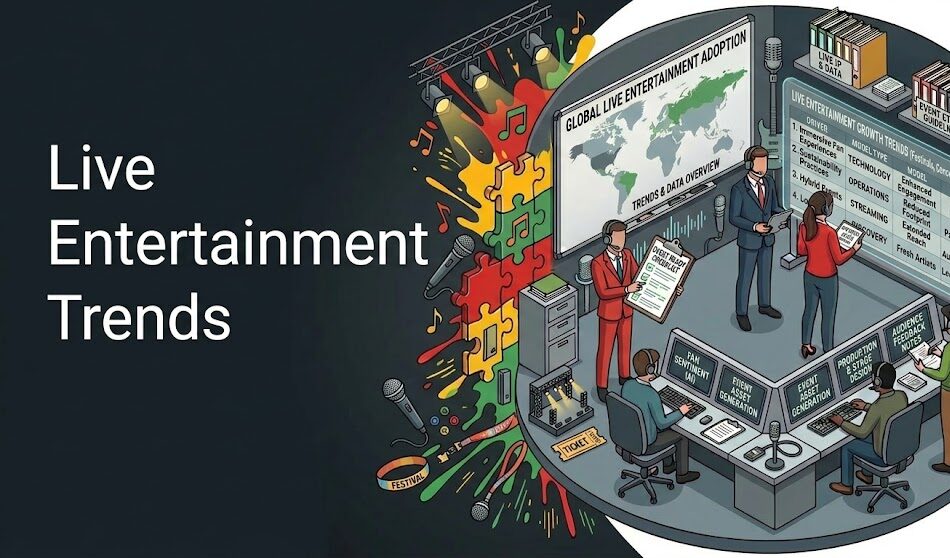
Live event and concert industry trends in 2026 are being driven by something that streaming platforms simply cannot replicate: the irreducible economic value of being physically present for a moment that only happens once.
Global live entertainment revenue crossed $35 billion in 2025 and analysts project continued growth through the decade—fueled not by volume alone but by a structural shift in how fans relate to artists and how event operators monetize that relationship.
The era of the flat-rate general admission ticket as the primary revenue lever is over. What’s replaced it is more sophisticated, more lucrative, and increasingly the dominant commercial model across touring, festivals, and venue development.
The post-pandemic surge in live attendance wasn’t a temporary revenge-spending phenomenon. It was a reset of consumer priorities—one that permanently elevated experiential spending relative to passive content consumption. And the industry has responded by building revenue architectures designed to capture that willingness to pay at every price tier, in every market, through every format that puts an audience in the same physical space as a performer or spectacle they can’t get anywhere else.
Here’s what’s actually driving live entertainment revenue growth in 2026—and what it means for the entertainment companies, investors, and content professionals operating across this space.
Table of Contents
- The Superfan Economy: How Premium Packages Are Restructuring Ticket Revenue
- Experience-First Ticketing and the Death of the Flat-Rate General Admission Model
- Hybrid Live Streaming: How Events Are Monetising the Digital Audience Without Cannibalising the Room
- Immersive Venue Concepts and the Next Generation of Event Infrastructure
- Festival Consolidation: What Happens When Private Equity Runs the Circuit
- Global Touring Expansion: Sovereign Hubs Are Building Live Entertainment Infrastructure
- Data and Personalisation: How Live Event Operators Are Using Fan Intelligence to Drive Revenue
- Residencies, IP Events, and the Move Away from Traditional Touring Economics
- FAQ
- Conclusion
Ask VIQI: Where Is Live Entertainment Revenue Heading in Your Region?
VIQI is Vitrina’s AI assistant—trained on 1.6 million titles, 300,000+ companies, and 5 million entertainment professionals. Ask it about live event deal structures, touring economics in specific markets, superfan monetisation strategies, or which entertainment companies are investing in venue infrastructure globally.
✓ Included with 200 free credits | ✓ No credit card needed
The Superfan Economy: How Premium Packages Are Restructuring Ticket Revenue
The most significant structural shift in live entertainment economics over the past five years isn’t streaming competition or venue capacity—it’s the discovery that a small percentage of any artist’s fanbase will pay dramatically more than the standard ticket price for access, proximity, and exclusivity. That insight is now being systematically exploited at scale, and it’s changing how concerts, festivals, and touring economics are modelled from the planning stage.
Taylor Swift’s Eras Tour is the most documented case study, but the dynamics it demonstrated weren’t unique to her fan relationship. The tour generated an estimated $2.1 billion in revenue—making it the highest-grossing concert tour in history—partly through sheer scale and demand, but significantly through the premium packaging of the experience at multiple price tiers. VIP packages bundled with merchandise, meet-and-greet access, soundcheck viewing, and early entry started at several hundred dollars and extended into the thousands. The total-spend-per-fan figure for dedicated Swifties at these events was structurally different from what any previous touring model had captured.
What the industry has drawn from this and similar data across touring in 2024 and 2025:
The 10% Rule in Live Revenue
Event operators are finding consistently that roughly 10% of any venue’s audience will pay three to ten times the standard ticket price for a sufficiently differentiated premium experience. This isn’t an edge case—it’s a reliable revenue segment that was previously left almost entirely on the table by the traditional tiered seating model. A general admission floor ticket at £80 and a premium standing package at £350 with barrier access, branded merch, and artist-proximity guarantee represent a 4x price differential that a meaningful subset of fans consistently chooses when it’s made available.
Artist-Branded Experience Products
The most sophisticated touring operations in 2026 are building what amounts to an experience product catalogue alongside the standard ticket—and the products in that catalogue are artist-specific rather than generic venue upgrades. Fan club presale access, limited-edition physical packages mailed ahead of the show, in-show exclusives (alternate setlists, rare song performances, exclusive video content), and post-show artist interactions are all components of a premium experience architecture that generates revenue beyond the ticket price itself. The economics shift: the ticket becomes entry to an experience ecosystem, not the primary revenue unit.
Ticketing Platform Capture
Live Nation and Ticketmaster’s vertical integration—controlling venue ownership, ticketing, artist management, and promotion simultaneously—means that premium package revenue is increasingly captured at the infrastructure level rather than flowing exclusively to the artist. The political and regulatory pushback against this integration (the US Department of Justice antitrust suit filed in 2024) reflects how significant the financial stakes of this capture have become. Understanding the content licensing and distribution strategies that govern how live entertainment revenue is split between artists, promoters, and venue operators is increasingly complex—and increasingly consequential for anyone structuring deals in this space.

Your AI Assistant, Agent, and Analyst for the Business of Entertainment
VIQI AI helps you plan content acquisitions, raise production financing, and find and connect with the right partners worldwide.
- List the top commissioners at the BBC
- List the post-production and VFX decision-makers at Netflix
- List the development leaders at Sony Pictures
- List the scripted programming heads at HBO
- Find active co-producers and financiers for scripted projects
- Find equity and gap financing companies in North America
- Find top film financiers in Europe
- Find production houses that can co-produce or finance unscripted series
- Who is backing animation projects in Europe right now
- Who is Netflix’s top production partners for Sports Docs
- Who is Commissioning factual content in the NORDICS
- Who is acquiring unscripted formats for the North American market
- Show me recent drama projects available for pre-buy
- Show me Japanese Anime Distributors
- Show me true-crime buyers from Asia
- Show me documentary pre-buyers
- I am looking for production partners for a YA drama set in Brazil
- I am looking for producers with proven track record in mid-budget features
- I am looking for Turkish distributors with successful international sales
- I am looking for OTT platforms actively acquiring finished series for the LATAM region
- I am seeking localization companies offer subtitling services in multiple Asian languages
- I am seeking partners in animation production for children's content
- I am seeking USA based post-production companies with sound facilities
- I am seeking VFX partners to composite background images and AI generated content
Experience-First Ticketing and the Death of the Flat-Rate General Admission Model
Dynamic pricing—adjusting ticket prices based on demand signals in real time, the way airlines and hotels have operated for decades—is no longer controversial in live events. It’s standard. What’s replacing the flat-rate general admission ticket isn’t just dynamic pricing, though. It’s a fundamentally different philosophy about what a ticket is and what it entitles the holder to.
In the experience-first model, the ticket is the beginning of a commercial relationship, not a discrete transaction. The baseline ticket gets you in the door. Every additional dimension of the experience—better sightlines, less crowding, food and beverage inclusion, merchandise access, digital content, post-event engagement—is a separately monetisable layer. This model draws directly from theme park economics (Disney and Universal have been running it for years) applied to the temporary venue context of touring shows and festivals.
The commercial logic is compelling. According to Pollstar, average per-head spend at major concert events increased significantly between 2019 and 2025 even when ticket prices are held constant—driven by higher on-site food, beverage, and merchandise spend as operators invested in the quality of these offerings. When you improve the food and beverage experience at a concert venue, average spend per head goes up not because you’ve raised prices but because fans who previously wouldn’t spend on poor-quality options now purchase willingly from a premium offering. The investment in experience quality generates direct commercial return.
But the bigger shift is structural rather than operational. Festivals like Coachella, Glastonbury, and Primavera Sound are now engineering the experience architecture of their events from the ground up to maximise total revenue per attendee rather than optimising for ticket volume. Camping package upgrades. Glamping tiers with premium site positions, private showers, and curated food access. Artist experience add-ons. Shuttle and transport packages. The event becomes a multi-day resort product as much as a music event—and the total revenue per festival ticket-holder in the premium tier can be five to eight times the cost of a standard day ticket.
The risk of this model is pricing out the mainstream audience. But here’s what the data suggests: tiered experience pricing doesn’t necessarily reduce total attendance when it’s implemented with a genuine value ladder rather than simply price inflation. Keeping a genuinely affordable entry tier while building premium tiers above it preserves audience breadth while capturing significantly more revenue from the portion of the audience that has capacity and willingness to pay more. The failure mode is when the “affordable” tier becomes unaffordable relative to median incomes—which is a real and growing tension in markets where housing and cost-of-living pressures are compressing discretionary spending.
Track Live Entertainment Investment, Venue Development, and Tour Deal Structures Globally
Trusted by Netflix, Warner Bros, and Paramount. Join 140,000+ companies monitoring entertainment supply chain deals—including live event partnerships, artist deal structures, and venue infrastructure investment across 100+ markets.
✓ 200 free credits | ✓ No credit card required | ✓ Full platform access
Hybrid Live Streaming: How Events Are Monetising the Digital Audience Without Cannibalising the Room
The early pandemic-era assumption that livestreaming would permanently cannibalise in-person attendance has been comprehensively disproved by the post-pandemic data. Physical attendance at major live events has recovered to and in many markets exceeded pre-pandemic levels—while livestreaming of those same events has grown simultaneously rather than in opposition to physical attendance. The audiences aren’t the same people making different choices. They’re different audiences with different access constraints and different consumption preferences.
That distinction has significant commercial implications. A stadium show with 60,000 physical attendees and a paid livestream audience of 200,000+ global viewers is generating revenue from two distinct market segments that don’t compete with each other. The digital audience includes: fans who can’t afford physical tickets, fans who can’t travel to the venue geography, fans in markets where the artist doesn’t tour, and fans who prefer the at-home viewing experience for that specific event or moment. Treating the livestream as a revenue channel rather than a marketing cost is the model that’s emerging as standard practice among the most commercially sophisticated touring operations.
The pricing dynamics for paid livestreams are still being calibrated. The general finding: premium digital tickets—those positioned as exclusive access to content not available in the physical venue (alternate camera angles, backstage access, artist commentary tracks)—generate meaningfully higher revenue per viewer than standard stream access at a lower price point. Amazon Prime Video’s live music investments, Apple Music’s exclusive concert streaming deals, and YouTube’s pay-per-view concert experiments are all generating data on optimal pricing and format that the industry is actively learning from.
The production investment required for a high-quality livestream is not trivial. A broadcast-quality multi-camera production suitable for global streaming distribution at premium pricing requires £200,000–£500,000 in additional production cost above the standard live show infrastructure. But against a global digital audience willing to pay £15–£30 per ticket, the math works. Ten thousand paying digital viewers at an average of £20 each generates £200,000—breakeven on production cost before the much larger addressable audience of casual fans who would pay £10 or less. The commercial model becomes compelling at scale, and the marginal cost of adding the digital channel to an already-staged physical production is significantly lower than producing a standalone streaming event.
For producers and distributors tracking live streaming’s evolution as a content format, the live events sector is now one of the most active proving grounds for paid digital distribution models—generating real-world data on consumer willingness to pay for premium live digital content that has direct implications for how streaming platforms think about exclusive live sports, news, and entertainment rights acquisition.
Immersive Venue Concepts and the Next Generation of Event Infrastructure
The most capital-intensive trend in live entertainment right now is infrastructure. Specifically: a global wave of purpose-built venue development designed around immersive and technology-integrated experience concepts that existing general-purpose arenas simply can’t accommodate.
The Sphere in Las Vegas—opened in 2023 at a cost of approximately $2.3 billion—is the extreme case study. Its 160,000-square-foot interior LED screen, 4D haptic seat system, and multi-sensory environmental control create an event experience that is literally impossible to replicate in any other venue on Earth. U2’s residency there demonstrated both the creative possibilities and the premium pricing power that genuine exclusivity commands: tickets for U2 Achtung Baby at the Sphere started at several hundred dollars and extended to over a thousand, and the shows sold out repeatedly. The venue’s owners, MSG Sphere Entertainment, are already planning Sphere venues in London and other global markets.
But the Sphere is the billion-dollar end of a spectrum that extends down to much more accessible investment levels. Immersive experience venues—permanent installations that combine theatrical design, digital technology, and social interaction in formats that generate revenue through ticketed experiences rather than traditional performance—are proliferating across major markets. Meow Wolf (US), teamLab (Japan and global), Frameless (London), and dozens of smaller operators are building a category of destination entertainment venue that competes for leisure spend against traditional concerts, theatre, and dining without depending on the touring circuit for content.
The commercial appeal for investors: these venues generate revenue from a fixed asset with recurring audiences rather than requiring continuous touring relationships. Operating leverage is high once the experience is built—incremental visitors add revenue without proportional increases in operating cost. And the experience differentiation is physical and proprietary in a way that streaming competitors can’t easily replicate. According to Billboard, immersive entertainment is one of the fastest-growing segments within live entertainment investment, with institutional capital increasingly treating purpose-built immersive venues as infrastructure assets with predictable long-term revenue profiles rather than entertainment bets.
The design and production companies capable of creating these immersive environments—integrating LED technology, spatial audio, theatrical design, and narrative experience architecture—are in high demand and, frankly, short supply relative to the investment appetite. For entertainment supply chain professionals, virtual production technology developed for film and TV is directly applicable to immersive venue design—and the companies building expertise at that intersection are well-positioned for a significant market opportunity.
Festival Consolidation: What Happens When Private Equity Runs the Circuit
The festival circuit has undergone significant ownership consolidation over the past decade, and the pace accelerated during the post-pandemic period when distressed festival operators became attractive acquisition targets. Live Nation, DEAG, SFX (now rebranded), Superstruct Entertainment (backed by Providence Equity), and a handful of other large operators now control a significant proportion of major festival brand real estate globally. The independent festival—truly founder-operated, unaffiliated with a major entertainment conglomerate—has become the exception rather than the norm at the upper end of the market.
What does private equity ownership change about festival economics? Several things, not all positive from an audience or artist perspective:
Revenue Optimisation at Scale
Portfolio owners can apply consistent commercial frameworks—dynamic pricing, premium tier development, food and beverage margin management, sponsorship packaging—across multiple festival brands simultaneously. The operational efficiency gains are real. So is the risk of homogenisation: when every festival runs the same revenue optimisation playbook, the differentiation that made individual festivals culturally valuable can erode. Glastonbury’s stubborn independence from corporate ownership structures has become a competitive asset partly because it hasn’t subjected itself to these frameworks.
Artist Deal Leverage
Consolidated festival operators have significantly more negotiating leverage with artist management teams than independent promoters. When a single operator controls five or six major festivals across Europe and North America, they can offer artists a package deal across multiple events that reduces the artist’s booking friction and provides the operator with booking exclusivity that independent festivals can’t match. This benefits the largest artists who want efficient touring circuits. It disadvantages mid-tier artists who lose bargaining power when fewer independent operators are competing for their appearance.
The Ticket Price Ceiling Problem
Festival tickets across the UK, US, and major European markets have increased significantly above inflation since 2019—with some flagship events seeing standard ticket prices double between 2019 and 2025. This hasn’t suppressed demand at the top end, where the superfan audience has demonstrated willingness to pay. But it’s compressing participation from younger, lower-income audiences who formed the cultural foundation of festival culture. The industry’s challenge: maximising revenue from the current audience while maintaining the cultural accessibility that made these events significant enough to command premium prices in the first place.
Global Touring Expansion: Sovereign Hubs Are Building Live Entertainment Infrastructure
The geography of major touring has shifted materially in the past five years. Markets that barely featured on global touring itineraries in 2019 are now anchor dates for major international artists—and the shift is being driven by deliberate government investment in live entertainment infrastructure as part of broader cultural economy development strategies.
Saudi Arabia is the most aggressive example. MDLBeast Soundstorm—an annual multi-day electronic music festival launched in 2019—drew over 700,000 attendees at its 2022 edition, making it one of the largest music festivals on Earth within four years of founding. The event is backed by MDLBeast, a company formed under Saudi Arabia’s Entertainment Authority as part of Vision 2030’s entertainment sector development. The government’s calculated willingness to offer artist fees significantly above market rate for appearances in Saudi Arabia has created a global touring incentive that even artists with personal reservations about the country’s human rights record have found commercially compelling—generating a genuine tension between commercial rationality and reputational risk that the industry is still navigating imperfectly.
The UAE has continued to position Dubai as a global live entertainment hub, with venue infrastructure investments including Expo City Dubai’s permanent arena and outdoor event spaces, plus Formula E and other spectacle events that attract global audiences to the market. Abu Dhabi’s Formula 1 Grand Prix weekend has evolved into one of the most commercially valuable music showcase events on the global calendar, with artists commanding multimillion-dollar fees for headline performances in a market that couldn’t have supported that level of spend a decade ago.
India represents the largest untapped live entertainment market globally by any demographic measure. A population of 1.4 billion, rapid middle-class growth, and significant pent-up demand for live events of international scale have created conditions where the touring and festival economics that work in Western markets are increasingly viable. NH7 Weekender, Lollapalooza India, and the rapid proliferation of comedy festivals, standalone tours, and branded entertainment events all indicate a market in the early stages of formalising what could become one of the largest live entertainment economies globally within the next decade.
South Korea‘s live entertainment market has been globalised by K-pop’s export success in ways that make it structurally different from other markets. BTS’s stadium tours and the broader K-pop touring circuit have demonstrated that Korean acts can sell out the largest venues in North America, Europe, and APAC simultaneously—while also driving pilgrimage tourism to Korean concert venues from global fanbases. The Korean entertainment economy is more export-oriented than any other national music market, and live entertainment is now as significant a revenue channel as recorded music for the major K-pop agencies.
Data and Personalisation: How Live Event Operators Are Using Fan Intelligence to Drive Revenue
The streaming economy’s greatest gift to the live entertainment sector wasn’t competition—it was data. Spotify, Apple Music, YouTube, and similar platforms have normalised the idea that entertainment companies know exactly what each individual consumer engages with, how often, and in what context. Live event operators are now applying that same data intelligence framework to fan relationship management in ways that are generating meaningful commercial uplift.
The fundamental insight: a fan who has purchased tickets to three consecutive tours of the same artist isn’t the same commercial target as a casual fan who bought tickets once. The loyal returning attendee is a known quantity with demonstrated willingness to spend and a high probability of future purchase. Treating them identically to a first-time purchaser is a commercial failure—and the most sophisticated operators have stopped doing it.
Fan club and direct-to-fan infrastructure is becoming a primary commercial channel rather than a legacy marketing tool. Taylor Swift’s Taylor Nation fan club, BTS’s Weverse platform, and similar artist-operated direct fan relationship infrastructure aren’t just community tools—they’re data platforms that enable personalised commercial offers, exclusive content monetisation, and advance purchase signals that reduce booking risk for tours before general on-sale. When an artist can identify 500,000 fans who have demonstrated consistent high-spend behaviour across multiple purchase occasions, targeting premium package offers to that segment specifically generates conversion rates and average order values that mass-market general ticket marketing can’t match.
Venue-level data collection is also maturing. Cashless payment systems (now standard at most major venues and festivals) generate transactional data on every on-site purchase: what attendees eat and drink, what merchandise they buy, at what point in the event timeline they make purchases, and how those patterns vary by ticket tier. That data is being used to optimise food and beverage placement and pricing, merchandise timing and product mix, and premium experience packaging in ways that are generating 15–25% increases in average per-head on-site spend for operators who’ve invested in the analytics capability.
The privacy considerations are real and regulatory frameworks (GDPR in Europe, emerging US state-level privacy legislation) impose constraints on how this data can be collected, stored, and used. But within those constraints, the commercial opportunity from fan data intelligence is significant enough that it’s now a genuine competitive differentiator between operators who’ve invested in the capability and those still operating on gut feel and historical precedent.
Residencies, IP Events, and the Move Away from Traditional Touring Economics
Traditional touring—an artist moves between cities, performing the same show in different venues across weeks or months—is increasingly one option among several rather than the default format for major live entertainment commercial strategy. The alternatives that are taking market share are structurally different in ways that affect everything from artist risk profile to audience expectation to supply chain requirements.
Residencies represent the most significant structural alternative. An artist performs multiple shows in a single venue over a defined period—weeks or months—rather than moving the production between cities. The economic logic for the artist is compelling: the production cost of a technically complex show (sets, equipment, crew travel) is amortised over more performances at a single location. The audience experience is enhanced because the artist can invest in venue-specific production that wouldn’t be practical for a touring show. And the artist’s physical and logistical burden is significantly lower than constant city-to-city movement.
Las Vegas pioneered the residency model—Celine Dion, Elton John, Britney Spears, and later Adele (whose Weekends with Adele residency generated estimated revenues exceeding $100 million) demonstrated the format’s commercial viability at the premium tier. But residencies are now appearing in non-Las Vegas markets: London’s O2 Arena, Dubai, and increasingly purpose-built venues designed with residency formats in mind. The Sphere is explicitly a residency venue—its technology investment only makes sense when the production that deploys it runs for months rather than a single night.
IP events are a different but adjacent format: live entertainment productions built around intellectual property rather than individual artist performance. Immersive theatre productions based on film IP (Secret Cinema’s model), music IP experiences that recreate iconic albums or concerts as participatory theatrical events, branded entertainment experiences that fuse music, art, and brand identity into ticketed event formats—these are all generating revenue from IP in live contexts that traditional touring economics don’t capture.
The Abba Voyage experience in London—a permanent concert experience using real-time rendered avatars of the ABBA members performing on stage in a purpose-built arena—represents perhaps the most radical version of this: a live entertainment product that doesn’t require the physical presence of the artists at all, that can run multiple shows per day, seven days a week, indefinitely, without the logistical and physical limitations that constrain human touring. It’s generated over £200 million in revenue since launch and demonstrated that audiences will accept—and genuinely embrace—radically new formats for live entertainment when the execution is sufficiently excellent. Understanding how content distribution models are evolving across both physical and digital formats is essential context for anyone building live entertainment business strategy in 2026.
Need Direct Introductions to Live Entertainment Investors, Venue Operators, or Festival Partnerships?
Vitrina Concierge makes warm introductions directly to decision-makers at live entertainment companies, venue operators, sovereign hub entertainment authorities, and investment funds actively seeking live event partnerships and IP event development opportunities.
- Korean animation studio → Netflix Adult Animation (week one)
- LA producer → Netflix UK, Fifth Season, Fox Entertainment (48 hours)
- Middle Eastern studio → Legendary Pictures (direct access)
Frequently Asked Questions
What are the biggest live event and concert industry trends driving revenue growth in 2026?
The dominant revenue growth trends are the superfan economy and premium experience packaging, experience-first tiered ticketing replacing flat-rate general admission models, hybrid live streaming as a parallel revenue channel, immersive venue development attracting institutional capital, global touring expansion into sovereign hub markets like Saudi Arabia and India, and fan data intelligence enabling personalised commercial offers that significantly increase per-head spend. Together these trends are restructuring how live entertainment revenue is generated, captured, and distributed across the value chain.
How much revenue is the global live entertainment industry generating in 2026?
Global live entertainment revenue crossed $35 billion in 2025, with continued growth projected through the decade. The figure encompasses touring, festivals, residencies, immersive experiences, and live events of all scales. Individual tour records have been broken repeatedly, with Taylor Swift’s Eras Tour generating an estimated $2.1 billion—the highest-grossing concert tour in history. The industry has not only recovered from pandemic-era losses but has structurally reset at a higher revenue ceiling, driven by premium experience monetisation and expansion into new geographic markets.
What is the superfan economy in live entertainment?
The superfan economy refers to the commercial strategy of identifying and monetising the subset of any artist’s fanbase that has significantly higher willingness to pay than the general audience. Event operators consistently find that roughly 10% of any venue’s audience will pay three to ten times the standard ticket price for a sufficiently differentiated premium experience—VIP packages, meet-and-greet access, soundcheck viewing, barrier proximity, exclusive merchandise, and artist interactions. These premium tiers generate revenue that was previously left on the table by traditional flat-rate ticketing and are now standard commercial planning for major touring artists and festival operators.
Does livestreaming cannibalise in-person concert attendance?
Post-pandemic data comprehensively disproves the assumption that livestreaming reduces in-person attendance. Physical attendance at major live events has recovered to and often exceeded pre-pandemic levels while livestreaming of those same events has grown simultaneously. The audiences are different segments: fans who cannot afford physical tickets, fans who cannot travel to the venue geography, fans in markets where the artist does not tour, and fans who prefer the at-home experience for that specific event. Treating livestream as a parallel revenue channel rather than a substitute for physical attendance is the commercial model that’s emerged as industry standard among sophisticated touring operations.
How much does the MSG Sphere in Las Vegas cost and is it profitable?
The MSG Sphere cost approximately $2.3 billion to build. U2’s residency there demonstrated significant premium pricing power—tickets started at several hundred dollars and extended to over a thousand, with shows selling out repeatedly. MSG Sphere Entertainment is planning additional Sphere venues in London and other global markets, indicating confidence in the format’s commercial viability at scale. The venue represents the extreme end of a broader immersive venue investment trend that Billboard identifies as one of the fastest-growing segments within live entertainment, attracting institutional capital as infrastructure assets with predictable long-term revenue profiles.
Why are concert residencies growing as a format compared to traditional touring?
Residencies offer compelling economics for major artists: the production cost of technically complex shows is amortised over more performances at a single location rather than bearing the cost of moving the production between cities. Artists can invest in venue-specific production that wouldn’t be practical for touring shows. The physical and logistical burden on the artist is significantly lower than constant city-to-city movement. Adele’s Weekends with Adele residency generated estimated revenues exceeding $100 million. The format is expanding beyond Las Vegas to London’s O2 Arena, Dubai, and purpose-built immersive venues like the Sphere that are explicitly designed for residency economics.
Which new global markets are driving live entertainment revenue growth?
Saudi Arabia’s MDLBeast Soundstorm festival drew over 700,000 attendees at its 2022 edition within four years of founding, supported by Vision 2030 entertainment development investment and government willingness to pay above-market artist fees. The UAE has positioned Dubai as a global live entertainment hub through infrastructure investment and premium event programming. India represents the largest untapped live entertainment market globally by demographic measure, with rapid formalisation of international-scale events. South Korea’s K-pop touring circuit has demonstrated that Korean acts can sell out major venues globally while driving pilgrimage tourism to domestic Korean concert venues from international fanbases.
How is fan data being used to increase live event revenue?
Sophisticated live event operators are using fan data in two primary ways. First, direct-to-fan infrastructure like artist fan clubs and platforms enables personalised commercial offers targeted at demonstrably high-spend fans, generating higher conversion rates and average order values than mass-market ticket marketing. Second, cashless payment systems at venues and festivals generate transactional data on on-site purchasing behaviour—what attendees buy, at what point in the event, and at what price—that is being used to optimise food and beverage placement, merchandise timing, and premium tier packaging. Operators with mature analytics capabilities are seeing 15 to 25 percent increases in average per-head on-site spend compared to those still operating on historical averages.
Conclusion: Live Entertainment’s Revenue Architecture Has Been Permanently Upgraded
The live event and concert industry trends driving revenue growth in 2026 aren’t reversing. The superfan economy, immersive venue investment, hybrid digital-physical monetisation, and global market expansion are all structural changes rather than cyclical fluctuations. The industry that emerged from the pandemic is commercially more sophisticated, more globally distributed, and more deliberately engineered around maximum revenue extraction from every audience tier than the one that went into it—and the performance data justifies that architecture.
Key Takeaways:
- The superfan economy is the primary revenue growth driver: Roughly 10% of any audience will pay three to ten times the standard ticket price for premium experiences—and that segment was largely uncaptured by the flat-rate ticketing model that preceded this era.
- Livestreaming is a parallel revenue channel, not a cannibal: Post-pandemic data confirms that digital and physical audiences are distinct segments. A stadium show with a paid global livestream is generating revenue from two non-competing markets simultaneously.
- Immersive venues are attracting institutional capital: Purpose-built immersive experience venues generate revenue from fixed assets with recurring audiences—an investment profile that suits infrastructure-oriented capital more than traditional entertainment bets.
- Sovereign hubs are building live entertainment markets from scratch: Saudi Arabia, UAE, India, and South Korea are all investing in live event infrastructure in ways that are creating new commercial opportunities for artists, promoters, and producers willing to engage with non-Western markets seriously.
- Fan data intelligence is a genuine competitive differentiator: Operators with mature data capabilities are generating 15 to 25 percent higher per-head on-site spend than those operating on historical averages—a gap that will widen as data collection infrastructure matures.
- Residencies and IP events are challenging the touring default: The economics of fixed-location performances, whether traditional residencies or technology-driven experiences like Abba Voyage, are compelling enough that they’re genuinely competing with touring as the primary format for major live entertainment commercial strategy.
The companies that win in live entertainment over the next five years will be those that treat the revenue architecture holistically—not just selling tickets, but building experience ecosystems, data infrastructure, digital audience relationships, and global market access simultaneously. That’s a more complex operational challenge than traditional event promotion. But the revenue upside, demonstrated repeatedly by the data from 2024 and 2025, justifies the investment in capability.
Track Live Entertainment Deals, Venue Investment, and Global Touring Partnerships Before They Hit the Trades
Trusted by Netflix, Warner Bros, Paramount, and Google TV. Track 1.6 million+ projects, access 3 million verified executives, and use VIQI to research live event investment trends, superfan monetisation strategies, and sovereign hub entertainment infrastructure across 100+ markets.
✓ 200 free credits | ✓ No credit card required | ✓ Cancel anytime
Need direct introductions to live entertainment investors or venue development partners? Explore Concierge Service →