IHUB
IHUB
 Private Briefings (Webinars)


 LeaderSpeak Podcast
  Global Entertainment Digest (Newsletter)
  Premium Lists
 Membership Benefits
 About Vitrina
 Our Story
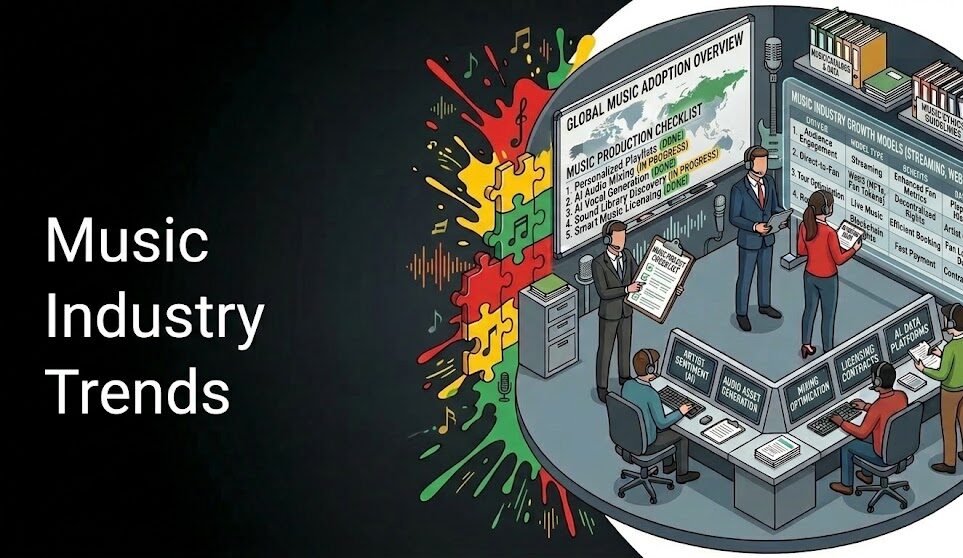
The biggest music industry trends in 2026 share one uncomfortable truth: the structures that made the music business work for the past twenty years are being replaced, not gradually, but in real time. Streaming killed the album cycle. TikTok rewrote discovery.
AI broke open the rights debate. And live revenue, which was supposed to be the safe harbor, is now facing its own structural pressures from rising costs, ticketing platform consolidation, and shifting fan behavior.
This isn’t a moment for cautious observation. Artists who don’t own their masters are watching AI train on their catalog for free. Labels that haven’t built direct-to-fan infrastructure are losing margin to platforms that have. And independent musicians who understand the new mechanics, short-form video, sync licensing, community monetization, live-first strategy, are building sustainable careers that would have been structurally impossible a decade ago.
Here’s what’s actually happening in the music industry right now, why it matters, and what artists and labels need to do about it.
Ask VIQI: How Do These Music Trends Affect Your Specific Genre or Territory?
VIQI is Vitrina’s AI assistant, trained on 1.6 million titles, 300,000+ companies, and 5 million entertainment professionals. Ask it how sync licensing works for independent artists, how AI music rights are evolving, or which global markets are growing fastest for your genre.
✓ Included with 200 free credits | ✓ No credit card needed
Short-Form Video Is Now the Primary Discovery Engine
This isn’t a new trend. It’s the new permanent reality, and labels and artists who haven’t restructured their release strategy around it are working against the grain of how music actually spreads in 2026.
TikTok’s influence on the music industry has been exhaustively covered, but the more precise point is often missed: short-form video didn’t just change music marketing, it changed music composition. Songs are now routinely written hook-first, with a moment designed for the 0–3 second clip window that determines whether a sound gets used in creator content. The 15-second drop, the earworm lyric that lands in the first line, the sonic signal that’s immediately recognizable out of context, these aren’t production choices anymore, they’re commercial requirements for tracks designed to travel through algorithmic discovery.
The data is unambiguous. According to Variety, songs that trend on TikTok before radio airplay now routinely outperform traditionally marketed releases on streaming platforms, sometimes by multiples. The discovery pathway has inverted, fans find music on short-form video, then search for it on Spotify or Apple Music, rather than the other way around.
What’s changed in 2026 is the multiplication of short-form video platforms and the shifting dynamics between them:
- TikTok remains the dominant discovery vector, but its regulatory uncertainty, ongoing legislative pressure in the US, has forced labels to hedge by investing in multi-platform strategies simultaneously.
- Instagram Reels and YouTube Shorts have captured meaningful music discovery traffic, particularly for artists in markets where TikTok has lower penetration. YouTube Shorts’ integration with full-length YouTube viewing creates a funnel that benefits artists with catalog depth.
- Spotify’s video features, short-form clips within the app, represent the most direct integration between discovery content and immediate streaming monetization, eliminating the platform hop that costs conversion.
The practical implication for artists and labels: content velocity matters as much as content quality in discovery. Artists who can generate consistent short-form content, not just around release windows but continuously, compound their algorithmic presence in ways that one-off viral moments can’t replicate. The label’s traditional job of managing a campaign window has been replaced by something closer to a content operations function. That’s a structural shift most major labels are still adjusting to, and it’s one where independent artists with strong personal brand presence can compete directly.
Streaming Economics: Why the Per-Stream Rate Debate Isn’t Going Away
Spotify paid out over $9 billion to rights holders in 2024. That sounds significant, and it is, for the industry as a whole. For the average independent artist, it translates to roughly $0.003–$0.005 per stream, which means you need approximately 250,000 streams to earn $1,000 before distributor and label cuts. That math drives most of the artist discontent with the current streaming model, and it’s not getting materially better anytime soon.
But the streaming economics debate is more complicated than per-stream rates suggest. What actually determines how much an artist earns from streaming:
- Pro-rata versus user-centric models. The current pro-rata model pools all subscription revenue and distributes it by total stream share, meaning superfan listening behavior benefits large artists disproportionately. User-centric models, where each subscriber’s payment flows to artists they actually listen to, would significantly increase revenue for artists with dedicated niche fanbases. Spotify has piloted versions of this. Broader adoption hasn’t materialized at scale.
- Label deal structure. A major label artist on a standard deal might receive 15–25% of streaming royalties after the label’s share and recoupment. An independent artist distributing through a service like DistroKid or TuneCore keeps 80–100% of the streaming royalty, a fraction of a cent, but their fraction. The per-stream rate debate is inseparable from label deal structures.
- Minimum stream thresholds. Spotify’s 2024 policy change establishing a minimum stream threshold before tracks qualify for royalty payment, designed to reduce fraud and noise from AI-generated content, affected a significant number of smaller artists whose tracks didn’t reach the threshold.
What 2026 has introduced: tiered royalty structures at several platforms that pay higher per-stream rates for tracks meeting specific engagement metrics, save rate, completion rate, playlist addition rate. This isn’t universally adopted yet, but it signals a direction: quality engagement signals replacing raw stream counts as the primary royalty determinant. For artists building genuine communities rather than gaming discovery algorithms, that’s a structural improvement worth tracking. For the future of music and royalty structures, the engagement-weighted model is where the most thoughtful policy proposals are currently pointing.
Track Music Industry Deals, Sync Opportunities, and Rights Holders in Real Time
Trusted by Netflix, Warner Bros, and Paramount. Join 300,000+ companies using Vitrina to track global entertainment deals, including music licensing, sync placements, and catalog acquisitions across 100+ markets.
✓ 200 free credits | ✓ No credit card required | ✓ Full platform access
Direct-to-Fan Monetization Is Replacing the Label Middleman
The most significant structural shift in artist economics over the past five years isn’t streaming rates, it’s direct-to-fan monetization. Artists who have built direct relationships with their audiences through Patreon, Substack, Bandcamp, Discord, exclusive merchandise drops, and fan subscription models are generating revenue streams that bypass the label and streaming platform intermediaries entirely.
The math is striking. An artist with 1,000 genuine superfans each paying $10 per month through a direct subscription platform earns $120,000 annually, before merchandise, live tickets, or streaming. That same artist would need roughly 30 million streams per year to match that figure on Spotify alone. The “1,000 True Fans” economic theory, proposed by Kevin Kelly in 2008, has become practically achievable at scale for the first time because the tools to monetize those relationships directly finally exist.
What’s fueling this shift in 2026:
Fan Subscription Platforms Maturing
Patreon has over 8 million active patrons supporting creators across music, podcasting, and video. Bandcamp, despite its acquisition by Songtradr and the resulting instability, still represents the most respected direct-to-fan music sales platform, particularly in independent and underground scenes where fans genuinely want to support artists financially. Substack’s move into audio content is creating new hybrid publishing and music revenue models that didn’t exist three years ago.
Community as Revenue Infrastructure
Discord servers, private fan communities, and exclusive content drops are functioning as revenue infrastructure, not just engagement tools. Artists offering backstage access, unreleased tracks, direct Q&A sessions, and physical merchandise to community members are generating recurring revenue that’s not dependent on algorithmic favor or label marketing budgets. This is particularly powerful for mid-tier artists, those who aren’t breaking radio but have cultivated genuine audiences of 50,000–500,000 engaged listeners. That’s a historically underserved commercial tier that direct-to-fan infrastructure is now making sustainable.
What Labels Are Doing About It
Major labels aren’t ignoring this, they’re adapting, sometimes clumsily. Distribution deals that give artists significantly higher royalty rates in exchange for shorter terms and non-exclusive arrangements are becoming more common as labels compete for artists who now have credible alternatives. The 360-deal model, where labels took percentage participation in touring, merchandise, and endorsements alongside recording, is under pressure from artists who can generate those revenue streams independently. The label’s value proposition is narrowing toward marketing reach, advance capital, and international distribution infrastructure. Those are still real values. They’re just no longer sufficient to justify terms that artists couldn’t otherwise survive.
AI-Generated Music and the Rights Crisis Nobody Has Solved
Here’s the honest state of AI and music rights in 2026: the technology has outpaced the legal rules by at least three to five years, and neither the courts nor the legislative process has produced a workable settlement. That gap is creating commercial uncertainty that affects every artist, label, and music supervisor working in the industry today.
The core dispute: AI music generation tools. Suno, Udio, and several enterprise platforms, were trained on cataloged music without explicit licensing agreements with the original composers, performers, or rights holders. That training produced tools capable of generating original-sounding music in virtually any style. Three major labels. Universal Music Group, Sony Music, and Warner Music Group, filed lawsuits in 2024 alleging copyright infringement in the training process. Those cases are still working through the courts.
But the commercial reality has moved faster than the litigation. AI-generated music is being used in advertising, social media content, film and TV, and game soundtracks, right now, at significant volume. The practical questions producers and music supervisors are navigating:
- Can AI-generated music be copyrighted? The US Copyright Office’s current position: no, not without sufficient human creative input. That limits the rights protection available to AI music creators but also, paradoxically, places AI music in the public domain in ways that can complicate commercial licensing.
- What’s the sync licensing risk? Music supervisors licensing AI-generated tracks for film and TV have to navigate two uncertainties: whether the track infringes on copyrighted training data, and whether the track itself has any protectable copyright. Most E&O insurers are still developing language for this, which means productions using AI music may face coverage gaps.
- What happens to artists whose voices and styles are replicated? The vocal synthesis dimension, tools like Respeecher that can replicate specific artist voices, requires consent agreements that the music industry hasn’t established comprehensively. Some artists have proactively signed deals permitting AI use of their voice in exchange for royalty arrangements. Most haven’t, creating a situation where unauthorized vocal replication is commercially common and legally contested.
The authorized AI path, explicitly licensing training data from rights holders, is emerging as the industry’s likely long-term settlement mechanism. According to The Hollywood Reporter, several major AI companies are in active licensing negotiations with music publishers and record labels that would establish royalty-bearing training data agreements. When those deals close, authorized AI music tools will have legal clarity that unlicensed tools lack, and the commercial pressure to switch to authorized tools will intensify. For the full picture of AI in music composition, the authorized versus unauthorized debate is the foundational issue that precedes all others, and it’s not resolved yet.
Seth Hallen and Craig German on the broader AI and entertainment supply chain intersection, including how music rights and authorized AI frameworks are evolving across the industry:
Live Revenue Is Still the Biggest Check, and Under More Pressure Than Ever
Ask any working artist where the real money is in 2026, and the answer is the same as it was ten years ago: live. Touring, residencies, festival appearances, and intimate ticketed experiences generate revenue that streaming will not match for the overwhelming majority of artists at any level below global superstar. A mid-tier touring act playing 150 shows per year at 500-capacity venues at $25 average ticket price generates roughly $1.875 million in gross ticket revenue, before production costs, agent commissions, venue fees, and crew. But that’s still orders of magnitude more than their streaming income.
But live revenue is under structural pressure from several directions simultaneously:
Ticketing Platform Concentration
The Live Nation–Ticketmaster merger created a vertically integrated live entertainment entity controlling a significant share of venue booking, ticketing, and artist management simultaneously. The antitrust case that followed, ultimately resulting in a consent decree in 2025 requiring structural separation of some functions, didn’t fundamentally reverse the concentration. Dynamic pricing, service fees averaging 30–40% above face value, and algorithmic ticket allocation have made the secondary market a feature of primary sales rather than a separate phenomenon. Artists face a choice between alienating fans over ticket pricing optics they don’t control and accepting revenue distributions they can’t renegotiate.
Production Cost Inflation
Post-COVID touring costs have increased dramatically and haven’t fully corrected. Crew wages, equipment rental, freight, fuel, and venue technical requirements have all risen faster than ticket prices can absorb without fan pricing resistance. Several mid-tier artists canceled or shortened 2024–2025 tours because they couldn’t make the economics work at ticket prices their fanbases would accept. This isn’t a temporary condition, it’s a structural margin squeeze that makes the financial viability of touring dependent on tour size and capitalization in ways that disadvantage independent artists without label tour support.
Experiential Formats and New Revenue Models
The response from many artists has been creative: smaller, premium-priced experiential formats, intimate venue residencies, destination festival experiences, fan club exclusive shows, that generate higher per-fan revenue with lower production scale. ABBA Voyage’s extended virtual concert residency in London demonstrated that technology-augmented live formats can achieve massive revenue without traditional touring economics. That’s a template more artists are studying, even if full-scale holographic production is outside their budget range. The accessible version, hybrid physical and livestream ticketing, exclusive fan experience add-ons, artist-hosted destination events, is already generating meaningful revenue for artists who’ve invested in building the community infrastructure to support it.
Sync Licensing Is the Underrated Revenue Stream Artists Keep Ignoring
Sync licensing, placing music in film, TV, advertising, video games, and social media, generates more revenue per placement than any streaming metric can touch, and independent artists have more access to this market than they’ve ever had. But most don’t pursue it systematically. That’s a significant missed opportunity in 2026.
The math on sync is fundamentally different from streaming. A single TV placement in a major network drama might earn a $5,000–$50,000 sync fee plus performance royalties that continue for years wherever the episode airs globally. A national advertising campaign placement can range from $50,000 to several hundred thousand dollars depending on usage scope. Even a smaller brand placement, a tech startup’s product video, an indie film’s opening sequence, typically generates more than 100,000 streams in single-placement value.
What’s changed in 2026 that makes sync more accessible to independent artists:
- Direct submission platforms. Music libraries like Musicbed, Artlist, and Epidemic Sound have created non-exclusive licensing marketplaces where independent artists can list tracks without label representation. Production companies, YouTubers, advertisers, and documentary filmmakers license directly, no music supervisor relationship required.
- Streaming platform content volume. The explosion of streaming original content has dramatically increased demand for music. A streaming platform producing 200+ original titles per year requires an enormous volume of music placements. Music supervisors are actively looking for tracks that aren’t already over-licensed into ubiquity, which is precisely where independent catalog has competitive advantage.
- Social media sync markets. TikTok, Instagram, and YouTube all operate licensing programs that compensate artists for commercial usage of their music in branded content. The rates are lower than traditional sync, but the volume creates meaningful aggregate revenue for artists with widely used catalog.
The practical barrier isn’t access, it’s preparation. Sync-ready tracks need clean rights documentation (no uncleared samples, publishing and master rights clearly defined), production-quality recordings, and metadata that makes them findable. Artists who invest in this preparation once have an asset that generates passive revenue for years. The broader connection between music licensing infrastructure and global entertainment production is one of the most direct commercial links between the music and film/TV supply chains, and it’s underexploited by most independent artists.
Music Catalog Has Become a Financial Asset Class
The catalog acquisition wave that peaked in 2020–2022, when companies like Hipgnosis Songs Fund, Primary Wave, and Irving Azoff’s Iconic Artists Group spent billions acquiring masters and publishing rights from legacy artists, has moderated but hasn’t stopped. What’s changed is the valuation environment: rising interest rates compressed multiples from the 20–30x multiplier peak to more sustainable ranges, and some early acquirers have had to reckon with whether their portfolio management operations can justify the acquisition prices paid.
But the fundamental thesis, that music catalog, properly managed, generates durable royalty income that outperforms fixed income in a low-yield environment, hasn’t been disproved. It’s been stress-tested. And the stress tests have revealed something important: catalog value is highly dependent on active management, sync placement, and platform optimization, not just passive royalty collection.
For artists, the catalog acquisition market in 2026 offers two distinct opportunities. The first is liquidity: selling a portion or all of their catalog for an upfront payment that monetizes future royalty streams at a discount to long-term value. This makes sense for artists who need capital now, who believe catalog value will decline, or who want to reduce exposure to royalty market volatility. The second is leverage: using catalog as collateral for loans, joint ventures, or partnership structures that provide capital without requiring outright sale. Several specialist lenders now offer catalog-backed financing at rates that can be materially better than unsecured artist loans.
What every artist and label needs to understand: catalog value is not static, and it’s increasingly tied to how actively the rights are managed. A catalog that generates $500,000 per year in passive royalties might generate $800,000–$1.2 million with active sync pitching, playlist placement strategy, and platform metadata optimization. The gap between active and passive catalog management is wide enough that it meaningfully affects both the catalog’s sale valuation and its ongoing revenue generation. The content licensing strategies that drive catalog value in film and TV apply directly to music catalog management, the principles translate across media categories.
Global Music Markets Are Reshaping the Industry’s Growth Story
The global recorded music market grew to approximately $28.6 billion in 2024, with streaming accounting for over two-thirds of that revenue. But the growth story is no longer being written in North America or Western Europe, those markets are mature. The next decade of music industry growth comes from emerging markets where smartphone penetration is rapidly expanding the potential streaming subscriber base.
Three markets that are genuinely reshaping the global picture:
South Asia
India’s music market is enormous in volume. Bollywood and regional language music generates staggering streaming numbers, but historically undermonetized because of low subscription pricing. As India’s middle class expands and subscription tier adoption increases, the revenue per user is climbing toward levels that make India one of the most important growth markets in global recorded music. JioCinema’s consolidation with Disney Hotstar, which includes substantial music content, is part of the platform battle for this expanding subscriber base.
Middle East and North Africa
The MENA region is experiencing genuine streaming growth driven by young demographics, 60% of Saudi Arabia’s population is under 30, and improving data infrastructure. Arabic music, Turkish content, and international pop are all performing strongly. OSN’s content acquisition team describes Turkish content as “performing amazingly well” on their platform, reflecting a broader pattern of regional language music finding cross-border audiences through streaming platforms in ways that weren’t commercially viable through physical or broadcast distribution.
Africa
African music. Afrobeats, Amapiano, Afropop, has achieved genuine global crossover in a way that’s not just cultural export but commercial infrastructure change. Artists like Burna Boy, Wizkid, and Tyla have demonstrated that African music can reach mainstream charts globally without the traditional Western label gatekeeping pathway. The music industry infrastructure to support this, regional distributor networks, streaming platform local investment, live touring infrastructure, is developing faster than most Western labels anticipated. This is one of the most significant structural opportunities in music that labels are still under-investing in relative to its scale.
The Korean Wave (Hallyu) continues as the most established proof of concept for regional music achieving global commercial scale without English-language content. K-pop’s methodical fan engagement infrastructure, fan clubs, limited physical collectibles, parasocial content strategies, has been widely studied and is being adapted by labels and artists in other markets who see it as a template for building the kind of dedicated fan economics that short-form video discovery alone doesn’t create. The sovereign content hub dynamics reshaping film and TV production are equally visible in music, government-backed regional production ecosystems are increasingly producing global cultural exports, not just domestic content.
Need Introductions to Music Licensing Buyers, Sync Supervisors, or Global Distributors?
Vitrina Concierge makes warm introductions directly to decision-makers at labels, streaming platforms, sync agencies, and entertainment companies actively seeking content partnerships.
- Korean animation studio → Netflix Adult Animation (week one)
- LA producer → Netflix UK, Fifth Season, Fox Entertainment (48 hours)
- Middle Eastern studio → Legendary Pictures (direct access)
Frequently Asked Questions
What are the biggest music industry trends affecting artists in 2026?
The most consequential music industry trends in 2026 are: short-form video as the primary discovery engine, direct-to-fan monetization replacing traditional label economics for independent artists, the unresolved AI music rights crisis, streaming royalty structure debates shifting toward engagement-weighted models, live revenue pressure from ticketing concentration and production cost inflation, and the emergence of sync licensing as an accessible independent artist revenue stream. Global music markets, particularly India, MENA, and Africa, represent the industry’s primary growth story.
How much do artists actually earn per stream on Spotify in 2026?
Spotify pays approximately $0.003 to $0.005 per stream before distributor and label cuts, meaning an independent artist needs roughly 250,000 streams to earn $1,000. This is why streaming alone doesn’t sustain most independent musicians, the math requires either massive scale or significant direct-to-fan and sync revenue alongside streaming income. Some platforms have introduced tiered royalty structures in 2025 and 2026 that pay higher per-stream rates for tracks meeting engagement thresholds, but these haven’t been universally adopted.
Is AI-generated music legal to use commercially in 2026?
It depends on the tool and the use case, and the legal picture is still evolving. The US Copyright Office’s current position is that AI-generated music without sufficient human creative input is not copyrightable. Major labels have filed copyright infringement lawsuits against AI music platforms over training data usage. Commercial use of AI-generated music carries potential liability depending on whether the tool was trained on unlicensed copyrighted material. Music supervisors and production companies are increasingly cautious about AI music placements due to unresolved E&O insurance questions. Authorized AI tools with explicitly licensed training data represent the legally safer commercial option.
How do independent artists get music sync licensing placements?
Independent artists can access sync licensing through direct submission to music libraries like Musicbed, Artlist, and Epidemic Sound, which license non-exclusively to advertisers, content creators, and productions. For higher-value placements in film, TV, and major advertising campaigns, working with a music publisher or sync agent who has relationships with music supervisors provides better access. Preparation matters: tracks need clean rights documentation with no uncleared samples, production-quality recordings, and accurate metadata. Artists should also register with performing rights organizations, as sync placements generate both sync fees and ongoing performance royalties.
Should artists sell their music catalogs in 2026?
It depends on the artist’s financial situation, catalog maturity, and long-term plans. Catalog sale multiples have moderated from the 20 to 30 times earnings peaks of 2021 to 2022 to more sustainable levels, but durable royalty-generating catalogs still attract significant acquisition interest. Artists who need liquidity, want to reduce exposure to royalty market uncertainty, or are older with limited touring capacity may find catalog monetization valuable. Artists earlier in their career with growing catalog value and active sync and streaming management may generate more long-term value from retaining ownership and actively managing the asset. Catalog-backed loans offer a middle path that provides capital without requiring outright sale.
How is K-pop’s business model influencing the broader music industry?
K-pop has become the most studied commercial template in the music industry for building fan economics that generate revenue independent of platform algorithms. The key elements being adopted elsewhere: fan club membership systems with exclusive content and physical collectibles, parasocial content strategies that deepen individual fan investment, diversified revenue across merchandise, fan events, and streaming, and systematic global expansion through coordinated fandom rather than traditional radio-first rollouts. Artists in Latin America, Africa, and Southeast Asia are explicitly adapting these strategies for their own markets with considerable commercial success.
What direct-to-fan platforms are most effective for independent artists in 2026?
The most effective platform depends on the artist’s existing audience and content type. Patreon works best for artists with dedicated fans who want exclusive access and ongoing creative connection. Bandcamp remains the most trusted platform for independent music sales, particularly in indie and underground genres. Substack is emerging as a strong option for artists who create substantial written or audio content alongside music. Discord servers are effective for community building and exclusive fan experiences. Most successful independent artists use multiple platforms simultaneously, with each serving a different layer of fan engagement and monetization rather than choosing a single platform exclusively.
Which global music markets are growing fastest in 2026?
The fastest-growing recorded music markets in 2026 are in emerging economies where smartphone penetration and streaming platform adoption are expanding simultaneously. India represents the largest near-term opportunity as subscription pricing climbs and the middle class grows. The MENA region is seeing strong growth driven by young demographics and improving data infrastructure, with Arabic and Turkish music performing particularly well. Sub-Saharan Africa is experiencing significant growth driven by the global success of Afrobeats and Amapiano, combined with rapidly expanding mobile data access and platform investment from Spotify, Audiomack, and Boomplay. Southeast Asia, particularly Indonesia, Thailand, and Vietnam, represents another significant growth market receiving substantial platform investment.
Conclusion: The Music Industry Doesn’t Reward Passive Observation
The biggest music industry trends affecting artists and labels in 2026 share one characteristic: they favor the prepared. Artists who’ve built direct-to-fan infrastructure, who understand sync economics, who are actively managing catalog value and navigating AI rights with clarity, they’re building durable businesses while others are still hoping the old model reasserts itself. It won’t.
Key Takeaways:
- Short-form video is the discovery engine: Artists need continuous content velocity, not just campaign windows, the algorithmic discovery system rewards consistent presence over occasional viral moments.
- Direct-to-fan economics change the math: 1,000 paying superfans at $10/month generates more revenue than 30 million streams, and that relationship is yours, not the platform’s.
- AI music rights are legally contested: Using unauthorized AI tools introduces commercial liability. Authorized tools with licensed training data are the commercially safer path as legal frameworks tighten.
- Live is still where the money is, but costs are rising: Smaller-scale, higher-margin experiential formats are the strategic response to production cost inflation and ticketing concentration.
- Sync licensing is underutilized: A single placement can outperform months of streaming revenue, artists who invest in sync preparation once create an asset that generates passive income for years.
- Global markets are the growth story: India, MENA, and Africa are where the next decade of music industry growth is being written, artists and labels who build presence there now have first-mover advantages that compound.
The music business has always rewarded those who understood its economics better than their peers. That’s more true in 2026 than it’s ever been, because the economics are more complex, the opportunities are more global, and the gap between artists who understand the system and those who don’t has never been wider.
Track Music Licensing, Catalog Deals, and Global Distribution Opportunities in One Place
Trusted by Netflix, Warner Bros, Paramount, and Google TV. Access 1.6 million+ tracked projects, 3 million verified executives, and VIQI. Vitrina’s AI assistant trained on the global entertainment and music supply chain.
✓ 200 free credits | ✓ No credit card required | ✓ Cancel anytime
Need direct introductions to sync buyers or global distributors? Explore Concierge Service →