IHUB
IHUB
 Private Briefings (Webinars)


 LeaderSpeak Podcast
  Global Entertainment Digest (Newsletter)
  Premium Lists
 Membership Benefits
 About Vitrina
 Our Story
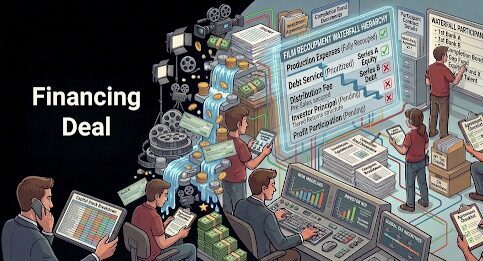
A film budget is not just a production document. It is a financing argument. When the budget is misaligned with what the market will realistically pay, no amount of creative ambition closes the gap. Based on Vitrina’s LeaderSpeak Podcast conversations with senior practitioners from HeadGear Films, Myriad Pictures, and Goldfinch — this article explains the specific ways a film budget breaks a financing deal, and what a budget that actually supports financing looks like.
Author:
Kunal Barai leads Global Markets at Vitrina.AI, working with producers and financiers across 100+ countries to facilitate content financing and co-production matchmaking. He recently hosted a roundtable on AI for Film Financing: Unlocking Smarter Global Matchmaking and Funding Strategies at MIP London 2026. Earlier, he spent 12+ years at Nielsen/Gracenote and completed MIT Sloan’s executive program on AI strategy.
Most producers approach film budgeting as a creative and logistical exercise: what does this story need to be made properly? That is a legitimate question. But it is the wrong starting point for a financing conversation. Financiers do not evaluate a budget in isolation. They evaluate it against realistic revenue projections. When the gap between those two numbers is too wide, the project does not move forward, no matter how strong the script is.
This is one of the most consistent observations across the Vitrina LeaderSpeak Podcast series. Practitioners who actively deploy capital, across sales, production finance, and equity investment, identify overblown or wrongly structured budgets as one of the leading reasons independent film financing stalls. Not the most dramatic reason, and not the most talked-about, but one of the most reliably fixable if a producer is willing to engage with it honestly.
The fix is not always about cutting costs. Sometimes it is about understanding what the market will actually support, then building the budget from that number rather than working in the opposite direction.
Why a budget is a financing argument
A film budget tells a financier one thing above all: whether the people behind this project understand the market they are operating in. A budget that is sized correctly for the genre, cast, and territory sales potential signals that the producer knows the difference between what they would ideally spend and what the financing structure can actually support. A budget that is detached from market reality signals the opposite — optimism without grounding, which is precisely the kind of thinking that makes financiers cautious.
Independent film finance is built on a capital stack, the layered structure of different funding sources that together cover the cost of production. Each layer of the stack has to be justified. Senior debt, the money that sits at the top and gets repaid first, is lent against concrete collateral like pre-sale agreements and tax credits. Equity, which sits at the bottom and absorbs the most risk, is committed by investors who need to believe there is a realistic return. If the budget cannot be supported by the revenue those layers are likely to generate, the entire structure weakens.
Table of Contents
1. What HeadGear Films looks for in a budget
Phil Hunt at HeadGear Films is one of the more prolific financiers in the independent market, involved in around 35 to 40 films a year. His starting observation about budgets is consistent across projects of all sizes: the budget must match the revenue that the market can realistically deliver.
HeadGear’s average project sits at around eight to nine million dollars, with most under ten million. That is not a philosophical preference. It reflects the practical reality of what international territory sales can support for independently financed productions at that packaging level. When producers arrive with budgets significantly above what the genre, cast, and likely territory deals can justify, the conversation becomes difficult very quickly.
The genre dimension matters here too. Action, thriller, and horror films travel reliably across international markets. Buyers understand them, can position them for local audiences, and can model revenue with some confidence. Drama is harder, not because drama is a lesser form, but because it requires exceptional packaging to generate the same level of buyer confidence. A drama with a seven-million-dollar budget needs a much stronger cast and a much clearer international sales argument than a thriller at the same number. Producers who build budgets for drama without accounting for that additional packaging requirement are setting themselves up for a financing problem.
| “Cut the budget before you compromise on cast.”
— Phil Hunt, HeadGear Films, Vitrina LeaderSpeak Podcast |
This is not a statement about frugality. It is a statement about priorities. Cast is one of the variables that most directly influences whether a film can be sold internationally, which means cast influences whether the financing structure can be built at all. A slightly smaller budget with the right names attached is a more financeable project than a larger budget with a cast that buyers cannot use to anchor their own marketing.
2. How Myriad Pictures tests whether a budget is fundable
Kirk D’Amico founded Myriad Pictures as a sales company, and that identity shapes how he thinks about film budgets. Sales is the centre of everything. How much a film can realistically generate from territory sales, the agreements with distributors in each market to pay for the rights to show the film in their country, is the primary filter for whether a budget is fundable.
| “I would say the one thing we don’t do is equity.”
— Kirk D’Amico, Myriad Pictures, Vitrina LeaderSpeak Podcast |
Myriad’s involvement in financing is limited to minimum guarantees, which are upfront payments against the value of distribution rights in specific territories. These can be used to support bank loans or specialist lenders, effectively turning a sales commitment into a component of the financing plan. But whether Myriad provides a minimum guarantee at all depends entirely on whether the territory sales projection for the film is credible at the budget level proposed.
Kirk D’Amico’s practical range is five to fifteen million dollars. Films above thirty million dollars are very difficult to finance independently without studio backing, because the reliance on pre-sales alone becomes insufficient at that budget level. Within his range, minimum guarantees can meaningfully support the financing structure, tax incentives can be layered in, and co-production arrangements can help spread cost and access additional incentive programmes. But all of that is contingent on the starting premise: the budget is sized for what the sales market will actually support.
Co-production, where two or more production entities across different countries formally share the cost and rights of a film, can extend what is achievable at a given budget. It unlocks access to multiple incentive programmes, shares production costs, and can broaden the territory appeal of a project. But it adds legal and structural complexity that has to be managed from the beginning. Rights allocation, revenue sharing, and the governance of the production relationship must all be clear. Producers who add co-production structures to solve a budget problem without addressing the underlying market mismatch find that the complexity compounds rather than resolves the issue.
3. How Goldfinch stress-tests a budget before committing
Kirsty Bell at Goldfinch brings a different angle to the same problem. Goldfinch is an equity investor, which means they sit at the bottom of the repayment stack and absorb the most risk if a film underperforms. That position makes them particularly rigorous about budget discipline, because their return depends on the film generating enough revenue to repay all the debt first and still have something left over.
Her standard approach is to discount projected sales by sixty percent before evaluating a project. That is not pessimism. It is a realistic acknowledgement that sales projections in independent film tend to be optimistic, and that an investment thesis built on best-case scenarios does not survive contact with actual market performance. By working from a heavily discounted projection, Goldfinch can assess what percentage of their investment is genuinely at risk in scenarios that are probable rather than ideal.
The budget questions they ask are not primarily about line-item costs. They are about whether the budget is realistic given the project’s scope, whether financial oversight is in place to manage spend during production, and whether the relationship between the budget and the expected revenue has been stress-tested rather than assumed. A budget that can survive a sixty percent discount on projected sales and still make sense structurally is a budget that inspires confidence. One that only works at optimistic sales numbers does not.
| “Creativity gets a project started. Structure is what gets it financed.”
— Kirsty Bell, Goldfinch, Vitrina LeaderSpeak Podcast |
Goldfinch’s zero-default record across more than 300 projects is built on this methodology. They are not looking for complexity. They are looking for clarity about where the money goes, who oversees it, and what happens to investors at each stage of the revenue journey. A disciplined budget is part of that clarity. An inflated or loosely constructed budget is a signal that the clarity is missing.
What a financeable budget actually looks like
A budget that supports a financing conversation has several characteristics that are consistent across all three of the practitioners covered here. It is sized for what the genre, cast, and territory sales can realistically support, not for what the production would ideally cost. It is defensible under scrutiny, meaning the producer can explain every major cost decision and justify it against market data. It has been stress-tested against lower-than-expected revenue scenarios, not just optimistic ones. And it treats cast as a financing variable, allocating budget to names that buyers can use, rather than cutting cast to fund other aspects of production.
None of this means the budget has to be small. Phil Hunt at HeadGear is clear that larger budget films, when properly structured with the right packaging and deal architecture, can actually carry less financing risk than smaller films with weak packaging. The number matters less than the relationship between the number and the revenue structure around it. A twenty-million-dollar film with strong cast, confirmed pre-sales, and a credible tax incentive may be more financeable than an eight-million-dollar film that has none of those elements in place.
The producers who navigate financing conversations successfully are the ones who have done the work to understand that relationship before they walk in the door. They know what their film will realistically sell for, territory by territory. They know what that translates to in terms of the capital stack they can build. And they have sized their budget to fit that structure, rather than hoping the market will stretch to meet their cost.
About This Article
This article is part of Vitrina’s LeaderSpeak Podcast programme, where senior practitioners across the entertainment supply chain share the structural realities of how their part of the business works. The voices in this article are drawn from LeaderSpeak Podcast conversations with Phil Hunt of HeadGear Films, Kirk D’Amico of Myriad Pictures, and Kirsty Bell of Goldfinch. The Vitrina Film Financing Playbook is the structured companion to these conversations, available for download.
Related reading:
Frequently Asked Questions
Why do film budgets kill financing deals?
The three most common budget failures that kill financing deals are: (1) inflated talent fees that assume stars will work for backend points rather than cash, (2) production cost estimates not benchmarked against comparable titles, and (3) a gap between pre-sales and negative cost that requires equity investors to take implausible risk. Financiers see hundreds of budgets; unrealistic assumptions are identified immediately.
What do film financiers look for in a budget?
Financiers evaluate budgets for: comparables alignment (is the budget proportional to similar films’ actual sales?), pre-sales coverage (do hard pre-sales cover at least 30–50% of negative cost?), below-the-line cost accuracy (are crew rates at prevailing market rates?), and contingency (is there a 10% production contingency that isn’t being used to hide overages elsewhere?).
How should a film budget be structured to attract financing?
A financeable film budget separates hard costs (non-negotiable: insurance, permits, locations, crew rates) from soft costs (negotiable: deferments, backend, equity fees). The recoupment waterfall must be clearly modelled: completion bond repayment first, then gap financier, then equity investors. Any financier should be able to trace exactly how they get repaid before the producer receives a share.
What is a gap in film financing and how does a budget affect it?
A financing gap is the difference between confirmed pre-sales and the negative cost. Most films have a gap of 20–40% that must be filled with equity or soft money (tax credits, grants). A budget that inflates the negative cost inflates the gap, making it harder to close. The most fundable budgets minimise the gap to under 20% of negative cost through conservative pre-sale estimates.
How can producers improve their budget to secure film financing?
Three immediate improvements: (1) get at least three comparable title sales analyses from a sales agent before finalising the budget, (2) separate the recoupment waterfall clearly on page one of your financing plan, (3) reduce above-the-line costs to what the talent will actually accept in cash — not what you’d like to pay them. Vitrina AI’s database of 300,000+ M&E companies can help identify sales agents and financiers who match your film’s profile.