IHUB
IHUB
 Private Briefings (Webinars)


 LeaderSpeak Podcast
  Global Entertainment Digest (Newsletter)
  Premium Lists
 Membership Benefits
 About Vitrina
 Our Story
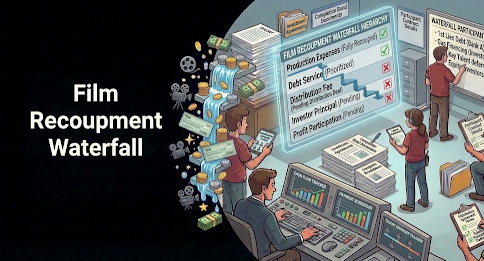
A plain-English guide to how film revenue is distributed once a project starts earning money — who gets paid first, who waits, and why the order is non-negotiable for every investor in the deal. Based on Vitrina’s LeaderSpeak Podcast conversations with senior practitioners from Lee & Thompson and Goldfinch, with structural context from Peachtree Media Partners.
Author:
Kunal Barai leads Global Markets at Vitrina.AI, working with producers and financiers across 100+ countries to facilitate content financing and co-production matchmaking. He recently hosted a roundtable on AI for Film Financing: Unlocking Smarter Global Matchmaking and Funding Strategies at MIP London 2026. Earlier, he spent 12+ years at Nielsen/Gracenote and completed MIT Sloan’s executive program on AI strategy.
When you raise financing for a film, most of your attention goes on bringing the money in. The question that matters just as much — and that most producers underestimate — is how it leaves. Revenue does not flow freely once a film starts earning. It flows in a specific order. That order is called the recoupment waterfall, and it determines who gets paid, when, and how much.
For investors and lenders, the waterfall is not a formality. It is the framework through which they understand the risk they are taking. A senior lender sitting at the top of the stack has a fundamentally different risk profile from an equity investor sitting at the bottom. Both have agreed to the deal knowing their position. The waterfall is what makes that agreement legible and legally enforceable.
For producers, understanding the waterfall — and being able to explain it clearly — is the difference between a financing conversation that moves forward and one that stalls. This article explains what the recoupment waterfall is, how it works in practice, and what practitioners from Lee & Thompson, Goldfinch, and Peachtree Media Partners say about why it must be documented before you approach capital.
Table of Contents
- What the Recoupment Waterfall Actually Is
- Why the Order Matters — And What It Means for Timing
- How the Waterfall Flows — Tier by Tier
- The 3.8–4% Benchmark — And What It Means for Equity
- What Goldfinch Looks For When Reviewing a Waterfall
- What This Means for Producers Approaching Capital
- The Bottom Line
What the Recoupment Waterfall Actually Is
A recoupment waterfall is the agreed sequence in which different capital providers get paid once a film starts generating revenue. Film revenue — from distribution deals, streaming platforms, territorial sales, and broadcast agreements — does not go directly to investors. It flows first into a collection account, which is a ring-fenced account managed by an independent third party. That administrator then distributes money to each investor in the order specified in the financing agreements.
The typical waterfall runs in a clear sequence. Senior debt is repaid first, because it carries the least risk and was structured to be repaid regardless of how the film performs commercially. Gap financing — money advanced against projected but not yet contracted revenue — comes second. Equity investors sit at the bottom, repaid only after all debt obligations have cleared. Net profit participation, if it exists at all, begins only after equity has been fully recouped.
That sequence has real consequences. Equity investors absorb uncertainty that debt providers do not. Understanding which tier you occupy — and which tier your financing partners occupy — shapes everything about how those conversations should go.
1. Why the Order Matters — And What It Means for Timing
Peachtree Media Partners, one of the most active independent film lenders across the US, Canada, UK, and Australia, is precise about how they understand their position in the waterfall. The primary risk Peachtree carries as a lender is not whether they get repaid. It is when.
This distinction matters more than it might first appear. Peachtree lends against identifiable assets within a project: pre-sale agreements, distribution contracts, tax incentives, assigned rights. Senior debt, secured against this collateral, flows back through the top of the waterfall once revenue arrives. The question they are actually managing is timing — how long before those cash flows materialise and the loan clears.
As the Vitrina Film Financing Playbook summarises from Peachtree’s model, once a completion bond is in place and the production closes, Peachtree’s risk shifts from whether they get repaid to when. Timing risk is a financing problem. Completion risk is an existential one. That is why senior lenders can operate at the lower interest rates they do: their position in the waterfall is protected.
For producers, this means that when you approach a lender like Peachtree, you are not reassuring them that the film will succeed commercially. You are showing them that the waterfall is structured so that their position — at the top, secured against defined collateral — means they get paid back in a defined, manageable timeframe.
2. How the Waterfall Flows — Tier by Tier
From Vitrina’s market tracking and Live Session discussions, most independent film waterfalls follow the same core structure, with variations in how fees and participations are treated within each tier.
Revenue enters the collection account first. A collection account — often documented in a CAMA, a Collection Account Management Agreement — is a legal arrangement where an independent administrator receives all the film’s revenues and distributes them according to the agreed schedule. This is not an informal instruction to a bank. It is a legal document, and every investor’s position within it must be explicitly defined before the first investor commits.
From there, the flow works like this. Senior debt is repaid in full, including principal and interest. Gap financing, which sits behind senior debt because it carries more risk — it was advanced against projected rather than confirmed revenue — is repaid next. Equity investors follow. At each tier, investors wait until the tier above is fully cleared before their distributions begin.
Net profit participation — the share of profits that producers, directors, or talent may have negotiated — begins only if revenue exceeds the total of all invested capital plus fees. The Part II structural analysis in the Vitrina Film Financing Playbook notes one pattern that is consistent across deals: financiers hesitate when recoupment schedules are vague. Clear waterfalls reduce disputes, speed up financing decisions, and build long-term trust between producers and capital providers.
3. The 3.8–4% Benchmark — And What It Means for Equity
Sam Tatton-Brown is a partner at Lee & Thompson, one of the leading specialist entertainment law firms working across independent film and television. His assessment of where equity sits in practice is worth sitting with.
According to the Vitrina Film Financing Playbook’s summary of his position, the percentage of UK independent films that actually reach net profits sits between 3.8 and 4 percent. Equity investors sit at the bottom of the stack. They are paid only after all debt has cleared. In practice, that means equity investors face very long odds of seeing any profit participation at all.
This is not a pessimistic framing. It is the structural reality of independent film finance. Equity investors accept that position because they are compensated with upside potential that debt providers do not have. If the film significantly outperforms expectations, equity participates in that upside. Debt does not — it simply gets repaid on the agreed terms.
| PRODUCER TAKEAWAY→ Only 3.8–4% of UK independent films reach net profits — equity investors must understand this position clearly before they commit
→ A vaguely documented waterfall — where repayment order is assumed rather than written — creates exactly the conditions for disputes when revenue flows → The cascade must be written down, not assumed — a properly documented recoupment schedule is legally enforceable in a way that verbal agreements are not |
What follows from this benchmark is not that equity investment in independent film is irrational. It follows that equity investors must understand their position clearly before they commit. A waterfall that is vaguely documented — one where the repayment order is assumed rather than written — creates exactly the conditions for disputes at the point when revenue starts flowing. That is the worst possible time for ambiguity.
As Sam Tatton-Brown’s position makes clear: the cascade must be written down, not assumed. A verbal agreement on repayment order does not hold in the same way that a properly documented recoupment schedule does.
4. What Goldfinch Looks For When Reviewing a Waterfall
Goldfinch has deployed over $250 million across more than 300 projects over 12 years without a single default. That track record reflects a consistent approach to evaluating risk before capital is committed, and one part of that approach is a close examination of how a project’s recoupment is structured.
As Kirsty Bell, a co-founder of Goldfinch, has described in the Vitrina LeaderSpeak conversations: Goldfinch discounts projected sales by 60 percent when evaluating a project and focuses on what percentage of the investment is actually at risk in realistic scenarios. That analysis only works when the waterfall is clearly documented. If the repayment order is vague, you cannot model what happens when sales come in below projection — because you do not know who absorbs the shortfall first.
| “We’ve got infrastructure to die for.”
— Kirsty Bell, Goldfinch, Vitrina LeaderSpeak Podcast |
Goldfinch looks for four things when reviewing how a project is structured: a clear investor hierarchy, a defined repayment order, transparent reporting commitments, and written agreements rather than verbal understandings. When those elements are present, investors feel protected. When structure is unclear, even a strong film can struggle to close financing.
This point is not specific to equity-heavy structures. It applies to any deal that combines debt, equity, and incentives. The more layers of capital a project carries, the more important it is that every participant understands their exact position in the queue.
5. What This Means for Producers Approaching Capital
The practical implication is straightforward: your recoupment schedule should be documented before you enter financing conversations, not after.
Lee & Thompson’s approach to independent film finance makes clear that every project must be able to clearly answer a set of basic questions before approaching any lender or investor. Who owns the rights? Who has security over those rights? What is the repayment order? What happens in default? If these answers are inconsistent across documents, or if they exist only in the producer’s head, lenders hesitate — and for good reason.
From Vitrina’s tracking of active independent financing structures, one pattern is consistent across markets: producers who treat the waterfall as part of the financing build, not a legal formality to be sorted before signing, move through financing conversations more smoothly. The waterfall is not the paperwork that follows the deal. It is part of the deal itself.
There is also a practical point about speed. Financing closes faster when the legal structure is ready. A producer who arrives at a financing conversation with a documented, legally reviewed recoupment schedule is signalling something important: they understand how institutional money works. That changes the quality of the conversation.
The Bottom Line
The recoupment waterfall is the architecture through which capital gets returned. A lender’s confidence that they will be repaid is not based on creative optimism. It is based on a clear, documented, legally enforceable sequence that defines exactly where their money sits and when it flows back.
For equity investors, the 3.8–4 percent net profit benchmark is a serious number. Equity is the patient, risk-absorbing layer of the stack. That is its function, and it carries the corresponding potential for upside when films do well. The waterfall makes that function explicit — and it protects everyone in the deal, including the producer, when things get complicated.
A producer who can explain their waterfall clearly — who knows who gets paid first, on what timeline, and when equity sees a return — is having a different kind of financing conversation. Not a harder one. A better one.
| “A producer who can explain their waterfall clearly — who knows who gets paid first, on what timeline, and when equity sees a return — is having a different kind of financing conversation. Not a harder one. A better one.” |
About This Article
This article is part of Vitrina’s LeaderSpeak Podcast programme, where senior practitioners across the entertainment supply chain share the structural realities of how their part of the business works. The voices in this article are drawn from LeaderSpeak Podcast conversations with Sam Tatton-Brown of Lee & Thompson and Kirsty Bell of Goldfinch, with structural context from Joshua Harris of Peachtree Media Partners. The Vitrina Film Financing Playbook is the structured companion to these conversations, available for download.
Related reading: