About Innovation Hub
 Global Content Pulse (Webinars)


 Global Production Financing
(Webinars)
Global Production Financing
(Webinars)  LeaderSpeak Podcast
  Global Entertainment Digest (Newsletter)
  About Vitrina
 About VIQI
 Our Story
 Our Solutions 🔥
 Film+TV Projects Tracker 🚀
 Case Studies
 Our Profile
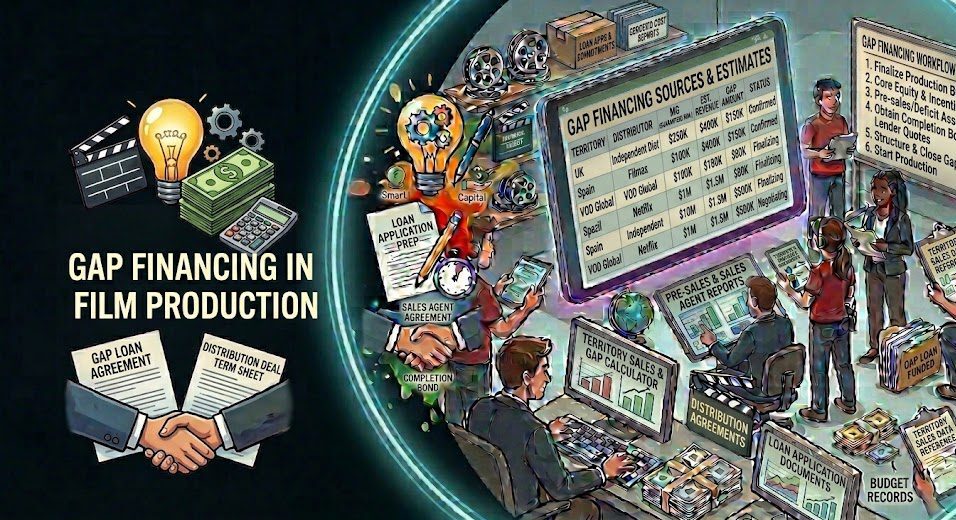
You’ve raised equity. You’ve closed a handful of pre-sales. You’ve confirmed your tax incentive. And you’re still 15–20% short of a full budget. That’s the moment gap financing in film production becomes a real conversation—not a theoretical one.
Gap financing is the tool that closes a production budget when conventional sources have taken you as far as they can. It’s mezzanine debt secured against your film’s unsold foreign territory rights. It’s not cheap, it’s not easy to get, and in 2026 the lending environment is significantly tighter than it was three years ago. But for the right project, with the right package, it’s one of the most powerful instruments in independent film finance.
This guide breaks down exactly how gap financing works—the mechanics, the real cost, the five non-negotiables lenders require, and what the current market means for producers approaching lenders right now. We’ve drawn from Vitrina’s research across dozens of film finance deals, including direct insights from Phil Hunt (Founder & CEO, Head Gear Films)—one of the most active gap financiers operating today with 550+ films financed—and Joshua Harris (President & Managing Partner, Peachtree Media Partners), whose lending model was built specifically to fill the void left by commercial bank retreats from this space.
In This Guide
- What Is Gap Financing? The Actual Definition
- How Gap Financing Works: Step by Step
- What Lenders Use as Collateral—and How They Value It
- The Real Cost of Gap Financing in 2026
- The 5 Non-Negotiables to Qualify
- The 2026 Market Reality
- Gap Financing vs. Your Other Options
- How to Position Your Project for Approval
- How Vitrina Helps
- FAQ
Ask VIQI: Does Your Project Qualify for Gap Financing?
VIQI is Vitrina’s AI assistant—trained on 1.6 million titles, 360,000 companies, and 5 million entertainment professionals. Describe your project package and VIQI will map your gap financing options, lender requirements, and capital stack strategy.
✓ 200 free credits included | ✓ No credit card required
What Is Gap Financing in Film Production? The Actual Definition
Gap financing is a form of mezzanine debt financing used to bridge the funding gap between what a producer has already secured—equity, pre-sales, tax incentives—and the total production budget. The loan is secured against the film’s unsold foreign territory distribution rights and future revenue streams. It typically covers the final 10–30% of a production budget that conventional sources haven’t reached.
You’ll also hear it called a gap loan, gap funding, or mezzanine financing—all interchangeable. When it exceeds roughly 15% of the budget, lenders start calling it a supergap, which signals higher risk and tighter underwriting criteria. The ceiling is rarely above 30% of total budget; anything beyond that suggests the project isn’t commercially packaged well enough for the market to support it.
Here’s what gap financing is not: it’s not equity. It’s not a grant. It’s not soft money. It’s debt—and it must be repaid from the film’s revenues, typically within 12–24 months of delivery. That distinction matters for how you structure your capital stack and recoupment waterfall. Our broader film financing guide for independent filmmakers covers where gap fits relative to all other funding mechanisms.
Stop Guessing Who’s Financing. Get Targeted Outreach.
Stop searching and start getting funded. We identify the exact decision-makers currently backing projects like yours, turning raw data into risk-aligned capital partnerships.
Major Studios
Scouting early stage projects, IP, and Regional partners for global studio pipelines.
IP Owners & Leads
Connecting creative leads with qualified financiers and major streaming platforms.
Streamers
Securing high-value pre-buy content and discovering early-stage global IP for platforms.
Indie Producers
Bridging the gap for indie filmmakers to reach executive production partners and capital.
Global Financing Ecosystems
Mapping complex markets and pairing projects with disciplined, risk-aligned capital across global territories worldwide.
How Gap Financing Works: Step by Step
The mechanics are straightforward—but each stage requires careful sequencing. Here’s how a typical deal moves from concept to funded:
Step 1: Primary Financing Is Secured First
Gap financing is never the starting point. A producer first assembles the primary financing sources: equity investment, confirmed pre-sales from territory distributors, and approved tax incentives. Together, these typically cover 65–80% of the total budget. The gap lender is approached only after this foundation is in place—not before.
Step 2: The Remaining Gap Is Identified
Once primary sources are locked, the shortfall becomes clear. On a $10M feature, a typical picture might look like this:
Step 3: The Lender Advances Against Unsold Rights
The gap lender—an entertainment bank, specialist finance firm, or private lending fund—reviews the project package and issues a loan secured against the remaining unsold territories. They’re essentially betting that those territories will eventually generate enough revenue to repay the loan. The advance arrives at or near the start of principal photography, enabling the full budget to be deployed.
Step 4: The Recoupment Waterfall
When revenues start flowing in, repayment follows a strict waterfall order. Understanding your position in this structure is critical—because it determines how long your money stays at risk. The gap loan sits second in line, behind any senior production loan but ahead of equity:
- Distribution/sales agent fees (20–35% off the top)
- P&A recoupment (marketing and prints costs)
- Senior production loan + interest
- Gap financing loan + interest ← Gap lender recoups here
- Tax credit / soft money recoupment
- Equity investors
- Net profit participants (deferred fees, backend)
That mezzanine position—senior to equity but junior to senior debt—is what defines gap financing’s risk profile. It’s not as safe as a bank production loan; it’s not as exposed as equity. Lenders price accordingly. For a deeper dive on recoupment mechanics, our guide to recoupment schedules in film finance covers the waterfall in full.
What Lenders Use as Collateral—and How They Value It
This is where gap financing gets genuinely complex—and where producers most often get tripped up. The collateral isn’t cash. It’s not hard assets. It’s the projected value of distribution rights in territories that haven’t yet sold. That makes it highly speculative by conventional lending standards, which is why so few institutions will touch it.
Gap loans are secured against:
- Unsold foreign territory distribution rights (Germany, France, Japan, UK, Spain, etc.)
- Streaming rights in those territories
- Ancillary rights—VOD, DVD, airline, broadcast
- Future distribution revenues as deals close
One critical point: most gap lenders only lend against foreign (non-North American) rights. Domestic US/Canada rights are considered “performance risk”—too unpredictable to underwrite as collateral. The international market is more formulaic, which makes it more modelable from a lending perspective.
How Lenders Value Your Unsold Territories
Your foreign sales agent provides territory-by-territory estimates—what they expect to sell Germany for, France for, Japan for, and so on. But here’s what most producers don’t fully account for: lenders apply a 50–70% haircut to those estimates. If your sales agent projects $3M from unsold territories, the lender may only count $1.5M–$2.1M as bankable collateral. They’re being conservative—and they’ve seen enough deals go sideways to know why.
Genre matters enormously to territory valuation. Action and thriller travel internationally—they’re consistently the most financeable genres for gap purposes. Horror has a strong genre following abroad. Comedy, on the other hand, is heavily dependent on stars and cultural context—it rarely carries meaningful gap collateral on its own. Drama sits in the middle: it can work, but it needs recognizable talent to justify territory estimates a lender will actually credit.
Find Active Gap Lenders for Your Project—In 48 Hours
Trusted by Netflix, Warner Bros, and Paramount. Join 140,000+ companies on Vitrina—the global platform for the entertainment supply chain. Map active gap lenders, sales agents, and co-production partners by genre, budget tier, and territory.
✓ 200 free credits | ✓ No credit card required | ✓ Cancel anytime
The Real Cost of Gap Financing in 2026
The headline interest rate is only part of the picture. Producers who budget only for the stated interest rate—and ignore the upfront fees—consistently underestimate their actual financing cost. Here’s how the real math works:
Upfront fees: Gap lenders charge origination fees of 7–15% of the loan amount, paid at closing. This is a one-time charge, separate from any interest. On a $1.5M gap loan, that’s $105,000–$225,000 before production has even started.
Interest rate: Charged from the moment funds close, typically at prime + 3–8%. Interest accrues daily and is repaid from the film’s revenues. It doesn’t stop accruing until the loan is fully repaid—which on a typical independent production might be 12–18 months post-delivery.
All-in cost on a real example—$1.5M gap loan over 18 months:
Upfront fee (10%): $150,000
Interest at 8% × 1.5 years: $180,000
Total financing cost: $330,000
Effective rate on original loan: ~22%
That 22% effective rate is the honest number to budget against—not the stated 8% interest rate alone. And interest starts accruing from the date of advance, not the date of delivery. If there’s a gap between closing and the start of principal photography, you’re paying for idle capital. Fast repayment matters; every month the loan sits outstanding adds to your effective cost. Plan your recoupment timeline realistically, and factor the full financing cost into your ROI projections from day one.
The 5 Non-Negotiables to Qualify for Gap Financing
Gap lenders don’t improvise their criteria. You either meet the thresholds or you don’t. These are the five requirements that appear across every active gap lender in the market—without exception:
1. Minimum 60–80% of Budget Already Secured
Gap lenders are the last money in—not the first. You need to demonstrate that the majority of the budget is already closed before they’ll consider advancing. Strong projects with commercial packages may qualify at 60% secured; higher-risk projects typically require 80%+. Coming in with 40% secured and asking a gap lender to cover the rest isn’t a gap loan—it’s an equity pitch, and they’ll tell you as much.
2. A Reputable Sales Agent with Lender Relationships
Your sales agent isn’t just a sales partner in a gap deal—they’re a critical underwriting input. Gap lenders rely on the sales agent’s territory estimates to value their collateral, and they rely on the agent’s track record to assess whether those estimates are realistic. The agent’s estimates must be 1.5–2× the gap amount to provide sufficient coverage. And they need to have existing relationships with the lending institutions you’re approaching. A sales agent the lender has never heard of doesn’t move the needle. Our guide to finding the right sales agent covers what to look for before you lock one in.
3. A Completion Bond—Non-Negotiable
The completion guarantor is the gap lender’s insurance policy. It guarantees the film will be delivered on time and on budget—or the bond company steps in to complete it. Without a completion bond, there is no gap financing conversation. Period. The bond adds 3–6% to your production budget, but it’s the price of unlocking the loan. Factor it into your budget from the first draft. For a full breakdown of how this instrument works, see our guide to completion bonds in production financing.
4. Recognizable Cast for Foreign Markets
Territory values are largely talent-driven. Lenders want to see recognizable names that foreign distributors will actually bid on. That doesn’t always mean Hollywood A-listers—it means names that move the needle in the key revenue territories: Germany, France, Japan, UK, Australia. A “nobody” lead in an action film doesn’t give the lender confidence in the collateral backing their loan, no matter how good the script is.
5. Minimum Budget Threshold of $2M+
Most gap lenders won’t look at projects below a $2M total budget. The transaction costs—legal, underwriting, bond, administration—are too high relative to the loan size. Many active lenders focus on $5M+ projects. If you’re under $2M, you’re in microbudget territory where gap financing isn’t the right instrument. Consider equity vs. debt structures for smaller-budget films instead.
Find the Financiers Backing Your Genre
Stop searching and start getting funded. We identify the exact decision-makers currently backing projects like yours, turning raw data into risk-aligned capital partnerships.
The 2026 Market Reality: What Gap Financing Looks Like Right Now
Let’s be direct about the current environment. It’s harder. Significantly harder than 2021 or 2022—and even considerably tighter than two years ago.
The post-COVID “revenge production” surge created a period of excess capital availability that distorted the market. Lenders got aggressive. Finance plans got sloppy. And then the reckoning hit: streamer pullback, collapsed pre-sale values, revenue windows that had been decimated by digital disruption. The gap financing market contracted sharply—and in 2026, it hasn’t fully recovered.
Phil Hunt—Founder & CEO of Head Gear Films, which finances 35–40 films per year (more than most studios) and has backed over 550 films since 2002—described the current landscape plainly in a Vitrina interview: the whole industry has become much, much harder in terms of getting movies off the ground and getting movies sold. He notes that Head Gear receives huge volumes of submissions—but most finance plans are, in his words, “pie in the sky.” Budgets need to come down massively, or certain projects simply shouldn’t be made.
That’s a significant signal from one of the most active lenders operating today. It means the bar for gap financing approval has risen—not just in terms of package quality, but in terms of realistic budget discipline and genre selection.
On the lender side, the retreat of commercial banks from the space has reshaped who’s available. Joshua Harris (President & Managing Partner, Peachtree Media Partners) has built his entire business model around the void left when commercial banks—most notably City National Bank—stepped back. As Harris has noted in Vitrina’s LeaderSpeak series, that bank’s exit “created an enormous gap in the marketplace” that private capital like Peachtree is now filling. But private capital is more expensive than bank debt, and its risk appetite, while broader, is still sharply focused on commercial projects with credible packages. The entertainment bank financing landscape has shifted materially over the past three years.
Phil Hunt (Founder & CEO, Head Gear Films) discusses the current production financing crunch—and what it takes to get a film made in this environment:

The broader market context, as reported by Variety, is one where only a handful of institutions actively provide gap financing at any given moment—a structural constraint that hasn’t changed, but feels more acute now that the pool of willing lenders has narrowed further from its 2022 peak.
Gap Financing vs. Your Other Options
Gap financing makes sense when conventional sources have genuinely been exhausted—not as a first resort. Before you approach a gap lender, make sure you’ve genuinely evaluated the alternatives:
The smart approach is to de-risk your capital stack with tax incentives and co-production structures first—reducing the gap to the smallest number possible—then close what remains with gap financing. A $1.5M gap on a $10M film is fundable. A $3.5M gap on the same film is a much harder story to tell a lender. The pre-sale ecosystem across international territories and your gap financing strategy are tightly linked—how aggressively you pre-sell determines how small a gap you need to bridge.
How to Position Your Project for Gap Financing Approval
Getting a gap loan approved isn’t just about meeting the minimum thresholds—it’s about making the lender’s underwriting job as easy as possible. These are the practices that consistently separate funded projects from the ones that get declined:
Get to 70%+ secured before approaching any lender. The difference between 60% and 75% secured isn’t marginal—it’s the difference between a cautious conversation and a real negotiation. The more of the budget you’ve already closed, the less risk the lender is taking, and the better your terms will be. Don’t approach lenders early to “gauge interest.” Approach them with a package.
Present clean chain of title from day one. Chain of title issues—unclear rights, unresolved IP questions, missing clearances—are among the most common reasons gap deals stall or collapse in due diligence. Get your entertainment attorney to audit your chain of title before you approach a lender, not after.
Choose genre deliberately. If you’re building a project specifically to be gap financeable, choose a genre that travels internationally: action, thriller, horror. These consistently command the highest territory estimates and give lenders the most confidence in their collateral. Period pieces, ensemble dramas, and comedies without major stars are genuinely harder to finance on gap—not impossible, but the bar is higher. As Deadline has noted, genre remains the primary driver of international pre-sale viability in the current market.
Build lender relationships before you need them. Gap financing is relationship-driven. Lenders deal in volume and trust—they need to know your sales agent, your team, your track record. Attending EFM, Cannes, AFM, and Toronto regularly—not just to sell projects but to build relationships with financing principals—is how that trust gets built. Your entertainment attorney can help bridge introductions to lenders they know directly. That warm introduction compresses your timeline significantly.
Be honest about your weaknesses upfront. Lenders will find every issue in due diligence anyway—budget gaps, cast uncertainty, territorial restrictions, rights encumbrances. Producers who surface problems proactively build trust. Those who hide them kill deals. Candor during the pitch isn’t a liability; it’s a signal that you’re professional enough to run a production without surprises.
Need a Warm Introduction to Active Gap Lenders? Vitrina Concierge Does That.
Vitrina’s Concierge team connects producers directly to matched gap lenders, sales agents, and entertainment attorneys—not a database dump, but curated introductions from our team who knows who’s active and who’s closing deals right now.
- LA producer → Netflix UK, Fifth Season, Fox Entertainment (48 hours)
- Korean studio → Netflix Adult Animation (week one)
How Vitrina Helps You Navigate Gap Financing
The Fragmentation Paradox of gap financing is this: only a handful of active lenders exist globally at any given moment, they’re relationship-driven, and they don’t advertise. Knowing who’s lending, what their current criteria are, and who can give you a warm introduction is the difference between a funded project and a stalled one.
Vitrina maps 140,000+ companies across the global entertainment supply chain—including active gap lenders, entertainment banks, specialist finance firms, and the sales agents who have established relationships with each. You can identify not just who’s active but who’s actively doing deals at your budget tier and in your genre. And VIQI, Vitrina’s AI assistant, can model your capital stack in real time—stress-testing your gap financing requirement against different pre-sale and incentive scenarios before you approach a lender.
But the most powerful tool for gap financing is Smart Pairing: Vitrina’s intelligence layer that identifies which lenders are most likely to engage with your specific project based on genre, budget, territory profile, and team track record. That’s the difference between cold outreach and a targeted approach backed by data.
Frequently Asked Questions About Gap Financing in Film Production
What is gap financing in film production?
Gap financing is mezzanine debt used to bridge the shortfall between confirmed production financing—equity, pre-sales, tax incentives—and the total budget. It’s secured against a film’s unsold foreign territory distribution rights. Typically covering 10–30% of the total budget, it’s the last money into a capital stack, not the first. The loan is repaid from the film’s revenues, usually within 12–24 months of delivery.
How much does gap financing cost?
The stated interest rate is typically prime + 3–8%—but that’s not your all-in cost. Upfront origination fees of 7–15% of the loan amount are charged at closing, separate from interest. On a $1.5M gap loan over 18 months, total financing cost often reaches $300,000–$350,000—an effective rate of approximately 18–25% of the original loan amount. Always budget the effective rate, not just the interest line.
What’s the minimum budget required for gap financing?
Most gap lenders won’t consider projects below a $2M total budget—the transaction costs are too high relative to loan size. Many active lenders focus on $5M+ projects. Under $2M, gap financing isn’t the right instrument; equity structures or grants are more appropriate for micro-budget productions.
Is a completion bond required for gap financing?
Yes—without exception. A completion bond is a non-negotiable requirement for every active gap lender. It guarantees the film will be delivered on time and on budget, protecting the lender’s collateral position. The bond adds 3–6% to your production budget. Factor it in from your first budget draft; trying to negotiate around it wastes everyone’s time.
What genres qualify most easily for gap financing?
Action, thriller, and horror consistently command the strongest international territory values—which is what lenders use to underwrite their collateral. These genres travel globally with more predictable demand. Comedy is the most difficult to finance on gap without major international stars, as it doesn’t export well cross-culturally. Drama sits in the middle; it can work, but requires recognizable cast for key revenue territories.
How long does it take to close a gap financing deal?
Typically 4–8 weeks from application to funding—assuming documentation is clean and the lender knows your sales agent. Chain of title issues, incomplete cast packages, or first-time producer relationships extend the timeline. Lenders who have existing relationships with your sales agent and team will move faster. First-time gap deals almost always take longer than the producer expects.
What’s the difference between gap financing and supergap financing?
Gap financing typically refers to a loan covering 10–15% of the production budget. When the loan exceeds 15%—sometimes reaching up to 30%—lenders call it supergap. Supergap is harder to secure because the collateral requirement is larger relative to confirmed financing. It requires a stronger project package, more conservative territory estimates, and often a lender with higher risk tolerance than a conventional entertainment bank.
Can gap financing be combined with tax incentives?
Absolutely—and you should structure it that way. Tax incentives (like the UK’s 25% credit, Australia’s 30% Location Offset, or Saudi Arabia’s 40% rebate) directly reduce the size of the gap you need to finance. A confirmed incentive also strengthens your overall package in a lender’s eyes, signalling reduced project risk. Smart producers lock their incentive strategy first, then approach gap lenders for the remaining shortfall rather than running both processes in parallel.
Conclusion: What Gap Financing Is—and What It Takes to Get It in 2026
Gap financing in film production is a precision instrument, not a safety net. It’s designed for projects that are mostly funded, professionally packaged, and commercially positioned for international markets. Used correctly, it closes the final 10–30% of a capital stack without further diluting equity or surrendering territory rights prematurely.
But it’s not forgiving. The 2026 market—tighter lending criteria, fewer active institutions, and a much sharper focus on commercial viability—means the bar is higher than it’s been in years. Phil Hunt’s candid assessment from Head Gear Films reflects what every active lender is seeing: submissions are up, but the finance plans behind them too often don’t hold up to scrutiny. Budgets need to be realistic. Packages need to be genuine. And the gap itself needs to be small enough that your territory estimates actually support it.
Key Takeaways:
- Gap financing covers 10–30% of a production budget, secured against unsold foreign territory rights—it’s the last money in, not the first.
- The effective cost is 18–25% on an 18-month loan once upfront fees are included—budget the full number, not just the stated interest rate.
- Five non-negotiables apply universally: 60–80% secured, reputable sales agent, completion bond, recognizable cast, $2M+ budget.
- Lenders apply a 50–70% haircut to territory estimates—your sales agent’s projections must be 1.5–2× the gap amount to provide sufficient coverage.
- The 2026 market is selective—only action, thriller, and horror travel reliably enough to support strong gap collateral; finance plans need to reflect current market reality, not 2021 optimism.
- Relationships drive access—lenders deal with people they know and trust; building those connections before you need them is the single best thing you can do for your financing timeline.
Map the Active Gap Financing Market for Your Project
Trusted by Netflix, Warner Bros, and Paramount. Join 140,000+ companies on Vitrina—the global intelligence platform tracking who’s actively lending, buying, and building across the entertainment supply chain.
✓ 200 free credits | ✓ No credit card required | ✓ Cancel anytime
Find Film+TV Projects, Partners, and Deals – Fast.
VIQI matches you with the right financiers, producers, streamers, and buyers – globally.
Join Industry Briefings Trusted by Leaders

Unreleased Film+TV Projects: Opportunities & Showcase
A curated view of unreleased Film and TV projects open for financing and collaboration
The Mid-Budget Comeback: Why Mid-Budget Films Is the Smartest Bet in the Room
Mid-budget films are attracting new capital. See why this segment is becoming one of the strongest bets in Film today.
Franchise Fatigue vs. IP Dependency: What Studios Should Be Betting On Now
s franchise performance softens, where will the next generation of valuable IP come from? Join the briefing.

Unscripted Is Eating the World: The Multi-Billion Reality and Format Boom
Unscripted is the new prestige — inside the $19.8B global format boom reshaping how streaming platforms compete.