IHUB
IHUB
 Private Briefings (Webinars)


 LeaderSpeak Podcast
  Global Entertainment Digest (Newsletter)
  Premium Lists
 Membership Benefits
 About Vitrina
 Our Story
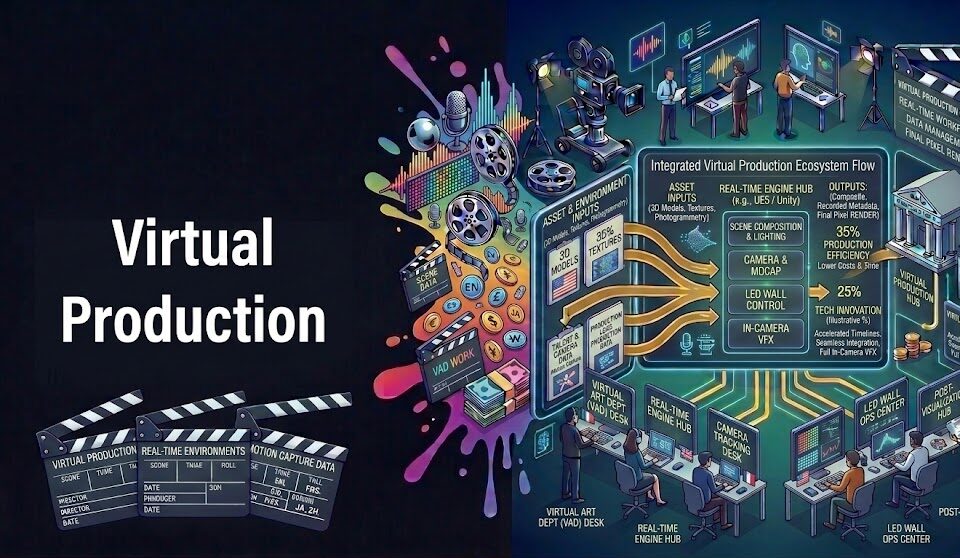
There’s a conversation happening in production offices across Los Angeles, London, Seoul, and Riyadh that didn’t exist five years ago—and it’s not about which location to scout. It’s about whether you need a location at all.
Virtual production powered by LED volume stages is no longer the exclusive territory of Disney and ILM. It’s a $3.7 billion market in 2026 growing at 16% annually, and it’s reshaping not just how films get made, but where the facilities capable of making them are being built. That’s a production strategy question, a capital allocation question, and increasingly—a competitive positioning question for every studio, producer, and line producer who touches a high-budget shoot.
But here’s what the market headlines don’t tell you: the most consequential shift isn’t the technology itself. It’s the geography. LED volume stages are being built at sovereign content hubs in Saudi Arabia, Abu Dhabi, South Korea, and India as foundational infrastructure—not retrofitted into legacy studio lots. New Sovereign Content Hubs are leapfrogging Hollywood’s infrastructure constraints by adopting virtual production technology from day one. And that means producers who’ve been treating virtual production as a Hollywood-specific workflow option are making decisions on incomplete information about where their production can actually go.
This guide covers the technology state of play in 2026, the cost dynamics that are finally making LED volume stages viable for mid-budget productions, the geographic distribution of stage capacity, and what it all means for producers sourcing facilities in a market that’s moving faster than most trades can track.
Table of Contents
- The Market Reality: Virtual Production Hits $3.7 Billion in 2026
- What LED Volume Stages Actually Are — and Why They Beat Green Screen
- The Cost Equation: Why Mid-Budget Productions Are Finally Adopting ICVFX
- The Geography Shift: Where LED Volumes Are Being Built Right Now
- Sovereign Content Hubs Are Leapfrogging Legacy Infrastructure
- The Fragmentation Paradox in Virtual Production Facility Sourcing
- Real-Time Engines, AI, and What’s Coming Next in LED Volume Technology
- What This Means for Producers and Production Companies Right Now
- How to Source and Vet Virtual Production Facilities in 2026
- FAQ
- Conclusion
Find Verified Virtual Production Facilities Before Your Shoot Window Closes
Netflix, Warner Bros, and Paramount use Vitrina to track 300,000+ companies across the global entertainment supply chain — including LED volume stages, virtual production studios, and ICVFX vendors worldwide. Ask VIQI to surface verified facilities matched to your project’s budget, timeline, and geography.
✔ Free to explore | ✔ No credit card needed | ✔ Real-time facility intelligence
The Market Reality: Virtual Production Hits $3.7 Billion in 2026
The numbers have reached a point where no one can call this a niche. The virtual production market is valued at approximately $3.67 billion in 2026, growing from $3.16 billion in 2025, with projections showing $7.75 billion by 2031 at a 16.12% CAGR. Put that alongside SNS Insider’s reading of $3.70 billion in 2025, expected to reach $16.71 billion by 2035 at a 16.29% CAGR — different methodologies, same directional signal. This is a market that’s doubling roughly every four to five years, and the fastest-growing segment within it isn’t software or motion capture. It’s the hardware category that’s driving everything else.
LED volume stages are expanding at a 31.48% CAGR — the single fastest-growing segment in the virtual production market — and are expected to surpass chromakey (green screen) stages as the dominant production format before 2031. That’s a fundamental infrastructure replacement, not an incremental upgrade. And it’s happening faster than the facility build-out many markets anticipated.
The television segment is expected to grow at the fastest application CAGR of over 21% from 2026 to 2031. Not film — episodic TV and streaming series. Which makes perfect sense when you think about it: the economics of LED volume production compress most sharply for high-volume episodic content where you’re shooting the same environments across 8-10 episodes and the traditional cost of location shoots compounds weekly. Netflix, Amazon Prime, and Apple TV+ have been the most aggressive institutional adopters precisely because their slate volumes make the upfront infrastructure cost ROI-positive faster than a single theatrical feature would.
The state of virtual production market forces in 2024 and beyond reveals that the supply chain pressure points have shifted too. It’s no longer “can we access a facility?” — it’s “can we access the right facility for our budget, timeline, and location requirements, with crew who know how to work in it?” That’s a sourcing intelligence question. And it’s where producers are losing time and money in 2026.

Your AI Assistant, Agent, and Analyst for the Business of Entertainment
VIQI AI helps you plan content acquisitions, raise production financing, and find and connect with the right partners worldwide.
- List the top commissioners at the BBC
- List the post-production and VFX decision-makers at Netflix
- List the development leaders at Sony Pictures
- List the scripted programming heads at HBO
- Find active co-producers and financiers for scripted projects
- Find equity and gap financing companies in North America
- Find top film financiers in Europe
- Find production houses that can co-produce or finance unscripted series
- Who is backing animation projects in Europe right now
- Who is Netflix’s top production partners for Sports Docs
- Who is Commissioning factual content in the NORDICS
- Who is acquiring unscripted formats for the North American market
- Show me recent drama projects available for pre-buy
- Show me Japanese Anime Distributors
- Show me true-crime buyers from Asia
- Show me documentary pre-buyers
- I am looking for production partners for a YA drama set in Brazil
- I am looking for producers with proven track record in mid-budget features
- I am looking for Turkish distributors with successful international sales
- I am looking for OTT platforms actively acquiring finished series for the LATAM region
- I am seeking localization companies offer subtitling services in multiple Asian languages
- I am seeking partners in animation production for children's content
- I am seeking USA based post-production companies with sound facilities
- I am seeking VFX partners to composite background images and AI generated content
What LED Volume Stages Actually Are — and Why They Beat Green Screen
Let’s be precise about the technology, because the term “virtual production” has become a catch-all that covers everything from previsualization software to motion capture to full LED volume shoots. For the purposes of understanding where production decisions are actually shifting, the relevant innovation is in-camera visual effects (ICVFX) — and the LED volume is what makes it possible at production quality.
An LED volume is a curved or cylindrical wall of high-resolution LED panels, typically surrounding a practical set on three sides (and often overhead), onto which photorealistic digital environments are rendered in real time via a game engine — almost universally Epic Games’ Unreal Engine, which has become the de facto industry standard for real-time rendering. The result is that what appears behind, above, and around the actors isn’t a green screen that compositors will replace in post — it’s a live, interactive environment that responds to camera movement, changes with lighting conditions, and reflects correctly on physical surfaces and performers’ faces. Directors can see final-quality images through the lens on set. DPs can light the scene using the LED wall as a practical light source. Editors work with material that’s essentially picture-locked on key visual elements before the first cut.
Green screen doesn’t do any of that. And the workflow differences compound across a production: LED volume reduces post-production VFX work on environmental shots by 40-70% compared to greenscreen workflows — that’s not an efficiency improvement, it’s a budget line transformation. You’re moving spend from post (which happens after principal photography, often when budgets are already stressed) to pre-production and production (where you can control it). CFOs who’ve worked through a post-VFX cost overrun understand exactly why this matters.
The average cost per square metre for 1.5mm-pitch panels manufactured in Shenzhen has fallen by double digits since 2023, bringing total stage-rental rates down for mid-budget shoots — widening the addressable customer base to independent filmmakers and regional broadcasters that previously relied on chromakey. The technology isn’t just better. It’s becoming affordable. And that changes the competitive calculus for every production that previously dismissed LED volume as “for the big studios.”
James Blevins — Hollywood insider and HPA-NET committee member — discusses the real-world adoption of virtual production in TV commercials and the technology developments reshaping the industry from the ground up:
The Cost Equation: Why Mid-Budget Productions Are Finally Adopting ICVFX
Here’s the honest version of the cost story, because the industry marketing around virtual production has created an impression that LED volume is still premium-tier infrastructure for tentpole productions. That was true in 2021. It’s not the full picture in 2026.
The capital cost of building a new LED volume stage has come down substantially. Panel costs — the most expensive hardware component — have dropped roughly 30-40% since 2019 as Chinese manufacturers including ROE Visual, INFiLED, and Leyard Optoelectronic scaled production and competition in the display manufacturing market intensified. A mid-range LED volume with 1.5mm pixel pitch panels, appropriate for broadcast and streaming-quality ICVFX work, can now be built for $1-3 million depending on size, versus the $5-10 million range that characterized first-generation installations. Stage rental rates have followed: major LED volume stage day rates in 2026 range from $15,000 to $80,000 depending on size, location, and included services — with smaller regional stages offering significantly lower access points than the marquee facilities in LA and London.
But rental rate isn’t the real number to focus on. The total production cost equation is. A $5 million drama that would have required 12 days of location shooting in three countries — with the associated travel, accommodation, location fees, and weather contingency — can now compress that to a fraction of the location spend by replacing 60-70% of those environments with LED volume shoots. Productions report overall budget savings of 15-25% when shifting location-heavy sequences to LED volume. That’s not a small number on a $5-15 million independent or streaming drama.
Then there’s the schedule compression. Location shoots in complex environments — international cities, historical periods, extreme weather scenarios — carry inherent scheduling risk. LED volumes don’t have weather delays. They don’t require permits. They don’t put your cast on a transatlantic flight 48 hours before a critical shoot day. For series production where one delayed shooting block can cascade through an entire season delivery schedule, that schedule reliability has real dollar value. Understanding how cloud-based VFX workflow vendors integrate with LED volume production is now a line-producer-level competency, not just a VFX supervisor conversation.
Discover Verified LED Volume Stages and ICVFX Vendors Worldwide
Trusted by Netflix, Warner Bros, and Paramount. Join 300,000+ companies using Vitrina to find and vet virtual production facilities — with verified credits, project history, and current capacity data across 195 countries.
✔ 200 free credits | ✔ No credit card required | ✔ 159,223 projects tracked
The Geography Shift: Where LED Volumes Are Being Built Right Now
If you’re still mentally mapping “virtual production” to “Hollywood,” you’re working from outdated intelligence. The global distribution of LED volume stage infrastructure in 2026 looks nothing like it did in 2022 — and the pace of build-out outside North America is accelerating significantly.
North America maintained a 40.55% share of the virtual production market in 2025, while Asia-Pacific is on track for a 19.05% CAGR through 2031 — making it the fastest-growing region for virtual production infrastructure investment by a significant margin. The UK remains the second-largest European market. But the absolute growth volumes are now coming from APAC and MENA, where new facility investment is being made against blank slates rather than retrofitted into legacy infrastructure.
China moved aggressively. In July 2023, Wuxi Studios introduced China’s largest LED volume for film production, utilizing Brompton Technology processing — a significant technical benchmark for what the Chinese domestic market is now capable of delivering. South Korea, already the source of global content hits, has been systematically building out virtual production capacity aligned with the Hallyu Wave’s international ambitions. Japan’s Toho and NHK have invested in LED volume stages integrated with the country’s established anime and live-action pipelines.
Europe has seen incentive-driven facility investment in the UK, Ireland, and Germany — where generous tax credits (the UK’s AVEC at 40% on qualifying VFX spend, including virtual production) have catalyzed private investment in LED stage infrastructure alongside government support. As Screen International has tracked, the European virtual production cluster is now genuinely competitive with North America for episodic and mid-budget feature work — particularly when you combine facility quality with incentive stacking.
And then there’s the MENA story — which deserves its own section, because what’s happening there isn’t incremental build-out. It’s an infrastructure leap.
Sovereign Content Hubs Are Leapfrogging Legacy Infrastructure
One of the clearest expressions of the Sovereign Content Hub advantage — the tectonic shift of production capital from the Hollywood/UK axis to government-backed regional powerhouses — is virtual production infrastructure. New hubs aren’t inheriting legacy studio lots with 1970s-era soundstages that need expensive conversion. They’re building from scratch, and when you build from scratch in 2025-2026, you build LED volumes in.
Saudi Arabia’s NEOM Media Hub includes a 1,200 square metre virtual production stage — purpose-built and integrated into a 6-soundstage facility complex that also houses post-production, VFX, and accommodation for 350-750 production crew. Film AlUla — built at the UNESCO World Heritage site that’s become one of the most visually distinctive production locations in the world — operates two major soundstages at 2,400 square metres each with a 4-square-kilometre backlot and partnership structures that combine incentive-stacked financing with virtual production capability. Since 2023, Film AlUla has hosted over 1,500 production days. Saudi Arabia has invested over $4 billion in film-specific infrastructure as part of Vision 2030’s $71.2 billion entertainment sector commitment — and virtual production is explicitly embedded in those facility specs rather than added as an afterthought.
Abu Dhabi, offering up to a 50% cash rebate — among the highest globally — has built world-class production facilities where LED volume capability is table stakes for attracting international productions. The UAE free zone structure (0% taxation for 50 years for qualifying projects) combined with physical infrastructure that includes virtual production stages creates a compelling capital stack for international co-productions that want to access MENA incentives without compromising production capability.
The strategic implication here isn’t just “there are now more LED stages available globally.” It’s that the incentive stacking opportunity for productions that incorporate virtual production is now genuinely international. A production that needs desert environments — which would historically mean location shoots in Morocco, Namibia, or Jordan with all the associated cost and logistics — can now shoot those environments on a Saudi LED volume stage, access a 40% cash rebate, and deliver results that are visually indistinguishable from on-location work. That’s not a technology pitch; it’s a production finance argument.
“New hubs adopt latest technology immediately. There are no legacy infrastructure constraints — which means virtual production from day one. That’s a competitive advantage over studios that are trying to retrofit a 60-year-old facility.
— Vitrina Strategic Intelligence, KB_INDUSTRY_SOVEREIGN_HUBS
The Fragmentation Paradox in Virtual Production Facility Sourcing
The Fragmentation Paradox — the counterintuitive situation where an abundance of suppliers creates a scarcity of actionable intelligence — is hitting virtual production facility sourcing hard right now. And it’s costing productions real money.
There are now hundreds of LED volume stages operational globally, from the 4,000-square-foot flagship facilities in LA and London down to regional installations in Eastern Europe, Southeast Asia, and MENA. But the information about their actual capabilities, current availability, verified past credits, technical specifications, and pricing benchmarks is almost nowhere consistently aggregated. A producer trying to source the right LED volume for a specific shoot — the right pixel pitch for the required shot sizes, the right rendering hardware for the environment complexity, a facility with crew experienced in the specific content type — is facing the same manual research process that VFX sourcing has always required: ask your network, get three referrals that may or may not reflect current market reality, spend weeks on capability calls before you know if the shortlist is actually right.
That process costs 3-6 weeks of pre-production time minimum, and it introduces the same 15-20% margin leakage risk through information asymmetry that the broader supply chain fragmentation creates. A facility that quotes $40,000 per day for an LED volume shoot when the market rate for comparable capability and specifications is $28,000 — and you have no benchmark to challenge it — is the Fragmentation Paradox in direct action. The 600,000+ companies in the global film/TV supply chain now include a rapidly growing population of virtual production facilities, and the information opacity hasn’t kept pace with the infrastructure expansion. Our analysis of VFX and virtual production services capacity maps where current demand is outpacing verified supply intelligence across key markets.
The producers winning at virtual production facility sourcing in 2026 aren’t winning because they have better relationships — they’re winning because they have better data. Verified facility track records, pricing benchmarks, technical specification databases, and current availability intelligence that compress the sourcing timeline from weeks to days. That’s the Insider Advantage, and it’s accessible to any producer willing to use Vitrina’s virtual production intelligence rather than relationship networks alone.
Real-Time Engines, AI, and What’s Coming Next in LED Volume Technology
John Kilshaw, Creative Director and VFX Supervisor at Framestore, has worked extensively with Netflix on episodic productions including One Piece and Avatar: The Last Airbender — shows that represent the frontier of how virtual production integrates with large-scale VFX pipelines. The workflow intelligence from that level of episodic complexity is filtering through to the broader market in ways that are meaningfully changing what producers can expect from LED volume stages in 2026 versus 2022. Read the full perspective from Framestore’s John Kilshaw on the modern VFX landscape.
The technology curve has three distinct vectors in 2026. First is the AI integration with real-time rendering engines. Generative AI toolsets embedded in real-time engines are removing days from previsualization by auto-populating parallax-correct backgrounds, fog volumes, and surface textures. What used to take a virtual art department weeks to build — a photorealistic digital environment detailed enough to hold up under principal photography — can now be generated and iterated in days. That compression changes the pre-production schedule and reduces the technical preparation cost that has historically made LED volume inaccessible for lower-budget productions.
Second is the hardware quality leap driven by microLED panels and higher-brightness displays. The persistent limitation of first-generation LED volumes — performance degradation in high-contrast daylight scenes, moiré patterns, viewing angle restrictions — is being addressed by manufacturers investing in microLED technology and improved panel architecture. Innovations in microLED and high-brightness panels are improving performance in challenging shooting conditions, though costs remain higher than standard LED panels at this stage. The trajectory is clear: higher fidelity at lower cost, with hybrid workflows bridging the gap until the next hardware generation commoditizes.
Third is the cloud workflow integration that Leon Silverman — founder of the Hollywood Post Alliance (HPA), former Disney and Netflix executive, and Chair at MovieLabs — has been articulating through the MovieLabs 2030 Vision. The vision of cloud-native production where real-time collaboration, Zero Trust security infrastructure, and AI-assisted creative tools are standard features rather than experimental add-ons is directly relevant to how LED volume production connects to the broader post pipeline. Virtual production generates enormous data volumes — high-resolution plate photography, tracked camera data, real-time environment captures — and the ability to pipe that into cloud-based editorial and VFX workflows in near-real-time is what makes the “finished picture on set” promise genuinely deliverable at scale.
What This Means for Producers and Production Companies Right Now
Let’s make this operational. If you’re a producer or production executive making decisions today, what does the LED volume stage landscape in 2026 actually mean for how you structure a production?
First: Virtual production is now a financing conversation, not just a creative one. The combination of LED volume capability at sovereign hubs with 40-50% cash rebates changes the capital stack calculus for any production with significant environmental VFX requirements. A production that can replace $3 million in international location costs with $1.2 million in LED volume shoot time at a facility that qualifies for a 40% rebate is effectively generating gap financing through production efficiency. That’s a CFO-level argument, and it belongs in the pitch deck, not just the production design meeting.
Second: The crew question is real and needs to be planned early. A shortage of skilled LED-volume operators and a lack of unified technical standards are the two most significant restraints on sector expansion. The facilities exist in more markets than ever — the crew who know how to work efficiently in them don’t yet exist in proportional numbers everywhere. If you’re shooting at a newer LED volume facility in a market that’s just stood up the infrastructure, budget for senior technical crew travel from established markets while local talent develops. Don’t assume facility availability means crew availability.
Third: Pre-production lead time for virtual production is longer than traditional shoots in specific ways. Virtual art department work — building the digital environments that will live on the LED wall — needs to begin 8-12 weeks before photography, significantly earlier than traditional production design workflows. But it’s parallelizable with other pre-production tracks in ways that physical location prep isn’t. A production that plans correctly can actually compress total pre-production time by running virtual art department prep in parallel with other pre-production activity. Productions that discover this reality 4 weeks out are the ones that end up over-schedule and over-budget.
Duncan McWilliam, founder and CEO of Outpost VFX, has been consistently direct about the macroeconomic shifts hitting the entertainment supply chain — AI, industry transformation, and the structural changes that distinguish the vendors adapting successfully from those being left behind. Virtual production facility integration into the broader VFX pipeline is exactly the kind of supply chain efficiency that separates competitive production companies from those still treating post-VFX as a separate, sequential workflow. The producers who’ve internalized that distinction are building better budgets, closing faster, and delivering with fewer surprises.
Accelerate Your Virtual Production Facility Search With Verified Global Intelligence
Join 140,000+ companies — including Netflix, Warner Bros, and Paramount — who use Vitrina to discover and vet virtual production facilities, LED volume stages, and ICVFX vendors with verified credits and real project history. Get full platform access with 200 free credits today.
✔ 200 free credits | ✔ No credit card required | ✔ 159,223 projects tracked
Track Virtual Production Vendors Now
Need direct facility introductions for a complex shoot? Explore Concierge Service →
How to Source and Vet Virtual Production Facilities in 2026
The production that sources its LED volume facility well is the one that starts asking the right questions 12-16 weeks out — not 4 weeks out when you’ve already locked other production elements around assumptions that may not be accurate. Here’s what the due diligence checklist should actually cover.
Technical specification verification is non-negotiable. LED panel pixel pitch (the distance between LED elements, measured in millimetres — lower is higher resolution) is the primary quality indicator for ICVFX work. At typical camera-to-wall distances for film and drama production, 1.5mm pitch panels are the current quality standard for work that needs to hold up in 4K. Older facilities running 2.5mm or 3mm pitch panels can produce acceptable results for backgrounds that stay in soft focus, but won’t deliver in close-up-heavy dramatic work. Ask the facility: what’s the pixel pitch, what’s the maximum brightness (measured in nits), and what rendering hardware is driving the wall in real time? These aren’t hostile questions; a facility confident in its capability will answer them immediately.
Verified project history in your content category matters more than raw facility specs. A facility that’s shot 200 hours of advertising content has a very different production crew culture and problem-solving capability than one that’s done episodic drama for a streaming platform. Ask for verified credits — not a showreel that may be curated to include work the facility serviced alongside a primary vendor — and specifically ask about the content type and budget range of productions they’ve worked. Through Vitrina, you can surface verified project histories across 159,223 tracked productions, meaning you’re not relying solely on what facilities choose to self-disclose.
Crew capability and availability is the third check, and it’s the one most commonly skipped. A shortage of skilled LED-volume operators is one of the two most significant restraints on sector expansion. For facilities in markets where virtual production infrastructure is newer — MENA, Southeast Asia, Eastern Europe — ask specifically: do you have resident technical crew who’ve done [X number] of production days on the stage, or are you relying on bringing crew in from other markets? If the answer involves flying in specialists, that cost belongs in your budget, and that availability needs to be locked before you commit to shooting dates.
Incentive compatibility requires legal verification before location lock. The 40-50% rebates available at sovereign hub facilities sound attractive — and they are — but qualifying spend definitions, local workforce requirements, cultural approval processes, and minimum production thresholds vary significantly between programmes. Get legal verification on whether your specific production qualifies and what the actual net benefit is after compliance costs, before building the facility choice into your financing structure. As Variety has covered extensively, the gap between incentive headline rates and what productions actually receive after qualification requirements is one of the most common sources of budget variance on international productions.
Frequently Asked Questions
What is virtual production and how do LED volume stages work?
Virtual production combines physical filmmaking with real-time digital technology to create immersive environments during principal photography rather than in post-production. An LED volume stage consists of curved or cylindrical high-resolution LED panel walls surrounding a practical set, onto which photorealistic digital environments are rendered live via real-time engines like Unreal Engine. Cameras capture what’s on the LED wall as a genuine lighting and environment source — not a placeholder for compositors to replace — enabling in-camera visual effects (ICVFX) that look final through the lens during the shoot. This eliminates the majority of traditional greenscreen compositing work in post-production and creates interactive lighting that responds correctly to physical performers and props.
How large is the virtual production market in 2026?
The virtual production market is valued at approximately $3.67-$4.37 billion in 2026 depending on methodology, with projections ranging from $7.75 billion by 2031 (Mordor Intelligence at 16.12% CAGR) to $16.71 billion by 2035 (SNS Insider at 16.29% CAGR). The LED volume segment specifically is the fastest-growing component, expanding at a 31.48% CAGR and expected to surpass traditional chromakey stages as the dominant virtual production format before 2031. North America holds approximately 35-40% market share; Asia-Pacific is the fastest-growing region at 17-19% CAGR through 2031.
How much does it cost to shoot on an LED volume stage in 2026?
LED volume stage day rates in 2026 typically range from $15,000 to $80,000 depending on stage size, panel quality, location, and included services — substantially down from first-generation installations. LED panel hardware costs have fallen approximately 30-40% since 2019 as manufacturing scale increased. For productions replacing location shoots, overall budget savings of 15-25% are commonly reported when shifting location-heavy sequences to LED volume work. The full cost equation includes not just rental rates but the cost of virtual art department pre-production (which begins 8-12 weeks before photography), rendering hardware, technical crew, and any data pipeline integration for post-production workflows.
What are LED volume stages being used for beyond Hollywood tentpoles?
LED volume stages are now used across episodic streaming drama (the fastest-growing segment at 21%+ CAGR), broadcast television, TV commercials and advertising (where adoption has been particularly aggressive for the ability to shoot multiple environments in a single studio day), corporate video production, live events, and documentary content requiring period or location environments that would be prohibitively expensive to reproduce practically. Independent filmmakers and regional broadcasters are increasingly accessing mid-range facilities as hardware costs and rental rates continue to fall. The dropping cost threshold is the key driver: stages that required $10 million productions to justify in 2020 are now viable for $2-5 million productions in 2026.
Which regions have the most significant virtual production infrastructure in 2026?
North America (led by Los Angeles) and the UK remain the largest established markets by facility count and cumulative production experience. But the most significant infrastructure growth is occurring in Asia-Pacific — China (Wuxi Studios hosts China’s largest LED volume), South Korea, Japan, and Australia — and in MENA, where Saudi Arabia’s NEOM Media Hub (1,200 sq m virtual production stage) and Film AlUla represent purpose-built sovereign hub facilities with LED volumes integrated from day one. The EU market, led by the UK, Ireland, and Germany, has seen incentive-driven investment where 40% VFX tax credits directly subsidize virtual production facility development. New Zealand’s screen incentives have similarly catalyzed LED volume investment to complement its established location production infrastructure.
What is the difference between LED volume virtual production and green screen?
Green screen (chromakey) replaces a coloured background in post-production, meaning the final environment is created by compositors after principal photography is complete — requiring significant VFX work and creating uncertainty for directors and DPs about the final image during shooting. LED volume production renders the environment live in real time during shooting, making it a genuine lighting source and interactive backdrop that directors see through the lens. This eliminates most environmental compositing work, enables accurate physical lighting from the LED wall, allows real-time environment adjustments during the shoot, and compresses post-production VFX timelines by 40-70% on environmental shots. LED volumes currently have performance limitations in very high-contrast lighting and require significantly more pre-production preparation than greenscreen workflows.
What are the main challenges of virtual production with LED volumes?
The primary challenges in 2026 are: (1) skilled crew shortage — experienced LED-volume operators, virtual art department leads, and on-set real-time engine technicians are in supply-constrained demand globally, particularly outside established markets; (2) extended pre-production lead time — virtual art department work begins 8-12 weeks before photography; (3) high-contrast scene limitations — daylight and bright exterior environments still challenge current LED panel brightness and contrast ratios, often requiring hybrid LED-plus-CGI approaches; (4) lack of unified technical standards across facilities, creating compatibility friction when moving between stages or integrating with specific VFX pipelines; and (5) upfront capital cost relative to greenscreen, which still disadvantages LED volumes for productions with very tight shoot schedules where pre-production compression is critical.
How do sovereign content hub incentives interact with virtual production decisions?
Sovereign content hub incentives — 40% cash rebate in Saudi Arabia, up to 50% in Abu Dhabi, 40% AVEC in the UK on qualifying VFX spend — can directly subsidize LED volume production costs when productions qualify under the relevant programme. This creates a capital stack benefit: a production that can replace $3M in international location costs with LED volume shoots at a facility qualifying for a 40% rebate is effectively generating soft money through production efficiency. The key caveat is that qualifying spend definitions vary significantly between programmes, and local workforce requirements, minimum spend thresholds, and cultural approval processes must be verified legally before building incentive assumptions into a financing structure.
Conclusion: Virtual Production Is a Location Decision, a Financing Decision, and a Supply Chain Decision
The conversation about virtual production in 2026 has matured past “should we use LED volumes?” into something more operationally interesting: “which facility, in which market, with which incentive structure, with crew experienced enough to deliver on our specific production requirements?” That’s the question that separates productions making smart strategic decisions from those discovering mid-shoot that their assumptions didn’t survive contact with reality.
The market data is clear. LED volumes are the fastest-growing segment in a $3.7 billion market growing at 16% annually. They’re being built at sovereign hubs in MENA and APAC that combine cutting-edge infrastructure with incentive regimes that reframe the cost calculus for productions with significant environmental requirements. And the Fragmentation Paradox is at work in facility sourcing — more options, less verified intelligence, real cost to the producers who don’t solve it before they lock location.
Key Takeaways:
- The virtual production market is $3.7B in 2026 at 16% CAGR, with LED volume stages growing at 31.48% — the fastest-expanding segment, on track to surpass green screen as the dominant format before 2031.
- LED panel costs have dropped 30-40% since 2019, making ICVFX viable for productions in the $2-5M range that previously couldn’t justify the infrastructure investment.
- Sovereign Content Hubs are the biggest geography story: Saudi Arabia, Abu Dhabi, South Korea, and India are building LED volumes as foundational infrastructure — no legacy constraints, full incentive stacking.
- Skilled crew remains the binding constraint in newer markets. Facility availability ≠ crew availability. Budget for technical crew development or senior crew travel in markets where virtual production infrastructure is newer than the talent pipeline.
- Pre-production planning is longer and earlier — virtual art department work starts 8-12 weeks before photography. Productions that discover this at week 4 pay for it in schedule and budget.
- The sourcing intelligence gap is real and costly. Verified facility data — pixel pitch, rendering hardware, verified credits, current availability, pricing benchmarks — compresses the sourcing process from weeks to days and protects against the 15-20% margin leakage that information asymmetry creates.
Build Your Virtual Production Strategy With Verified Global Facility Intelligence
Netflix, Warner Bros, and Paramount use Vitrina to track 1.6 million+ projects and 300,000+ companies across the entertainment supply chain — including LED volume stages, virtual production studios, and ICVFX vendors worldwide. Get full platform access with 200 free credits. No credit card, no commitment.
✔ 200 free credits | ✔ No credit card required | ✔ Cancel anytime