About Innovation Hub
 Global Content Pulse (Webinars)


 Global Production Financing
(Webinars)
Global Production Financing
(Webinars)  LeaderSpeak Podcast
  Global Entertainment Digest (Newsletter)
  About Vitrina
 About VIQI
 Our Story
 Our Solutions 🔥
 Film+TV Projects Tracker 🚀
 Case Studies
 Our Profile
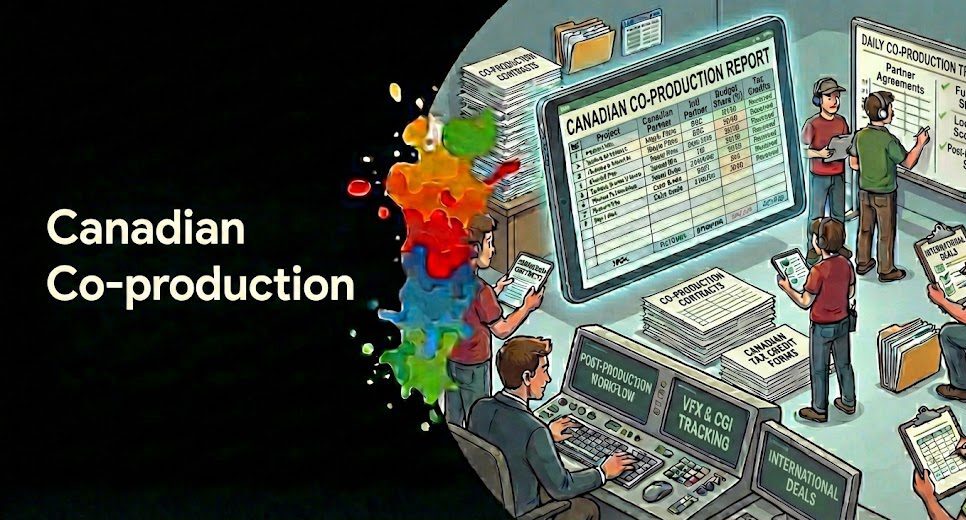
If you’re sourcing a top production house in Canada, you’re already looking in the right place. Canada isn’t just a tax credit destination—it’s a genuine content powerhouse with 60+ active official co-productions annually worth over $500M CAD, bilateral treaties with more than 60 countries, and a provincial incentive stack that routinely hits 25–40% of qualified spend. That’s a capital stack most territories can’t touch.
But here’s the thing: identifying which Canadian production house actually fits your project—your genre, your budget tier, your co-production structure—that’s where producers get stuck. The Fragmentation Paradox hits hard in Canada too. With 140,000+ active film and TV suppliers globally and hundreds of Canadian-based production entities, you can’t just Google your way to the right partner.
This guide cuts through the noise. Below you’ll find the 10 Canadian production houses most relevant to international buyers, co-production partners, and service providers looking to tap into the Canadian market—with the intelligence on each that actually matters before you pick up the phone.
Find Verified Canadian Production Partners in 48 Hours
Trusted by Netflix, Warner Bros, and Paramount. Join 140,000+ companies using Vitrina to discover verified production capabilities across Canada and 195 countries.
✔ 200 free credits | ✔ No credit card required | ✔ Real-time project tracking
Why Canada Dominates the Global Co-Production Map
Canada’s production infrastructure didn’t happen by accident. Decades of CAVCO certification, Telefilm Canada funding, and a provincial credit system that stacks federal and regional incentives have created something rare: a country where a UK or Australian producer can structure a legitimate bilateral co-production, claim national status in both territories, and walk away with recoupment timelines that actually hold.
British Columbia offers up to 33–35% refundable labor credits. Ontario runs 21.5–40% depending on project type. Quebec’s foreign production rebate reaches 36–40%—with Montreal increasingly attractive for post and animation. And on top of all that, Canada’s federal production tax credit adds another 25% on qualified Canadian content expenditure. Stack those correctly and you’re de-risking your capital stack before you’ve sold a single territory.
But incentives are only half the story. Canada’s talent pool—particularly in VFX, animation, and high-end drama—has been shaped by decades of major studio service work. As Variety has noted repeatedly, productions ranging from superhero franchises to prestige drama series consistently route through Vancouver and Toronto not just for credits, but for crew depth and infrastructure that rivals any production market globally. You don’t need to take anyone’s word for it—the output speaks for itself.

Your AI Assistant, Agent, and Analyst for the Business of Entertainment
VIQI AI helps you plan content acquisitions, raise production financing, and find and connect with the right partners worldwide.
- Find active co-producers and financiers for scripted projects
- Find equity and gap financing companies in North America
- Find top film financiers in Europe
- Find production houses that can co-produce or finance unscripted series
- I am looking for production partners for a YA drama set in Brazil
- I am looking for producers with proven track record in mid-budget features
- I am looking for Turkish distributors with successful international sales
- I am looking for OTT platforms actively acquiring finished series for the LATAM region
- I am seeking localization companies offer subtitling services in multiple Asian languages
- I am seeking partners in animation production for children's content
- I am seeking USA based post-production companies with sound facilities
- I am seeking VFX partners to composite background images and AI generated content
- Show me recent drama projects available for pre-buy
- Show me Japanese Anime Distributors
- Show me true-crime buyers from Asia
- Show me documentary pre-buyers
- List the top commissioners at the BBC
- List the post-production and VFX decision-makers at Netflix
- List the development leaders at Sony Pictures
- List the scripted programming heads at HBO
- Who is backing animation projects in Europe right now
- Who is Netflix’s top production partners for Sports Docs
- Who is Commissioning factual content in the NORDICS
- Who is acquiring unscripted formats for the North American market
How We Selected These 10 Production Houses
This list isn’t a vanity ranking. Each company was evaluated on four criteria that actually matter to international buyers and co-producers: verified co-production track record, genre depth and creative range, financial structuring capability, and—critically—their history of working across treaty territories. CAVCO certification alone doesn’t make a production house a serious co-production partner. Deal history does.
And here’s what most lists miss: 30% of the highest-value Canadian production opportunities right now sit with companies that aren’t household names. They’re mid-tier, regionally focused, and deeply experienced in specific genres or treaty corridors. That’s the Insider Advantage—knowing who to call before the project’s packaged, not after it hits the trades.
The 10 Top Production Houses in Canada for Global Entertainment Needs
1. Entertainment One (eOne) — Toronto
Verdict: The institutional anchor for major co-productions. Now operating under Hasbro’s ownership, eOne remains one of Canada’s most important production and distribution entities. Their hero projects—including the Peaky Blinders co-production and their extensive drama slate—signal a company that understands both the creative and financial architecture of major international deals. If your project needs institutional scale, North American distribution muscle, and a counterpart with relationships across Netflix, Amazon, and the major broadcasters, eOne is your first call. They’re not a fit for the indie tier—but for mid-to-high budget co-productions with US/UK angle, they’re in a class of their own.
2. WildBrain — Halifax / Vancouver
Verdict: The global standard for children’s animation co-production. WildBrain (formerly DHX Media) manages one of the world’s largest independent libraries of children’s content—over 13,000 half-hours—and operates production studios capable of handling full-season animation orders. Their Peanuts and Teletubbies management deals tell you everything about their IP pedigree. But what makes them genuinely strategic for international partners is their distribution network: WildBrain Spark reaches audiences directly, bypassing traditional broadcast gatekeepers. If you’re packaging animated content for global SVOD, they’re a must-evaluate partner—and their track record with the Canada-UK co-production treaty corridor is extensive.
3. Shaftesbury — Toronto
Verdict: Canada’s premium drama house for international buyers. Shaftesbury has built a thirty-year track record in high-quality drama and comedy series—Murdoch Mysteries being their flagship, now in its eighteenth season. That kind of longevity signals production reliability that’s rare. CEO Christina Jennings has been vocal about structured international partnerships, and the company has co-production history with UK and Australian broadcasters. Don’t let the domestic success fool you—Shaftesbury understands international licensing architecture and knows how to structure a deal that protects rights holders on both sides. Their sweet spot is scripted drama with broad appeal and strong female leads.
4. Boat Rocker Studios — Toronto
Verdict: The vertically integrated platform play. Boat Rocker is unusual in that it spans production, distribution, and brand management under one roof. Their animation arm, Jam Filled Entertainment, handles premium work for major streamers. Their scripted division has placed content with Netflix and Amazon. What makes them interesting for international co-producers is their hybrid model—they can act as creative partner, production services provider, or full co-producer depending on what you bring to the table. They’re one of the few Canadian companies genuinely thinking about content as a multi-territory IP play from day one of development.
5. Muse Entertainment — Montreal
Verdict: The co-production specialist that punches well above its weight. Muse is a Montreal-based production house with deep experience structuring official co-productions across the Canada-UK, Canada-Ireland, and Canada-France treaty corridors. They’ve produced content for CBC, CTV, Netflix, and multiple European broadcasters. Their value isn’t headline scale—it’s co-production intelligence. If you’re a European producer looking to access Canadian soft money and structure a project with CAVCO certification, Muse Entertainment is one of the most practical and experienced partners in the country. They know how to navigate the 4-week-before-principal-photography approval timeline and have the relationships at Telefilm Canada that matter.
6. Cineflix — Toronto / Montreal
Verdict: The factual and unscripted powerhouse for global format buyers. Cineflix is one of North America’s most prolific producers of factual entertainment, true crime, and lifestyle content—with over 6,000 hours of programming in active distribution. Their Rights division manages a significant catalog. For international format buyers, broadcasters seeking unscripted content, or co-production partners in the documentary/factual space, Cineflix offers industrial-scale output capability and a proven model for international licensing. They work across multiple Canadian provinces to optimize incentive access on a project-by-project basis—exactly the kind of financial discipline that keeps ROI intact across a multi-project slate.
Track Every Canadian Production House in Real Time
Stop relying on trade reports that are 6 months out of date. Vitrina gives you verified capability data on 140,000+ active suppliers — including who’s currently in production, what treaty corridors they’ve activated, and which projects are actively seeking co-production partners.
400,000+ projects tracked | 195 countries | Real-time intelligence
7. Cream Productions — Toronto
Verdict: The unscripted specialist with a serious international footprint. Cream Productions has built a reputation on high-quality documentary and factual series for History Channel, Smithsonian, National Geographic, and streaming platforms. They’re prolific—producing 20+ series annually—and their development team genuinely understands international buyer needs. For format rights holders looking to commission Canadian-qualified content, or for international streamers seeking reliable unscripted supply, Cream operates with the production discipline and broadcaster relationships that de-risk a commission. Their Canadian tax credit utilization is sophisticated, running federal and Ontario incentives simultaneously on most projects.
8. Omni Film Productions — Vancouver
Verdict: BC’s drama and documentary anchor for international treaty projects. Omni is one of Vancouver’s most established independent production houses, with a track record spanning drama series, feature documentaries, and children’s content. Their geographic positioning in British Columbia means they can access the province’s 35% labor tax credit—one of the highest provincial rates in Canada—on qualifying projects. For international partners specifically targeting the Canada-Australia or Canada-UK treaty corridor with projects requiring Pacific Northwest locations, Omni brings both creative credibility and local production infrastructure that typically takes years to build.
9. Buffalo Gal Pictures — Winnipeg
Verdict: Prairie-based, internationally connected, and consistently surprising. Don’t let the Winnipeg address fool you into underestimating Buffalo Gal Pictures. Producer Phyllis Laing has built a company with genuine international co-production depth—projects have screened at TIFF, Berlin, and Sundance, and their co-production partnerships span Europe and North America. Their niche is prestige independent drama and documentary with a distinct authorial voice. If your project has festival potential and you need a Canadian partner who understands the difference between a transactional co-production and a genuine creative collaboration, Buffalo Gal deserves serious consideration. Manitoba’s incentive structure, while less publicized than BC or Ontario, offers competitive terms for qualifying projects.
10. Sienna Films — Toronto
Verdict: The indie drama house with a track record above its market cap. Sienna Films has produced projects that consistently outperform expectations in the international marketplace—Indian Horse being their most notable feature, a film that found global distribution despite its domestic Canadian story. That’s the sign of a production house that understands how to package and position content for international buyers rather than just produce it for domestic broadcasters. For co-production partners seeking a Canadian counterpart with a strong creative instinct and a real understanding of how festival success translates into sales, Sienna represents the indie tier at its best.
As Andrea Scarso from IPR VC notes in discussions about co-production strategy, producers today need to think about co-production partnerships from day one of packaging—not as an afterthought once the budget is assembled. Canada’s treaty network with 60+ countries gives the right partner genuine structural advantages in building a capital stack. But you need a counterpart who’s done it before, not one who’s figuring it out on your project.
Canada’s Incentive Structure: What International Producers Actually Need to Know
Here’s the part of the Canada story that doesn’t get enough airtime: the incentive stack is genuinely powerful, but it’s not automatic. You need to structure your project correctly—from creative contributions to shooting location percentages—or you leave significant soft money unclaimed. Telefilm Canada administers official co-productions, and applications must be submitted at least 4 weeks before principal photography begins. That clock starts earlier than most producers expect.
The federal Canadian Film or Video Production Tax Credit (CPTC) runs at 25% of eligible Canadian labor. Stack British Columbia’s provincial credit and you’re looking at an effective combined rate that meaningfully changes your project’s recoupment trajectory. Quebec’s system for foreign productions offers up to 40% on eligible labor for animation and VFX work—which is why Montreal has become an animation hub rivaling any European alternative.
But beyond the percentages, Canada’s real structural value is what a verified official co-production unlocks: national film status in both territories. That means your project can access local broadcaster funding, content quotas, and distribution preferences in both Canada and your home country simultaneously. That’s not a marginal benefit—it fundamentally changes your financing optionality. As we explored in our guide to stacking incentives across two jurisdictions, this kind of dual-status structure is one of the most underutilized tools in independent film finance.
The Fragmentation Challenge: Why Finding the Right Partner Takes So Long
Here’s what most guides won’t tell you: even with a list like this one, you’re still looking at a significant research gap. Canada has hundreds of active production entities—and knowing which one has current capacity, has worked in your genre tier, and has actually closed a deal in your target treaty corridor requires real-time intelligence that a static list can’t provide.
The Fragmentation Paradox hits Canadian production sourcing hard. 600,000+ companies globally operate in opaque silos, and even within Canada, capability verification is typically relationship-dependent—meaning you’re working your festival contacts, not the actual market. That’s how you end up 3 months into conversations with a production house that can’t actually structure the co-production you need, while the right partner was accessible all along.
Per Screen International, Canadian co-production activity has grown steadily as international producers increasingly recognize the capital stack advantages. But accessing those advantages requires verified partner intelligence—not hope.
Vitrina resolves this by mapping 140,000+ active suppliers with verified capabilities, real-time project tracking, and the kind of deal history data that lets you evaluate a Canadian production house before you’ve sent a single email. That’s how you compress a 3-month partner search to 48 hours—and protect the 15–20% margin that opaque sourcing typically leaks. You can explore our deeper analysis on finding co-production partners with Vitrina’s project tracker to see exactly how this works in practice.
Phil Hunt (CEO, Head Gear Films) discusses why the independent film financing landscape has fundamentally shifted—and what that means for producers navigating international co-production structures like Canada’s treaty network:

How to Evaluate a Canadian Production Partner Before You Commit
Don’t just look at their credits page. Here’s what the Smart Pairing framework asks before entering any Canadian co-production conversation:
- Treaty corridor experience: Have they specifically closed a deal under the same bilateral treaty you need? Canada-UK and Canada-France have different application norms than Canada-Australia or Canada-India.
- Current Telefilm Canada relationship: Are they actively funded, or have they had a gap? Telefilm relationships signal development pipeline health.
- Provincial credit optimization: Do they understand how to structure split-province shoots to maximize the federal-plus-provincial incentive stack? Many companies leave money on the table here.
- Genre alignment: Their last 5 productions matter more than their entire catalog. Genre drift is real—a company that pivoted from drama to unscripted in 2022 isn’t your drama co-producer in 2026.
- Capacity right now: Are they in mid-production on something that consumes their key executives? Even the best partner is the wrong partner if they don’t have attention to give your project.
De-Risk Your Canadian Partner Search With Verified Intelligence
Vitrina’s concierge team has helped productions from Netflix, Google TV, and Paramount identify and verify production partners across treaty corridors. Get expert-guided intelligence—not a database search.
✔ Verified partner matching | ✔ Treaty corridor expertise | ✔ No commitment required
The Bottom Line on Canadian Production Houses
Canada offers something genuinely rare in global production: infrastructure depth, incentive generosity, creative talent, and the broadest bilateral co-production treaty network of any country on the planet. But the value is only as real as your ability to find and verify the right partner for your specific project—not just a name that shows up on a list.
The 10 production houses above represent the strongest starting points across the major genres and treaty corridors. But starting points are just that—starting points. The real Insider Advantage comes from knowing which of them has current capacity, which is actively seeking your type of co-production partner, and which has the Telefilm Canada relationships that will get your application processed without delays you can’t afford.
Key takeaways for international producers evaluating Canadian production houses:
- Incentive stacking is real: Federal 25% + provincial 21–40% creates one of the most competitive capital stacks globally—but only if structured correctly from day one.
- Treaty corridor matters more than geography: The right Canadian partner for a Canada-UK co-production may be very different from the right partner for a Canada-France or Canada-Australia structure.
- Capacity now beats reputation always: The best production house with no bandwidth for your project is worse than a lesser-known company that can give you full attention and executive focus.
- Verify before you call: Real-time intelligence on 140,000+ suppliers—including Canadian production houses—is available on Vitrina, compressing a months-long partner search to days.
- Telefilm Canada relationships are non-negotiable: For official co-productions, your Canadian partner’s relationship with the competent authority is as important as their creative track record.
Discover Canada’s Full Production Ecosystem—140,000+ Companies Verified
Join Netflix, Warner Bros, and 140,000+ entertainment companies using Vitrina to track projects, verify capabilities, and connect with production partners across Canada and 195 countries.
✔ 200 free credits | ✔ No credit card required | ✔ Full platform access from day one
Frequently Asked Questions: Production Houses in Canada
What makes a production house in Canada attractive for international co-productions?
Canada’s appeal for international co-productions combines three structural advantages: the largest bilateral co-production treaty network of any country (60+ countries), a stacked provincial-plus-federal incentive system reaching 25–40% of qualified spend, and deep production infrastructure in Vancouver, Toronto, and Montreal. A CAVCO-certified official co-production grants national film status in both Canada and your home territory—unlocking local broadcaster funding, content quota credits, and distribution advantages that can meaningfully change your capital stack and recoupment profile.
Which provinces offer the strongest production incentives in Canada?
British Columbia offers up to 33–35% refundable labor tax credits, making Vancouver one of North America’s most competitive production hubs. Ontario runs 21.5–40% depending on project type and Canadian content qualification—Toronto is particularly strong for drama and scripted. Quebec’s system offers 36–40% for foreign productions, with Montreal especially competitive for animation and VFX. All three stack with the federal 25% Canadian Film or Video Production Tax Credit for qualifying Canadian content projects.
How do I structure an official Canada co-production with a Canadian production house?
Official co-productions require a bilateral or multilateral treaty between Canada and your home country, administered by Telefilm Canada. Each partner must contribute financially and creatively in proportion to their ownership stake—typically a minimum 10–20% financial contribution per partner under bilateral frameworks. Applications must be submitted at least 4 weeks before principal photography begins. Working with a Canadian production house experienced in your specific treaty corridor (Canada-UK operates differently from Canada-France or Canada-Australia) is essential for ensuring approval and avoiding timeline delays.
What genres are Canadian production houses strongest in?
Canada has particular depth in animation (WildBrain, Nelvana, Boat Rocker), children’s content, unscripted and factual (Cineflix, Cream Productions), and prestige drama (Shaftesbury, eOne, Sienna Films). The VFX and post-production sector in Vancouver and Montreal is world-class, supporting major studio work from Disney, Warner Bros, and Netflix. Documentary production is strong in both English and French Canada. High-concept action, thriller, and horror also have a significant production base, particularly in BC, where the cost-to-production-value ratio is highly competitive.
How does Vitrina help identify verified Canadian production partners?
Vitrina maps 140,000+ active film and TV suppliers globally—including Canadian production houses—with verified capabilities, hero project histories, real-time capacity indicators, and deal flow intelligence. Instead of relying on festival relationships or trade directories, you can search by genre, budget tier, treaty corridor experience, and current project status. This compresses a typical 3–6 month partner search to days, while protecting against the 15–20% margin leakage that opaque sourcing typically creates. The platform starts with 200 free credits and requires no credit card to get started.
Can US producers access Canadian co-production treaty benefits?
No—the United States does not have a bilateral co-production treaty with Canada, so US producers cannot structure an official Canadian co-production that grants dual national status. US-Canada collaborations typically proceed as Production Service Agreements (PSAs), which provide access to Canadian crew, locations, and some incentive structures, but not the national film status benefits of an official treaty co-production. European, Australian, UK, and other treaty-country producers have full access to official co-production benefits when partnering with CAVCO-certified Canadian entities.
What questions should I ask a Canadian production house before committing to a co-production?
Beyond creative alignment, verify: their specific experience in your target treaty corridor (Canada-UK differs significantly from Canada-France in practice), their active Telefilm Canada relationship and recent certification history, whether they’ve successfully stacked provincial and federal credits on comparable projects, their current production capacity and key executive availability, and how many of their last five projects included international co-production structures versus domestic-only. A production house that sounds great on paper but can’t answer these questions in detail is not your right partner.
How long does Telefilm Canada co-production certification typically take?
The application must be submitted at least 4 weeks before principal photography begins, but experienced producers recommend submitting significantly earlier—6 to 8 weeks—to allow for queries, revisions, and provisional approval confirmation. Final certification comes after production completion. Your Canadian production house’s relationship with Telefilm Canada will directly affect how smoothly this process runs. Production houses with active, long-standing Telefilm relationships can navigate the process more efficiently than newer entrants or companies whose last co-production was several years ago.
Find Film+TV Projects, Partners, and Deals – Fast.
VIQI matches you with the right financiers, producers, streamers, and buyers – globally.
Join Industry Briefings Trusted by Leaders

Unreleased Film+TV Projects: Opportunities & Showcase
A curated view of unreleased Film and TV projects open for financing and collaboration

The Mid-Budget Comeback: Why Mid-Budget Films Is the Smartest Bet in the Room
Mid-budget films are attracting new capital. See why this segment is becoming one of the strongest bets in Film today.

Franchise Fatigue vs. IP Dependency: What Studios Should Be Betting On Now
s franchise performance softens, where will the next generation of valuable IP come from? Join the briefing.

Unscripted Is Eating the World: The Multi-Billion Reality and Format Boom
Unscripted is the new prestige — inside the $19.8B global format boom reshaping how streaming platforms compete.