About Innovation Hub
 Global Content Pulse (Webinars)


 Global Production Financing
(Webinars)
Global Production Financing
(Webinars)  LeaderSpeak Podcast
  Global Entertainment Digest (Newsletter)
  About Vitrina
 About VIQI
 Our Story
 Our Solutions 🔥
 Film+TV Projects Tracker 🚀
 Case Studies
 Our Profile

You can have the best content in the world and still deliver a terrible experience if your AV integration falls short. Audiences don’t forgive bad audio. Production teams don’t recover lost shoots caused by failing signal chains. And in 2026, as virtual production stages multiply, live broadcasting goes fully IP-native, and streaming delivery chains grow more complex by the quarter—the AV integration companies you partner with aren’t a line item. They’re infrastructure.
But here’s the thing most procurement guides won’t tell you: the top AV integration companies don’t all look the same anymore. Some are broadcast specialists. Some focus on studio build-outs. Others live in IP video transport, cloud signal routing, or immersive live event production. Finding the right partner means matching your specific workflow to a company that’s genuinely built for it—not just one that advertises broadly.
This guide covers what audio visual integration actually involves in 2026, which companies are leading different segments of the market, how to evaluate them intelligently, and how Vitrina’s platform helps entertainment professionals connect with verified AV vendors across 140,000+ companies worldwide.
In This Guide:
Find Verified AV Integration Companies for Your Production
Join 140,000+ companies—including Netflix, Warner Bros, and Paramount—already using Vitrina to source qualified AV and broadcast technology vendors across 400,000+ projects worldwide.
Ask VIQI, Vitrina’s AI, which AV integration vendors are active in your territory—right now.
No credit card required • 200 free credits • Instant answers
What AV Integration Actually Means in 2026
AV integration—or audio visual integration—refers to the design, installation, and management of systems that combine audio and visual technologies into cohesive, functional environments. In film and TV, that means everything from broadcast signal chains and studio monitoring systems to live event production rigs and IP video transport infrastructure.
But the definition has shifted significantly over the past five years. Traditional AV integration was largely a hardware discipline—cables, switchers, amplifiers, screens. In 2026, it’s a hybrid of hardware, software, networking, and cloud infrastructure. The lines between AV integrator and IT systems integrator are blurring fast.
What does that mean practically? Your AV integration partner now needs to understand:
- IP-based signal transport (SMPTE ST 2110, NDI, RIST, SRT protocols)
- Cloud and hybrid production workflows (cloud-native switching, remote production, REMI)
- Immersive and virtual production environments (LED volumes, real-time rendering, camera tracking)
- Live streaming and broadcast delivery (CDN integration, latency management, multi-platform output)
- Unified communications integration (remote collaboration, intercom, monitoring)
Production teams that treat AV integration as an afterthought—bolting vendors on after the workflow is designed—pay for it in reshoots, delivery failures, and tech debt that compounds across every subsequent project. The smart approach is to build AV infrastructure into the production architecture from day one.

Your AI Assistant, Agent, and Analyst for the Business of Entertainment
VIQI AI helps you plan content acquisitions, raise production financing, and find and connect with the right partners worldwide.
- Find active co-producers and financiers for scripted projects
- Find equity and gap financing companies in North America
- Find top film financiers in Europe
- Find production houses that can co-produce or finance unscripted series
- I am looking for production partners for a YA drama set in Brazil
- I am looking for producers with proven track record in mid-budget features
- I am looking for Turkish distributors with successful international sales
- I am looking for OTT platforms actively acquiring finished series for the LATAM region
- I am seeking localization companies offer subtitling services in multiple Asian languages
- I am seeking partners in animation production for children's content
- I am seeking USA based post-production companies with sound facilities
- I am seeking VFX partners to composite background images and AI generated content
- Show me recent drama projects available for pre-buy
- Show me Japanese Anime Distributors
- Show me true-crime buyers from Asia
- Show me documentary pre-buyers
- List the top commissioners at the BBC
- List the post-production and VFX decision-makers at Netflix
- List the development leaders at Sony Pictures
- List the scripted programming heads at HBO
- Who is backing animation projects in Europe right now
- Who is Netflix’s top production partners for Sports Docs
- Who is Commissioning factual content in the NORDICS
- Who is acquiring unscripted formats for the North American market
The AV Integration Market Landscape: What You’re Navigating
The global AV integration market is substantial—and growing. According to AVIXA, the AV industry association, the global AV market is projected to reach $426 billion by 2026, with professional AV integration driving a significant share. That’s not a niche category. That’s infrastructure at global scale.
But raw market size doesn’t tell you much about finding the right partner for a specific production context. Here’s how the landscape actually breaks down for entertainment professionals:
Tier 1: Global Mega-Integrators
Companies like AVI-SPL and Diversified operate at massive scale—thousands of employees, global offices, multi-market capabilities. They’re built for enterprise-scale deployments. Broadcasting infrastructure for network operations centers, corporate studios for media companies, complex multi-site productions. If you need a single vendor to manage an entire broadcast campus build-out across multiple continents, this is your tier.
Tier 2: Broadcast & Media Specialists
This is where most film and TV production teams find their strongest partners. Companies that live specifically in broadcast infrastructure—signal routing, monitoring, live production switching, IP transport. They know SMPTE standards, they understand production timelines, and they won’t need six weeks to understand what a master control room does. Vendors like Grass Valley, Ross Video, and Vizrt sit at the technology end of this tier, with specialist integrators building around their platforms.
Tier 3: Specialist and Boutique Integrators
Smaller shops with deep expertise in specific verticals—virtual production stages, immersive audio (Dolby Atmos mixing rooms), live events, remote production infrastructure. Don’t underestimate them. For many production contexts, a boutique integrator who has built 20 LED volumes and knows every gotcha in the process is worth more than a global firm assigning a generalist team to your project.
Access 140,000+ AV and Production Technology Vendors—Instantly
Vitrina tracks verified audio visual equipment suppliers, broadcast technology vendors, and production technology companies across every major production market. Netflix, Warner Bros, and Paramount use it. You should too.
Get 200 Free Credits — Start Now
No credit card required • Cancel anytime
Top AV Integration Companies by Segment in 2026
Here’s the honest breakdown of who’s leading what—matched to actual production use cases. These aren’t ranked by revenue. They’re organized by where each company genuinely excels.
Enterprise Broadcast Infrastructure
AVI-SPL — The largest AV integrator globally by revenue, with over 35 offices across North America, Europe, and APAC. Strong in media operations centers, large-format broadcast studios, and unified communications deployments at network scale. Good fit for major broadcaster studio build-outs and multi-site operations.
Diversified — A close competitor to AVI-SPL, with particular strength in live event production, sports broadcasting, and managed services. Diversified has done significant work with major sports leagues and live entertainment properties—if your production sits at the intersection of live events and broadcast, they’re worth evaluating.
Control Systems and Signal Processing
Crestron — The category leader in AV control systems. If a facility needs centralized control of multiple AV systems—switching, routing, automation—Crestron’s platform is frequently specified. Their systems run in studios, screening rooms, broadcast facilities, and production offices at major studios globally.
Extron — Strong in AV signal distribution and processing. Particularly reliable for fixed installations requiring consistent, low-latency signal routing. Not glamorous, but found in the infrastructure of serious production facilities worldwide.
Immersive Audio and Cinema
HARMAN Professional Solutions (a Samsung company) covers a broad spectrum—from JBL and Crown amplification to BSS signal processing to AMX control. For productions requiring Dolby Atmos monitoring rooms, screening theaters, or large-format audio deployment, HARMAN-certified integrators are frequently on the shortlist.
QSC — Increasingly prominent in entertainment audio. QSC’s Q-SYS platform—a software-defined AV, voice, and control platform—has been adopted widely in studio monitoring environments, broadcast facilities, and live event rigs. Their cloud management capabilities are a genuine differentiator for multi-location productions.
As we covered in our guide to post-production companies and quality infrastructure, the audio monitoring environment inside a facility has direct consequences on final delivery quality—and the integrators who specialize in this space understand the tolerance levels that film and TV demand.
Broadcast & IP Video Delivery: The Segment That’s Moving Fastest
Here’s where the most significant change is happening—and where the most consequential vendor decisions are being made right now. Broadcast production is moving from SDI to IP. Not “someday.” Now. And the AV integration decisions you make in 2026 will define your technical architecture for the next decade.
The shift to IP-based broadcast infrastructure (SMPTE ST 2110, the dominant standard) creates both opportunity and risk. Opportunity: lower infrastructure costs, more flexible routing, cloud-native remote production capability. Risk: interoperability complexity, latency sensitivity, and a much steeper learning curve for teams accustomed to SDI workflows.
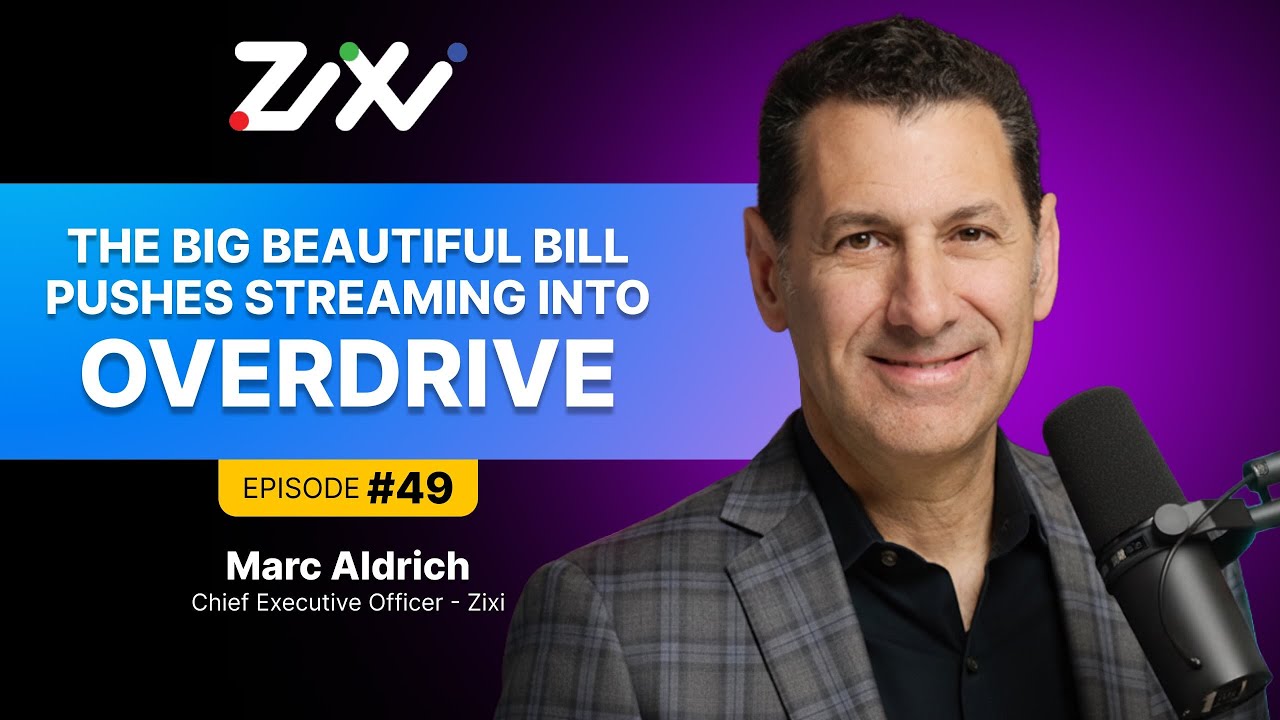
The companies that have genuinely mastered IP video delivery at broadcast quality are a distinct category. Zixi, for example, provides Emmy Award-winning software for delivering broadcast-quality video over any IP network. In a Vitrina LeaderSpeak conversation, Marc Aldrich, CEO of Zixi, explained that their technology sits at the core of content delivery for major broadcasters and studios—enabling reliable, high-quality video transport that traditional broadcast infrastructure simply can’t match for flexibility and scale. Watch Marc Aldrich break down how IP video delivery is reshaping broadcast infrastructure:
Other significant players in the broadcast IP integration space:
- Grass Valley — Deep roots in broadcast hardware (cameras, switchers, servers), now moving aggressively into IP and cloud-native solutions. Strong in live production and master control.
- Ross Video — Broadcast automation and live production infrastructure. Ross’s Ultrix router platform and Carbonite production switchers are widely deployed in sports and news broadcast environments globally.
- Vizrt — Graphics and real-time visualization for broadcast. Vizrt’s Viz Engine powers broadcast graphics for major news networks and sports broadcasters—increasingly integrated with virtual production environments.
- NEP Group — A managed services model rather than pure integration, NEP provides broadcast infrastructure, mobile units, and production services at live events worldwide. Strong in sports, concerts, and awards shows.
For productions exploring virtual production specifically, our analysis of how virtual production is revolutionizing film and TV creation covers how AV integration decisions intersect with LED volume design, real-time rendering, and camera tracking—a genuinely specialized AV discipline.
Need to Source the Right AV Vendor for a Specific Production?
Vitrina’s concierge team helps production companies and studios identify verified AV integration partners matched to their specific workflow, territory, and budget requirements.
Trusted by Netflix, Warner Bros, Paramount, and 140,000+ global companies.
No commitment required • Matched to your project requirements
How to Choose the Right AV Integration Partner in 2026
The worst vendor selection process is the one where you write a generic RFP, get generic responses, and pick based on price. Here’s a more useful framework—one that actually de-risks the decision.
Step 1: Define Your Workflow First, Vendor Second
What’s the actual production model? Live-to-tape, remote production, virtual stage, post-production mixing room, broadcast distribution chain? Each has fundamentally different AV integration requirements. A vendor that excels at live events won’t automatically be your best partner for a post facility build. Map the workflow precisely before you open any conversation.
Step 2: Verify Protocol and Standards Fluency
In 2026, any broadcast-focused integrator should be fluent in SMPTE ST 2110, NMOS (Networked Media Open Specifications), SRT, and RIST. Ask directly. If they hesitate or reach for marketing language, that’s a signal. According to Variety‘s technology coverage, the fastest-growing production companies in 2025 were those that fully transitioned broadcast infrastructure to IP—and the integrators who enabled that transition had deep protocol expertise, not just hardware catalogue depth.
Step 3: Ask About Post-Installation Support—Before You Sign
AV integration isn’t a one-time transaction. Systems evolve, software updates break things, productions expand into new capabilities. The integrators worth partnering with offer structured ongoing support—not just warranty coverage for hardware. Ask for specific SLAs. Ask what happens at 2am during a live broadcast when something fails. The answer tells you more than any RFP response.
Step 4: Check Regional Presence Against Production Locations
Global companies don’t always mean global capability at the local level. A firm headquartered in New York may have thin coverage in Southeast Asia or MENA—exactly where Sovereign Content Hub productions are accelerating. If you’re producing across multiple territories, verify that local technical resources actually exist before contracts are signed.
For live streaming and broadcast delivery infrastructure specifically, our guide to live streaming companies powering the real-time content revolution covers adjacent vendor categories that often intersect with AV integration decisions—particularly around CDN delivery, encoding, and origin infrastructure.
Find Verified AV Integration Vendors on Vitrina
The Fragmentation Paradox of the AV integration market is this: there are more qualified vendors than ever, operating in more territories, with more specialized capabilities—and finding the right one for your specific project is measurably harder than it was five years ago. Vendor lists get stale. Trade show contacts don’t tell you who’s actually active. And generic web searches return whoever spent most on SEO, not whoever is best for your workflow.
Vitrina solves this with live data across 140,000+ companies and 400,000+ projects—including verified audio visual equipment suppliers, broadcast technology vendors, and production technology partners. You can filter by capability, territory, project type, and technology specialization. And VIQI, Vitrina’s AI assistant, answers specific vendor questions conversationally: “Which AV integrators have done LED volume installations in the UAE?” or “Who are the top IP broadcast infrastructure vendors active in South Korea right now?”
That’s the Smart Pairing approach—matching your production’s specific technical requirements to vendors with proven experience in exactly that context. Not a curated list from two years ago. Live intelligence from active projects.
You can also explore Vitrina’s dedicated audio visual equipment opportunities section and the AV equipment digital storefronts to browse vendors directly by category and region.
FAQ: AV Integration Companies
Key Takeaways: Choosing Top AV Integration Companies in 2026
AV integration isn’t a commodity decision. It’s foundational infrastructure—and in an industry where production complexity keeps rising, the vendors you partner with either accelerate your capabilities or create technical debt that costs you on every subsequent project. Here’s what to carry forward:
- Match vendor type to workflow type. Global mega-integrators, broadcast specialists, and boutique shops each serve different needs. Don’t default to name recognition—match capability to production context.
- IP fluency is non-negotiable for broadcast in 2026. Any AV integrator working in broadcast must demonstrate genuine ST 2110, NMOS, SRT, and RIST expertise. Hardware catalogue depth doesn’t substitute for protocol knowledge.
- The AV market is global—but coverage isn’t uniform. Sovereign Content Hubs in MENA, APAC, and LATAM are driving infrastructure investment. Verify local technical resources actually exist where you’re producing.
- Post-installation support is part of the deal. Define SLAs before signing. Live production environments don’t tolerate vendors who disappear after commissioning.
- Vitrina accelerates the sourcing process. Over 140,000 verified companies, 400,000+ projects tracked, and VIQI’s AI to surface the right AV vendors for your specific production—before you waste time on mismatched RFPs.
Find Your Next AV Integration Partner—Start With 200 Free Credits
Vitrina connects production professionals to 140,000+ verified companies—including audio visual equipment vendors, broadcast technology partners, and post-production infrastructure specialists across every major market. No credit card required.
Find Film+TV Projects, Partners, and Deals – Fast.
VIQI matches you with the right financiers, producers, streamers, and buyers – globally.
Join Industry Briefings Trusted by Leaders
Unreleased Film+TV Projects: Opportunities & Showcase
A curated view of unreleased Film and TV projects open for financing and collaboration
The Mid-Budget Comeback: Why Mid-Budget Films Is the Smartest Bet in the Room
Mid-budget films are attracting new capital. See why this segment is becoming one of the strongest bets in Film today.
Franchise Fatigue vs. IP Dependency: What Studios Should Be Betting On Now
s franchise performance softens, where will the next generation of valuable IP come from? Join the briefing.

Unscripted Is Eating the World: The Multi-Billion Reality and Format Boom
Unscripted is the new prestige — inside the $19.8B global format boom reshaping how streaming platforms compete.