About Innovation Hub
 Global Content Pulse (Webinars)


 Global Production Financing
(Webinars)
Global Production Financing
(Webinars)  LeaderSpeak Podcast
  Global Entertainment Digest (Newsletter)
  About Vitrina
 About VIQI
 Our Story
 Our Solutions 🔥
 Film+TV Projects Tracker 🚀
 Case Studies
 Our Profile
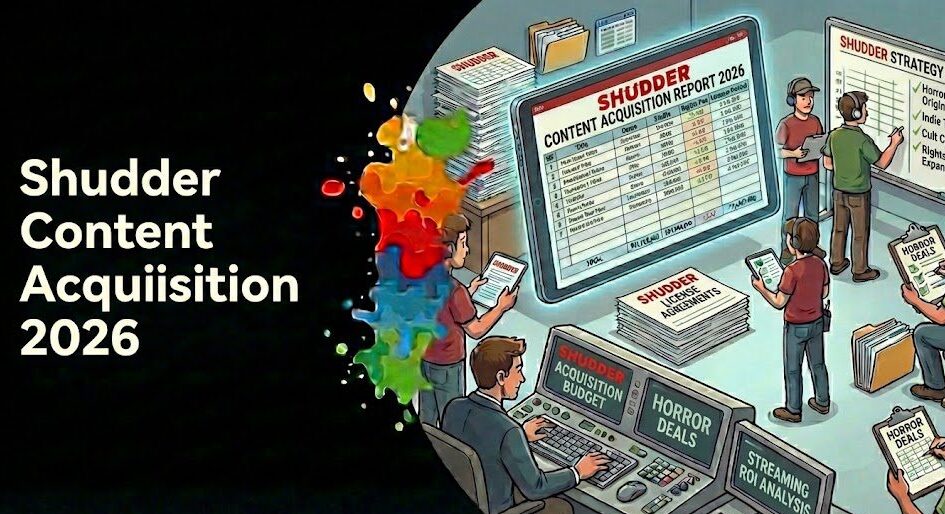
If you’re selling horror content right now, Shudder content acquisition is one of the most targeted—and often misread—deal conversations in the streaming space. The platform runs lean. The team knows their audience cold. And they’re not interested in general thrillers dressed up with a few jump scares. What they’re actually buying in 2026 is something more specific, and understanding that spec is the difference between a fast yes and a polite no that goes nowhere.
Shudder sits inside AMC Networks alongside Sundance Now, IFC Films Unlimited, and the flagship AMC+ bundle. That parent structure shapes everything—budgets, deal timelines, rights structures, and which projects get greenlighted versus passed. What the trades don’t report is how AMC Networks’ own financial position directly compresses what Shudder can deploy per title. Sellers walking in without that context tend to misprice their asks.
This guide breaks down Shudder’s acquisition strategy across seven dimensions, covers what the platform’s budget reality means for deal structures in 2026, and explains how producers and sales agents can track Shudder’s deal flow before negotiations begin. If you’ve got a horror title in your slate—or you’re scouting supply on behalf of a buyer—this is the intelligence you need.
In This Guide:
- What Makes Shudder’s Acquisition Model Unique
- The AMC Networks Connection and Why It Matters
- 7 Content Types Shudder Actively Acquires
- Shudder’s International Expansion in 2026
- Budget Realities and Deal Structure Implications
- How to Get Your Title in Front of Shudder’s Team
- Tracking Shudder Deals Before They Hit the Trades
- Frequently Asked Questions
- Key Takeaways
Track Shudder’s Active Acquisitions—Before the Deals Close
Vitrina monitors deal activity across 140,000+ companies in the global entertainment supply chain—including streaming platforms like Shudder. Know what’s in the pipeline before it hits Deadline.
Netflix, Warner Bros, and Paramount teams already use Vitrina to de-risk acquisition decisions. Ask VIQI—Vitrina’s AI research layer—what Shudder has acquired in the last 90 days.
200 free credits · No credit card required
What Makes Shudder’s Acquisition Model Unique
Most streaming platforms acquire across genres—they’re building breadth. Shudder does the opposite. It’s a single-genre specialist with a subscriber base of roughly 1.5 million horror fans who are among the most engaged in streaming. These aren’t casual viewers. They’re the ones who’ll watch a 1978 Italian giallo on a Tuesday and post frame-by-frame analysis by Wednesday morning.
That audience depth is the asset. It’s also the constraint. Shudder can’t drift toward the mainstream without losing the core. So their acquisition team—led by Craig Engler (Shudder General Manager) and content executives who’ve spent years in the horror community—runs a tight filter. Generic supernatural thrillers don’t move the needle. True horror, weird horror, extreme horror, and international horror that English-speaking fans can’t get anywhere else—that’s the supply Shudder actually wants.
Here’s what makes Shudder’s model worth studying: they’ve built a devoted subscriber base with a fraction of Netflix’s content budget. That’s efficient programming. But it also means every acquisition has to pull weight—either as a buzzworthy original, a catalogue depth play, or a festival title that signals Shudder’s authority in the genre. There’s no padding for the sake of volume.
As we covered in our guide to OTT content acquisition strategy, niche platforms succeed precisely because they don’t try to be everything to everyone. Shudder is the clearest proof of that thesis in the streaming market today.

Your AI Assistant, Agent, and Analyst for the Business of Entertainment
VIQI AI helps you plan content acquisitions, raise production financing, and find and connect with the right partners worldwide.
- Find active co-producers and financiers for scripted projects
- Find equity and gap financing companies in North America
- Find top film financiers in Europe
- Find production houses that can co-produce or finance unscripted series
- I am looking for production partners for a YA drama set in Brazil
- I am looking for producers with proven track record in mid-budget features
- I am looking for Turkish distributors with successful international sales
- I am looking for OTT platforms actively acquiring finished series for the LATAM region
- I am seeking localization companies offer subtitling services in multiple Asian languages
- I am seeking partners in animation production for children's content
- I am seeking USA based post-production companies with sound facilities
- I am seeking VFX partners to composite background images and AI generated content
- Show me recent drama projects available for pre-buy
- Show me Japanese Anime Distributors
- Show me true-crime buyers from Asia
- Show me documentary pre-buyers
- List the top commissioners at the BBC
- List the post-production and VFX decision-makers at Netflix
- List the development leaders at Sony Pictures
- List the scripted programming heads at HBO
- Who is backing animation projects in Europe right now
- Who is Netflix’s top production partners for Sports Docs
- Who is Commissioning factual content in the NORDICS
- Who is acquiring unscripted formats for the North American market
The AMC Networks Connection and Why It Matters to Sellers
AMC Networks is Shudder’s parent—and that relationship carries real implications for anyone selling content or pitching co-productions. AMC Networks reported $2.66 billion in revenue for 2024, but its streaming division remains a small fraction of that. The company has been navigating linear TV decline while trying to scale digital. Shudder operates within that fiscal context.
What does that mean in practice? Shudder’s acquisition budget is more constrained than Peacock or Paramount+ at equivalent subscriber counts. MGs are tighter. Deals tend to be SVOD-exclusive for defined windows—not the kind of broad multi-platform buy that inflates the headline number. And the approval chain runs through AMC Networks, which adds timeline. Budget the deal cycle accordingly.
But here’s the strategic upside for the right seller: Shudder can move faster on titles that fit their known acquisition parameters because they don’t have to debate genre fit. If your project is clearly horror, with festival credentials or recognizable talent, you’ll get a faster read than you’d get pitching an ambiguous genre hybrid to a general entertainment buyer.
Shudder also bundles with AMC+, giving acquired content a secondary audience window that’s often undervalued in licensing negotiations. Titles acquired for Shudder get exposure to AMC+’s broader 11 million subscriber base. Smart sellers factor that into their valuation conversation.
7 Content Types Shudder Actively Acquires in 2026
Not all horror is equal in Shudder’s acquisition calculus. Based on their 2023–2025 deal history and programming patterns, these seven categories consistently move through their pipeline:
1. Original Series and Films
Shudder’s originals are its identity anchors. Shows like “Creepshow”, “The Last Drive-In with Joe Bob Briggs”, and films like “Hosts” and “She Dies Tomorrow” signal what Shudder stands for. These are greenlit in-house or co-produced with production companies that bring genre credibility. If you’re pitching an original, the producing team matters as much as the premise.
2. Festival Acquisitions
Shudder is an active buyer at Sundance, SXSW, Fantastic Fest, Tribeca, and Toronto After Dark. These are pre-screened by their team. Strong festival buzz—a special jury mention, sold-out screenings—accelerates the conversation. But the title still has to be horror. Crossing-genre arthouse that “has horror elements” rarely closes.
3. International Horror
This is where Shudder differentiates from every other SVOD player. South Korean, French, Spanish, Australian, and Scandinavian horror all perform well on the platform. Shudder acquired the South Korean film “Train to Busan” rights for specific territories, the French extreme horror wave in the early 2010s built its catalogue depth, and recent Spanish-language titles have tested strongly with US subscribers. If you’ve got a foreign-language horror title with genre clarity, Shudder is a logical first call.
4. Horror Documentaries
The genre’s documentary space is an underutilized acquisition lane. Shudder’s “Cursed Films” series proved there’s real appetite for horror-industry nonfiction. Productions that sit at the intersection of true crime and supernatural, or that cover cult horror history, consistently over-index on the platform. Budget requirements are lower. Deal cycles are faster.
5. Extreme and Cult Horror
Shudder doesn’t avoid challenging content. It’s one of the few platforms where extreme horror—body horror, splatter, psychological brutalism—gets a fair acquisition read. The audience expects it. But they want craft alongside shock value. Productions that combine technical quality with genuine genre commitment work. Shock-for-shock’s-sake without production substance doesn’t make the cut.
6. Classic Horror Library
Catalogue depth is a subscription retention tool. Shudder regularly licenses classic horror from studios including Universal, Lionsgate, and independent catalogues. If you hold rights to a proven horror title from the 1970s–2000s—particularly one with a cult following—the conversation with Shudder is easier than you might expect. Their audience actively seeks legacy titles.
7. Live Events and Special Programming
Joe Bob Briggs’ marathon programming events generated genuine appointment viewing for Shudder. That model has expanded. Halloween-season event programming—whether live commentary, marathon programming blocks, or special-event screenings—drives short-term subscriber acquisition. If you can bring a talent-driven event format with horror credibility, Shudder’s programming team will take the meeting.
Find the Right Buyer for Your Horror Title—Fast
Stop guessing which platforms are acquiring your genre. Vitrina tracks active acquisition activity across 400,000+ projects—including Shudder, AMC Networks, and the international horror buyers your sales agent might not have on their call sheet.
Join the 140,000+ companies on Vitrina already using real-time supply chain intelligence to close deals faster.
No credit card required · Start tracking deals today
Shudder’s International Expansion Play in 2026
Shudder is available in the US, Canada, UK, Ireland, Australia, and Germany—and the international footprint is still the platform’s most underdeveloped growth lever. Horror has genuinely global demand. But the The Fragmentation Paradox™ applies here: production companies and rights holders outside North America often don’t know how to route their titles into Shudder’s acquisition funnel.
The German market is worth watching specifically. Horror has a strong tradition in German-language cinema—from the classic Herzog and Fassbinder era horror-adjacent work to contemporary genre filmmakers building real audiences. Shudder’s German-language acquisition activity has been increasing, and that’s a signal. If you’re working with German-language genre production companies, Shudder is a live conversation.
British horror also commands attention. As Variety has reported, UK genre production—particularly from companies like Warp Films and independent genre labels—represents exactly the kind of talent-driven, budget-conscious horror production that fits Shudder’s sweet spot. And the UK rights landscape often allows sellers to carve territories in ways that make Shudder-specific deals viable without blocking premium window options.
For international sellers, the strategic play is clear: don’t wait for Shudder to find you at AFM. Get your title into their acquisition team’s field of view at genre-specific events—FrightFest in London, Fantasia in Montreal, Sitges in Spain. These are the places Shudder’s team is actively scouting, not just evaluating submissions.
Budget Realities: What They Mean for Your Deal Structure
Let’s get specific about the capital reality. Shudder isn’t writing the kind of MGs that Netflix deploys for a genre title. You’re typically looking at low-to-mid six figures for a feature acquisition—sometimes lower for catalogue titles, occasionally higher for a festival breakout with competitive interest. The platform’s originals budget has been in the range of $1–4 million per film, which is micro-budget by streaming standards but appropriate for the genre.
That budget reality shapes what kind of sellers Shudder deals with most efficiently. Indie producers who’ve made a $500K feature at genre festivals? Strong match. Major studio horror titles looking for SVOD windows? The gap between their ask and Shudder’s offer tends to be wide. International sales agents working with European co-productions that already have territory pre-sales covering production costs? Good fit—because the MG doesn’t need to carry the whole budget.
Here’s something insiders recognize: Shudder’s tighter budget actually creates faster deal cycles for the right projects. There are fewer approval layers when the numbers are contained. If your production is fully packaged—chain of title clean, deliverables ready, E&O in place—a Shudder deal can close in 4–8 weeks from first offer. That’s faster than most streaming platforms at equivalent terms.
Understand the rights structure too. Shudder typically wants SVOD exclusivity for the acquisition window, which can run 12–36 months. They’ll often want US rights as a minimum, with territory extensions for their international markets. Sellers who try to hold back the UK or Canada for separate deals may find Shudder’s interest cooling—those territories are meaningful for the platform’s international growth push.
For more on navigating streaming platform licensing terms, our overview of content acquisition in entertainment covers the rights structure fundamentals that apply across SVOD deals.
How to Get Your Horror Title in Front of Shudder’s Team
The acquisition path into Shudder isn’t opaque—but it is specific. Cold submissions through general inboxes get deprioritized. There are a few routes that actually work:
Sales agents with Shudder relationships are the most efficient first door. Shudder maintains ongoing conversations with a core group of international sales agents—companies that consistently bring them titles worth evaluating. If your sales agent has done a Shudder deal in the last 24 months, they’re in an active conversation. If not, it’s worth asking who has that relationship before deciding who reps your title.
Genre film festivals are the second track. As reported by Deadline, Shudder has historically closed multiple acquisitions directly out of Sundance, SXSW, and Fantastic Fest each year. Getting a title programmed in a genre-focused section—rather than a general dramatic competition—puts it in front of buyers who are there specifically to acquire. That’s the targeting discipline that moves deals.
Package your submission correctly. Shudder’s team evaluates genre authenticity quickly. A submission package should lead with the horror credentials—festival program placement, any genre-specific awards, comparable titles in Shudder’s existing catalogue. Don’t lead with crossover potential or “broad appeal.” The platform’s buyers are specialists. They respond to genre-specific positioning.
And make sure your deliverables picture is clean before you enter any serious discussion. A title that tests well with Shudder’s team but has a cloudy chain of title or missing E&O insurance will stall out fast—and that’s a reputation cost with a buyer you want on your side long-term.
Need Concierge Support for Streaming Platform Outreach?
Vitrina’s Concierge Service connects you directly with the right acquisition contacts at platforms like Shudder—cutting the cold-outreach cycle. Netflix, Paramount, and Warner Bros teams use Vitrina’s intelligence layer to de-risk content partnerships before they commit.
Identify acquisition contacts · Accelerate deal timelines · No commitment required
Tracking Shudder Deals Before They Hit the Trades
Here’s what most sellers and buyers get wrong: by the time a Shudder acquisition shows up in Deadline or Variety, the deal is closed. The competitive intelligence window—the 4–8 weeks of active negotiation before announcement—is where strategic players extract the most value. And that window requires real-time supply chain data, not trade coverage.
The The Fragmentation Paradox™ applies directly here. The global horror content supply is fragmented across 600,000+ companies in opaque silos. Production companies in South Korea, Spain, and Australia are all pitching Shudder—but they don’t know who else is pitching, what Shudder’s current slate looks like, or which acquisition conversations are already in advanced stages. That information asymmetry costs sellers negotiating leverage.
Strategic players—sales agents, producers with active slates, co-production partners—need a different approach. Tracking Shudder’s acquisition patterns across project types, genres, budget levels, and territory preferences gives you the positioning intelligence to enter a deal conversation on the right terms. You’re not guessing at their needs; you’re bringing supply that matches documented demand.
Vitrina’s platform maps this deal flow in real time. You can surface Shudder’s recent acquisition activity, identify the production companies they’ve been buying from repeatedly, and spot the genre patterns that signal where their acquisition budget is being deployed. That’s the intelligence edge that compresses deal cycles and protects your terms. Explore how genre-specific OTT platform strategies play out across the streaming market for a broader view of where this logic applies.
Frequently Asked Questions About Shudder Content Acquisition
What types of content does Shudder acquire?
Shudder focuses exclusively on horror and genre content. Their active acquisition categories include original series and films, festival acquisitions, international horror (particularly South Korean, French, Spanish, and Scandinavian), horror documentaries, extreme and cult horror, classic horror catalogue titles, and live event programming formats.
How much does Shudder pay for content acquisitions?
Shudder’s acquisition MGs typically fall in the low-to-mid six-figure range for feature films, depending on festival pedigree, cast, and competitive interest. Originals budgets have run roughly $1–4 million per film. These are tighter than larger SVOD platforms—a direct reflection of AMC Networks’ streaming budget allocation and Shudder’s subscriber scale of approximately 1.5 million.
Who owns Shudder and how does that affect its content acquisition strategy?
Shudder is owned by AMC Networks, the cable and streaming conglomerate that also operates AMC+, Sundance Now, and IFC Films Unlimited. AMC Networks’ overall financial position—$2.66 billion revenue in 2024 but ongoing linear TV margin pressure—directly constrains Shudder’s acquisition budget. Deals are approved through AMC Networks’ structure, which adds timeline but also means Shudder-acquired titles can receive secondary exposure through AMC+’s broader subscriber base.
Where is Shudder available internationally?
Shudder currently operates in the US, Canada, UK, Ireland, Australia, and Germany. The platform’s German-language market is an active expansion focus in 2026. International horror producers in these territories have a direct licensing path to Shudder, while producers in other territories typically license through territory-specific rights deals if Shudder has limited presence.
How do I submit a film to Shudder for acquisition?
The most effective routes are through sales agents with existing Shudder relationships, or via genre film festivals where Shudder’s acquisition team actively scouts—particularly Sundance, SXSW, Fantastic Fest, and Toronto After Dark. Cold submissions through general inboxes are deprioritized. Submissions should lead with genre credentials and comparable titles already in Shudder’s catalogue, not with broad audience appeal.
What rights does Shudder typically request in an acquisition deal?
Shudder typically wants SVOD exclusivity for acquisition windows running 12–36 months. They’ll request US rights as a minimum, with territory extensions for their active international markets (Canada, UK, Ireland, Australia, Germany). Sellers who try to carve out these secondary territories for separate deals often encounter resistance, as they’re central to Shudder’s international growth strategy.
Does Shudder acquire international horror films?
International horror is one of Shudder’s most active acquisition categories. South Korean, French, Spanish, Australian, and Scandinavian horror all have a track record on the platform. Shudder’s audience actively seeks foreign-language genre content that isn’t available elsewhere on mainstream SVOD platforms. This makes Shudder a logical first call for international producers with strong horror titles—especially if the production already has festival placement or critical recognition.
How does Shudder’s Shudder content acquisition compare to other AMC Networks streaming platforms?
Shudder is the most genre-focused of AMC Networks’ streaming platforms. Sundance Now focuses on arthouse and international drama. IFC Films Unlimited covers independent cinema broadly. AMC+ aggregates all three plus linear AMC content. Each platform has a distinct acquisition mandate and separate buyer relationships. Content sellers should approach each as a distinct acquisition pathway rather than routing everything through AMC Networks generally.
Key Takeaways
Shudder’s acquisition model in 2026 rewards sellers who understand the platform’s specific parameters—its genre focus, its budget constraints, its international growth priorities, and the parent company dynamics that shape every deal. Here’s the summary intelligence:
- Genre purity wins. Shudder doesn’t acquire general thrillers or soft horror. Authentic genre commitment—craft plus content—is the filter that separates pitches that close from pitches that get a polite pass.
- Budget reality shapes deal structure. MGs in the low-to-mid six figures are standard. Sellers who calibrate their ask to Shudder’s actual budget range—rather than their Netflix comparable—close faster and preserve the relationship.
- International is an active lane. Shudder’s appetite for South Korean, French, Spanish, and German-language horror is real and ongoing. International producers with clean rights packages and festival placement have a direct path.
- AMC+ multiplier is undervalued. Shudder acquisitions get secondary exposure through AMC+’s 11 million subscribers. Factor this into your licensing valuation conversation.
- Track deal flow before it’s public. The competitive window—before announcements hit the trades—is where strategic sellers and buyers position themselves. Real-time deal tracking through platforms like Vitrina de-risks that intelligence gap.
Surface Your Next Horror Content Deal with Vitrina
Track Shudder’s acquisition activity—and every other platform’s—before it goes public. 140,000+ entertainment companies trust Vitrina for real-time supply chain intelligence. Start with 200 free credits and no credit card required.
No credit card required · Netflix, Warner Bros and Paramount teams use Vitrina
Find Film+TV Projects, Partners, and Deals – Fast.
VIQI matches you with the right financiers, producers, streamers, and buyers – globally.
Join Industry Briefings Trusted by Leaders

Film & TV Production Financing: 2026 Trends
Production financing conditions are changing quickly. Understanding where money is moving and what buyers are backing is key to getting projects approved and funded in 2026.
Unreleased Film+TV Projects: Opportunities & Showcase
A curated view of unreleased Film and TV projects open for financing and collaboration

The Mid-Budget Comeback: Why Mid-Budget Films Is the Smartest Bet in the Room
Mid-budget films are attracting new capital. See why this segment is becoming one of the strongest bets in Film today.
Franchise Fatigue vs. IP Dependency: What Studios Should Be Betting On Now
s franchise performance softens, where will the next generation of valuable IP come from? Join the briefing.