IHUB
IHUB
 Private Briefings (Webinars)


 LeaderSpeak Podcast
  Global Entertainment Digest (Newsletter)
  Premium Lists
 Membership Benefits
 About Vitrina
 Our Story
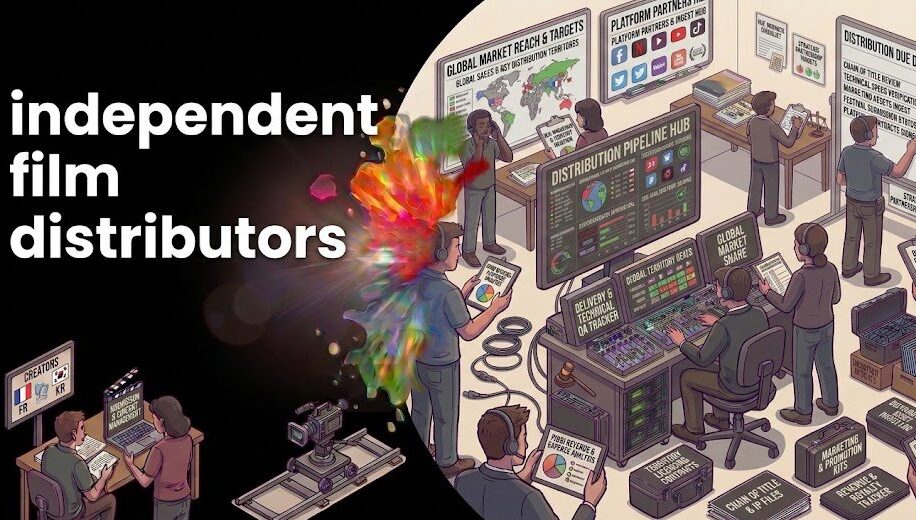
The deal you want is sitting at AFM or Cannes. The financing—that’s the part that separates distributors who close from those who keep circling. Independent film distributor financing isn’t just about finding money. It’s about assembling the right capital stack at the right time, from the right mix of sources, before your acquisition window slams shut.
Here’s the uncomfortable truth: the independent film financing landscape got harder in 2024 and hasn’t fully recovered. Phil Hunt, Founder & CEO of Head Gear Films—which has financed 550+ movies over 25 years and produces 35–40 films annually (more than most studios)—put it plainly: the industry has become “much, much harder in terms of getting movies off the ground and getting movies sold.” That pressure applies equally at the acquisition stage.
But distributors who understand the full toolkit are still closing. Fast. This guide breaks down exactly how they’re doing it—from presales mechanics to gap financing structures, equity models to tax incentive stacking—and where real-time intelligence gives you the edge before the competition even knows a deal exists.
Table of Contents
- The Capital Stack Behind Every Acquisition Deal
- Presales: The Foundation of Independent Film Distributor Financing
- Gap Financing: Bridging the Final 10–30%
- Equity Models That Actually Work
- Tax Incentives: The Hidden Multiplier in Your Acquisition ROI
- Co-Production Treaties: Multi-Government Capital in One Structure
- The Commercial Bank Retreat and What It Means for Your Strategy
- How Vitrina Accelerates Your Financing Strategy
- Frequently Asked Questions
- Key Takeaways
Ask VIQI: Who Are the Active Gap Lenders for Your Budget Range?
VIQI is Vitrina’s AI assistant—trained on 1.6 million titles, 300,000+ companies, and 5 million entertainment professionals. Ask it exactly who’s lending against which territory, at what budget threshold, right now.
✓ Included with 200 free credits | ✓ No credit card needed
The Capital Stack Behind Every Acquisition Deal
Before you pitch a lender or approach an equity partner, you need to understand how acquisition financing layers together. As we cover in our complete breakdown of the film capital stack, the sequencing matters as much as the individual pieces. Get one layer wrong and the whole structure collapses.
A typical independent acquisition at the $3–10M level draws from four buckets: equity (20–40%), presales and distribution commitments (30–50%), tax incentives (15–30%), and gap or mezzanine debt (10–30%). That’s the model. And that’s the sequence you need to build in order—equity first, presales second, gap third, incentives layered throughout.
What changed post-2021? The post-COVID “revenge production” era flooded the market with content. Capital was freely available. Then came the contraction. Joshua Harris, President & Managing Partner of Peachtree Media Partners, described how City National Bank’s exit from entertainment lending “created an enormous gap in the marketplace.” Private capital rushed in—but selectively, and at a premium above what the banks ever charged.
The distributors closing deals today aren’t lucky. They’re structured. They’ve pre-assembled lender, sales agent, and equity relationships before they need them. And they’re using real-time intelligence to surface opportunities the Fragmentation Paradox would otherwise bury—600,000+ companies operating in opaque silos, creating information asymmetry that costs distributors 15–20% in margin leakage through legacy intermediary markup.
Presales: The Foundation of Independent Film Distributor Financing
Presales remain the backbone of independent film distributor financing—and yet they’re widely misunderstood by distributors who’ve only operated on the buy side. A presale is a license agreement where a distributor commits to pay a Minimum Guarantee (MG) for territorial distribution rights before the film is produced. Those MG contracts then serve as collateral for production loans.
Banks typically lend 70–90% of MG face value, depending on the distributor’s credit standing in that territory. A-list distributors in Germany (Constantin), France (Pathé), or Japan unlock maximum loan-to-value ratios. Less established regional players get lower advance rates—or outright rejection. That’s the tier system operating in plain sight, and it explains why sales agent relationships are worth protecting.
For acquisitions specifically, presales serve a dual function. They validate market demand before you commit acquisition capital, and they generate the receivables that unlock debt financing. A distributor who’s secured MG commitments in Germany, France, and Japan before approaching a gap lender is presenting an entirely different risk profile than one who arrives empty-handed.
The presale ecosystem by international territory operates on market timing—Cannes Marché (May), AFM (November), EFM Berlin (February), and MIPCOM (October). Packages hit buyers 2–3 weeks before each market. Miss that window and you’re negotiating without momentum. Get ahead of it and you’re leveraging competing offers against each other.
Phil Hunt’s perspective cuts through the noise. There was a time when films were presold off concepts before a script was written—deals closed at Cannes on an idea alone. Those days are gone. Today’s presale market demands: recognizable cast, commercial genre (action, thriller, and horror travel best internationally), experienced producer track record, and a reputable sales agent. Comedy is a tough presell internationally—it’s a domestic piece. Don’t build your acquisition financing strategy around comedy MGs and expect the numbers to work.
Gap Financing: Bridging the Final 10–30%
Once you’ve stacked equity and presales, you’re likely sitting at 65–80% of total budget. That final chunk—typically 10–30% of spend—is where gap financing either closes the deal or exposes how thin the package really is.
Gap financing is a mezzanine debt instrument secured against a film’s unsold territorial distribution rights. The lender evaluates which territories remain unsold, applies conservative estimates—typically 50–70% of what the sales agent projects—and advances against that value. Standard gap covers 10–15% of budget. Supergap, above 15%, is harder to secure and comes at a premium cost.
The all-in cost isn’t modest. On a $1.5M gap loan with a 10% upfront fee and 8% annual interest, you’re looking at $270,000 in first-year costs—an effective rate of 18%. Over 18 months, that climbs to roughly 22% of the original loan amount. Budget for this from day one. Discovering it during closing is how deals collapse under their own cost structure.
Track What’s Getting Greenlit Before It Hits the Trades
Trusted by Netflix, Warner Bros, and Paramount. Join 160,000+ companies tracking the global entertainment supply chain.
✓ 200 free credits | ✓ No credit card required | ✓ Full platform access
Who’s providing gap financing today? The commercial bank retreat is real, and the void has been filled by private lenders and specialist finance firms. Peachtree Media Partners‘ distinctive approach: they’ll advance against future territory value before distribution agreements are even executed—lending against what the market will pay, not just what’s already signed. BondIt Media Capital was built specifically to fill the post-2008 credit void. Head Gear Films, with its 550-film track record, provides structured lending where it sees strong deal economics—deal structure, not passion for the material.
Phil Hunt, Founder & CEO of Head Gear Films, breaks down exactly what makes a project lender-ready in today’s market:
Phil Hunt (Founder & CEO, Head Gear Films) on the post-COVID financing crunch and what independent distributors need to demonstrate before approaching gap lenders in 2025.
One non-negotiable across every gap lender: a completion bond. Budget an additional 3–6% of total production costs for the completion guarantee. Skip it and gap financing simply isn’t available. Lenders won’t carry delivery risk without third-party insurance. That’s the market, not a negotiating position.
And the recoupment waterfall? Gap financing sits in the mezzanine position—ahead of equity, behind senior production debt. That sequencing matters when you’re structuring the deal and setting investor expectations from the start. Our full guide to the recoupment waterfall structure walks through exactly how each layer recoups in sequence.

Your AI Assistant, Agent, and Analyst for the Business of Entertainment
VIQI AI helps you plan content acquisitions, raise production financing, and find and connect with the right partners worldwide.
- List the top commissioners at the BBC
- List the post-production and VFX decision-makers at Netflix
- List the development leaders at Sony Pictures
- List the scripted programming heads at HBO
- Find active co-producers and financiers for scripted projects
- Find equity and gap financing companies in North America
- Find top film financiers in Europe
- Find production houses that can co-produce or finance unscripted series
- Who is backing animation projects in Europe right now
- Who is Netflix’s top production partners for Sports Docs
- Who is Commissioning factual content in the NORDICS
- Who is acquiring unscripted formats for the North American market
- Show me recent drama projects available for pre-buy
- Show me Japanese Anime Distributors
- Show me true-crime buyers from Asia
- Show me documentary pre-buyers
- I am looking for production partners for a YA drama set in Brazil
- I am looking for producers with proven track record in mid-budget features
- I am looking for Turkish distributors with successful international sales
- I am looking for OTT platforms actively acquiring finished series for the LATAM region
- I am seeking localization companies offer subtitling services in multiple Asian languages
- I am seeking partners in animation production for children's content
- I am seeking USA based post-production companies with sound facilities
- I am seeking VFX partners to composite background images and AI generated content
Equity Models That Actually Work
Equity is the highest-risk, highest-potential-return layer of the capital stack—and it sits last in the recoupment waterfall, behind senior debt and gap loans. That’s the honest conversation you need to have with equity partners before anyone signs anything. Sophisticated equity investors already know it. Don’t soften it.
Andrea Scarso at IPR VC—founded in Helsinki in 2014—describes their model as taking equity positions in specific projects rather than production companies, using a portfolio approach to manage risk. Their capital comes from institutional investors, family offices, and insurance companies. His central insight: “When you hit a successful IP, the upside can be greater than the overall risk you’re taking on a portfolio.”
For distributors seeking equity, the equity vs. debt financing decision comes down to control and recoupment position. Equity carries no mandatory repayment—but it dilutes ownership and backend participation. Slate financing—where an investor backs a portfolio of projects rather than one title—reduces single-project exposure and is increasingly attractive to institutional capital that needs diversification. It’s also your strongest pitch if you can demonstrate consistent deal flow.
Tactically: get equity committed and confirmed before approaching gap lenders. Lenders need to see 60–80% of budget secured. Showing up with only equity in hand and asking a gap lender to cover 40% signals a weak package. Show up with equity plus presales and you’re negotiating from strength. That sequencing—equity first, presales second, gap last—isn’t bureaucracy. It’s the logic of how lenders assess risk.
According to Deadline, private equity interest in independent distribution companies accelerated significantly since 2023—precisely because proven distributors with repeatable deal flow offer the portfolio diversification institutional investors need in a volatile content market.
Tax Incentives: The Hidden Multiplier in Your Acquisition ROI
Tax incentives are the most underutilized tool in independent film distributor financing—primarily because they require production flexibility that some distributors don’t build into acquisition deals. But for those who do, the ROI impact is structural, not marginal. We’re not talking about a rounding error. We’re talking about deals that pencil out versus deals that don’t.
The numbers speak plainly. The UK’s Audio-Visual Expenditure Credit delivers 25% (rising to 29.25% for VFX as of April 2025)—and the UK attracted £4.2B ($5.3B) from film and TV in 2023. Georgia’s unlimited 30% transferable tax credit generated $4.2B in production activity in 2024. Ireland’s Section 481 reaches 40% for films under €20M. Saudi Arabia’s Vision 2030—backed by $71.2B in committed entertainment investment from the Public Investment Fund—offers a 40% cash rebate as part of its push toward 100 films by 2030.
Then there’s stacking. Combining a national incentive with a regional program can push effective returns to 40–58% of qualifying spend. Canada’s federal plus British Columbia credit combination routinely hits those levels. New Mexico (25–40%) and New Jersey (30–40%) stack similarly. As reported by Screen International, cross-border incentive stacking has become a defining feature of how sophisticated independent distributors structure acquisition packages in 2025—not an afterthought, a design principle built in from the first conversation.
But here’s what most distributors miss: incentives are paid after production completes and spend is audited. You need bridge financing against the tax credit receivable. That’s another layer to budget for before closing—not after you’re already committed to the deal.
Co-Production Treaties: Multi-Government Capital in One Structure
Co-production treaties are the most sophisticated—and most underused—financing tool available to independent distributors. A treaty co-production grants national film status in each participating country, simultaneously unlocking their respective incentive programs, national film funds, and broadcaster pre-buy requirements. One structure, multiple government programs, stacked returns.
Canada’s federal plus British Columbia credit can reach 58% of qualifying spend. Layer in a UK partner and you’re stacking UK AVEC on top. Eurimages—the European multilateral fund—further supplements treaty co-productions between qualifying member states. The 2018 revision of the European Convention lowered the minimum co-producer contribution to just 5%, making smaller creative contributions viable as financial structures. That change opened treaty access to projects that previously couldn’t meet the threshold.
And the Sovereign Content Hubs are building treaty frameworks specifically to attract this kind of co-production capital. Saudi Arabia’s 17 purpose-built studios, Film AlUla, and NEOM infrastructure—backed by the Public Investment Fund’s long-term commitment—represent co-production and acquisition opportunities most Western distributors haven’t yet systematically mapped.
The role your sales agent plays in identifying treaty co-production opportunities is worth every point of their 10–15% commission. They know which territories have appetite for which genres, which national broadcasters need to hit local content quotas, and which incentive programs have active capacity versus which are already oversubscribed. That intelligence—when it closes a deal six weeks ahead of your competition—is how the math justifies the cost.
The Commercial Bank Retreat and What It Means for Your Strategy
Here’s something you won’t read in the trades until six months after it’s moved the market: the commercial bank retreat from entertainment lending isn’t reversing. City National’s exit is the most prominent example—but it’s part of a broader pattern of conservative institutional capital pulling back from independent film risk in the post-strike, post-streamer-pullback environment.
Private capital has stepped into the void—selectively. Peachtree Media Partners lends against film IP as collateral, advancing against future territory value before distribution agreements are executed. BondIt Media Capital was built specifically to fill the post-2008 credit crisis gap. Head Gear Films, with 550 films behind it, provides structured lending where it sees strong deal economics—not passion for the material. Deal structure. Financial discipline. That’s their frame, and it should be yours when approaching them.
Josh Harris at Peachtree said it directly: “We’re not investing in film and TV. We lend in film and TV. We take a collateral position against the film IP.” That distinction—lender vs. investor—changes how you package the ask and the documentation you need to bring.
The distributors navigating this landscape well built multiple lender relationships before they needed them. They’re at the markets. They’re in the conversations. They’re not cold-calling lenders when a deal is already under time pressure. And they’re using platforms like Vitrina to track which private lenders are actively deploying capital—before it hits the trades.
Need Financing Partners for Your Next Acquisition? We’ll Find Them.
Vitrina Concierge is your Virtual Agent. We don’t give you a list—we make warm introductions directly to decision-makers actively seeking your type of content.
- Korean animation studio → Netflix Adult Animation (week one)
- LA producer → Netflix UK, Fifth Season, Fox Entertainment (48 hours)
- Middle Eastern studio → Legendary Pictures (direct access)
How Vitrina Accelerates Your Financing Strategy
Here’s the thing about independent film distributor financing in 2025: the tools are all there. Capital exists. Incentive programs are generous. Gap lenders are active—just more selective. What’s missing for most distributors isn’t money. It’s the intelligence to surface the right partner at the right stage, before the information leaks into the trades and your window closes.
That’s exactly where Vitrina cuts through the Fragmentation Paradox. With 1.6 million+ tracked projects and 300,000+ companies in the database, you can surface verified co-production partners by territory, identify active gap financing relationships, track presale activity by market segment, and monitor which Sovereign Content Hubs—Saudi Arabia, South Korea, India—are actively deploying acquisition capital right now.
Ask VIQI a direct query and get actionable intelligence in minutes. Not months of manual research. Not a biased referral from one contact in your network. Real-time data on who’s lending, who’s buying, and which deals have already closed in your target territory—so you walk into every market conversation with the insider advantage your competition doesn’t have.
Frequently Asked Questions: Independent Film Distributor Financing
What is independent film distributor financing?
Independent film distributor financing refers to the capital structures distributors use to fund content acquisitions—including presales, gap loans, equity investment, tax incentive monetization, and co-production treaty arrangements. It differs from studio acquisition financing primarily in its reliance on multi-source capital stacking rather than balance sheet lending.
How much of a film’s budget does gap financing typically cover?
Standard gap financing covers 10–15% of a film’s total budget. Supergap can reach up to 30%, but requires name talent, commercial genre, a reputable sales agent, and 60–80% of budget already confirmed from equity and presales. Gap lenders rarely exceed 30% under any conditions.
What do gap lenders look for in independent film distributor financing deals?
Gap lenders prioritize five criteria: 60–80% of budget already confirmed; a reputable sales agent with track record; a completion bond in place (adds 3–6% to budget); name talent with demonstrable foreign market value; and commercial genre with proven international appeal—action, thriller, and horror travel best across territories.
How do presales function in independent film distributor financing?
Presales are license agreements where distributors commit to pay a Minimum Guarantee (MG) for territorial rights before production completes. Banks lend 70–90% of MG face value against these contracts. Payment structure is typically 10% on signature and 90% on delivery—creating a financing gap that gap lenders bridge.
What are the strongest tax incentives for independent film financing in 2025?
The UK (25–29.25% AVEC), Georgia (30% unlimited), Ireland (40% for films under €20M), Canada (40–58% federal plus provincial), and Saudi Arabia (40% Vision 2030 rebate) lead the field in 2025. Stacking national and regional programs can push effective returns to 40–58% of qualifying spend.
How has the commercial bank retreat affected independent film distributor financing?
City National Bank’s exit from entertainment lending forced independent distributors toward private lenders—Peachtree Media Partners, BondIt Media Capital, Head Gear Films—at effective all-in rates of 15–22% over 18 months. These lenders offer greater structural flexibility, including Peachtree’s model of advancing against future territory value before distribution agreements are signed.
What is the recoupment waterfall order in independent film financing?
The standard waterfall flows: distribution and sales agent fees (20–35%) first, then P&A costs, then senior production debt plus interest, then gap financing plus interest, then tax credit recoupment, then equity investors, then deferred fees and profit participants. Equity is last—highest risk, highest potential return.
Key Takeaways
Independent film distributor financing in 2025 rewards distributors who build their capital infrastructure before they need it—not during a deal under time pressure. The tools are available. The capital exists. The question is whether you’ve structured the approach correctly and have the intelligence to move before your acquisition window closes.
- Capital stack sequencing matters as much as the pieces themselves. Equity and presales must be confirmed before approaching gap lenders—60–80% of budget secured is the minimum threshold to be taken seriously.
- Gap financing is available but increasingly selective in 2025. Expect 10–30% budget coverage at effective all-in costs of 15–22% over 18 months. Completion bonds (3–6% of budget) are non-negotiable with every lender.
- Private lenders fill the commercial bank void—at a price, but with flexibility. Firms like Peachtree Media Partners and Head Gear Films lend against deal economics and IP collateral, not passion for the project. Structure the ask accordingly.
- Tax incentive stacking transforms acquisition ROI from marginal to structural. UK, Georgia, Ireland, Canada, and Saudi Arabia’s Vision 2030 fund offer 25–58% on qualifying spend. Build it into the deal architecture from day one.
- The Fragmentation Paradox is the real enemy of deal speed. 600,000+ companies in opaque silos cost distributors 15–20% margin through information asymmetry. Vitrina’s real-time intelligence resolves it—surface the right partner before the competition does.
De-Risk Your Next Acquisition Before the Market Moves
Trusted by Netflix, Warner Bros, Paramount, and Google TV. Track 160,000+ projects. Access 3 million verified executives. Ask VIQI strategic questions about your next acquisition market.
✓ 200 free credits | ✓ No credit card required | ✓ Cancel anytime
Need hands-on partner introductions? Explore Vitrina Concierge—warm introductions to decision-makers actively seeking your content type.