IHUB
IHUB
 Private Briefings (Webinars)


 LeaderSpeak Podcast
  Global Entertainment Digest (Newsletter)
  Premium Lists
 Membership Benefits
 About Vitrina
 Our Story
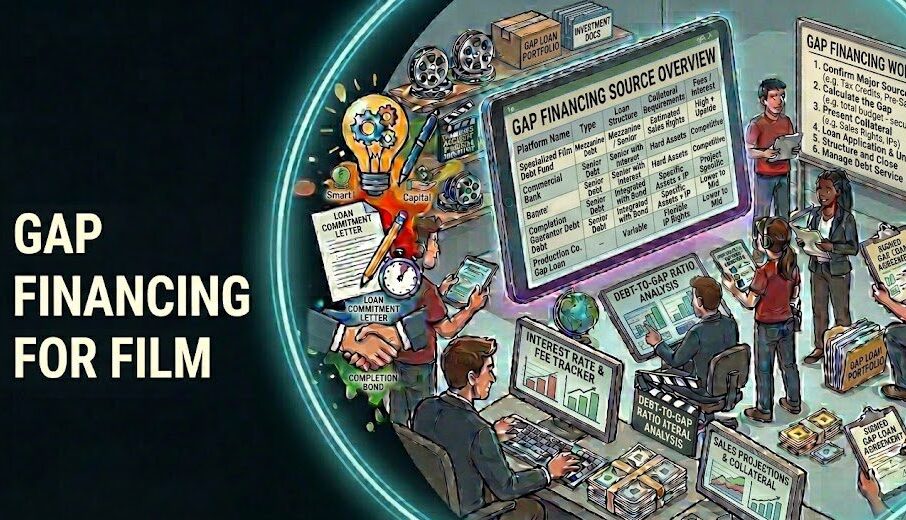
Here’s what nobody tells you upfront: gap financing companies for film are rare. Not because the concept is complicated—it isn’t—but because the risk profile terrifies most institutional lenders. You’re asking someone to lend against territories that haven’t sold yet. Collateral that exists only as projected revenue on a sales agent’s spreadsheet.
And yet, for independent producers closing a $5M–$15M budget, gap financing is often the difference between greenlight and development purgatory. You’ve secured your equity. You’ve closed pre-sales on your major territories. But there’s still that 10–20% funding gap staring at you. So you need to know exactly which companies actually do this—and what they need from you before they’ll have a conversation.
That’s what this guide covers. We’ve pulled together the active players across entertainment banks, specialized film finance companies, and private lending funds—drawing on our independent film financing guide and direct interviews with lenders operating in today’s market. No theory. No padding. Just the companies, what they want, and how you approach them.
In This Guide
- What Gap Financing Is (And Why So Few Companies Do It)
- Entertainment Banks: The Conservative Tier
- Specialized Film Finance Companies
- Private Lending Funds Filling the Bank Void
- The 2025–2026 Lender Shakeup: New Entrants and Names to Verify
- 5 Non-Negotiables Every Gap Lender Requires
- How to Find Gap Financing Companies on Vitrina
- FAQ
Ask VIQI: Which Gap Financing Companies Are Right for My Project?
VIQI is Vitrina’s AI assistant—trained on 1.6 million titles, 300,000+ companies, and 5 million entertainment professionals. Tell it your budget, genre, and current capital stack—it’ll identify the right lender profile for your film.
✓ Included with 100 free credits | ✓ No credit card needed
What Gap Financing Is (And Why So Few Companies Do It)
Gap financing is mezzanine debt—a loan secured against a film’s unsold territorial distribution rights and anticipated future revenues. It typically covers 10–30% of the total production budget, bridging the space between confirmed financing (equity, pre-sales, tax incentives) and the full amount you need to greenlight.
A standard capital stack on a $10M independent feature might look like this: $2M equity (20%), $4.5M pre-sales (45%), $2M tax incentives (20%)—leaving a $1.5M gap (15%). That’s where gap lenders step in. The loan sits in a mezzanine position: senior to equity investors, junior to any senior production loan. It recoups before your equity partners see a dollar—which is exactly why lenders want it.
But why don’t more companies offer it? Because the collateral is speculative by definition. You’re pledging rights to territories that haven’t sold yet. Lenders can only lend against foreign (non-North American) rights—domestic rights are considered performance risk, not quantifiable risk. Most gap lenders will apply 50–70% of the sales agent’s territory projections when calculating loan eligibility. That conservative haircut, combined with the sheer complexity of entertainment law, keeps most banks out of this space entirely.
The ones that stay in it? They charge for that risk. Expect 7–15% upfront fees plus prime + 3–8% annual interest. An 18-month gap loan carries an all-in effective cost of 18–25% on the borrowed amount. That’s the honest number—budget it properly or the waterfall math won’t work.
Lenders also size the loan against a safety margin on top of that territory haircut: most want the estimated unsold-territory value to sit at roughly 150% of the loan amount—$1.50 of projected rights value for every $1.00 lent—and in exchange, most gap lenders take no profit participation, unlike an equity investor would. And this isn’t a niche tool used by a handful of desperate productions: Screen Australia market data covering 197 financing applications between January 2023 and October 2025 found gap financing used in 34% of feature film applications overall, rising to roughly 50% of applications for films budgeted between AUD5–15M, with 70% of those gap positions exceeding 10% of the total budget.
Source: MovieMaker Magazine, “The Low Down on Gap Financing,” updated January 6, 2025. Figures are illustrative for a $10M budget, not a current-market quote—use the 7–15% upfront / prime + 3–8% framing above for your own waterfall math, and this table to see where that cost actually lands line by line.
Stop Guessing Who’s Financing. Get Targeted Outreach.
Stop searching and start getting funded. We identify the exact decision-makers currently backing projects like yours, turning raw data into risk-aligned capital partnerships.
Major Studios
Scouting early stage projects, IP, and Regional partners for global studio pipelines.
IP Owners & Leads
Connecting creative leads with qualified financiers and major streaming platforms.
Streamers
Securing high-value pre-buy content and discovering early-stage global IP for platforms.
Indie Producers
Bridging the gap for indie filmmakers to reach executive production partners and capital.
Global Financing Ecosystems
Mapping complex markets and pairing projects with disciplined, risk-aligned capital across global territories worldwide.
Entertainment Banks: The Most Conservative Gap Lending Tier
A handful of banks have historically maintained dedicated entertainment divisions willing to do gap. They’re the most conservative—and the cheapest—option. Don’t mistake that for easy. Their lending criteria are strict precisely because they’re working at lower margins.
1. Comerica Bank
Comerica Bank runs one of the most established entertainment banking divisions in Los Angeles. They’ve been active in film and TV production lending for decades—providing gap financing as part of broader production finance packages. Comerica’s entertainment group focuses on projects with strong commercial packaging and typically requires $2M+ budgets, proven producers, and solid sales agent support. If you’re a first-time producer without existing relationships here, you’ll need an entertainment attorney to warm the introduction.
2. JP Morgan Entertainment Division
JP Morgan’s entertainment lending operation focuses on the higher end—primarily $5M+ projects—and tends to bundle gap financing within larger slate deals or production credit facilities. Direct access for independent producers is limited; the path typically runs through an established production finance attorney or entertainment banker with existing JP Morgan relationships.
3. City National Bank (The Cautionary Context)
City National Bank was, for decades, the unofficial bank of Hollywood and Broadway. Their entertainment division was uniquely relationship-driven—they understood the business at a level commercial banks rarely do. But following their acquisition by Royal Bank of Canada, the strategic focus shifted. As Joshua Harris (President & Managing Partner, Peachtree Media Partners)—a former City National entertainment banker himself—put it bluntly: they moved from being an entertainment finance company that happened to offer banking products to a bank that happened to offer an entertainment solution. That created what he calls an enormous gap in the marketplace. It’s a cautionary example of how institutional priorities can hollow out specialized expertise fast.
For context on how entertainment banking has evolved—and what that means for your financing options today—our analysis of the entertainment banking landscape covers the structural shift in detail.
Specialized Film Finance Companies Stepping Into the Space
When the banks pull back, specialized film finance companies absorb the demand—typically at higher cost but with deeper genre knowledge and more flexible structuring.
4. Film Financial Services (FFS)
Film Financial Services (FFS) is one of the dedicated gap financing firms—focused exclusively on film finance rather than treating entertainment as a side operation. FFS brings industry expertise that generalist lenders can’t replicate: they understand completion bonds, territory valuation, and the nuances of how a sales agent’s estimates should be stress-tested. Their risk appetite sits in the moderate-to-high range, and they operate in the mid-budget independent space. Their underwriting criteria are territory-specific—they’ll run detailed analysis on which markets are truly bankable before committing to a loan amount.
5. Head Gear Films: High-Volume Structured Lending
Most producers think of Head Gear Films as a production outfit. That’s only part of the picture. Founded by Phil Hunt and Compton Ross in 2002, Head Gear has evolved into a three-headed operation: structured lending, production/packaging services, and gap/senior equity. They’ve financed over 550 films—making Hunt and Ross the most highly credited producers in UK history since records began in 1906. They’re currently doing 35–40 films per year. More than studios.
But don’t confuse volume with loose criteria. Hunt is direct about the current market: it’s much harder to get movies off the ground and get movies sold in 2025 than it was three years ago. What Head Gear is primarily looking for are projects the market actually wants—commercial genre content with recognizable cast that will move in Germany, France, Japan, and the UK. Bring a prestige drama with no star attachment and you’ll hear a polite no fairly quickly.
Phil Hunt (Founder & CEO, Head Gear Films) discusses why the independent film financing market has tightened sharply—and what lenders actually need to say yes:
Find Active Gap Financing Companies in 48 Hours
Trusted by Netflix, Warner Bros, and Paramount. Join 300,000+ companies on Vitrina tracking active film financiers, sales agents, and production partners globally.
✓ 100 free credits | ✓ No credit card required | ✓ Full platform access
Private Lending Funds: Where the Real Action Is in 2025
The most interesting gap financing activity right now isn’t happening in banks. It’s happening in private capital funds that have spotted exactly the void Joshua Harris described—institutional retreat creating a supply-demand imbalance for production capital. And because private capital can price risk more aggressively, these funds are often more creative in how they structure deals.
6. Peachtree Media Partners
Peachtree Media Partners is doing something structurally distinctive in the gap financing space. They don’t invest in film—they lend. The difference matters enormously for producers. Peachtree takes a collateral position against the film IP—pre-sales, distribution agreements, tax incentives—and then does something most lenders won’t: they advance against the value of future territory rights before the distribution agreements are executed. That de-risks the production timeline significantly—you’re not waiting for all territory deals to close before you can access capital.
The strategic logic from Harris is clean: by using calculated risk lending rather than equity, Peachtree earns a higher return for their investors while enabling producers to maintain creative control and backend upside. They’re backed by Peachtree Group—a major private equity firm—with a sister production company, Gramercy Park Media, that understands the creative side. And they’re actively seeking deal flow. That’s worth noting in a market where most gap lenders are being conservative.
Peachtree Group itself markets this gap-lending program directly for $5M–$50M budgets, reporting more than $60M deployed to date across named clients including Muzzle, Sleeping Dogs, The Surfer, The Fabulous Four, Mary, and Motor City—though it doesn’t publicly disclose specific rates or loan-to-value terms, so treat those as negotiated deal-by-deal rather than published pricing.
7. Goldfinch
Goldfinch, led by founder and CEO Kirsty Bell, bridges the gap between art-house independent film and commercial financing discipline. Bell’s background in financial services before moving into film production informs their approach—they run disciplined business models against the creative investment decisions that many indie financiers avoid. Goldfinch operates across diverse revenue streams: vertical series, brand integration deals, and international co-productions across MENA, Africa, and Asia. Their model rewards producers who come with commercial genre packaging that travels internationally, rather than projects built primarily for domestic arthouse distribution.
For a broader map of the financing landscape these companies operate within, the guide to navigating film financiers covers lender types, hierarchy, and how to structure your approach to each tier.
Find the Financiers Backing Your Genre
Stop searching and start getting funded. We identify the exact decision-makers currently backing projects like yours, turning raw data into risk-aligned capital partnerships.
The 2025–2026 Lender Shakeup: New Entrants and Names to Verify
The active-lender list above isn’t static—gap lending desks open and close as streamer pre-buys rise and fall. Two names surfaced in 2025 trade press that aren’t on most older lists, and they’re worth knowing alongside the seven companies already covered.
8. TPC (Forest Road Company / ACF)
TPC, the lending arm of The Forest Road Company (sister firm to investment bank ACF), publicly expanded into gap lending against unsold territories for the first time in February 2025—a direct response to declining streamer pre-buys—closing its first named gap deal on Gus Van Sant’s Dead Man’s Wire. The film stars Bill Skarsgård, Colman Domingo, and Cary Elwes, with WME Independent handling world sales. TPC’s head of global lending, Ali Jazayeri, said the move addresses “a key gap in the film financing landscape,” and producer Cassian Elwes credited TPC with closing the deal “at the last minute” and “rapidly,” per Screen Daily’s February 13, 2025 report. The deal is also a useful real-world sequence to study: WME Independent’s territory estimates are what gave TPC the comfort to lend, confirming that for most producers the real point of entry is the sales agent, not the lender directly.
9. BondIt Media Capital
BondIt Media Capital, a Santa Monica firm founded in 2013, offers gap and mezzanine debt “selectively” alongside other production finance products. They finance more than 50 films a year from a pipeline of over 1,500 annual submissions, deploying more than $100 million per year with under 1% write-offs and reported 15–20% investor returns, typically taking a first-position claim in the recoupment waterfall. CEO Matthew Helderman told Forbes (February 26, 2025, updated March 31, 2025): “We’ve got capital inside the company that wants to take a little more risk that can have outsized returns.” One unverified Variety report suggests MEP Capital may have taken a majority stake in BondIt alongside a new $100 million credit facility in 2026—that specific claim sat behind a paywall during research and couldn’t be independently confirmed, so treat it as reported-but-unverified rather than settled fact.
One caution worth flagging before you spend time chasing introductions: older industry coverage names Comerica Bank, Film Financial Services, and Artist View Entertainment as gap lenders, but those references trace back to a 2014-original source. No independent 2025–2026 confirmation was found that these specific desks or individuals are still active in gap lending today—treat Comerica and FFS above as historically relevant and verify current appetite directly before you build a financing timeline around them.
The 5 Non-Negotiables Every Gap Financing Company Will Ask For
You can approach any of these nine companies—but you won’t get far without the following. These aren’t preferences. They’re hard requirements. Missing one of them typically means the conversation ends before it starts.
1. 60–80% of budget already secured. Gap lenders don’t lead the financing. They close it. If you’re coming to them with only 40% of your budget confirmed, you’re not ready. Most require 60–80% secured from equity, pre-sales, and tax incentives before they’ll consider a gap loan. Strong projects with name talent might qualify at 60%. Higher-risk packages may need 80%+.
2. A reputable sales agent—with proven lender relationships. Your sales agent isn’t just selling territories. They’re providing the estimates that underpin your gap loan application. Lenders rely on those estimates, and they know which sales agents inflate numbers and which don’t. You need an agent with a track record specifically in gap-supported productions. Their estimates need to be 1.5–2× the gap amount for the numbers to work.
3. A completion bond. Non-negotiable. Full stop. No gap lender will advance money without a third-party completion guarantee—it’s the mechanism that protects them if the film goes over budget or stalls in production. Budget an additional 3–6% of production costs for the bond itself. Try to secure the bond company’s assessment early—it signals seriousness and streamlines lender due diligence significantly.
4. Recognizable cast for foreign markets. This is where a lot of independent producers underestimate the ask. Gap lenders are lending against the value of unsold foreign territories—Germany, France, Japan, UK, Spain. An A-list star can meaningfully increase territory estimates across all of those markets. Unknown cast creates almost no bankable collateral. Genre matters too: action and thriller travel internationally; domestic-focused drama often doesn’t. According to Deadline, the gap financing market has tightened considerably since 2022—lenders today apply even more conservative territory haircuts than they did three years ago.
5. A minimum budget threshold. Most active gap lenders require $2M+ budgets; many focus on $5M+. Under $2M, you’re outside the risk-adjusted return threshold where gap financing makes economic sense for the lender. If your budget is below that floor, you’ll likely need to look at alternative structures—additional equity, co-production deals, or regional soft money—before gap financing becomes a viable tool. Our guide to securing film and TV financing covers those alternatives in detail.
What Lenders Actually Evaluate: A Real-World Example
Here’s why the package matters more than the pitch. The King’s Speech (2010) used gap financing to close its $15M budget—a film that ultimately grossed over $400M worldwide (Box Office Mojo) and won Best Picture. The gap loan was repaid quickly from initial distribution revenues. But here’s the thing: it worked because the project had everything lenders want. Period drama with commercial appeal. Name cast. Proven producers. UK tax incentives confirmed. Strong sales agent estimates backed by a script with obvious award-season trajectory.
The comparison table below shows how the nine companies stack up on the key decision factors:
Need Warm Introductions to Gap Lenders? We’ll Make Them.
Vitrina Concierge is your Virtual Agent. We don’t hand you a list—we identify lenders actively seeking your content type and make direct introductions to decision-makers.
- LA producer → Netflix UK, Fifth Season, Fox Entertainment (48 hours)
- Korean studio → Netflix Adult Animation (week one)
How Vitrina Helps You Find and Approach Gap Financing Companies
The Fragmentation Paradox in entertainment finance is real: the companies you need are out there—but they’re distributed across markets, relationship networks, and deal structures that aren’t indexed anywhere cleanly. Vitrina solves that problem. With 300,000+ companies mapped across the entertainment supply chain, including active film financiers, you can filter by financing type, deal history, content genre, and territory focus.
But finding a company name isn’t the same as getting a meeting. Gap financing is relationship-driven—lenders are allocating scarce capital, and they favor producers they know or producers vouched for by people they trust. That’s where Vitrina Concierge operates differently from a database search. We use Smart Pairing to match your project profile against the actual content appetite of active lenders, then make warm introductions through existing relationships.
As reported by Variety, the independent film financing market in 2025 is the most selective it’s been since the post-2008 contraction—lenders are fewer, more conservative, and more relationship-dependent. In that environment, your ability to access the right room quickly is a genuine competitive advantage. Producers who can identify which of the nine companies above matches their project’s risk profile—and get to them before the capital is committed elsewhere—close their capital stacks faster. That’s not luck. That’s information.
For a deeper look at how to package your project for maximum gap financing appeal, the comprehensive overview of film financing companies covers packaging, approach strategy, and what to lead with in your first conversation.
Frequently Asked Questions
Which companies offer gap financing for independent films?
The active gap financing companies for independent film fall into three tiers: entertainment banks (Comerica Bank, JP Morgan), specialized film finance companies (Film Financial Services, Goldfinch), and private lending funds (Peachtree Media Partners, Head Gear Films, TPC, BondIt Media Capital). Only a handful of lenders are active at any given time—availability shifts with market conditions and their current portfolio exposure.
What is the minimum budget for gap financing?
Most gap financing companies require a minimum production budget of $2M, with many focused on $5M+. Under $2M, the risk-adjusted economics don’t work for lenders—the fees and interest earned don’t justify the underwriting complexity. Micro-budget films under $2M are typically better served by equity crowdfunding, regional grants, or co-production structures.
How much does gap financing cost?
Gap financing typically costs 7–15% upfront fees plus prime + 3–8% annual interest. On an 18-month loan, the all-in effective cost runs 18–25% of the borrowed amount. On a $1.5M gap loan, that’s roughly $270,000–$375,000 in total financing cost. Itemized industry figures put the total add-on cost (interest, loan fee, legal costs, and completion bond premium) on a $10M film at roughly $775,000—budget for this in your waterfall analysis before you approach lenders.
Do you need a completion bond for gap financing?
Yes—a completion bond is a non-negotiable requirement for virtually every gap financing company. The bond is a third-party guarantee that the film will be delivered on time and on budget, protecting the lender if production goes sideways. Budget an additional 3–6% of production costs for the bond. Securing the bond company’s assessment early signals seriousness and speeds up lender due diligence.
What genres qualify most easily for gap financing?
Action, thriller, and horror genres have the strongest gap financing track records because they carry predictable international territory value. Comedy is typically the weakest—it travels poorly without a major star. Drama performance varies widely based on cast and commercial hooks. Lenders will discount territory estimates for genres without proven foreign sales histories, so genre selection directly affects the loan amount you can access.
What percentage of budget can gap financing cover?
Standard gap financing covers 10–15% of total production budget. Supergap—a higher-risk variant—can reach 15–30% but requires an even stronger project package and is harder to secure. A gap exceeding 30% of budget is a red flag to most lenders—it signals that the project hasn’t attracted sufficient primary financing, which undermines confidence in the sales agent’s territory estimates.
How do gap financing companies evaluate unsold territory value?
Gap lenders rely on the sales agent’s territory estimates but apply their own discount—typically 50–70% of the agent’s projections for major markets (Germany, France, Japan, UK), and generally want the resulting estimated value to sit at roughly 150% of the loan amount as a safety margin. They exclude small markets entirely. The lender’s in-house analysis cross-references comparable sales data for similar genre, budget level, and cast attachment. Sales agents with established lender relationships carry significantly more credibility in this process.
How is gap financing repaid?
Gap loans are repaid from the film’s distribution revenues in the recoupment waterfall—after any senior production loan, but before equity investors. This mezzanine position is what makes gap financing attractive to lenders: they’re behind senior debt but ahead of all equity. Interest accrues daily from loan initiation, so faster repayment from early distribution deals meaningfully reduces total financing cost.
Who are the newest gap financing lenders to emerge in 2025–2026?
TPC (Forest Road Company/ACF) publicly entered gap lending in February 2025, closing its first named deal on Gus Van Sant’s Dead Man’s Wire. BondIt Media Capital, a Santa Monica firm founded in 2013, has stepped up visibility in the same period, deploying $100M+/year across 50+ films. Both are worth adding to your outreach list alongside the more established names—just verify current appetite directly, since the field shifts fast.
Are festival “gap financing markets” the same as gap lending?
No. Festival “gap financing markets”—including sessions at Venice, Rome’s MIA, and Tokyo—are co-production pitching forums where projects with a financing gap are presented to potential financiers, not lending facilities themselves. Deadline’s July 2026 coverage of Venice’s Gap Market describes it as a curated pitch forum (naming filmmakers Ursula Meier, Jessica Hausner, and Lav Diaz among 2026 participants). Don’t conflate these festival pitch markets with the lending mechanism described throughout this guide—they’re a venue for finding a gap lender or equity partner, not a substitute for one.
The Short Version: What You Need to Do Right Now
Gap financing exists. It’s accessible. But it’s not forgiving of weak packaging or misaligned expectations about cost. The nine companies above represent the active universe—from conservative entertainment banks to private funds actively seeking deal flow like Peachtree Media Partners, the volume lenders like Head Gear Films who’ve built their business on exactly this type of structured deal, and newer entrants like TPC and BondIt Media Capital stepping in as streamer pre-buys decline.
Your job isn’t to knock on all nine doors. It’s to identify which two or three match your project’s risk profile, approach them with 70%+ of budget already confirmed, and get the relationship started before you actually need the capital. Because lenders talk to producers they already know when the good projects come through—and you want to be in that conversation.
Key Takeaways:
- Gap financing covers 10–30% of budget, secured against unsold territorial distribution rights—not domestic performance promises.
- Nine companies are active or recently active: entertainment banks (Comerica, JP Morgan), specialized firms (FFS, Goldfinch, Head Gear), and private funds (Peachtree, plus 2025 entrants TPC and BondIt Media Capital).
- Budget 18–25% effective cost on an 18-month loan—upfront fees plus daily-accruing interest add up fast; on a $10M film, itemized figures put the all-in add-on cost at roughly $775,000.
- A completion bond is non-negotiable—no lender proceeds without it, no exceptions.
- Relationships drive access—gap financing is not a cold-outreach market; you need warm introductions to the right decision-makers.
- It’s more common than most producers assume—Screen Australia data found gap financing used in 34% of feature applications overall, rising to roughly 50% for AUD5–15M budget films.
Track Gap Financing Companies Before Your Next Project Needs Them
Trusted by Netflix, Warner Bros, and Paramount. Join 300,000+ companies on Vitrina—the global platform for entertainment supply chain intelligence.
✓ 100 free credits | ✓ No credit card required