IHUB
IHUB
 Global Content Pulse (Webinars)


 Global Production Financing
(Webinars)
Global Production Financing
(Webinars)  LeaderSpeak Podcast
  Global Entertainment Digest (Newsletter)
  About Vitrina
 About VIQI
 Our Story
 Our Solutions 🔥
 Film+TV Projects Tracker 🚀
 Case Studies
 Our Profile
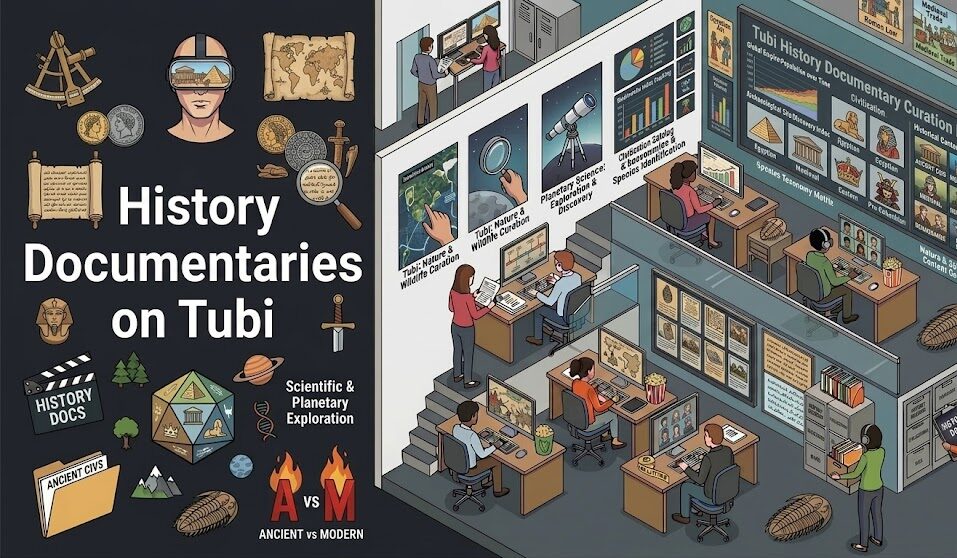
Here’s the thing nobody tells you about Tubi: it’s sitting on one of the most comprehensive collections of ancient history and archaeology programming available anywhere in free streaming—and most people scroll right past it.
The mysteries of ancient Egypt, the collapse of Rome, the blood rituals of the Maya kings, the forgotten empires of Africa—all of it is on Tubi in 2026, at no cost, no subscription required. And we’re not talking about YouTube-level content assembled with stock footage and AI narration. We’re talking Emmy Award-winning series, PBS productions hosted by Harvard professors, and archaeology docuseries built on genuine fieldwork in Iraq’s Kurdistan territories.
This guide identifies the best free documentaries on Tubi about ancient civilizations and lost empires—ranked by historical accuracy, production quality, and narrative depth. But there’s also a layer underneath the watchlist worth understanding: why these specific titles are on a free platform, how the licensing mechanics work, and what that tells you about the future of history content on AVOD.
Whether you’re a history enthusiast, a researcher, or just someone who can’t sleep without falling into a three-hour rabbit hole about Mesopotamia—this is your guide. Let’s get into it.
Table of Contents
- Why Tubi Has Become a Serious Destination for Ancient History Docs
- Lost Civilizations — The Emmy-Winning Series That Covers Everything
- Lost Secrets of the Pyramid — The Most Compelling Egypt Docuseries on Tubi
- Africa’s Great Civilizations — The Series That Rewrites What You Think You Know
- Colosseum: The Whole Story — Rome’s Most Iconic Monument Gets Its Due
- More Ancient History Titles Worth Exploring on Tubi
- Why Premium History Docs Keep Landing on Free Platforms
- FAQ
- Key Takeaways
Ask VIQI: Which Platforms Are Actively Acquiring History Documentaries Right Now?
VIQI is Vitrina’s vertical AI assistant—trained on 1.6 million titles, 360,000 companies, and 5 million entertainment professionals. Ask it about documentary acquisition strategies, platform windowing, or what’s trending in history and archaeology content globally.
✓ Included with 200 free credits | ✓ No credit card needed
Why Tubi Has Become a Serious Destination for Ancient History Docs
This isn’t an accident. It’s the direct result of how AVOD licensing economics work—and it’s a story worth understanding if you want to know why the ancient history category on Tubi keeps getting better.
Tubi, owned by Fox Corporation since a $440 million acquisition in 2020, now reaches over 80 million monthly active users and runs a library of more than 50,000 titles in 2026. As Deadline reported, Tubi surpassed $1 billion in annualized revenue heading into 2025—a number that gives its acquisition team real leverage in licensing negotiations. History and archaeology represent one of the platform’s highest-completion-rate documentary categories. Viewers who start an ancient Egypt docuseries finish it. That’s the metric AVOD platforms live and die by, because more completed views means more ad impressions means more revenue.
But why are genuinely excellent history productions here instead of behind paywalls? It’s the Fragmentation Paradox of streaming itself. The SVOD wars inflated subscription counts and content costs simultaneously. Subscription fatigue set in. Audiences didn’t stop wanting documentary content—they stopped wanting another monthly bill for it. Meanwhile, premium productions that aired on PBS, Discovery Channel, and History Channel began completing their SVOD windows and migrating toward AVOD licensing. Tubi’s content acquisition strategy is specifically built to capture these windowing opportunities—which is why Emmy-winning series from the 1990s and 2010s both coexist in the same history category today.
The result is a history catalog that spans multiple decades of television archaeology. And that’s actually a feature, not a limitation. Older series often have richer on-location cinematography shot before access restrictions tightened at archaeological sites like Machu Picchu and Petra. Newer productions bring the forensic science. Together they form something genuinely valuable.
Lost Civilizations — The Emmy-Winning Series That Covers Everything
If you watch one ancient history series on Tubi, make it this one. Time-Life’s Lost Civilizations (1995) is the complete package: 10 episodes, each covering a distinct civilization—ancient Egypt, the Aegean, the Maya, Mesopotamia, Rome, China, Greece, Africa, the Inca, and Tibet. And it earned its reputation. The series won the 1996 Primetime Emmy Award for Outstanding Informational Series—the highest recognition in American non-fiction television. That’s not catalog filler. That’s a production that competed against the best documentary work of its era and won.
What sets Lost Civilizations apart from lesser ancient history programming? Three things. First: original location cinematography filmed in 25 countries—from Cuzco in Peru to Petra in Jordan—shot at a time when access to key archaeological sites was broader than it is today. The footage has aged beautifully. Second: dramatic reconstructions that hold up. The special effects aren’t CGI showboating—they’re in service of the historical narrative, grounding you in what these civilizations actually looked, felt, and smelled like at their peaks. Third: the scope. Eight and a half hours of documentary covering 7,000 years of human civilization, from Mesopotamia’s first cities to Tibet’s struggle for cultural survival. That’s genuinely unprecedented for a free streaming library.
Individual episode highlights worth calling out: the Maya — The Blood of Kings episode remains one of the most unflinching examinations of Mayan ritual ever committed to documentary film—neither sensationalized nor sanitized. The Rome — The Ultimate Empire episode enters the Colosseum alongside gladiators at the zenith of Roman power, then tracks precisely which structural weaknesses led to the empire’s collapse. And Africa — A History Denied gives deserved attention to the hidden history of Africa’s great coastal kingdoms and the mysteries of Zimbabwe’s heartland—civilizations that academic curricula routinely underserve.
It’s all free on Tubi. Start with Egypt. You won’t stop there.
Track Which History Docs Are Landing on Tubi — Before Anyone Else Knows
Trusted by Netflix, Warner Bros, and Paramount. Vitrina monitors documentary acquisitions across 140,000+ companies in real time. Know exactly which ancient history productions are entering AVOD windows—weeks before they appear.
✓ 200 free credits | ✓ No credit card required | ✓ Full platform access
Lost Secrets of the Pyramid — The Most Compelling Egypt Docuseries on Tubi
Ancient Egypt has been documented to death. There are bad Egypt documentaries. There are mediocre ones. And then there’s Lost Secrets of the Pyramid—a docuseries available free on Tubi that earns its place on this list by doing something most Egypt productions never attempt: building its entire narrative around a single primary source.
The show’s central premise is extraordinary and verifiable. A team of archaeologists is decoding a pyramid worker’s 4,500-year-old journal—the oldest papyrus diary ever discovered, found in 2013 at the ancient harbor of Wadi el-Jarf on the Red Sea coast. Its author, Merer, was an inspector overseeing workers who transported limestone blocks for the construction of the Great Pyramid of Giza. His daily logs—written in hieratic script, the administrative shorthand of the period—represent the only first-person account of pyramid construction that has ever been found. That’s not a dramatized premise. That’s real archaeology.
The series uses Merer’s journal as a framework to attempt a practical reconstruction: can a modern team transport a heavy stone block using only the manpower and technology available in 2500 BCE? The result is the rare documentary that tests historical hypothesis in real conditions rather than simply asserting conclusions. It’s methodologically honest in a way that most archaeology television isn’t. And it covers one of history’s most enduring engineering questions—how the Great Pyramid was built—without resorting to pseudoscientific shortcuts or alien intervention theories. Just evidence, experiment, and rigor.
For viewers who’ve exhausted the standard Egyptology catalogue and want something with genuine scholarly grounding, Lost Secrets of the Pyramid is the next level. It’s exactly the kind of production that demonstrates why Tubi’s history category rewards patient browsing over algorithm-driven discovery.

Your AI Assistant, Agent, and Analyst for the Business of Entertainment
VIQI AI helps you plan content acquisitions, raise production financing, and find and connect with the right partners worldwide.
- Find active co-producers and financiers for scripted projects
- Find equity and gap financing companies in North America
- Find top film financiers in Europe
- Find production houses that can co-produce or finance unscripted series
- I am looking for production partners for a YA drama set in Brazil
- I am looking for producers with proven track record in mid-budget features
- I am looking for Turkish distributors with successful international sales
- I am looking for OTT platforms actively acquiring finished series for the LATAM region
- I am seeking localization companies offer subtitling services in multiple Asian languages
- I am seeking partners in animation production for children's content
- I am seeking USA based post-production companies with sound facilities
- I am seeking VFX partners to composite background images and AI generated content
- Show me recent drama projects available for pre-buy
- Show me Japanese Anime Distributors
- Show me true-crime buyers from Asia
- Show me documentary pre-buyers
- List the top commissioners at the BBC
- List the post-production and VFX decision-makers at Netflix
- List the development leaders at Sony Pictures
- List the scripted programming heads at HBO
- Who is backing animation projects in Europe right now
- Who is Netflix’s top production partners for Sports Docs
- Who is Commissioning factual content in the NORDICS
- Who is acquiring unscripted formats for the North American market
Africa’s Great Civilizations — The Series That Rewrites What You Think You Know
This is the series that shouldn’t be free on a streaming platform—and yet here it is on Tubi. Africa’s Great Civilizations is a 6-part PBS series hosted by Henry Louis Gates Jr., the Alphonse Fletcher University Professor at Harvard University and one of the most recognized public historians in the world. It covers 200,000 years of African history—and it does so with the kind of intellectual rigor and on-location authenticity that most ancient history programming can’t approach.
The series challenges a persistent and damaging misconception: that African history before European colonization was essentially a blank page punctuated by Egyptian pharaohs. It isn’t. Not even close. The first three episodes focus on ancient Africa—from Mitochondrial Eve and humanity’s origins in the continent’s interior, to the spread of religion, the rise of the Nubian Kingdoms (which ruled over Egypt for nearly a century), the Mali Empire founded by Sundiata Keita in 1240, and the astronomical knowledge of the Dogon people of Mali, who accurately mapped the Sirius star system centuries before Western astronomers confirmed their observations.
But it’s not just about obscure civilizations. The Nubian Pyramids in Sudan—over 200 pyramids, more than Egypt built—represent one of the most visually arresting and least-discussed archaeological sites on Earth. Africa’s Great Civilizations covers them with the depth they deserve. As PBS described it, Gates goes in search of a history that has been systematically suppressed and marginalized. What he finds is extraordinary.
This is a series that belongs in classrooms and on research watchlists, not just streaming queues. The fact that it’s available free on Tubi in 2026 is the direct result of PBS’s licensing strategy—pushing content toward AVOD windows to maximize educational reach after SVOD cycles close. It’s one of the best examples of the system working exactly as it should.
Colosseum: The Whole Story — Rome’s Most Iconic Monument Gets Its Due
Everybody knows the Colosseum. Not everybody knows its complete story. The structure most tourists photograph today is a ruin—a fraction of its original form, stripped of marble cladding, missing its upper tiers, with a floor long since removed to expose the hypogeum below. Colosseum: The Whole Story is a 2-part documentary available free on Tubi that reconstructs the full history of Rome’s most recognizable monument—from its original construction under Emperor Vespasian in 70 CE, through its use as a quarry for medieval building projects, to its modern restoration controversies.
What elevates this production above standard Roman history television is its equal attention to the Colosseum’s long post-classical life. The gladiatorial games are covered, but so are the centuries during which the structure housed a church, sheltered a small city of squatters, and served as a source of travertine stone for St. Peter’s Basilica. The restoration story—ongoing and politically contentious—is itself a fascinating study in how modern Rome navigates the tension between historical preservation and tourist infrastructure revenue. That’s not the documentary you expected from a Colosseum title. But it’s a far more complete one.
For viewers who’ve already absorbed the gladiator-and-empire framing of Roman history, this is the natural next step. Pair it with the Rome episode from Lost Civilizations for a complete picture that moves from the empire’s zenith to its architectural legacy a millennium later. Both are free on Tubi. Both are worth your time.
Discover Every History Documentary Entering the Tubi Library in Real Time
Netflix, Warner Bros, and Paramount rely on Vitrina to track content movement across 140,000+ companies globally. Start with 200 free credits—no credit card, no commitment—and monitor exactly which ancient history productions are entering AVOD windows before they disappear again.
✓ 200 free credits | ✓ No credit card required | ✓ Cancel anytime
More Ancient History Titles Worth Exploring on Tubi Right Now
Beyond the four headline titles, Tubi’s ancient civilization category includes a rotating selection of archaeology programming that rewards exploration. Several titles currently confirmed in the library are worth bookmarking:
- Egypt: The Temples Saved From the Nile — Originally a MagellanTV production, now free on Tubi. Covers the international effort to relocate the temples of Abu Simbel and Philae before the construction of the Aswan Dam flooded their original locations in the 1960s. A story about engineering, diplomacy, and preservation that most Egypt documentaries completely skip over.
- Kurdistan: The Untold Story of Mesopotamia — A team follows archaeologists into Iraq’s Kurdistan territories to investigate ancient Mesopotamian cities—the sites of humanity’s earliest known writing, agriculture, and urban planning. That the production was filmed in one of the world’s most dangerous regions adds a layer of stakes you don’t get in studio-controlled archaeology television.
- Secrets of the Dead: The Lost Vikings — PBS’s long-running forensic archaeology series gets a dedicated episode on the mysterious collapse of Greenland’s Viking settlements. New forensic studies from the early 2000s revealed what classical documentary coverage missed about why a thriving community vanished. It’s methodologically current even if the production dates from the late 1990s.
- Ancient Secrets of the Bible — Uses expert testimony, archaeological experiments, and location filming to investigate the physical evidence behind biblical-era sites including Jericho, Babylon, and the archaeological layers beneath the Dead Sea. More rigorous than its title suggests—this is genuine archaeology applied to historically contested questions.
Browsing strategy that works: filter Tubi’s history documentary section by runtime. Productions over 60 minutes per episode are almost always network or PBS-grade. Anything under 30 minutes is typically fill content assembled from stock archives. The distinction matters more in history than in any other documentary genre because the quality of on-location access is everything.
Why Premium History Documentaries Keep Landing on Free Platforms
History documentary rights follow a predictable recoupment arc—and understanding it tells you exactly why Tubi’s ancient civilization library keeps improving.
A PBS series like Africa’s Great Civilizations or a MagellanTV production like Egypt: The Temples Saved From the Nile originates with commissioning budgets that fund on-location shoots, academic consultants, and post-production at broadcast quality. Those productions recoup through licensing windows: broadcast rights, then SVOD placement, then digital retail, and finally AVOD. By the time they reach Tubi, the original commissioning costs are largely recovered. What AVOD licensing generates—ad revenue shared between the platform and the rights holder—is essentially incremental income on an amortized asset.
This is the same dynamic that drives historical documentary rights strategy in 2026: content owners are increasingly structuring multi-window deals that include AVOD placement from day one, rather than treating AVOD as a fallback after premium windows close. That means the pipeline of high-quality history content flowing into free platforms is structural—not circumstantial.
For viewers, the implication is straightforward: Tubi’s ancient history catalog will keep getting stronger. Productions currently sitting behind paywalls on Curiosity Stream, MagellanTV, and National Geographic are completing their SVOD cycles and heading for AVOD licensing. The titles arriving on Tubi in 2026 and 2027—tracked across Vitrina’s documentary monitoring tools—include productions that specialists in archaeology and ancient history are still paying to watch. They’re coming to free. You just need to know when.
Frequently Asked Questions: Ancient Civilization Documentaries on Tubi
Are there really good free documentaries on Tubi about ancient civilizations and lost empires in 2026?
Yes — and the quality is significantly higher than most people expect. Tubi’s ancient history category includes the Emmy Award-winning Lost Civilizations series (10 episodes, 1996 Primetime Emmy for Outstanding Informational Series), the Harvard-hosted PBS series Africa’s Great Civilizations, and the forensic archaeology docuseries Lost Secrets of the Pyramid, all available free with ad breaks and no subscription required.
What is the single best ancient civilization documentary currently on Tubi?
Time-Life’s Lost Civilizations is the standout. It won the 1996 Primetime Emmy Award for Outstanding Informational Series, covers 10 civilizations across 8.5 hours, and used original location cinematography in 25 countries — from Cuzco in Peru to Petra in Jordan. The Maya, Rome, Egypt, Greece, Mesopotamia, China, Africa, Inca, Tibet, and Aegean civilizations each get their own episode. All free on Tubi.
Does Tubi have documentaries about ancient Egypt specifically?
Multiple. Lost Civilizations’ first episode covers Egypt’s quest for immortality and the construction of the pharaohs’ tombs. Lost Secrets of the Pyramid focuses entirely on the Great Pyramid of Giza through the lens of a 4,500-year-old worker’s journal — the oldest papyrus diary ever discovered. Egypt: The Temples Saved From the Nile covers the dramatic rescue of Abu Simbel and Philae. All three are currently free on Tubi.
Are the free documentaries on Tubi about ancient history historically accurate?
The titles highlighted in this guide—Lost Civilizations, Africa’s Great Civilizations, Lost Secrets of the Pyramid, and Colosseum: The Whole Story—are all grounded in genuine academic scholarship, with named expert consultants and on-location access to primary archaeological sites. They are not speculative or fringe content. Henry Louis Gates Jr. is an Alphonse Fletcher University Professor at Harvard. The Lost Secrets of the Pyramid is based on real papyrus documents, not reconstructions.
Does Tubi have documentaries about the Maya and Mesoamerican civilizations?
Yes. The Lost Civilizations series dedicates a full episode to the Maya — specifically their bloodletting rituals, peak cultural sophistication around 800 CE when Maya cities matched the scale and complexity of European capitals, and the still-unexplained sudden collapse of Maya civilization in the ninth century. The Inca also receive a dedicated episode, focusing on the ancestral cultures — Moche, Nazca, and Paracas — whose legacies shaped the greatest South American empire.
Why are premium history documentaries available free on Tubi instead of behind a paywall?
Content licensing works in windows. A documentary funded by PBS or a network broadcaster goes through broadcast rights, SVOD placement, digital retail, and then AVOD licensing. By the time a production reaches Tubi, the original commissioning budget is largely recouped. AVOD revenue — ad income shared between the platform and rights holder — is incremental income on an amortized asset. Content owners benefit from ongoing revenue; viewers get free access. It’s a functional system that will keep improving Tubi’s history library over time.
How do I find the best ancient civilization docs on Tubi without hours of browsing?
Search directly for the titles named in this guide — Lost Civilizations, Africa’s Great Civilizations, Lost Secrets of the Pyramid, and Colosseum: The Whole Story. For broader browsing, filter for episode runtimes over 45 minutes, and prioritize titles associated with PBS, Discovery Channel, History Channel, or MagellanTV in their descriptions. These broadcaster associations are reliable quality markers. For real-time intelligence on what ancient history docs are entering Tubi’s library, Vitrina’s VIQI tool tracks documentary windowing across all major AVOD platforms.
Key Takeaways: Free Ancient Civilization and Lost Empire Docs on Tubi in 2026
Tubi’s ancient history category is better than it has any right to be on a free platform—and it’s getting better. The combination of AVOD licensing economics, PBS windowing strategy, and Tubi’s own deep catalog acquisitions has produced something genuinely valuable for history enthusiasts, educators, and documentary researchers.
Here’s what to take away:
- Lost Civilizations is the starting point. Emmy-winning, 10 civilizations, location cinematography in 25 countries. Egypt, Maya, Rome, Greece, Mesopotamia, China, Africa, Inca, Tibet, and the Aegean — all covered in a single 8.5-hour series. Free on Tubi.
- Lost Secrets of the Pyramid is the most rigorous Egypt doc on the platform. It’s built on a real 4,500-year-old papyrus worker’s diary — the oldest document of its kind ever discovered — and tests ancient construction methods empirically. No pseudoscience, no shortcuts.
- Africa’s Great Civilizations is the most important series most people haven’t watched. Harvard professor Henry Louis Gates Jr. covers 200,000 years of African history — including civilizations that built more pyramids than Egypt and astronomical knowledge that predated Western science. It’s a PBS production. It’s free on Tubi.
- Colosseum: The Whole Story covers what tourism doesn’t. Not just gladiators — the full 2,000-year story of construction, quarrying, squatter settlements, religious conversion, and modern restoration politics. Two parts, all free.
- The pipeline keeps filling. Productions currently behind paywalls on Curiosity Stream and MagellanTV are completing their SVOD cycles. Tubi’s ancient history library in 2027 will be richer than it is today. Track what’s coming with Vitrina’s VIQI.
See Which History Docs Are Moving to Tubi Before They Arrive
Trusted by Netflix, Warner Bros, Paramount, and Google TV. Track 159,223 projects. Access 3 million verified executives. Ask VIQI anything about documentary acquisitions, windowing timelines, and platform strategy—in real time, right now.
✓ 200 free credits | ✓ No credit card required | ✓ Cancel anytime
Need direct introductions to documentary distributors or financiers? Explore Concierge Service →
Find Film+TV Projects, Partners, and Deals – Fast.
VIQI matches you with the right financiers, producers, streamers, and buyers – globally.
Producers Seeking Financing & Partnerships?
Book Your Free Concierge Outreach Consultation
(To know more about Vitrina Concierge Outreach Solutions click here)
Join Industry Briefings Trusted by Leaders

Unscripted Is Eating the World: The Multi-Billion Reality and Format Boom
Unscripted is the new prestige — inside the $19.8B global format boom reshaping how streaming platforms compete.

Scripted Without Borders
As global drama evolves, which stories travel, which stay local, and how are they getting financed?

What Film & TV Financiers Actually Want in 2026
What do Film and TV financiers look for before they invest? Join the briefing to understand how capital decisions are changing in 2026.

From Prompt to Production: How AI Is Rewriting the Rules of Filmmaking
AI is reshaping every stage of filmmaking. Discover where it delivers real value across development, production, and distribution.