IHUB
IHUB
 Private Briefings (Webinars)


 LeaderSpeak Podcast
  Global Entertainment Digest (Newsletter)
  Premium Lists
 Membership Benefits
 About Vitrina
 Our Story
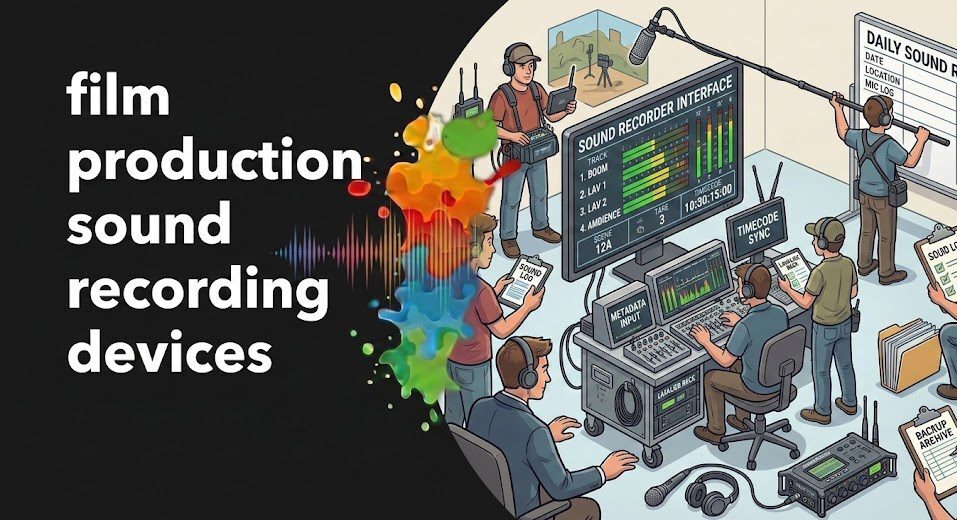
Sound is the part of your film that viewers feel before they consciously register it—and bad production sound recording is the technical problem that costs you most in post. Dialogue replacement through ADR is expensive, time-consuming, and never quite indistinguishable from a clean original take.
The producers and sound mixers who understand this invest in the right film production sound recording devices from day one, not as an afterthought once the camera package is locked.
But the sound department is fragmented across three distinct hardware categories—field recorders, boom microphones, and wireless systems—each with its own brand ecosystem, budget tier, and trade-off logic. Getting the combination wrong doesn’t just hurt sound quality. It creates workflow friction on set, which bleeds into schedule and ultimately into your BTL costs.
This guide gives you a clear comparison of the most widely used film production sound recording devices across all three categories, organized by budget tier and production context. Whether you’re equipping a micro-budget indie or evaluating a mid-range production sound package, the framework here will sharpen your decisions—and your conversations with your production sound mixer.
In This Guide
- Why Sound Hardware Decisions Are a Production Economics Issue
- Field Recorders: Sound Devices vs. Zoom vs. Tascam
- Boom Microphones: Sennheiser, Rode, DPA Compared
- Wireless Lavalier Systems: Lectrosonics, Zaxcom, Sennheiser, Sony
- Timecode and Sync: The Invisible Production Insurance
- Sound Package by Budget Tier: What to Prioritize
- Quick Comparison Table: Sound Recording Devices
- FAQ: Film Production Sound Recording Devices
Ask VIQI: Which Sound Equipment Suppliers Are Active in My Territory?
VIQI is Vitrina’s AI assistant—trained on 1.6 million titles, 300,000+ companies, and 5 million entertainment professionals. Ask it to find verified sound equipment rental houses and production service providers matched to your shoot territory and project type.
✓ 200 free credits | ✓ No credit card needed
Why Sound Hardware Decisions Are a Production Economics Issue
The Fragmentation Paradox™ in production sound is real—and it’s specific to how gear decisions get made. Camera packages get obsessed over. Lens choices get discussed for weeks. The sound package? It often gets delegated entirely to the production sound mixer, with a budget figure attached and a vague instruction to “handle it.” That’s a mistake.
Here’s why it matters at the producer level: ADR sessions in post run $2,000–$6,000 per day at a reputable facility, and that’s before you’re dealing with actor availability, synchronization work, and the subtle performance degradation that comes from looping dialogue in a booth rather than capturing it live on a real location. A sound package that’s $3,000 under-specced for your production context can turn into a $15,000+ post problem—and that’s before you factor in the timeline hit.
The right framework: sound hardware decisions break down into three distinct tool categories—field recorders, boom microphones, and wireless lavalier systems. They’re interdependent but distinct, and the right choice in each category depends on your production context, crew size, and shooting conditions. Let’s work through them in order.

Your AI Assistant, Agent, and Analyst for the Business of Entertainment
VIQI AI helps you plan content acquisitions, raise production financing, and find and connect with the right partners worldwide.
- List the top commissioners at the BBC
- List the post-production and VFX decision-makers at Netflix
- List the development leaders at Sony Pictures
- List the scripted programming heads at HBO
- Find active co-producers and financiers for scripted projects
- Find equity and gap financing companies in North America
- Find top film financiers in Europe
- Find production houses that can co-produce or finance unscripted series
- Who is backing animation projects in Europe right now
- Who is Netflix’s top production partners for Sports Docs
- Who is Commissioning factual content in the NORDICS
- Who is acquiring unscripted formats for the North American market
- Show me recent drama projects available for pre-buy
- Show me Japanese Anime Distributors
- Show me true-crime buyers from Asia
- Show me documentary pre-buyers
- I am looking for production partners for a YA drama set in Brazil
- I am looking for producers with proven track record in mid-budget features
- I am looking for Turkish distributors with successful international sales
- I am looking for OTT platforms actively acquiring finished series for the LATAM region
- I am seeking localization companies offer subtitling services in multiple Asian languages
- I am seeking partners in animation production for children's content
- I am seeking USA based post-production companies with sound facilities
- I am seeking VFX partners to composite background images and AI generated content
Field Recorders: Sound Devices vs. Zoom vs. Tascam
Your field recorder is the nerve center of the sound department. It receives inputs from boom microphones and wireless receivers, applies gain and mix decisions, and commits clean audio to a reliable media format that your post team can actually work with. Choosing wrong here creates problems that no amount of downstream processing can fully fix.
Sound Devices MixPre Series (~$600–$2,500)
The Sound Devices MixPre-3 II (~$600) and MixPre-6 II (~$800) are the dominant field recorders for indie narrative and documentary production at the sub-$1,000 tier. They run Sound Devices’ proprietary Kashmir preamp technology—which delivers a noise floor performance that competes with recorders costing three times as much. The 32-bit float recording mode is the key operational advantage: it eliminates gain-setting errors entirely by recording a complete dynamic range that can be optimized in post without clipping or noise floor issues. For productions with small sound teams where the mixer is also booming, this removes a critical failure point.
Step up to the Sound Devices 8-series (8-Series starting ~$4,000) and you’re in broadcast-grade territory used by Netflix originals and major network productions. The form factor, I/O count, and integration with timecode systems at this level are genuinely different from the MixPre tier. But for most indie features and documentaries, the MixPre-6 II is where the ROI concentrates.
Zoom F-Series: F6 (~$500), F8n Pro (~$700)
Zoom’s F6 and F8n Pro are the most capable sub-$800 recorders outside of Sound Devices, and they’ve won genuine professional credibility over the past few years—particularly in the documentary and run-and-gun production community. Both record in 32-bit float. The F8n Pro’s 8-channel configuration is a meaningful advantage for complex multi-mic setups. The F6 with its dual AD converters—which essentially records a safety track at lower gain simultaneously—is the more elegant single-operator solution for two-person sound teams.
But the operational reality: the Zoom F-series preamps don’t quite reach Sound Devices Kashmir preamp quality at very high gain settings. In quiet dialogue scenes shot in acoustically challenging environments—a room with HVAC noise, a location near a road—that gap becomes audible. For most controlled narrative setups, it’s a non-issue. For documentary work in unpredictable acoustic environments, it matters.
Tascam DR-701D (~$400)
The Tascam DR-701D occupies a specific niche: it’s a 6-channel recorder designed to mount directly under a DSLR or mirrorless camera, with timecode sync and HDMI connection to common camera bodies. If you’re on a micro-budget production with a two-person crew where the same operator is running camera and sound—and your distribution target is digital platforms rather than theatrical—it’s a pragmatic solution. But it’s not in the same performance class as Sound Devices or Zoom F-series, and experienced production sound mixers won’t touch it for professional narrative work.
Find Verified Sound Equipment Suppliers on Vitrina
Trusted by Netflix, Warner Bros, and Paramount. Join 300,000+ companies using Vitrina to discover verified production sound equipment partners, rental houses, and post-audio service providers across the global entertainment supply chain.
✓ 200 free credits | ✓ No credit card required | ✓ Full platform access
Boom Microphones: Sennheiser, Rode, DPA Compared
The boom microphone is where your dialogue actually gets captured—everything else in the signal chain is just preservation and routing. Getting this decision right is arguably more important than your recorder choice, because a mediocre preamp can be compensated for in post; a mediocre boom microphone in the wrong acoustic environment cannot.
Sennheiser MKH 416 (~$1,000): The Industry Standard
The Sennheiser MKH 416 has been the default production boom microphone on professional film and television sets for the past three decades. Not because it’s perfect—but because its characteristics are so well-understood that the entire post-production pipeline has calibrated around them. Its short shotgun supercardioid pattern provides good off-axis rejection in most location recording conditions. Its RF-condenser design gives it meaningful resistance to humidity—relevant for outdoor and location shooting in variable weather.
The MKH 416 is, in honest terms, not the most transparent or technically sophisticated boom microphone at its price point. But when you’re working with an experienced boom operator, a post-production facility that knows the microphone’s sonic characteristics, and the industry-standard expectation that your deliverable was recorded on one—the MKH 416 is the path of least resistance. It’s the microphone that never generates a conversation about the microphone.
Sennheiser MKH 50 (~$1,500): The Interior Specialist
If your production shoots primarily in interior locations—controlled studio sets, house locations with manageable acoustics—the Sennheiser MKH 50 is a genuine upgrade over the MKH 416. Its hypercardioid pattern with a tight rear lobe rejects room sound more effectively than the 416 in reverberant spaces. Many productions carry both: an MKH 416 for exteriors and challenging spaces, an MKH 50 for controlled interiors. It’s the combination you’ll see on professional episodic television production.
Rode NTG5 (~$500): The Budget Alternative
The Rode NTG5 is genuinely impressive for its price—lighter than the Sennheiser options (~76g vs. 175g for the MKH 416), with a transparent sound and good off-axis characteristics. For micro-budget indie productions where a $1,000 microphone isn’t the right allocation, it’s the strongest option available. But it doesn’t have the environmental robustness of the MKH RF-condenser design in unpredictable outdoor conditions. And the post-production community doesn’t have the same familiarity with its sonic signature.
DPA 4017C (~$2,200): When Transparency Is Non-Negotiable
The DPA 4017C is the choice for productions where absolute sonic transparency matters—particularly dialogues requiring the most natural, uncolored capture possible. Documentary features, naturalistic drama, anything where the slightest shotgun microphone coloration will be noticed by a discriminating ear. At $2,200, it’s not a standard indie rental, but it appears regularly on theatrical documentary productions and high-end episodic drama where the sound mixer has latitude in their equipment choices.
Wireless Lavalier Systems: Lectrosonics, Zaxcom, Sennheiser, Sony
Wireless systems are where the price disparity in production sound is most dramatic—and where the performance gap between budget and professional tiers is most consequential. Wireless dropout during principal photography is almost never recoverable. It’s not a post fix. It’s a reshoot.
Lectrosonics SMV/SMWB (~$2,000–$2,500 per channel)
Lectrosonics is the professional standard in US film and television production wireless. The SMV and SMWB transmitter series—combined with their compatible receiver counterparts—deliver the RF performance, frequency agility, and operational reliability that justify the price point at scale. A complete two-channel Lectrosonics setup runs approximately $4,000–$5,000. On a production where wireless reliability affects multiple scenes per day across a 20-day schedule, that reliability premium has a concrete ROI calculation.
Lectrosonics’ Digital Hybrid Wireless technology compresses and expands audio digitally before transmitting over an analog-like RF signal—giving it exceptional performance in RF-congested environments (major cities, large locations with multiple productions nearby) that defeat cheaper wireless systems entirely.
Zaxcom ZMT4 (~$1,800–$2,200 per transmitter)
Zaxcom competes with Lectrosonics at the top of the professional tier, but with a key differentiator: the ZMT4 transmitter records audio internally as a backup on a micro SD card while simultaneously transmitting wirelessly. In RF-hostile environments—live music venues, film locations near broadcast towers, studio facilities with heavy RF traffic—this onboard recording is genuine production insurance. If the wireless transmission fails, the recording continues. No take is ever completely lost. For high-stakes scenes on demanding locations, this feature alone justifies the premium over Lectrosonics in specific production contexts.
Sennheiser EW-DP (~$700–$900 per channel)
The Sennheiser EW-DP series occupies a real middle ground—genuine digital wireless performance at a price point that smaller productions can absorb without the full Lectrosonics investment. The sound quality is professional-grade. The RF performance is strong in moderately complex environments. It won’t match Lectrosonics in the most challenging RF conditions, but for controlled location work, stage production, and documentary shoots in typical environments, it’s the strongest value proposition in its tier. The EW-DP EK receiver’s USB-C power is a meaningful operational convenience for mobile production teams.
Sony UWP-D (~$600–$900 per channel)
Sony’s UWP-D series is a competent professional wireless system that integrates cleanly with Sony camera bodies—which makes it particularly practical for Sony FX3 or FX6-based productions where the camera operator is also monitoring sound. The audio quality is solid. It doesn’t have the RF performance depth of Lectrosonics in congested environments, but it’s a reliable, practical system for productions working in clean RF windows with straightforward lavalier requirements.
Timecode and Sync: The Invisible Production Insurance
Here’s something that gets missed on lower-budget productions: timecode sync between your sound recorder and camera is not a luxury—it’s the difference between an edit that flows and one that costs your editor an extra week of sync work at $400–$800 per day.
The Deity TC-1 (~$150 per unit) is the most cost-effective professional timecode solution currently available—a small, lightweight unit that jams timecode wirelessly to the Sound Devices MixPre series and many compatible cameras, maintaining sync accuracy within 0.2 frames per 24 hours. At $150 for a system that eliminates manual sync work across a full production schedule, it’s one of the best ROI decisions in the sound department.
Ambient Recording Lockit boxes remain the broadcast-grade standard at approximately $700–$1,200 per unit, used on the highest-end productions and broadcast originals where absolute timecode accuracy is mission-critical. But for most indie narrative production, the Deity TC-1 closes the gap to a degree that doesn’t justify the price difference.
Connect with Verified Production Sound Partners Worldwide
A LA-based producer connected with Netflix UK, Fifth Season, and Fox Entertainment in 48 hours through Vitrina. Join 300,000+ companies using the platform to discover verified production service providers—including sound equipment rental companies matched to your territory.
✓ 200 free credits | ✓ No credit card required
Sound Package by Budget Tier: What to Prioritize
Rather than treating each device category in isolation, here’s how a well-structured sound package looks at three common indie production budget tiers. These assume rental, not ownership—for most independent productions, renting a better sound package is the smarter allocation than buying into a tier below what your production context demands. Our guide to cost vs. quality when hiring creative services covers this trade-off framework in more depth.
Micro-Budget Indie (Under $300K)
- Recorder: Sound Devices MixPre-6 II or Zoom F8n Pro — 32-bit float removes the gain error risk for a small sound team
- Boom mic: Rode NTG5 (budget) or Sennheiser MKH 416 (preferred if you can stretch)
- Wireless: Sennheiser EW-DP for 1–2 channels; skip wireless entirely if your shoot is controlled interior and you can boom everything
- Timecode: Deity TC-1 (~$150) — non-negotiable at any budget tier
Low-to-Mid Indie ($300K–$2M)
- Recorder: Sound Devices MixPre-10 II or 833 — proper 10-channel input for multi-mic narrative coverage
- Boom mics: Sennheiser MKH 416 (exteriors) + MKH 50 (interiors) — the professional standard two-mic kit
- Wireless: Lectrosonics SMV or Sennheiser EW-DP for 2–4 channels depending on cast size per scene
- Timecode: Deity TC-1 per camera, or Ambient Recording for broadcast-quality sync
Mid-Budget / TV Pilot ($2M–$8M)
- Recorder: Sound Devices 8-series (888 or 833) — broadcast-grade, networked, full I/O for episodic-scale production
- Boom mics: MKH 416 + MKH 50 + DPA 4017C — full mic locker that covers all acoustic contexts
- Wireless: Lectrosonics SMWB or Zaxcom ZMT4 for 4–8 channels — professional-grade with backup recording capability
- Timecode: Ambient Recording Lockit per camera and sound cart
For context on how to build the full sound department that operates these tools—including how to vet and hire a production sound mixer—see our guide to hiring film production crew and professional services. And for how sound design decisions feed into the overall post workflow, the breakdown in our guide to post-production audio, ADR, and Foley is worth your time before production begins.
Quick Comparison Table: Sound Recording Devices
FAQ: Film Production Sound Recording Devices
Conclusion: Sound Is Where You Can’t Afford to Shortcut
The camera conversation gets all the attention in indie production planning. Sound gets the leftover budget and a delegation to whoever you hired as your mixer. But film production sound recording devices are where production economics and creative outcomes intersect most directly—because the cost of fixing bad production sound in post dwarfs the cost of recording it right on set.
The framework is clear. De-risk the recorder with 32-bit float—the Sound Devices MixPre-6 II at $800 is the floor for professional indie production. Invest in the Sennheiser MKH 416 as your primary boom microphone—the universality of the choice alone saves you post-production conversations. And don’t skip wireless reliability: a single scene lost to dropout can cost more in ADR than the entire upgrade from Sennheiser EW-DP to Lectrosonics across a full production run.
Key Takeaways:
- Sound Devices MixPre-6 II is the professional floor for indie field recording—32-bit float, Kashmir preamps, ~$800.
- Sennheiser MKH 416 remains the industry standard boom mic—not because it’s technically superior, but because its universality eliminates production and post-production friction.
- Wireless reliability is non-negotiable—Lectrosonics or Sennheiser EW-DP for professional indie work; Zaxcom ZMT4 when RF conditions are extreme and backup recording is essential.
- Timecode at every budget tier—the Deity TC-1 at ~$150 per unit eliminates manual sync work across a full production schedule.
- ADR is never free—$2,000–$6,000/day in post. Budget the right sound package upfront and protect that spend as hard as you protect your camera package.
Find Verified Production Sound Partners on Vitrina—Start Free
Join 300,000+ companies on Vitrina, trusted by Netflix, Warner Bros, and Paramount. Discover verified sound equipment rental houses, production service companies, and post-audio facilities filterable by territory and production type.
✓ 200 free credits | ✓ No credit card required | ✓ Cancel anytime
Need Sound Department and Post-Audio Partners? We’ll Connect You.
Vitrina Concierge is your Virtual Agent. We make warm introductions to verified production service companies and post-audio facilities actively seeking projects like yours—not a list, but real connections. Korean animation studio to Netflix Adult Animation in week one. LA producer to Netflix UK in 48 hours.