About Innovation Hub
 Global Content Pulse (Webinars)


 Global Production Financing
(Webinars)
Global Production Financing
(Webinars)  LeaderSpeak Podcast
  Global Entertainment Digest (Newsletter)
  About Vitrina
 About VIQI
 Our Story
 Our Solutions 🔥
 Film+TV Projects Tracker 🚀
 Case Studies
 Our Profile
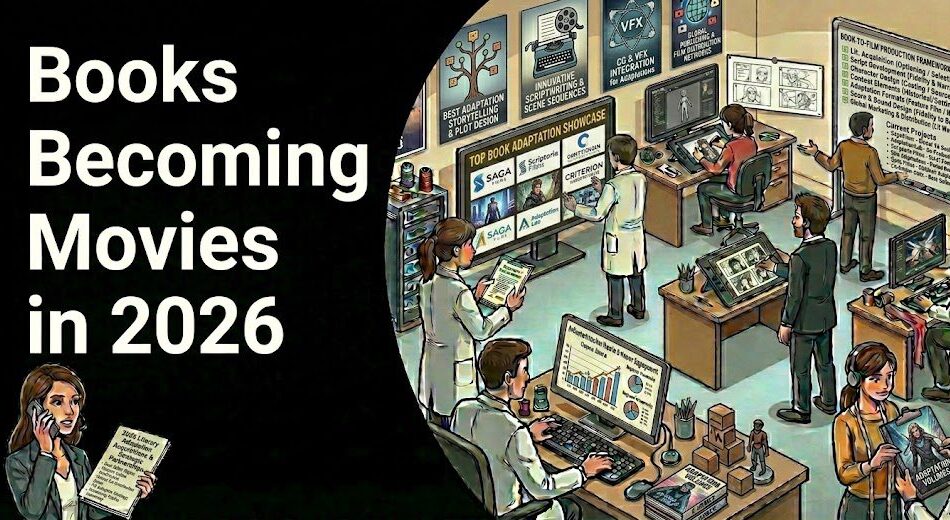
The volume of books becoming movies in 2025 isn’t an accident—and it’s not sentiment. Studios, streamers, and independent financiers are all chasing the same thing: IP with a built-in audience, de-risked pre-sales potential, and an existing emotional relationship with readers. It’s a capital allocation decision as much as a creative one.
Here’s the thing: not every bestseller gets greenlit. And not every adaptation that gets greenlit gets made. The gap between “option signed” and “theatrical release” is where most projects die—quietly, expensively, without a press release. If you’re tracking adaptation deals, sourcing literary IP, or trying to understand why certain titles move and others stall, you need the data layer underneath the headlines. That’s what this piece is about.
In This Article
- Why Studios Are Betting Big on Literary IP in 2025
- The Biggest Books in the Adaptation Pipeline Right Now
- How the Option-to-Greenlight Pipeline Actually Works
- What Makes a Book Adaptation Worth the Financial Risk
- Streaming vs. Theatrical: Where Adaptations Land in 2025
- How to Find and Track Book-to-Film Deals Before They Break
- FAQ
- Conclusion
Ask VIQI: Which Books Are Currently in Active Film Development?
VIQI is Vitrina’s AI assistant—trained on 1.6 million titles, 360,000 companies, and 5 million entertainment professionals. Get real-time intelligence on adaptation deals, rights status, and who’s buying what.
✓ Included with 200 free credits | ✓ No credit card needed
Why Studios Are Betting Big on Literary IP in 2025
Adaptation economics have always made sense on paper. But in 2025—after the post-COVID content glut, streaming platform budget corrections, and a theatrical rebound that no one fully predicted—the calculus has shifted. Studios and financiers aren’t just looking for good stories. They’re looking for stories with proven commercial traction: books that already have sales data, reader communities, and social proof baked in before a single frame gets shot.
As Joshua Harris (Managing Director, Peachtree Entertainment) puts it, the market now demands projects with a built-in consumer base. “We’re cherry-picking those projects that can be made for the right budget that have a built-in audience—we know they can be commercial,” Harris told Vitrina’s LeaderSpeak podcast. That’s exactly why BookTok-driven bestsellers have become high-value acquisition targets in the last 18 months. A novel with 2 million TikTok views before publication isn’t just a publishing win—it’s a pre-validated audience for a distributor’s P&A conversation.
And the Fragmentation Paradox—where content supply has exploded while quality discovery has collapsed—makes literary IP even more strategic. When Netflix, Amazon, Paramount, and dozens of independent streamers are all competing for viewer attention, a title people already know cuts through the noise without paying for awareness twice.
But there’s a harder truth underneath the trend. Phil Hunt (Founder & CEO, Head Gear Films), who has financed over 550 movies and co-produces 35–40 films per year—more than most major studios—describes 2025’s independent film climate as a “big crunch.” It’s genuinely harder to get movies off the ground and sold than it was five years ago. Literary IP helps—but it’s not a guarantee.

Your AI Assistant, Agent, and Analyst for the Business of Entertainment
VIQI AI helps you plan content acquisitions, raise production financing, and find and connect with the right partners worldwide.
- Find active co-producers and financiers for scripted projects
- Find equity and gap financing companies in North America
- Find top film financiers in Europe
- Find production houses that can co-produce or finance unscripted series
- I am looking for production partners for a YA drama set in Brazil
- I am looking for producers with proven track record in mid-budget features
- I am looking for Turkish distributors with successful international sales
- I am looking for OTT platforms actively acquiring finished series for the LATAM region
- I am seeking localization companies offer subtitling services in multiple Asian languages
- I am seeking partners in animation production for children's content
- I am seeking USA based post-production companies with sound facilities
- I am seeking VFX partners to composite background images and AI generated content
- Show me recent drama projects available for pre-buy
- Show me Japanese Anime Distributors
- Show me true-crime buyers from Asia
- Show me documentary pre-buyers
- List the top commissioners at the BBC
- List the post-production and VFX decision-makers at Netflix
- List the development leaders at Sony Pictures
- List the scripted programming heads at HBO
- Who is backing animation projects in Europe right now
- Who is Netflix’s top production partners for Sports Docs
- Who is Commissioning factual content in the NORDICS
- Who is acquiring unscripted formats for the North American market
The Biggest Books in the Adaptation Pipeline Right Now
Which books are actually moving? Here’s where the deals stand across the studio and streamer landscape in 2025:
Freida McFadden’s “The Housemaid” series became one of the most-watched adaptation announcements in recent memory. Amazon MGM Studios moved aggressively on the rights—it’s a natural fit for a platform with global distribution infrastructure and an appetite for psychological thrillers that over-index with female audiences. The deal reportedly came together well before the books’ social media dominance peaked, which is exactly how smart development teams move: ahead of the market, not behind it.
Gabrielle Zevin’s “Tomorrow, and Tomorrow, and Tomorrow” is another that shows the new acquisition logic. The novel explores gaming culture, creative partnership, and ambition across decades—giving studios not just a one-off but a world with sequel and franchise optionality. Paramount Pictures acquired the rights, recognizing that the book’s New York Times bestseller run represented exactly the kind of audience pre-qualification that justifies a feature-level investment.
On the thriller side, Emily Henry‘s romance-adjacent dramas—including “Happy Place”—are moving toward production. Universal Pictures has been active in this space, and the commercial logic is clear: rom-coms adapted from popular fiction perform well theatrically in the $15–40M budget range, where the risk-reward profile makes sense for mid-market financiers.
What’s notable about all of these? None of them are legacy IP plays. They’re all recent bestsellers—published within the last 3–5 years—which tells you studios are now moving faster. The option window between publication and studio acquisition has compressed from 2–3 years to, in some cases, pre-publication. If a book has a strong advance and early trade buzz, producers are optioning it before readers can even buy it.
Phil Hunt (Founder & CEO, Head Gear Films) breaks down what the independent film market actually wants in 2025—and why “built-in audience” IP is dominating financing conversations:

Track What’s Getting Greenlit Before It Hits the Trades
Trusted by Netflix, Warner Bros, and Paramount. Join 140,000+ companies tracking the global entertainment supply chain—including adaptation deals, rights movements, and production status on 400,000+ projects.
✓ 200 free credits | ✓ No credit card required | ✓ Full platform access
How the Option-to-Greenlight Pipeline Actually Works
Let’s demystify this—because the book-to-movie adaptation process is more structured than the press coverage suggests. There are three distinct stages, each with its own capital exposure and risk profile.
Stage 1: The Option. A producer or studio pays the author—typically 1–5% of the eventual purchase price—for the exclusive right to develop the property into a screenplay over a defined period (usually 12–18 months, renewable). Option fees for popular fiction have risen sharply: six-figure options on BookTok bestsellers are no longer unusual. The option doesn’t guarantee production. Most optioned books never move past this stage.
Stage 2: Development. A writer is attached. A screenplay is developed—often through multiple drafts and a lot of notes. This is where most projects stall. Scripts that don’t crack the story, can’t get talent attached, or can’t align with a distributor’s release calendar die quietly in development. According to industry estimates, fewer than 10% of optioned properties make it to production. That’s the cold math of the adaptation process.
Stage 3: Greenlight and Financing. A studio or streamer commits capital. The capital stack gets structured—equity, gap, tax incentives, pre-sales by territory. This is where a project either moves fast or dies slowly. The adaptation deal has now evolved from a simple rights transaction into a multi-party financing event.
But here’s what most coverage misses: the greenlight isn’t the end—it’s the beginning of a more complex set of decisions. Territory pre-sales can reduce the effective net production cost by 30–60%. Tax incentives in the UK, Canada, or Australia can stack on top of that. Smart financiers are running book adaptation economics as a capital stack optimization problem, not a rights acquisition story.
What Makes a Book Adaptation Worth the Financial Risk
Not all bestsellers are equal candidates. The factors that actually move a book adaptation from option to greenlight—from a financier’s perspective—are more specific than “it sold a lot of copies.”
Audience specificity matters more than audience size. A thriller with 500,000 passionate readers in the 35–55 female demographic is more financeable than a literary novel with 2 million casual readers. Why? Because the first group buys opening weekend tickets. The second group says they’ll watch it “when it streams.”
Genre alignment with the current market is critical. Phil Hunt notes that action, thriller, and horror have historically over-indexed commercially in the independent space—and 2025 hasn’t changed that. The genres that work for books—romance, psychological thriller, domestic suspense, fantasy—also happen to be the genres where book-to-film adaptations have the clearest distributional pathway.
Franchise potential. A standalone novel is fine. A series is better. Studios and streamers aren’t just buying one film—they’re buying optionality. “The Housemaid” has sequels. “Tomorrow, and Tomorrow, and Tomorrow” has a world. This franchise logic now filters acquisition decisions at every level from major studios to boutique financiers.
Rights clarity. Nothing kills an adaptation faster than a messy chain-of-title. If the author co-wrote the book, has an agent with a complicated backend deal, or if there are pending rights disputes—the deal slows down or dies. Smart producers verify this before the option term sheet is drafted, not after. Platforms like Vitrina let you surface rights status on 400,000+ tracked projects without the back-and-forth of cold outreach to literary estates.
Streaming vs. Theatrical: Where Book Adaptations Land in 2025
This question was essentially settled during COVID—streaming won everything. But 2025 is more nuanced. The theatrical pendulum is swinging back, and it’s pulling book adaptations with it.
As Joshua Harris observed after the most recent American Film Market: “The entire base is really seeing the swing back to theatrical being the future of our business.” Most distributors now actively look for films that can play theatrically first, then go to home entertainment. That dual-window model—cinema, then SVOD—is now the de facto strategy for mid-to-large adaptation releases.
But streaming still dominates the sheer volume of books becoming movies and series in 2025. Netflix and Amazon Prime Video have both signaled continued investment in literary IP—particularly serialized fiction that benefits from multi-episode storytelling. If a book has more narrative complexity than two hours can contain, the streamer path becomes the natural fit. Think of how Warner Bros. handled “All the Light We Cannot See” (Netflix), or how Amazon has structured its own literary acquisition pipeline for Prime Video originals.
What you’re seeing is a bifurcation: high-concept, event-sized adaptations are being positioned for theatrical with streaming secondary. Character-driven, serializable fiction is going direct to streamers. The budget determines the path more than the story does—a $15M romance adaptation doesn’t need to fight for a May theatrical slot; it can anchor a streamer’s monthly content release with lower audience risk.
Have a Literary IP You’re Developing? We’ll Connect You to the Right Buyers.
Vitrina Concierge doesn’t send you a list—we make warm introductions directly to decision-makers actively seeking your content type.
- LA producer → Netflix UK, Fifth Season, Fox Entertainment (48 hours)
- Korean studio → Netflix Adult Animation (week one)
- Middle Eastern producer → Legendary Pictures (direct access)
How to Find and Track Book-to-Film Deals Before They Break
This is where most people in the industry are still operating inefficiently. The standard workflow—waiting for Variety to report a deal, then scrambling to find similar projects—means you’re always reacting. You’re seeing what happened, not what’s about to happen.
The Smart Pairing approach is different. You’re not searching for announced deals—you’re identifying pattern matches: which production companies have a history of acquiring specific genres of literary IP, which financiers have recently closed deals in the adaptation space, and which titles are in active option negotiations before it hits the trades.
Practically, this means tracking a few data signals simultaneously:
- Literary agency deal flow — which agencies are actively shopping manuscripts to production companies right now
- Production company acquisition patterns — what genres and budget ranges each company has targeted in the last 24 months
- Streamer commissioning mandates — which platforms are currently in-market for which content types (and their 6-week content pipeline windows)
- Rights expiry tracking — optioned books where the option period is about to lapse back to the author
Vitrina’s platform surfaces all of this. You can filter 140,000+ companies by deal type, content focus, and acquisition history. You can use VIQI—Vitrina’s AI intelligence layer—to ask directly: “Which production companies are actively acquiring domestic thriller adaptations under $25M?” and get a verified, data-backed answer in seconds, not days.
But the real edge isn’t just the search—it’s the Concierge service. One LA-based producer used it to get warm introductions to Netflix UK, Fifth Season, and Fox Entertainment within 48 hours. That’s what “before it hits the trades” looks like in practice. Not luck. Not connections. Data-driven introductions to people who are actively looking.
And for those navigating the optioned rights process for the first time—or those who’ve been through it but want to de-risk their next development slate—the platform gives you the intelligence layer that used to require years of relationships to access.
Frequently Asked Questions
Why are so many books becoming movies in 2025?
Studios and streamers are prioritizing literary IP because it comes with a pre-validated audience—readers who already have an emotional relationship with the story. In a crowded content landscape where 140,000+ companies are all competing for viewer attention, a known title de-risks both marketing spend and audience acquisition. BookTok has accelerated this trend by creating measurable social proof before a film enters production.
How does a book get optioned for a movie?
A producer or studio pays the author an option fee—typically 1–5% of the eventual purchase price—for the exclusive right to develop the book into a screenplay over a set period, usually 12–18 months. If the project moves forward, the full purchase price is paid. If it doesn’t, the rights revert to the author. Most optioned books never reach production; industry estimates suggest fewer than 10% make it from option to screen.
Which streaming platforms are most active in book adaptations in 2025?
Netflix and Amazon Prime Video lead in volume, with both platforms maintaining active literary acquisition pipelines. Netflix has leaned heavily into psychological thrillers and domestic suspense adaptations. Amazon’s MGM Studios unit has been particularly aggressive in the domestic thriller space. Paramount+ and Apple TV+ are also active acquirers, particularly for serialized fiction with strong character development potential.
What makes a book a good candidate for film adaptation?
The primary criteria aren’t literary quality—they’re commercial specificity. A strong adaptation candidate has a clearly defined audience demographic, a genre that maps to existing distributional pathways (thriller, romance, fantasy), franchise potential through sequels or spinoffs, and clean chain-of-title. Financially, the book needs to justify the option and development spend relative to the budget range the project will realistically attract.
How has BookTok changed the book-to-film adaptation market?
BookTok has compressed the timeline between publication and acquisition. Books that achieve viral status on TikTok now generate measurable audience data—view counts, reader community size, emotional engagement metrics—that development executives can use to justify option spend. It’s converted literary IP valuation from a qualitative judgment call into something closer to an audience analytics decision, which is why several BookTok bestsellers have been optioned before their official release dates.
Are theatrical book adaptations coming back in 2025?
Yes. After the post-COVID streaming-first shift, there’s a visible swing back toward theatrical releases for mid-to-large budget adaptations. As Joshua Harris (Peachtree Entertainment) noted post-AFM 2025, distributors are now actively seeking films that can play theatrically before going to streaming. The dual-window model—cinema release followed by SVOD—is increasingly the default for adaptations with event-film potential above the $15–20M production threshold.
How can I track which books are in active film or TV development?
The most efficient method is using a platform that aggregates deal flow across production companies, distributors, and literary agencies in real time. Vitrina tracks 400,000+ projects and 140,000+ companies globally, with filtering by deal type, content genre, and acquisition status. VIQI, Vitrina’s AI intelligence engine, lets you query active adaptation pipelines directly—without waiting for trade press coverage that typically lags deal closure by weeks or months.
Conclusion: The Book-to-Film Gold Rush Has a Data Layer Now
The volume of books becoming movies in 2025 isn’t slowing—but the market for which books get made, how they get financed, and where they land is getting more sophisticated fast. Studios aren’t just picking stories they like. They’re running audience analytics, capital stack models, and franchise optionality assessments before they sign a term sheet.
Key Takeaways:
- Built-in audiences drive acquisition decisions: BookTok has made literary IP valuation more data-driven—books with measurable social proof now move faster from publication to option than at any point in studio history.
- Fewer than 10% of optioned books reach production: The option-to-greenlight funnel is brutal. Understanding where projects die—and why—is the intelligence edge most producers still don’t have.
- Theatrical is back for event-level adaptations: The dual-window model (theatrical first, streaming second) is now the default for adaptations above the $15–20M threshold, reversing the COVID-era streaming-first trend.
- Franchise potential multiplies IP value: Standalone novels are good. Series with sequel optionality are significantly more attractive—studios are effectively buying a development pipeline, not a single project.
- Deal intelligence has a compressible timeline: A one-page Variety deal announcement reflects weeks of negotiation. Platforms like Vitrina let you track acquisition patterns and rights movements before they’re announced—which is when the real competitive advantage exists.
The producers who win in this environment aren’t the ones with the best literary taste. They’re the ones with the best intelligence. Waiting for trade coverage means you’re reacting to yesterday’s decisions. The window to move on high-value literary IP is weeks, sometimes days—and it’s closing faster every year.
Track Every Book-to-Film Deal Before It Hits the Trades
Trusted by Netflix, Warner Bros, Paramount, and Google TV. Track 400,000+ projects. Access 3 million verified executives. Ask VIQI strategic questions about your adaptation market in seconds.
✓ 200 free credits | ✓ No credit card required | ✓ Cancel anytime
Find Film+TV Projects, Partners, and Deals – Fast.
VIQI matches you with the right financiers, producers, streamers, and buyers – globally.
Producers Seeking Financing & Partnerships?
Book Your Free Concierge Outreach Consultation
(To know more about Vitrina Concierge Outreach Solutions click here)
Join Industry Briefings Trusted by Leaders
The Mid-Budget Comeback: Why Mid-Budget Films Is the Smartest Bet in the Room
Mid-budget films are attracting new capital. See why this segment is becoming one of the strongest bets in Film today.
Franchise Fatigue vs. IP Dependency: What Studios Should Be Betting On Now
s franchise performance softens, where will the next generation of valuable IP come from? Join the briefing.
Unscripted Is Eating the World: The Multi-Billion Reality and Format Boom
Unscripted is the new prestige — inside the $19.8B global format boom reshaping how streaming platforms compete.
How Co-Productions and Regional IP Are Reshaping Global Drama
As global drama evolves, which stories travel, which stay local, and how are they getting financed?