About Innovation Hub
 Global Content Pulse (Webinars)


 Global Production Financing
(Webinars)
Global Production Financing
(Webinars)  LeaderSpeak Podcast
  Global Entertainment Digest (Newsletter)
  About Vitrina
 About VIQI
 Our Story
 Our Solutions 🔥
 Film+TV Projects Tracker 🚀
 Case Studies
 Our Profile
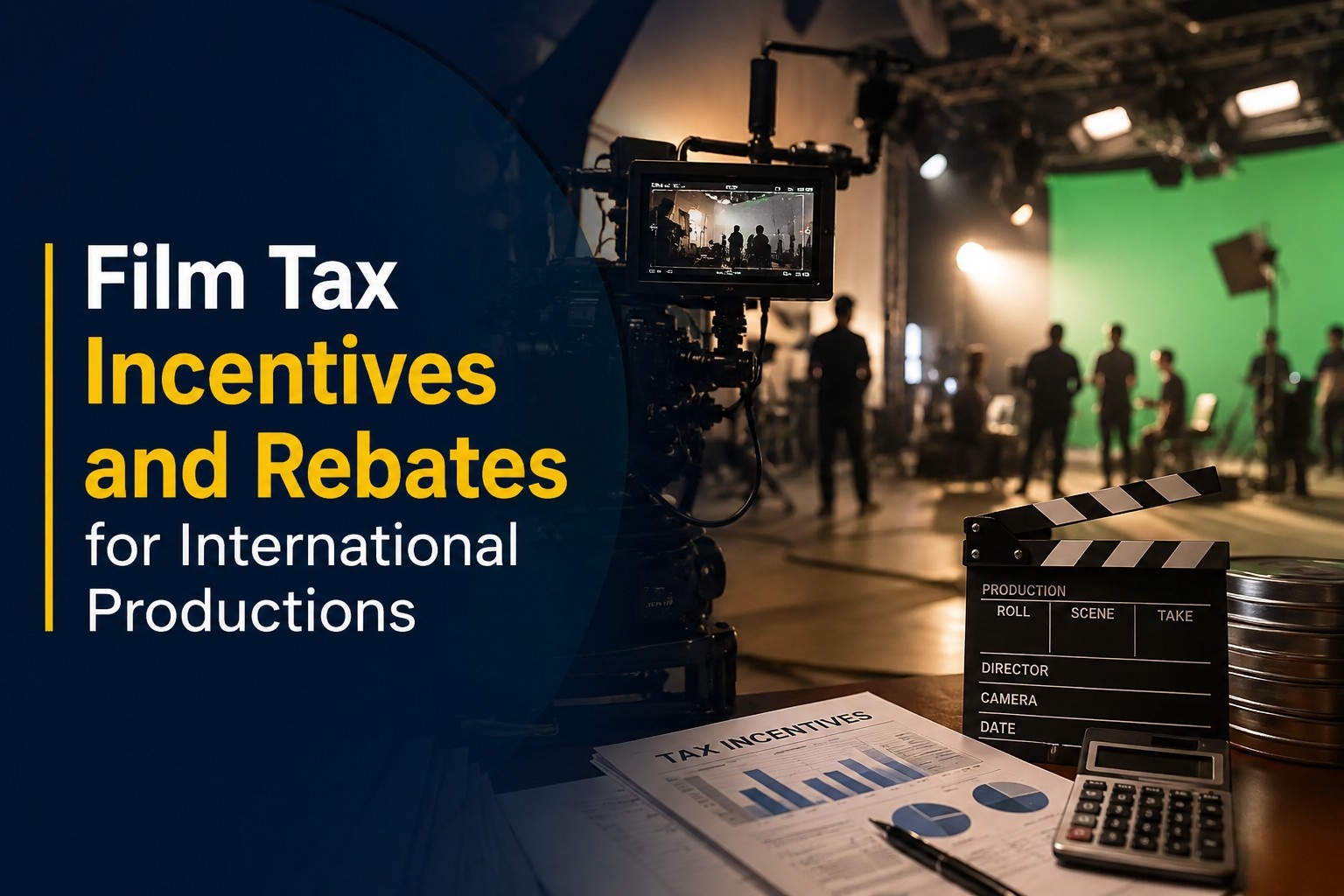
The best film tax incentives available to independent productions in 2026 range from 20% to 50% of qualifying spend—and the gap between choosing the right location and the wrong one can be worth hundreds of thousands of dollars on a mid-budget production. Georgia’s uncapped 30% transferable credit has made it the default for US productions without location-specific creative requirements.
The UK’s 29.25% cash rebate on VFX spend makes it structurally competitive for effects-heavy projects. Saudi Arabia’s 40% cash rebate through Vision 2030 makes MENA shoots financially compelling in ways that didn’t exist five years ago. And Australia’s increase to 30% Location Offset has put it back in contention for international productions eyeing the Asia-Pacific region.
But incentive percentages are only part of the decision. Minimum spend thresholds, qualifying expense definitions, whether the credit is refundable or transferable, how long the audit-to-payment cycle takes, and what’s actually been budgeted for are all critical variables. This guide covers the programs genuinely available to independent productions in 2026—with honest assessments of the requirements and practical access advice, not just headline rates.
Table of Contents
- How Film Tax Incentives Actually Work as a Financing Tool
- Best US States for Film Tax Incentives in 2026
- Best International Film Tax Incentive Programs in 2026
- The Vitrina Film Incentive Decision Matrix™
- How to Actually Access Your Tax Incentive
- Stacking Multiple Incentives to Maximise Return
- Frequently Asked Questions
- Conclusion
Find Production Partners and Service Companies in Every Incentive Territory
Trusted by Netflix, Warner Bros, and Paramount. Vitrina maps 140,000+ verified production service companies, studios, and co-production partners across every major incentive territory—so you can find the right local partners to qualify your spend and maximise your rebate.
✓ 200 free credits | ✓ No credit card required | ✓ Full platform access
How Film Tax Incentives Actually Work as a Financing Tool
Understanding the mechanism matters as much as knowing the rates. Film tax incentives are not money you receive before production—they’re money you earn by spending in a qualifying jurisdiction, then recover after production through a government-administered process. The distinction is critical for cash flow planning: you spend first, then claim back a percentage of qualifying expenditure, typically after an audit that confirms your spend was real and compliant.
There are four main incentive structures, and they have meaningfully different implications for how you access the money:
Cash rebates are direct payments from the government—the simplest structure and the most valuable for independent producers who don’t have significant tax liability in the jurisdiction. Australia, the UK, and Saudi Arabia operate cash rebate programs. You spend qualifying money, you get audited, you receive a payment. No pre-existing tax liability required.
Refundable tax credits function like cash rebates in practice—the credit reduces your tax liability, and if the credit exceeds what you owe, the excess is refunded in cash. Georgia’s program and New York’s program are structured this way for qualifying productions. Very close to a cash rebate in terms of practical access.
Transferable (non-refundable) tax credits can be sold to a third party with tax liability—typically a broker or a company with Georgia or Louisiana state tax obligations. You receive cash at a discount (typically 85–93 cents per dollar of credit value), the buyer uses the credit to offset their own tax bill. More complex than refundable credits but still accessible for most producers.
Non-refundable, non-transferable credits are the least useful for independent producers—you can only use them against your own tax liability in the jurisdiction, which most independent production entities don’t have. Treat these as irrelevant unless you have a compelling creative reason to film there regardless.
Rebate loans (bridging finance) solve the cash flow gap. Because incentives pay out months or years after wrap, many productions can’t afford to wait. Entertainment banks advance against approved incentive claims—typically 80–90% of the expected rebate value—so you access capital during production. This carries a financing cost (interest on the bridge loan) that must be factored into your net incentive calculation. Budget for it from the outset.
Best US States for Film Tax Incentives in 2026
Georgia — 30% Transferable Credit, No Annual Cap
Georgia is the most significant US state incentive program for independent productions because it combines a strong rate, no annual program cap, and mature infrastructure. The credit is 30% of qualifying Georgia production expenditure—rising to 40% if you include the Georgia promotional logo in your film. There’s no cap on above-the-line costs and no annual limit on program funding, meaning you don’t compete against other productions for a fixed pot of money.
Georgia generated $4.2 billion in production spending in 2024—roughly the third-largest production centre globally. That scale means crew depth, studio availability, and a vendor ecosystem sophisticated enough to support any budget level. The audit process has improved significantly following 2025 reforms. Credits are transferable at broker rates of approximately 88–92 cents per dollar. Minimum qualifying spend: $500,000.
New Mexico — 25–40% Refundable Credit
New Mexico offers a 25–40% refundable tax credit with the rate depending on where in the state you film and how much of your crew is hired locally. The base rate is 25%, with uplifts for rural filming, diversity initiatives, and local hire percentages. The credit is refundable—you receive cash regardless of your New Mexico tax liability—making it straightforwardly accessible for independent productions. There is a $40 million cap on above-the-line cost qualification, but below-the-line spend is uncapped. Oppenheimer filmed significant sequences here—the infrastructure is genuine.
New York — 25–30% Refundable Credit, $700M+ Annual Pool
New York operates a refundable credit of 25–30% with uplifts for filming outside New York City and using New York facilities. The annual credit pool exceeds $700 million—expanded in 2025—and includes a $100 million dedicated fund for independent films under a certain budget threshold. That indie-specific fund is meaningful: it’s designed to prevent large studio productions from crowding out independent filmmakers in the annual allocation. Minimum spend: $1 million. Unlike Georgia, New York has an annual cap—timing your production start date around the application cycle matters.
New Jersey — 30–40% Transferable Credit, Extended Through 2039
New Jersey offers a 30% base transferable credit rising to 40% with an approved diversity and inclusion plan. The program runs through July 2039 with an annual cap of $300 million for general productions plus $250 million for studio partner productions. Netflix has a $900 million+ production facility under development in the state. New Jersey’s proximity to New York gives it a practical advantage for New York-adjacent stories—access to New York’s talent pool while qualifying for New Jersey’s incentive. Credits sell at approximately 87–91 cents per dollar. Minimum spend: $1 million.
Louisiana — 18–25% Transferable Credit, $125M Annual Cap
Louisiana reduced its annual cap from $150M to $125 million and adjusted its base rate to 18–25% in 2024 tax reforms. Still competitive for productions where New Orleans’ visual character serves the story—but less dominant than in peak years. The state’s established production community and distinctive aesthetic maintain its relevance for certain genres. A genuine option if Louisiana locations are creatively integral, less compelling as a purely financial decision versus Georgia or New Mexico.

Your AI Assistant, Agent, and Analyst for the Business of Entertainment
VIQI AI helps you plan content acquisitions, raise production financing, and find and connect with the right partners worldwide.
- Find active co-producers and financiers for scripted projects
- Find equity and gap financing companies in North America
- Find top film financiers in Europe
- Find production houses that can co-produce or finance unscripted series
- I am looking for production partners for a YA drama set in Brazil
- I am looking for producers with proven track record in mid-budget features
- I am looking for Turkish distributors with successful international sales
- I am looking for OTT platforms actively acquiring finished series for the LATAM region
- I am seeking localization companies offer subtitling services in multiple Asian languages
- I am seeking partners in animation production for children's content
- I am seeking USA based post-production companies with sound facilities
- I am seeking VFX partners to composite background images and AI generated content
- Show me recent drama projects available for pre-buy
- Show me Japanese Anime Distributors
- Show me true-crime buyers from Asia
- Show me documentary pre-buyers
- List the top commissioners at the BBC
- List the post-production and VFX decision-makers at Netflix
- List the development leaders at Sony Pictures
- List the scripted programming heads at HBO
- Who is backing animation projects in Europe right now
- Who is Netflix’s top production partners for Sports Docs
- Who is Commissioning factual content in the NORDICS
- Who is acquiring unscripted formats for the North American market
Best International Film Tax Incentive Programs in 2026
United Kingdom — 25–29.25% Cash Rebate
The UK’s Audio-Visual Expenditure Credit (AVEC) provides a 25% base cash rebate on qualifying UK spend—rising to 29.25% for VFX work as of April 2025, with the 80% qualifying VFX expenditure cap removed. For effects-heavy productions, the UK’s VFX uplift is now among the most competitive internationally. The UK also reduced business rates for film studios by 40% through 2034, further reducing effective studio-based production costs. The UK passes a cultural test; official co-productions (with Australia, Canada, India, and other treaty partners) automatically qualify. No formal minimum spend. 2023 total production spend: £4.2 billion from film and TV combined.
Australia — 30% Location Offset (Increased from 16.5% in July 2024)
Australia near-doubled its international production incentive in July 2024—from 16.5% to a 30% Location Offset. The Producer Offset for Australian productions remains at 40% for features. The PDV (Post, Digital, VFX) Offset is 30%—applicable even for productions that didn’t shoot in Australia, making it a pure post-production incentive tool. Australian states add regional incentives: Queensland 15%, New South Wales and Victoria 10% each—stackable on the federal offset. Minimum spend: AUD $15 million for the Location Offset. High threshold but the combined effective rate approaching 45% in Queensland for qualifying spend makes it compelling at higher budgets.
Saudi Arabia — 40% Cash Rebate Through Vision 2030
Saudi Arabia’s 40% cash rebate is one of the highest headline rates globally, backed by the country’s Public Investment Fund and Vision 2030 commitment to building a global production hub. The rebate applies to qualifying Saudi spend, with additional cost offsets on local talent and services. The programme requires cultural clearance (GCAM script approval), a minimum of five filming days in the Kingdom, and a registered production entity or co-production agreement. Minimum qualifying spend: Approximately $200,000 for features.
Saudi Arabia’s infrastructure has expanded rapidly: 17 operational studios as of 2024, Film AlUla (a UNESCO heritage site with soundstage facilities), and the NEOM Media Hub with virtual production capabilities. The country’s box office reached $248.9 million in 2024, growing at approximately 8.5% annually—meaning Saudi pre-sales alongside the rebate create a genuinely combined financing and distribution strategy for the right project.
Czech Republic — 25–35% Cash Rebate (Increased January 2025)
The Czech Republic increased its cash rebate to 25% standard and 35% for animation and digital content from January 2025, with the annual cap nearly tripled to approximately $19 million. Prague’s production ecosystem—experienced crews, diverse European locations, cost-effective below-the-line rates—has supported productions including Blade Runner 2049 and multiple Mission: Impossible entries. For historical, thriller, and European-set projects with realistic Czech location fit, it’s a competitive option.
Ireland — 32–40% Tax Credit
Ireland’s Section 481 credit provides a 32% base rate rising to 40% for films under €20 million budget—specifically structured to support independent productions at the scale where the need is greatest. A 2025 addition created a 20% incentive for unscripted TV productions capped at €15 million per project. Ireland’s English-language environment, proximity to the UK, and available creative talent make it a natural complement to UK shoots and co-productions seeking to maximise combined incentive value.
Ask VIQI: Which Tax Incentive Program Is Right for My Specific Project?
VIQI is Vitrina’s AI research assistant—trained on 1.6 million titles, 360,000 companies, and 5 million entertainment professionals. Ask it to match your project’s genre, budget, and location flexibility to the incentive programs where your qualifying spend generates the strongest return.
✓ Included with 200 free credits | ✓ No credit card needed
The Vitrina Film Incentive Decision Matrix™
Headline rates are marketing. The Vitrina Film Incentive Decision Matrix™ evaluates each major program on five dimensions that actually determine whether it delivers value for your specific production—not just what it advertises. Use this to narrow your location shortlist to the two or three programs worth pursuing in detail before locking your shoot location.
The Vitrina Film Incentive Decision Matrix™
Matrix rule: Start with the jurisdiction where your story is set or where creative requirements point naturally. Check whether the incentive is accessible at your budget level. Only choose location primarily on incentive rate if your creative requirements are genuinely flexible—and even then, crew depth and infrastructure quality matter as much as the headline percentage.
How to Actually Access Your Tax Incentive
The gap between having a qualifying incentive and receiving the money is where independent productions most commonly run into trouble. The administrative requirements are real, the timelines are long, and the cash flow implications can be significant. Here’s the practical process.
Pre-qualify before you lock your budget. Most incentive programs require registration or pre-certification before principal photography begins. Missing this window can disqualify significant portions of your spend retroactively—even if every dollar was spent in the right jurisdiction. Some programs (New York, New Mexico) have specific application windows; others (Georgia) operate on rolling applications but require pre-shoot registration for certain elements. Apply early. Not “before you shoot.” Before you lock your budget.
Track qualifying expenditure separately from day one. Production accountants who regularly work in incentive-heavy jurisdictions maintain separate cost codes for qualifying versus non-qualifying expenditure from the first week of prep. Trying to reconstruct compliance documentation after wrap is expensive, time-consuming, and frequently results in disallowed costs. Hire a production accountant with direct program experience in the specific jurisdiction—not just general film accounting experience.
Budget for the third-party audit. All major incentive programs require an audit of your qualifying expenditure by a firm approved by the relevant film commission or government authority. This typically takes 4–12 weeks from submission of your cost report. Audit fees run approximately $15,000–$40,000 depending on program complexity and production size. They’re a production cost—build them in from the start.
Bridge if you need production cash flow. From wrap to incentive payment: typically 6–18 months. If your production needs that capital during or after production, a rebate loan bridges the gap—an entertainment bank advances approximately 80–90% of the expected rebate value at 6–12% annualised interest. Factor the bridging cost into your net incentive calculation before building your budget around a specific programme return.
As reported by Variety, productions that experience the most significant incentive shortfalls are almost uniformly those where qualifying expenditure was not tracked rigorously during production—resulting in lower-than-projected credit values and capital stack gaps that surface post-wrap. Hire right, track right from day one.
For how incentives integrate with the complete independent film capital stack alongside pre-sales, equity, and gap financing, see our guide to film and TV financing through tax credits and incentives.
Stacking Multiple Incentives to Maximise Return
The most financially sophisticated independent productions layer multiple programs to cover different portions of the production spend. Stacking is legal and common; most programs explicitly permit it so long as the same spend isn’t claimed twice against different programs simultaneously.
Federal + State (US): A production shooting in Georgia qualifies for the Georgia 30% transferable credit. If the production uses qualified opportunity zones or certain rural locations within the state, additional local credits may stack. The federal R&D credit occasionally applies to VFX-heavy productions developing novel visual effects techniques—niche but real in certain cases.
State + Regional (Australia): Australia’s federal Location Offset (30%) stacks with Queensland’s additional 15% for qualifying productions—creating a combined effective rate approaching 45% of qualifying Queensland expenditure. New South Wales and Victoria offer 10% regional uplifts each.
Co-production + Incentive: Official co-productions between treaty countries can qualify for incentives in multiple jurisdictions simultaneously—provided different portions of the production spend occur in each country. A UK-Australia official co-production can access UK AVEC on UK spend and the Australian Location Offset on Australian spend. Creative Europe’s MEDIA fund adds development financing on top of national incentives for qualifying European co-productions.
PDV-only incentives for post-production: Australia’s PDV Offset (30%), the UK’s VFX credit (29.25%), and New Mexico’s credit all permit post-production and VFX work to qualify even if principal photography didn’t occur in the jurisdiction. A production that shot entirely in Georgia can perform VFX in the UK and access the UK’s VFX credit on that spend—an increasingly common strategy for productions needing both US production infrastructure and UK VFX depth.
The critical constraint: The same dollar of spend cannot be claimed under two programs simultaneously. Proper allocation across programs requires planning from the budget stage, not as a post-production exercise. For detail on how stacking works within co-production structures, see our overview of production financing and commissioning in the UK and EU.
Structure Your Incentive Strategy With the Right Local Partners
Vitrina Concierge identifies verified production service companies, co-production partners, and entertainment accountants in your target incentive territories—then makes direct introductions so you can qualify your spend correctly and access the programmes you’ve built your budget around.
- US indie feature → matched to Georgia-specialist production accountant who maximised qualifying spend classification
- UK VFX-heavy drama → connected to AVEC-registered VFX vendor with direct film commission relationships
- APAC project → introduced to Queensland co-producer who stacked federal and regional offsets to 45%
Frequently Asked Questions
What are the best US states for film tax incentives for independent productions in 2026?
Georgia is the default choice for most US independent productions—an uncapped 30% transferable credit (rising to 40% with the promotional logo), a $500,000 minimum threshold, and world-class infrastructure. New Mexico offers a refundable 25–40% credit ideal for desert-landscape projects. New York’s $700 million-plus annual pool includes a dedicated fund for independent films. New Jersey’s 30–40% program runs through 2039 and is increasingly viable for studio-based shoots near New York.
Which countries offer the best film tax incentives internationally?
Saudi Arabia offers the highest headline rate at 40% cash rebate through Vision 2030. The UK provides 25% base rising to 29.25% for VFX with no annual cap. Australia’s increase to 30% Location Offset in 2024 repositioned it for international APAC-region shoots. Ireland’s 40% credit for films under €20 million is specifically structured for independent productions. The Czech Republic’s January 2025 increase to 25–35% with a nearly tripled program cap adds competitive European options.
What is the difference between a refundable and transferable film tax credit?
A refundable tax credit reduces your tax liability in the state, and if the credit exceeds what you owe, the excess is paid out in cash—functioning essentially like a cash rebate. A transferable tax credit cannot be cashed directly but can be sold to a third party at a discount of typically 85–93 cents per dollar of credit value. Both are accessible for independent productions without significant state tax liability, but refundable credits are simpler and slightly more valuable per dollar than transferable credits sold at discount.
How long does it take to receive a film tax incentive payment?
Typically 6–18 months from the end of qualifying production to receiving your incentive payment. The timeline includes completing your final cost report, commissioning a third-party audit from an approved auditor (4–12 weeks), submitting to the film commission or government authority, and processing time. Productions that need capital during production use rebate bridging loans—advances of 80–90% of the expected rebate value at 6–12% annualised interest—to close the timing gap.
Can I stack multiple film tax incentives on the same production?
Yes, stacking is legal and common—provided the same dollar of spend is not claimed against two programs simultaneously. Federal and state credits can stack in the US. Australia’s federal Location Offset stacks with Queensland’s additional 15% regional uplift. Post-production and VFX incentives can be accessed in a different jurisdiction from where principal photography occurred. Official co-productions between treaty countries can access incentives in both jurisdictions for their respective spend portions.
What costs qualify for film tax incentive programs?
Qualifying costs vary by program but typically include below-the-line crew hired in the jurisdiction, equipment rented locally, locations and permits, catering and on-set services, qualifying post-production and VFX costs performed in jurisdiction, and some above-the-line costs. Most programs exclude costs incurred outside the qualifying jurisdiction, pass-through costs to third parties outside the jurisdiction, and certain marketing and distribution expenses. Read the specific program guidelines and hire a jurisdiction-specialist accountant before designing your budget around a specific incentive return.
Does choosing a tax incentive location mean I have to shoot there?
For most programs, yes—you need to incur qualifying expenditure in the jurisdiction. However, several programs apply specifically to post-production and VFX spend without requiring a shoot in the jurisdiction. Australia’s PDV Offset and the UK’s VFX credit both qualify purely on post-production expenditure, allowing a production that shot elsewhere to access these programs for post-production and VFX spend in those territories.
How does Georgia’s film tax incentive work for independent films?
Georgia offers a 30% transferable tax credit on qualifying Georgia expenditure with no annual program cap. The minimum spend is $500,000. An additional 10% credit is available for including the Georgia promotional logo. Credits are transferable and sold to brokers at approximately 88–92 cents per dollar. Productions register before principal photography, track qualifying spend throughout, undergo a third-party audit post-wrap, and receive the transferable credit certificate to convert to cash through a broker. The audit process improved significantly following 2025 programme reforms.
Conclusion: The Right Incentive Program Doesn’t Find Your Production—You Find It
The best film tax incentives for independent productions in 2026 are genuinely transformative financing tools—but only for productions that plan around them from day one, track qualifying spend rigorously, and hire the right local expertise to navigate each program’s specific requirements. The difference between a production that realises 28% of its Georgia spend back in transferable credits and one that realises 19% is almost always compliance and documentation—not the program itself.
Key Takeaways:
- Georgia is the US default for most independent productions. An uncapped 30% transferable credit with a low $500K minimum threshold and mature infrastructure makes it the strongest all-around US incentive for projects without specific location requirements.
- International programs are genuinely competitive in 2026. Saudi Arabia’s 40%, Australia’s new 30%, Ireland’s 40% for under-€20M films—these are not marginal programs. They can cover a substantial portion of production budgets for projects that work in those territories creatively.
- Stacking can push effective coverage to 40–50%+ of qualifying spend. Federal plus state in the US, federal plus regional in Australia, and PDV incentives in a different jurisdiction from the shoot are all legal and common strategies.
- Rebate bridging loans solve the cash flow timing problem. Banks advance 80–90% of the expected rebate—at an interest cost that should be built into your net incentive calculation from the budget stage.
- Compliance begins before production, not after. Pre-certify before you shoot, hire a jurisdiction-specialist accountant, and track qualifying costs in separate cost codes from day one. Productions that reconstruct compliance post-wrap consistently receive lower credit values than projected.
Tax incentives don’t automatically belong in your financing plan—they belong there when you’ve confirmed the program is accessible at your budget level, the qualifying spend can be realistically achieved in the jurisdiction, and the net return after compliance costs and bridging interest materially improves your capital stack. Get those three things right, and they’re among the most powerful non-dilutive financing tools available to independent production.
Find Production Partners in Every Incentive Territory Your Project Could Use
Trusted by Netflix, Warner Bros, Paramount, and Google TV. Access 140,000+ verified production service companies, co-producers, and incentive consultants across every major incentive territory. Track qualifying local spend, meet programme-registered vendors, and connect with the right partners before you lock your location.
✓ 200 free credits | ✓ No credit card required | ✓ Cancel anytime
Need hands-on help structuring your incentive and financing plan? Explore Concierge Service →
Find Film+TV Projects, Partners, and Deals – Fast.
VIQI matches you with the right financiers, producers, streamers, and buyers – globally.
Join Industry Briefings Trusted by Leaders

Unreleased Film+TV Projects: Opportunities & Showcase
A curated view of unreleased Film and TV projects open for financing and collaboration
The Mid-Budget Comeback: Why Mid-Budget Films Is the Smartest Bet in the Room
Mid-budget films are attracting new capital. See why this segment is becoming one of the strongest bets in Film today.
Franchise Fatigue vs. IP Dependency: What Studios Should Be Betting On Now
s franchise performance softens, where will the next generation of valuable IP come from? Join the briefing.

Unscripted Is Eating the World: The Multi-Billion Reality and Format Boom
Unscripted is the new prestige — inside the $19.8B global format boom reshaping how streaming platforms compete.