IHUB
IHUB
 Global Content Pulse (Webinars)


 Global Production Financing
(Webinars)
Global Production Financing
(Webinars)  LeaderSpeak Podcast
  Global Entertainment Digest (Newsletter)
  About Vitrina
 About VIQI
 Our Story
 Our Solutions 🔥
 Film+TV Projects Tracker 🚀
 Case Studies
 Our Profile
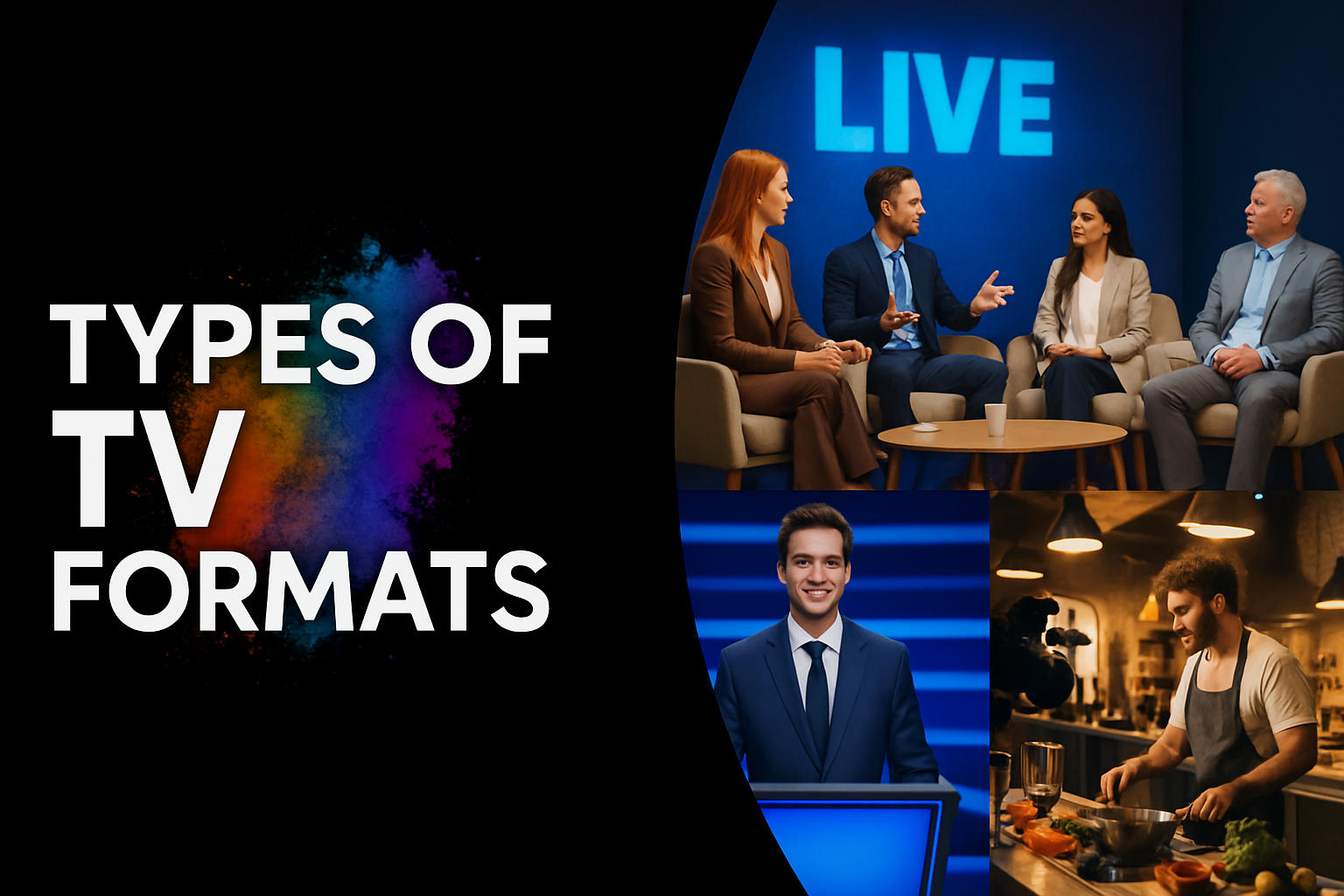
The global content investment figure heading into 2026 is $255 billion — and behind every commission, every greenlight, every licensing deal, there’s a format decision. Types of TV formats determine how a show is structured, how it can be sold across territories, what it costs to produce, and whether it can survive the leap from one market to another. Get the format taxonomy wrong, and you’re pitching the wrong type of content to the wrong buyer in the wrong window. Get it right, and you’re operating with the intelligence that separates reactive acquisition from strategic content development.
Here’s the thing most guides miss: a TV format isn’t a genre. Genre tells you how a show feels — thriller, comedy, drama. A format is the actual structure and blueprint of how a show works, episode to episode and season to season. It’s that blueprint — not the characters, not the setting — that gets licensed across borders. It’s why Who Wants to Be a Millionaire? can run in 100+ countries while keeping its core “lifelines” and “final answer” mechanics intact. And it’s why producers, commissioners, and acquisition leads need to understand format types with precision, not just category labels.
This guide maps every major type of TV format operating in the global market in 2026 — scripted and unscripted, legacy and emerging — with the strategic context that acquisition professionals, commissioners, and content buyers actually need. We’ll cover the mechanics, the licensing realities, the market dynamics, and — critically — where the format supply chain is shifting right now.
💡 Vitrina Analyst Note
From our analysis, most format acquisition decisions are reactive rather than strategic. Commissioners buy what is being pitched at markets rather than starting with the format type their platform actually needs. This guide is essential reading for any acquisition executive who wants to close better format deals before the right IP gets locked up by someone else.
Table of Contents
- Format vs. Genre: The Distinction That Actually Matters
- Types of Unscripted TV Formats
- Types of Scripted TV Formats
- Emerging Format Types Reshaping the Market in 2026
- How TV Format Rights and Licensing Work
- The Global Format Market: Who Controls the Supply Chain?
- How to Identify and Acquire the Right Format for Your Market
- FAQ
- Conclusion
Ask VIQI: Which TV Format Types Have Active Licensing Availability in Your Territory?
VIQI is Vitrina’s AI intelligence engine — trained on 1.6 million titles, 360,000 companies, and 5 million entertainment professionals. Ask VIQI to surface available formats by type, territory, genre, and window — and get verified answers before your first outreach.
✔ 200 free credits included | ✔ No credit card required
Format vs. Genre: The Distinction That Actually Matters
Before you can navigate the format market intelligently, you need to be clear on this one thing. Genre and format are not synonyms — and in licensing negotiations, confusing them costs real money.
Genre is a descriptive category for the emotional and narrative territory a show occupies. Drama. Comedy. Thriller. Horror. These labels communicate tone and audience expectation, but they don’t contain any licensable IP by themselves. You can’t buy the rights to “crime drama.” But you can buy the rights to a specific crime drama format — its protagonist structure, its episodic mechanics, its case-file architecture.
Format, by contrast, is the documented blueprint of a show’s structure — the production bible, the running order, the specific mechanical rules, the recurring elements that make the show reproducible in any market. It’s IP. When a broadcaster in Turkey acquires the format rights to a Dutch dating show, what they’re actually acquiring is the right to follow a specific documented system — casting criteria, episode structure, elimination mechanics, set design parameters — and produce their own version using local talent and language.
Why does this distinction matter practically? Because format protection in law is still remarkably fragile. As Jan Salling, co-chairman of FRAPA (Format Recognition and Protection Association) and head of BBC Studios Nordic, told Variety: “The old distribution model is broken.” Courts regularly decline to protect format rights the way they’d protect a screenplay or musical composition, treating formats as unprotectable ideas rather than creative works. That legal gap makes the production bible — the thick document that codifies every repeatable element of a format — the central artifact in format licensing.
And it’s why the global format industry is dominated by companies that own formats with exceptionally thick, detailed production bibles — and why verification of that documentation is step one in any format acquisition due diligence.

Your AI Assistant, Agent, and Analyst for the Business of Entertainment
VIQI AI helps you plan content acquisitions, raise production financing, and find and connect with the right partners worldwide.
- Find active co-producers and financiers for scripted projects
- Find equity and gap financing companies in North America
- Find top film financiers in Europe
- Find production houses that can co-produce or finance unscripted series
- I am looking for production partners for a YA drama set in Brazil
- I am looking for producers with proven track record in mid-budget features
- I am looking for Turkish distributors with successful international sales
- I am looking for OTT platforms actively acquiring finished series for the LATAM region
- I am seeking localization companies offer subtitling services in multiple Asian languages
- I am seeking partners in animation production for children's content
- I am seeking USA based post-production companies with sound facilities
- I am seeking VFX partners to composite background images and AI generated content
- Show me recent drama projects available for pre-buy
- Show me Japanese Anime Distributors
- Show me true-crime buyers from Asia
- Show me documentary pre-buyers
- List the top commissioners at the BBC
- List the post-production and VFX decision-makers at Netflix
- List the development leaders at Sony Pictures
- List the scripted programming heads at HBO
- Who is backing animation projects in Europe right now
- Who is Netflix’s top production partners for Sports Docs
- Who is Commissioning factual content in the NORDICS
- Who is acquiring unscripted formats for the North American market
Types of Unscripted TV Formats
Unscripted formats are the engine of the global format trade. They’re faster and cheaper to produce than scripted drama, they travel more easily across cultural borders (the core competitive mechanics translate without the language-specific nuance that can sink scripted adaptations), and they generate social media engagement that’s structurally built into the format itself — voting, challenges, weekly reveals. No wonder Vitrina’s global production tracking data from October 2025 showed 37% of active commissions were unscripted, with that share growing on streaming platforms.
At MIPCOM 2025, Lisa Perrin, Managing Director of International Production at ITV Studios, noted that while some linear broadcasters were pulling back from expensive scripted drama, “viewers still love watching unscripted shows — I’m not sure I’d call it a boom, but a continued love.” She’s right. And here’s the strategic breakdown of the major unscripted format types that acquisition professionals need to understand in 2026.
1. Competition and Game Show Formats
The oldest and most reliable unscripted format type in the global market. Competition formats pit contestants against each other in a defined challenge structure with clear win/loss mechanics, eliminations, and a final resolution. The format IP lives in the specific rules — the “lifelines” in Who Wants to Be a Millionaire?, the “Phone a Friend” mechanic, the specific escalating stakes structure. Not just “quiz show.”
Game shows split into two strategic categories. Knowledge-based game shows (trivia, quizzes) travel easily because general knowledge is culturally universal. Skill or stunt-based game shows require careful cultural adaptation — what’s entertaining in Japan may be too physically demanding for certain markets or too tame for others. For acquisition executives, the key variable is how culturally specific the challenge mechanics are. The more universal the core challenge, the broader the licensing territory potential.
2. Talent Show Formats
Talent formats are a specialized subset of competition formats, but they deserve their own category because the licensing mechanics differ significantly. Shows like The Voice, Got Talent, and American Idol generate secondary rights value from the actual talent they produce — music rights, recording deals, touring — which creates a revenue architecture that pure game shows don’t have. The format rights themselves are priced accordingly.
The Voice is the defining case study in format licensing complexity. Banijay Asia’s 2025 exclusive two-year agreement with Talpa Studios secured sole rights to represent, license, and produce Talpa’s entire format catalogue — including The Voice — across India and Thailand, covering all distribution windows: linear, SVOD, and AVOD. That single deal restructured how every broadcaster and streamer in those markets accesses one of the world’s most valuable talent format libraries. It’s a live demonstration of how consolidation in the format supply chain creates bottlenecks that acquisition executives need to map before they start outreach.
3. Dating and Social Experiment Formats
Dating formats have become the dominant unscripted format category on streaming platforms. Netflix’s investment in formats like Too Hot to Handle, Love is Blind, and Love on the Spectrum represents a strategic shift: streaming platforms aren’t just licensing dating formats — they’re owning them, protecting the IP, and adapting them across territories internally. That’s a format acquisition strategy that’s qualitatively different from the broadcast licensing model that dominated the 2000s.
Social experiment formats — where the “game” is social dynamics rather than a defined task or competition — have higher cultural sensitivity requirements than standard competition formats. What reads as edgy and entertaining in the UK can come across as exploitative in other markets. Acquisition executives should factor cultural adaptation cost and sensitivity review time into deal timelines for this format type specifically.
4. Lifestyle, Cooking, and Home Formats
These formats are the backbone of FAST channel programming strategies in 2026. Cooking competition formats like The Great British Bake Off (licensed to Netflix internationally as The Great British Baking Show) and renovation formats like The Block offer the “volume-driven” programming characteristic that FAST channels need — cost-effective to produce, highly watchable in any order, and buildable into 24/7 dedicated channel schedules. For FAST operators filling grid hours, bulk lifestyle format licensing is the most cost-efficient content strategy available.
5. Premium Factual and Documentary Series Formats
Premium factual formats are the format type that’s most rapidly evolving in 2026. These are distinct from one-off documentaries — they’re structured as multi-part series with defined episodic mechanics and a narrative engine that’s built into the format itself. True crime docuseries have a recognizable structural format: the cold open, the revelation of evidence, the shifting suspect, the legal climax. That structure is what gets licensed, not just the story.
For Vitrina’s guide on the full landscape of unscripted TV formats, including emerging sub-genres and acquisition frameworks, that’s the reference destination for buyers going deeper on this category.
Barry Poznick (President, MGM Alternative) — the executive behind global unscripted hits from Shark Tank to Survivor — discusses the evolution of unscripted TV formats, the changing economics of the format market, and how MGM Alternative is adapting its 35+ show slate for the streaming-first era:
Types of Scripted TV Formats
Scripted formats are more expensive, more culturally specific, and harder to adapt across territories than unscripted. But when they work internationally — and they do work, from Turkish dizi to Korean drama to Colombian telenovela — the licensing returns are extraordinary. A single successful scripted format can generate 15–20+ local adaptations. Yo soy Betty, la Fea (Ugly Betty), originally produced by Colombia’s RCN, was licensed for 18 local adaptations across the globe. That’s the asymmetric upside that makes scripted format IP so strategically valuable for sellers.
Scripted commissioning has “notably slowed down, primarily due to limited returns vs. significant and rising production costs,” according to executives speaking at MIPCOM 2025. But the nuance matters: it’s primarily linear broadcasters pulling back. Streamers — particularly Netflix and Amazon — continue to invest in high-quality scripted originals with genuine global distribution ambition. And as Sebastian Kim, VP of International Content Business at CJ ENM, noted at MIPCOM 2025: “Demand for Korean scripted shows has remained consistently strong. Buyers continue to prioritize high-concept dramas with clear export potential: character-driven thrillers, elevated rom-coms, and IP-based titles that leverage built-in awareness.”
1. Procedural Drama Formats
Procedurals are the workhorses of linear television — and they’re having a quiet renaissance as streaming platforms rediscover the value of shows that don’t demand binge consumption. The procedural format has a specific structure: each episode contains a self-contained case, crime, or problem that’s introduced and resolved within the hour. Character development exists, but the primary appeal is the repeatable case-of-the-week structure. Law & Order, CSI, House, Grey’s Anatomy.
For licensing and syndication, procedurals have enormous advantages. Audiences can watch any episode in any order — which means the back catalogue has perpetual monetization potential. Streaming platforms love procedurals for mid-week engagement; linear broadcasters love them for schedule reliability. The format’s structural predictability is both its creative limitation and its commercial superpower.
2. Serialized Drama Formats
Serialized drama is the format that streaming was built to amplify. Every episode ends on a hook that demands the next. Character arcs span entire seasons. Mythology deepens over multiple years. This is the format architecture of peak TV — Breaking Bad, Succession, Korean drama in the 16-episode structure, Turkish dizi in the 140-episode long arc. It’s built for binging, for social conversation, for the “have you watched it yet?” cultural moment.
But. Serialized drama is the hardest format type to adapt across cultural boundaries. The character psychology, moral frameworks, relationship dynamics, and social hierarchies embedded in a serialized drama are often deeply culturally specific. Turkish dizi travels brilliantly to Arabic-speaking markets — but needs significant structural adaptation for East Asian markets. Korean drama travels to North American and European audiences faster than almost any other non-English format — but the 16-episode structure doesn’t map easily onto the 6–8 episode seasons that UK and US streamers prefer.
3. Limited Series and Anthology Formats
Limited series formats have become the premium scripted format category for streaming platforms. A complete, self-contained narrative in 4–8 episodes — no renewal commitment required, no franchise obligation, maximum talent attraction. Stars will do limited series who won’t commit to 5-year procedural deals. Chernobyl, The White Lotus, Ripley. The format’s commercial advantage for platforms: it can be positioned as an event, marketed as a complete story, and licensed internationally as a finished package with clear value.
Anthology formats are a variant: each season tells a completely different story with a completely different cast, connected only by thematic territory or format mechanics (American Horror Story, True Detective). For licensing, the anthology structure is particularly valuable — each season can be licensed independently to different territories, and the brand equity of the overall series generates marketing value that individual standalone projects don’t have.
4. Sitcom and Comedy Series Formats
Comedy format adaptation is the most culturally complex translation challenge in television. What’s funny in one culture is baffling — or offensive — in another. The scripted comedy format that travels best internationally typically relies on structural humor (misunderstanding, status reversal, timing mechanics) rather than culturally specific reference humor. The Office format worked in the US because Ricky Gervais and his team had built a documentary mockumentary format — the specific camera style, interview structure, and observational comedic mechanics — that was structurally replicable with local workplace dynamics substituted in. But plenty of UK comedy formats have failed in US adaptation because the humor was too rooted in specifically British class dynamics.
Track 159,223 Active TV Format Projects Across Every Genre and Territory
Netflix, Warner Bros, Paramount, and Google TV use Vitrina to monitor format development pipelines — from scripted dramas in development to unscripted formats available for licensing — across 140,000+ verified companies worldwide.
✔ 200 free credits | ✔ No credit card required | ✔ Full platform access
Emerging Format Types Reshaping the Market in 2026
Micro-Drama Formats
Micro-drama is the fastest-growing format category in 2026 — and the format type most misunderstood by executives who haven’t worked the Asian mobile-first markets. These are serialized scripted dramas in vertical format, delivered in 1–3 minute episodes, with 80–100 episodes per season. Each episode ends on a cliffhanger. The format is engineered for mobile consumption in transit moments — commutes, lunch breaks, queues.
Amazon MX Player’s launch of MX Fatafat micro-dramas for India signals that Western platforms are finally taking this format seriously. COL Group’s ReelShort platform — which pioneered Western micro-drama — has demonstrated that the format can generate subscription revenue from audiences who won’t commit to 60-minute episode formats. The licensing mechanics for micro-drama are still being established — production bibles are thinner, format protection is weaker — which creates both opportunity (lower acquisition cost) and risk (format copying is rampant).
FAST-Native Formats
FAST (Free Ad-Supported Streaming TV) channels have created demand for a format type that didn’t exist five years ago: content built from the ground up for ad-supported linear channel scheduling rather than binge-viewing. FAST-native formats prioritize short episode runtimes (22–25 minutes is ideal for ad break insertion), high rewatchability in any episode order, and low production cost-per-episode. Game show back catalogues, lifestyle formats, and classic competition formats are the dominant content on FAST grids today — but original FAST-native formats are a growing commissioning category for platforms looking to differentiate their channel lineups.
Interactive and Participatory Formats
The format type with the most uncertain future and the most exciting upside. Interactive formats build audience participation — voting, real-time prediction, social media integration — directly into the format mechanics. This isn’t new: Big Brother‘s eviction voting was an early version. But second-screen integration, social platform extensions, and increasingly AI-assisted personalization are expanding what “participation” can mean in a format’s IP. The risk: these formats often tie their mechanics to specific technology platforms that change rapidly. The opportunity: for platforms that can execute it, participatory format mechanics create engagement data that’s immensely valuable for subscriber retention analysis.
How TV Format Rights and Licensing Work
Understanding format types is only half the intelligence picture. The other half is knowing how format rights are actually structured — because a format deal is a very different transaction from a content licensing deal, and conflating them is how acquisition executives end up with contracts that don’t protect what they thought they bought.
The production bible is the central artifact. When you license a TV format, what you’re actually licensing is the right to use the production bible to create a locally produced adaptation. The bible specifies: episode structure, casting criteria, set design parameters, judging or elimination mechanics, music cue guidelines, promotional format requirements, and any proprietary catchphrases or visual elements that constitute the format’s distinguishing IP. A thin bible means weak IP protection; a comprehensive bible means the licensor can enforce consistency across territories.
Format rights come in several layers. The basic option grants the right to develop a local adaptation for a specified territory and time window. A full license grants production and broadcast rights for a defined number of series. Some format agreements include “flying producers” provisions — experienced producers from the original format who embed in the local production to ensure format fidelity. And a growing number of format deals now include digital extension rights, specifying how the format’s IP can be used in social media extensions, app-based participation elements, and streaming catch-up windows.
Format fees vary dramatically by format track record, territory size, and platform type. Established superbrands — The Voice, Survivor, Big Brother — command premium fees that reflect decades of proven ratings performance. Newer formats from independent producers might license for a fraction of that, but with development upside if the local adaptation succeeds and the format owner can point to that success when selling the next territory. For a detailed breakdown of how scripted and unscripted format structures differ in practice, Vitrina’s analysis of the differences between scripted and unscripted TV formats maps the commercial and structural distinctions that affect every licensing negotiation.
The Global Format Market: Who Controls the Supply Chain?
Four companies dominate the global format supply chain in 2026. Understanding their portfolios — and how consolidation is reshaping access to their format libraries — is essential intelligence for any acquisition executive operating at market speed.
Banijay Group is the world’s largest independent content production and distribution company, generating €3,348 million in revenue in 2024. Its format portfolio — built through acquisitions including Endemol Shine — includes global superbrands Big Brother, Deal or No Deal, Survivor, and MasterChef. James Townley, Banijay’s chief content officer for development, makes the point that explains why legacy formats remain commercially powerful even as the market demands novelty: “These shows need to stay fresh. A 2015 version of a format and a 2024 version of that same format are very different things.” It’s the format architecture that gets licensed. The execution is constantly refreshed.
Fremantle, owned by RTL Group and operating in 27 countries, held revenue steady at €2,254 million in 2024. Its format portfolio spans both unscripted (American Idol, The X Factor, Got Talent) and a growing scripted catalogue including Neighbours and high-end drama. Fremantle’s dual scripted-unscripted positioning gives it format licensing leverage across buyer categories that pure-unscripted companies don’t have.
ITV Studios, with £2.038 billion in 2024 revenue, distributes formats including Love Island, I’m a Celebrity… Get Me Out of Here!, and a deep drama format library that includes Downton Abbey and Cold Feet. ITV’s 2024 revenue decline was attributed partly to the lingering impact of 2023 US strikes and reduced free-to-air broadcaster demand — but its format licensing business held more resilience than its production operation.
MGM Alternative — led by Barry Poznick — operates a slate of 35+ shows including Shark Tank (licensed in 50+ territories as Dragons’ Den) and Survivor. And independent studios like Talpa (The Voice, The Floor) demonstrate that you don’t need scale to own format IP that commands premium licensing fees globally.
For acquisition professionals navigating this landscape, the Fragmentation Paradox is real: these companies represent the visible tip of a format market that includes thousands of independent format creators — many of them sitting on genuinely innovative format IP that never gets discovered because the international visibility infrastructure doesn’t reach them. Vitrina’s guide on streaming distribution models and licensing strategies for 2026 provides the framework for how format rights fit into broader content distribution strategy.
How to Identify and Acquire the Right Format for Your Market
Let’s be direct about something. Most format acquisition processes are backwards. Commissioners and acquisition executives attend MIPCOM, MIPTV, and FRAPA events, consume what’s being actively pitched, and make decisions based on the loudest formats in the room — rather than systematically identifying the format types their specific audience and platform need, and then going to find them. That reactive approach works fine in a simple market. It doesn’t work in a market where global content investment is $255 billion and the Fragmentation Paradox means the best available format for your territory might be developed by a company in a market you’ve never visited.
Start with format type, not title. Before you evaluate any specific format, be precise about which format type your platform or broadcaster actually needs. A FAST channel’s needs are fundamentally different from a premium streamer’s. A linear broadcaster targeting older audiences needs different format mechanics than an OTT platform optimizing for Gen Z engagement. The format type decision shapes everything downstream: production cost, cultural adaptation requirement, social media integration potential, rights complexity, and — critically — the realistic pool of available formats that match your mandate.
Map cultural adaptation cost before format cost. The licensing fee is often the smallest line item in a format acquisition budget. Cultural adaptation — adjusting casting criteria, reshooting format elements, localizing recurring segments, navigating regulatory requirements in your territory — can cost multiples of the format fee itself. For unscripted competition formats, estimate 20–40% of total production budget for adaptation. For scripted drama formats, the cultural adaptation work is embedded in the writing room, not as a separate line item — but it requires skilled local writers who understand both the source format’s mechanics and your local audience’s expectations.
Verify format track record across comparable territories. A format that worked brilliantly in Scandinavia doesn’t necessarily travel to the MENA market. A format that dominated ratings in Brazil might struggle in India. Before committing format acquisition budget, you need verified performance data from territories that are culturally and economically comparable to yours. Not self-reported pitch deck performance claims — verified data from third-party tracking that includes actual ratings, streaming performance, and social engagement.
The Smart Pairing principle matters here. The best format acquisitions match format type to platform DNA — not just audience demographics. A dating format acquired by a platform whose content identity is built around family viewing is a misalignment that no amount of localization can fix. Your format portfolio should feel like a coherent statement about who your platform is for, not a random assortment of available IP.
Skip the Cold Outreach. Get a Warm Introduction to Format Rights Holders Actively Seeking Licensing Partners.
Vitrina Concierge is your Virtual Agent in the global format supply chain. We don’t hand you a directory — we make warm introductions directly to format IP owners and licensing executives whose mandates match your territory and platform profile.
- LA producer → Netflix UK, Fifth Season, Fox Entertainment (48 hours)
- Korean animation studio → Netflix Adult Animation (week one)
- Middle Eastern studio → Legendary Pictures (direct access)
Frequently Asked Questions
What is the difference between a TV format and a TV genre?
A genre is a descriptive category for a show’s tone and narrative territory — crime, comedy, drama. A TV format is the specific, documented blueprint of a show’s structure: its rules, recurring mechanics, episode architecture, and proprietary elements that make it reproducible across different markets. Genre labels can’t be licensed; format IP can be. When a broadcaster pays to adapt Who Wants to Be a Millionaire?, they’re not buying “quiz show rights” — they’re buying the rights to use a specific documented system of mechanics, including the lifelines, the money tree structure, and associated IP elements that constitute the format’s competitive advantage.
Which types of TV formats travel best internationally?
Unscripted competition and game show formats with universal mechanical premises travel most easily across borders. Knowledge-based quiz formats, cooking competitions, and talent shows with strong structural mechanics adapt to local talent and language without requiring the deep cultural translation that scripted drama demands. Among scripted formats, limited series and procedural dramas tend to travel better than serialized drama — because the serialized format embeds character psychology and social dynamics that are harder to adapt. Turkish dizi and Korean drama represent notable exceptions: both serialized format types have demonstrated global travel capability despite (or because of) their cultural specificity.
What is a TV format production bible and why does it matter for licensing?
A production bible is the central document in any TV format licensing deal — the thick reference guide that codifies every repeatable, reproducible element of the format into a documented system a local production team can follow. It typically includes episode structure and running orders, casting criteria and character archetypes, set design specifications, music guidelines, judging or elimination mechanics, specific catchphrases or visual elements that constitute the format’s identity, and promotional format requirements. The comprehensiveness of a production bible is the primary indicator of format IP quality. A thin bible means weak protection and inconsistent adaptation across territories; a detailed bible is what allows formats like The Voice to maintain consistent identity across 150+ local versions.
How is the scripted vs. unscripted balance shifting in 2026?
Vitrina’s global production tracking data from October 2025 showed 63% scripted vs. 37% unscripted among active commissions globally — but the trend direction matters more than the snapshot. Linear broadcasters are reducing scripted commissioning budgets due to rising production costs and reduced ROI certainty. Streamers continue to invest in premium scripted with global distribution ambition. Unscripted and reality formats are gaining momentum on both linear and streaming because they provide more predictable ROI at lower production cost. FAST channels are driving renewed demand for legacy unscripted format catalogues. The practical implication: buyers have more leverage on scripted format rights than they did two years ago, while proven unscripted superbrands command sustained or increased licensing fees.
What is a micro-drama format and why is it growing?
Micro-drama is a serialized scripted format delivered in vertical video format with 1–3 minute episodes and 80–100 episodes per season. Each episode ends on a cliffhanger engineered for mobile consumption during transit moments. The format originated in Asian markets (particularly China and South Korea) and is expanding rapidly into Western markets through platforms like COL Group’s ReelShort and Amazon MX Player’s MX Fatafat. The growth drivers are structural: mobile-first audience habits, high episode-count structures that maximize engagement time per viewer, and significantly lower production cost per minute than conventional drama formats. For acquisition executives, micro-drama format licensing is still in an early stage of IP standardization — which creates opportunity for early-movers to secure format rights at below-market valuations.
Who are the largest format companies controlling global supply in 2026?
The global format supply chain is dominated by four major players: Banijay Group (€3,348 million revenue in 2024; portfolio includes Big Brother, MasterChef, Survivor), Fremantle (€2,254 million; American Idol, Got Talent, X Factor), ITV Studios (£2.038 billion; Love Island, I’m a Celebrity, Downton Abbey), and MGM Alternative (Shark Tank, Are You Smarter Than a Fifth Grader?). Independent format owners like Talpa (The Voice, The Floor) demonstrate that significant format IP value sits outside the major companies — but access to that IP is increasingly being channeled through exclusive representation deals, like Banijay Asia’s 2025 exclusive two-year agreement for Talpa’s entire catalogue across India and Thailand.
Conclusion: Format Type Precision Is Acquisition Leverage
The global format market in 2026 is a $255 billion content investment ecosystem where the difference between reactive and strategic acquisition is, fundamentally, a knowledge gap. The executives closing format deals faster and at better terms than their competitors aren’t smarter — they’re better informed. They know which format types are available in their territory before they walk into a pitch meeting. They know what comparable deals have looked like. They know which format IP companies have active licensing mandates and which are just attending the market to see what’s there.
- Format ≠ genre — the format is the licensable blueprint, not the descriptive label, and that distinction determines what you’re actually buying in any format deal.
- Unscripted formats dominate the global trade because they’re cheaper to produce, easier to adapt, and better suited to FAST channel volume strategies — but scripted IP generates higher long-term licensing returns when the adaptation works.
- Consolidation is reshaping format access — Banijay’s exclusive Talpa deal for India and Thailand is a template for how major format companies are locking up independent IP through exclusive representation agreements that channel all buyer access through a single point.
- Micro-drama and FAST-native formats are the two emerging format categories where early-mover acquisition creates disproportionate advantage — format IP is underpriced relative to its engagement and retention value.
- The production bible is the IP — verify its comprehensiveness before you sign any format option or license agreement, because thin documentation means weak protection and inconsistent adaptation.
The Fragmentation Paradox in format acquisition is acute: the world’s best available format for your specific platform mandate may be in development at a company you’ve never heard of, in a market you’ve never visited, without the international visibility infrastructure to find its way to your desk through traditional market routes. The acquisition executives who close the best format deals are the ones who de-risk that information asymmetry before it costs them a missed deal or an overpaid acquisition.
Track Every TV Format Type in Development — Before the Market Knows They Exist
Trusted by Netflix, Warner Bros, Paramount, and Google TV. Vitrina tracks 159,223 active projects, 140,000+ companies, and 5 million entertainment professionals — including scripted and unscripted formats in development, available format catalogues, verified deal histories, and direct executive contacts at the world’s leading format companies.
✔ 200 free credits | ✔ No credit card required | ✔ Cancel anytime
Need a direct introduction to a format rights holder or licensing executive? Explore Concierge Service →
Find Film+TV Projects, Partners, and Deals – Fast.
VIQI matches you with the right financiers, producers, streamers, and buyers – globally.
Producers Seeking Financing & Partnerships?
Book Your Free Concierge Outreach Consultation
(To know more about Vitrina Concierge Outreach Solutions click here)
Join Industry Briefings Trusted by Leaders
Franchise Fatigue vs. IP Dependency: What Studios Should Be Betting On Now
s franchise performance softens, where will the next generation of valuable IP come from? Join the briefing.
Unscripted Is Eating the World: The Multi-Billion Reality and Format Boom
Unscripted is the new prestige — inside the $19.8B global format boom reshaping how streaming platforms compete.
Scripted Without Borders
As global drama evolves, which stories travel, which stay local, and how are they getting financed?
What Film & TV Financiers Actually Want in 2026
What do Film and TV financiers look for before they invest? Join the briefing to understand how capital decisions are changing in 2026.