IHUB
IHUB
 Private Briefings (Webinars)


 LeaderSpeak Podcast
  Global Entertainment Digest (Newsletter)
  Premium Lists
 Membership Benefits
 About Vitrina
 Our Story
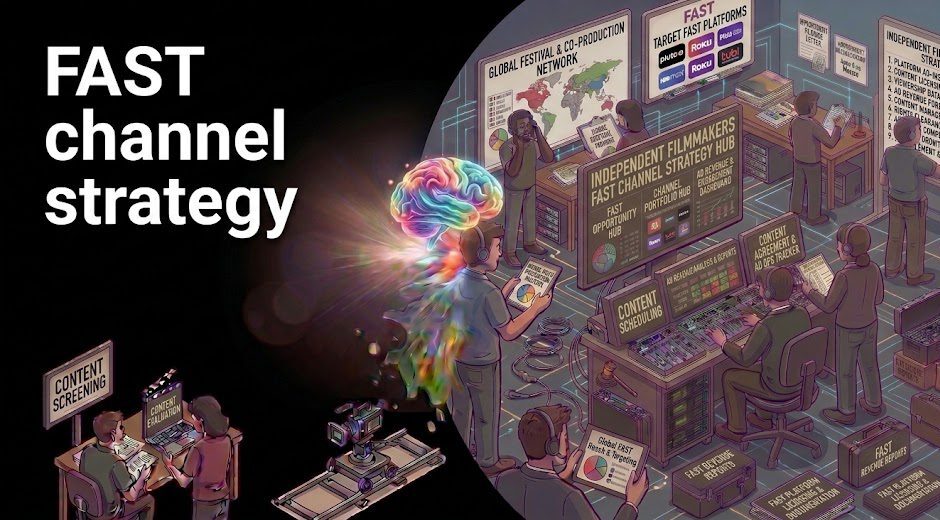
FAST—Free Ad-Supported Streaming TV—has stopped being a consolation prize for content that couldn’t get a streaming deal. In 2026, it’s the fastest-growing monetization channel in the global content business, and the content owners who’ve figured out their FAST channel strategy are generating sustained royalty revenue from libraries they’d written off. The ones who haven’t are leaving substantial money on the table.
But here’s the problem most content owners face: FAST isn’t one thing. It’s Tubi, Pluto TV, Peacock, Samsung TV Plus, The Roku Channel, Plex, LG Channels, Amazon Freevee, and dozens more—each with different audience demographics, ad inventory economics, content requirements, and licensing deal structures. Dropping your catalog onto every FAST platform simultaneously isn’t a strategy. It’s noise. And noise doesn’t convert to revenue.
This guide gives you the strategic frameworks—the same ones that serious content owners use to Weaponize their libraries across the FAST ecosystem. Use it to build a channel strategy that’s specific enough to execute and scalable enough to matter.
Track Which FAST Platforms Are Actively Acquiring Content Like Yours Right Now
Trusted by Netflix, Warner Bros, Paramount, and Google TV. Join 300,000+ companies using Vitrina to monitor FAST acquisition activity, channel launches, and licensing trends in real time.
✔ 200 free credits | ✔ No credit card required
Why FAST Matters More Than Ever for Content Owners in 2026
FAST’s rise isn’t accidental—it’s structural. The same window collapse that devastated independent film economics (where pay-one streaming deals once accounted for 75% of a film’s distributable value, as Phil Hunt of Head Gear Films has described) created a demand vacuum that AVOD and FAST have rushed to fill. Audiences who paid for Netflix, Max, Disney+, Peacock, and Paramount+ simultaneously are cutting back. Subscription fatigue is real—and when subscriptions get cancelled, people don’t stop watching. They shift to free.
The numbers support this. Tubi now streams over 4 billion hours annually. Pluto TV serves 80+ million monthly active users across 35+ countries. Samsung TV Plus reaches more than 500 million devices globally. The Roku Channel is embedded in 70+ million active accounts. This is not fringe consumption—it’s mainstream viewing that has quietly become one of the most significant monetization channels for content libraries at every scale.
For content owners specifically, the structural advantage of FAST is this: it generates ongoing ad-based royalties from catalog you’ve already made, without requiring new production investment, new upfront licensing fees, or exclusivity commitments that block other revenue streams. Done right, it’s the closest thing to passive revenue the content business offers. But done wrong—wrong platforms, wrong metadata, wrong channel architecture—it generates noise and modest CPM revenue that never compounds. The strategy is everything.
Framework 1: Understand the FAST Revenue Economics Before You License Anything
FAST revenue flows from advertising—specifically, from CPM (cost per thousand impressions) on ad inventory served against your content. Your share of that CPM depends on your deal structure with the FAST platform. Most content owners are operating on one of three models, and knowing which applies to you is the starting point for any serious FAST channel strategy.
Revenue Share Model
The platform sells ad inventory against your content and shares a percentage of ad revenue with you—typically 40–70% to the content owner, depending on the platform, your content’s performance, and the terms you negotiate. FilmHub, the dominant aggregator for FAST distribution, takes a 20% cut, passing the remainder to the content owner. The revenue share model rewards volume (more hours streamed = more ad impressions = more revenue) and quality (higher CPM categories like comedy, documentary, and true crime outperform lower-value genres).
Flat-Fee Licensing
Some FAST platforms—particularly those launching new genre channels—will pay a flat upfront license fee for your content, typically $500–$5,000 per title depending on recency, cast profile, and genre. This is cleaner for cash flow but caps your upside. If your title outperforms projections, the platform captures all the excess CPM revenue. Push for revenue share on titles you believe in; accept flat fees for older catalog with uncertain performance.
Owned & Operated (O&O) Channels
The highest-revenue FAST model for content owners with sufficient library depth: launch your own branded FAST channel on platforms like Pluto TV, Samsung TV Plus, LG Channels, or The Roku Channel. You supply the programming; the platform provides the distribution and ad sales infrastructure. Revenue is split—typically 50/50 to 60/40 in the platform’s favor—but the channel becomes a brand asset that builds audience loyalty over time. Companies like Fremantle, which has launched 25 FAST channels globally with Pluto TV featuring shows like Baywatch and Three’s Company, have demonstrated the scale that O&O channels can reach when backed by recognizable IP. As we detail in our 2026 streaming distribution models guide, the O&O channel approach is the most strategically significant shift in the FAST landscape right now.
Framework 2: Metadata Is Your FAST Moat — Get It Right Before You Get Listed
This is the most underappreciated driver of FAST channel performance. Tim Cutting, who leads strategic revenue initiatives at Gracenote—Nielsen’s content data and technology division serving global clients across North America, EMEA, LATAM, APAC, and India—made this point directly in the Vitrina LeaderSpeak series: metadata quality determines discoverability, and discoverability determines viewership. On a FAST platform with 1.6 million+ titles, the content that surfaces in algorithmic recommendations and search results is the content with complete, accurate, genre-tagged metadata. Everything else disappears into the catalog.
What does complete metadata look like for FAST distribution?
- Content IDs: Your title must be registered with Gracenote’s global content ID system (and EIDR if you’re targeting premium platforms). Without a clean content ID, your title cannot be correctly matched across platforms, which breaks audience analytics and can delay or prevent payment.
- Genre taxonomy: FAST platforms use granular genre tags for channel programming and recommendation engines. “Thriller” is insufficient—”Psychological Thriller,” “Legal Thriller,” “True Crime Thriller” are the tags that actually drive algorithmic placement. Use the platform’s own taxonomy, not your own classification system.
- Audience ratings and content descriptors: TV ratings, content warnings, and parental advisory data aren’t optional. Platforms use them for regulatory compliance (particularly in European markets) and for targeting specific audience segments in their ad inventory. Missing descriptors = missed CPM premium.
- Cast and crew data: Name recognition drives recommendations. Ensure all principal cast, director, and key crew credits are properly attached to your content ID. An unnamed cast in your metadata means no cast-based recommendations—leaving audience targeting revenue on the table.
- Artwork standards: Each FAST platform has specific artwork specifications (resolution, aspect ratio, safe zones for text). Wrong artwork gets auto-rejected or displays incorrectly, damaging click-through rates before a single impression is served.
Content owners who treat metadata as an afterthought—uploading whatever’s in their legacy rights management system—consistently underperform compared to those who invest 2–3 days per title in proper metadata preparation. The CPM difference can be 30–50% per thousand impressions between a well-tagged and poorly-tagged title on the same platform.
Tim Cutting (VP Strategic Revenue, Gracenote/Nielsen) on why metadata, content IDs, and discoverability solutions are the defining competitive factor in FAST channel monetization—not catalog size:
Framework 3: Platform Selection — Match Your Content to Audience Demographics, Not Just Reach
Bigger platforms don’t automatically mean more revenue. Platform selection for FAST distribution should be driven by audience demographic match—where your content’s natural viewership overlaps with the platform’s existing user base. Here’s how to read the major platforms:
Tubi (Fox Entertainment)
Tubi skews toward cord-cutters aged 25–44, with strong over-indexing in African American and Hispanic audiences. Their content sweet spot: horror, crime drama, urban comedy, Black cinema, and classic films. CPM rates on Tubi are competitive but not premium—volume and repeat viewership drive revenue. If your catalog has genre depth in Tubi’s core demographics, they’re your highest-volume non-exclusive FAST home.
Pluto TV (Paramount Global)
Pluto’s channel-based model means your content needs to fit a channel’s programming mandate, not just the general catalog. Pluto operates 350+ channels globally—including genre-specific channels like Pluto TV Horror, Westerns, Reality TV, and Spanish-language programming. Their international expansion (now active in 35+ countries) makes Pluto one of the best FAST platforms for content owners with multi-territory rights. Target specific Pluto channels rather than submitting to general inventory—channel placement gets more consistent viewership than catalog browsing.
The Roku Channel
Roku reaches 70+ million active accounts in the US, skewing toward connected TV viewers aged 35–64 with higher-than-average household income. Their CPM rates are among the highest in the FAST ecosystem for premium content categories. Crucially, Roku’s O&O channel program (Roku Channel Originals and branded channels) gives content owners access to Roku’s first-party audience data for targeting—a significant CPM premium over platforms with limited audience segmentation.
Samsung TV Plus & LG Channels
CTV (connected TV) native platforms built into smart TV hardware. Samsung TV Plus reaches 500+ million smart TV devices globally; LG Channels reaches 200+ million LG TVs. The device-level distribution means no app install barrier—users land on these platforms by default when they turn on their television. For content targeting older demographics (55+) who haven’t transitioned to streaming apps, Samsung and LG are underrated FAST distribution channels with growing ad inventory.
Ask VIQI: Which FAST Platforms Are Acquiring Your Genre Right Now?
VIQI is Vitrina’s AI intelligence assistant—trained on 1.6 million titles, 300,000+ companies, and 5 million entertainment industry professionals. Get specific answers on FAST acquisition activity, channel launches, and licensing trends in your genre and territory.
✔ 200 free credits included | ✔ No credit card needed
Framework 4: Weaponize Your Library — The O&O Channel Case for Catalog-Rich Content Owners
The single most strategic FAST move for any content owner with 50+ hours of related catalog is launching an owned-and-operated branded channel—not licensing titles piecemeal to platform inventory. Here’s why the math works differently for O&O versus catalog licensing.
When you license to a platform’s general catalog, your title competes against everything else for viewer attention. You’re one of 50,000 titles. But when you operate a branded channel—say, a dedicated true crime channel, a horror channel, or a documentary series channel—you’re programming a curated viewing experience that builds habitual audience return. Viewers come back to “your” channel the way they’d come back to a linear TV network. And habitual viewership compounds: higher average viewing hours per session = more ad impressions = higher total CPM revenue per title.
The Weaponized Distribution logic applies directly here. Content owners who license all their rights exclusively to a single SVOD platform capture one-time MG revenue but sacrifice the ongoing royalty streams that FAST generates. The WBD/Netflix model—a $72 billion multi-year licensing deal where WBD licenses HBO content to a competitor—illustrates the same principle at studio scale: content ownership beats platform control, and licensing flexibility maximizes financial value over time. Your O&O FAST channel is that same strategic position applied to your catalog.
Minimum viable O&O channel requirements:
- Content volume: 40–100 hours minimum for a linear FAST channel (continuous programming loop). Fewer than 40 hours creates repetitive scheduling that tanks viewer retention.
- Genre coherence: A channel programming horror, cooking, and travel documentaries indiscriminately won’t build a return audience. Single-genre or tight niche programming (e.g., “extreme sports documentaries”) outperforms general interest every time.
- Programming cadence: FAST channels need new content additions at least monthly—either from your own catalog pipeline or licensed from third parties—to retain algorithmic placement priority on the platforms.
- Channel management infrastructure: You’ll need a playlist management system, content delivery pipeline, and metadata management workflow. Companies like Gracenote, Whip Media, and Radial Entertainment provide channel management infrastructure specifically for FAST operators.

Your AI Assistant, Agent, and Analyst for the Business of Entertainment
VIQI AI helps you plan content acquisitions, raise production financing, and find and connect with the right partners worldwide.
- List the top commissioners at the BBC
- List the post-production and VFX decision-makers at Netflix
- List the development leaders at Sony Pictures
- List the scripted programming heads at HBO
- Find active co-producers and financiers for scripted projects
- Find equity and gap financing companies in North America
- Find top film financiers in Europe
- Find production houses that can co-produce or finance unscripted series
- Who is backing animation projects in Europe right now
- Who is Netflix’s top production partners for Sports Docs
- Who is Commissioning factual content in the NORDICS
- Who is acquiring unscripted formats for the North American market
- Show me recent drama projects available for pre-buy
- Show me Japanese Anime Distributors
- Show me true-crime buyers from Asia
- Show me documentary pre-buyers
- I am looking for production partners for a YA drama set in Brazil
- I am looking for producers with proven track record in mid-budget features
- I am looking for Turkish distributors with successful international sales
- I am looking for OTT platforms actively acquiring finished series for the LATAM region
- I am seeking localization companies offer subtitling services in multiple Asian languages
- I am seeking partners in animation production for children's content
- I am seeking USA based post-production companies with sound facilities
- I am seeking VFX partners to composite background images and AI generated content
Framework 5: International FAST—The Sovereign Opportunity Most Content Owners Miss
Most content owners treat FAST as a US-first strategy. That’s a mistake that costs real revenue. The FAST ecosystem is expanding rapidly outside North America—and the competitive dynamics in international markets are significantly more favorable for content owners than the saturated US environment.
In MENA, platforms like OSN—which covers 23 countries across the Middle East and North Africa—are actively transitioning from linear to streaming, and their content acquisition appetite for non-Arabic programming is real and immediate. As Rolla Karam, SVP Content Acquisition at OSN, explained in the Vitrina LeaderSpeak series: OSN’s content mix runs 90% Western content alongside 10–15% Arabic, Turkish, and Kids programming. Turkish content “does amazingly well on our platform.” For content owners with Turkish-language or European content libraries, MENA FAST distribution is an underutilized revenue channel. As we explore in our guide to navigating FAST channel visibility and monetization, the international FAST opportunity requires territory-specific rights clearance before you can distribute—but the upside is significant for content owners who’ve retained international rights.
In Europe, FAST adoption is accelerating across Germany (RTL+, Joyn), France (6play, Molotov), and the UK (ITVX, Channel 4 streaming). Samsung TV Plus and LG Channels provide hardware-based FAST distribution across European markets where app adoption lags behind smart TV penetration. For content owners with cleared European rights, these device-native platforms offer lower-friction distribution than building relationships with individual national broadcasters.
The rights question is critical before any international FAST push. Territory-by-territory rights clearance—especially for music cues embedded in your content—can block distribution if not verified upfront. This is where the Fragmentation Paradox hits FAST strategy directly: with 600,000+ companies operating globally in film and TV, the rights landscape for any given title can involve multiple clearance holders across territories. Verify rights before you list, not after a platform flags a violation.
Framework 6: Analytics and Optimization — How to Improve FAST Revenue After Launch
Most content owners treat FAST as a set-and-forget distribution channel. That’s exactly why most content owners underperform. The analytics infrastructure now available for FAST channel strategy optimization is sophisticated enough to drive meaningful revenue improvement—if you actually use it.
Carol Hanley, CEO of Whip Media, described in the Vitrina LeaderSpeak series how platform operators use streaming analytics—covering royalties, revenue tracking, and audience insights—to streamline content performance reporting across FAST, SVOD, TVOD, and AVOD. The same analytics tools are available to content owners, not just platforms. The metrics that matter:
Completion rate: The percentage of viewers who watch your title to completion. Low completion rates signal mismatched audience placement—your content is being recommended to the wrong audience segment. The fix is metadata refinement, not better content.
Return viewer rate: For O&O channels, the percentage of viewers who return within 7 days. Return rates above 25% indicate a channel with genuine audience loyalty—the kind that platforms will invest in with better scheduling placement and marketing support. Below 10% means your channel isn’t building a brand.
CPM by daypart: Ad CPM varies by time of day and day of week. Evening weekday and Sunday programming typically commands 2–3x the CPM of early morning and weekend afternoon slots. Scheduling your highest-value titles (best cast, best genre premium) in high-CPM dayparts is the simplest optimization most content owners never make.
Revenue per title by platform: Track CPM and total revenue per title across every platform you’re licensed on. Titles that overperform on one platform and underperform on another reveal audience mismatch—and tell you where to concentrate new catalog additions. Our content licensing revenue models overview covers how to structure this tracking across multiple distribution windows simultaneously.
Framework 7: Exclusivity vs. Non-Exclusive — The Rights Structure Decision That Defines Your Revenue Ceiling
FAST platforms want exclusivity—particularly the major ones (Tubi, Pluto, Roku) who are competing aggressively for differentiated content. Your job as a content owner is to know exactly when exclusivity is worth the premium it commands, and when non-exclusive distribution across multiple platforms generates more total revenue than any exclusive deal can offer.
The exclusivity calculus for FAST works differently than for SVOD. On SVOD, exclusivity is the entire value proposition—viewers subscribe specifically to access exclusive content. On FAST, viewers don’t subscribe; they browse. Non-exclusive FAST distribution means the same title generates CPM revenue across Tubi, Pluto, Roku, and Samsung simultaneously. Four revenue streams from one title, at the cost of being unable to offer any single platform an exclusive.
When exclusivity makes sense for FAST:
- The platform is paying a significant exclusivity premium (typically 2–4x the non-exclusive rate) that exceeds your projected multi-platform non-exclusive revenue for the exclusivity window.
- The platform is marketing your title as featured content—editorial placement, homepage promotion, email campaigns. This amplification effect can drive viewership volume on the exclusive platform that exceeds what scattered multi-platform distribution would generate.
- The exclusivity window is limited—90 days or less. Longer exclusivity periods (6+ months) are almost never in your interest on FAST, because they block all other FAST revenue during peak content value periods after launch.
When non-exclusive wins: for catalog titles more than 12 months old, non-exclusive multi-platform distribution almost always generates higher total revenue than exclusivity. Your leverage for an exclusivity premium on older catalog is limited, and four simultaneous CPM streams compound over time in ways a single exclusive stream can’t match. As we cover in our guide to mastering content rights, territories, and exclusivity, the rights structure decision is the one that most content owners get wrong—and most irreversibly.
Need a Direct Introduction to FAST Platform Acquisition Teams?
Vitrina Concierge is your Virtual Agent. We don’t send you a list of contacts—we make warm introductions directly to the acquisition decision-makers at the FAST platforms actively seeking your content.
- LA producer → Netflix UK, Fifth Season, Fox Entertainment (48 hours)
- Korean animation studio → Netflix Adult Animation (week one)
- Middle Eastern studio → Legendary Pictures (direct access)
Frequently Asked Questions
What is a FAST channel strategy for content owners?
A FAST channel strategy is a systematic plan for monetizing content libraries on Free Ad-Supported Streaming TV platforms—including Tubi, Pluto TV, The Roku Channel, Samsung TV Plus, and LG Channels—through ad-based CPM revenue. Effective FAST strategies address platform selection (matching content to audience demographics), metadata optimization (genre taxonomy, content IDs, cast data), licensing model selection (revenue share vs. flat fee vs. owned-and-operated channels), exclusivity decisions, international territory rights clearance, and ongoing analytics-driven optimization. The goal is compounding royalty revenue from existing catalog without new production investment.
How much revenue do FAST channels generate for content owners?
FAST revenue depends on CPM rates (typically $5–$25 per thousand impressions for general content, higher for premium categories), viewing hours generated, and your revenue share structure. Aggregators like FilmHub take a 20% cut, passing the remainder to the content owner. Owned-and-operated FAST channels typically split revenue 50/50 to 60/40 in the platform’s favor. CPM rates vary by genre (documentary, true crime, and comedy command premiums), daypart (evening hours earn 2–3x early morning rates), and platform (Roku typically commands higher CPMs than smaller FAST operators). Content owners with 100+ hours of strong-performing catalog on multiple platforms simultaneously can generate six-figure annual FAST revenue from library content that has no other active distribution window.
What is an owned-and-operated (O&O) FAST channel and should content owners launch one?
An O&O FAST channel is a branded streaming channel launched by the content owner on FAST platforms—rather than licensing titles to the platform’s general catalog. The content owner programs the channel, and the platform provides distribution infrastructure and ad sales. Revenue splits are typically 50/50 to 60/40 in the platform’s favor. O&O channels build audience loyalty through habitual viewership and generate higher per-title CPM than catalog licensing because viewers watch more hours per session on a branded channel. Minimum viable requirements: 40–100 hours of coherent genre catalog, monthly content additions to maintain algorithmic placement, and a channel management infrastructure. Fremantle’s model—25 FAST channels globally across Pluto TV—illustrates the scale achievable with strong IP and disciplined channel programming.
Why is metadata so important for FAST channel performance?
On FAST platforms with 50,000+ titles, content surfaces through algorithmic recommendations and search—not editorial curation. Metadata quality determines algorithmic discoverability, and discoverability determines viewership. Content with complete Gracenote content IDs, granular genre taxonomy, full cast data, and platform-specific artwork consistently outperforms poorly-tagged content by 30–50% in CPM revenue per thousand impressions. Missing or inaccurate metadata doesn’t just reduce discovery—it can break payment systems (content ID mismatches cause royalty attribution errors) and block international distribution (missing ratings and content descriptors fail regulatory compliance checks in European markets).
Should content owners choose exclusive or non-exclusive FAST licensing?
For catalog titles more than 12 months old, non-exclusive multi-platform FAST distribution almost always generates higher total revenue than exclusivity. Simultaneously licensing to Tubi, Pluto, Roku, and Samsung means four independent CPM revenue streams from one title. Exclusivity is justified only when a platform offers a 2–4x revenue premium over non-exclusive rates, provides active marketing support (editorial placement, homepage promotion), and limits the exclusivity window to 90 days or less. Longer exclusivity terms—particularly 6+ months—effectively cap your FAST revenue ceiling by blocking all other platform revenue during the content’s highest-value period. Negotiate exclusivity premiums aggressively or push for non-exclusive deals that let your catalog work across the full FAST ecosystem simultaneously.
Which international markets offer the best FAST expansion opportunities for content owners in 2026?
MENA presents the most acute near-term opportunity—platforms like OSN cover 23 countries across the Middle East and North Africa, with 90% of their content mix being Western programming and active appetite for non-Arabic catalog including Turkish content, which “does amazingly well” on the platform. Europe is expanding rapidly via Samsung TV Plus and LG Channels (device-native FAST distribution reaching 700M+ smart TV devices combined), alongside national broadcasters launching FAST extensions (ITVX in the UK, Joyn in Germany, 6play in France). Latin America is the next frontier, with Pluto TV and Tubi both accelerating Spanish-language FAST content acquisition. Rights clearance—particularly music synchronization rights—is the critical prerequisite for any international FAST push.
What analytics should content owners track to optimize their FAST channel strategy?
Four key metrics drive FAST optimization: (1) Completion rate—low completion rates signal audience mismatch, fixable through metadata refinement rather than content changes; (2) Return viewer rate—for O&O channels, above 25% indicates genuine audience loyalty; below 10% means the channel isn’t building brand recognition; (3) CPM by daypart—evening weekday and Sunday programming earns 2–3x early morning CPM; schedule premium titles in high-CPM dayparts; (4) Revenue per title by platform—titles that overperform on one platform and underperform on another reveal audience mismatch, guiding where to concentrate new catalog additions. Tools like Whip Media’s streaming analytics platform provide cross-platform reporting across FAST, SVOD, TVOD, and AVOD simultaneously.
Conclusion: FAST Strategy Is Library Strategy
The content owners who treat FAST as a dump for unsellable catalog will generate modest CPM royalties and wonder why the revenue never compounds. The ones who approach it as a strategic channel—with metadata infrastructure, platform selection discipline, O&O channel builds where the volume supports it, and analytics-driven optimization—are building revenue streams that grow quarter over quarter without new production spend.
That’s the real opportunity FAST offers in 2026. Not a replacement for SVOD acquisitions or theatrical—but a parallel monetization layer for the libraries you’ve already built, the rights you already own, and the audience relationships you’ve already established. The infrastructure to execute that strategy exists. The question is whether you’re using it.
Key Takeaways:
- FAST Economics First: Know whether you’re operating on revenue share (40–70% to content owner), flat-fee ($500–$5,000/title), or O&O channel (50/50 to 60/40 split) before you sign anything.
- Metadata Is the Moat: CPM differences of 30–50% separate well-tagged and poorly-tagged content on the same platform. Genre taxonomy, content IDs, and cast data are not optional.
- Match Platform to Audience Demographics: Tubi for horror and urban drama. Pluto for catalog and international. Roku for higher-income CTV audiences. Samsung/LG for older cord-cutters. One platform isn’t a strategy—it’s a start.
- O&O Channels Compound: Branded channel ownership builds habitual viewership that catalog licensing never achieves. Requires 40–100 hours of coherent genre content and monthly additions to sustain placement.
- Non-Exclusive Wins for Catalog: Four simultaneous CPM streams from one title almost always beat exclusivity deals for titles over 12 months old. Negotiate exclusivity premiums aggressively or walk away.
- International FAST Is Underserved: MENA (OSN, 23 countries), Europe (Samsung + LG, 700M+ devices), and LATAM are the next FAST frontiers. Rights clearance first—then distribute.
Track FAST Acquisition Activity Across 140,000+ Companies
Real-time intelligence on which FAST platforms are acquiring what. 200 free credits. No credit card required.
Ask VIQI: Build Your FAST Platform Target List
Trained on 1.6M titles and 300,000+ companies. Get genre-specific, territory-specific acquisition intelligence in seconds.