IHUB
IHUB
 Global Content Pulse (Webinars)


 Global Production Financing
(Webinars)
Global Production Financing
(Webinars)  LeaderSpeak Podcast
  Global Entertainment Digest (Newsletter)
  About Vitrina
 About VIQI
 Our Story
 Our Solutions 🔥
 Film+TV Projects Tracker 🚀
 Case Studies
 Our Profile
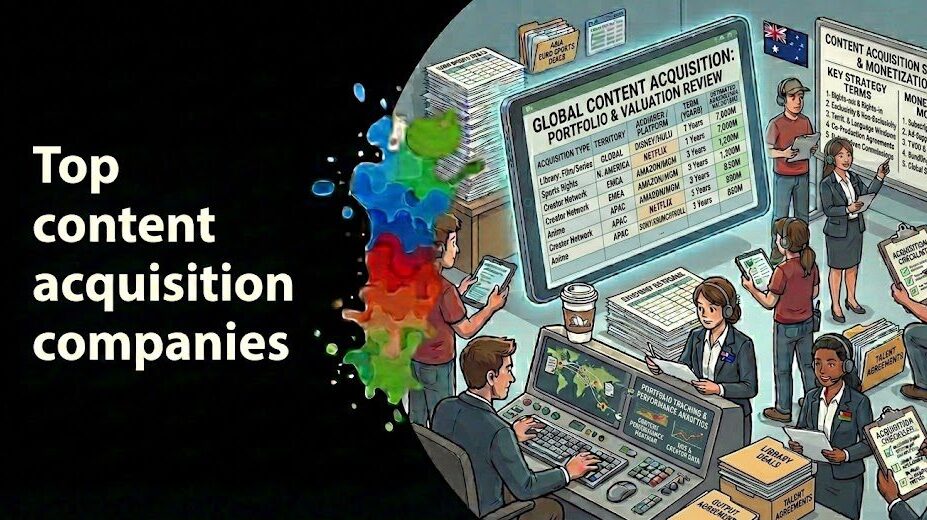
The top content acquisition companies in 2026 aren’t just buying more—they’re buying differently. Budgets are tighter in some corners, brazenly open in others. Strategies that worked in 2021 have been quietly retired. And the producers and rights holders who understand exactly which buyers are active, what they’re prioritising, and how to get in front of them six weeks ahead of budget season—they’re closing deals that others don’t even know are available.
Here’s the thing: the global content acquisition market now runs on intelligence gaps as much as it runs on relationships. With 600,000+ film and TV companies operating globally and the Fragmentation Paradox accelerating, knowing who’s buying what—before it hits the trades—is the actual competitive advantage. So let’s map exactly where the money is, who controls it, and what they want in 2026.
This guide covers nine players whose acquisition strategies matter most right now: the streaming giants, the regional powerhouses, and the European format buyers who collectively greenlight thousands of projects every year. Whether you’re pitching content, licensing rights, or building a distribution strategy—this is your map. And for a deeper read on how to approach them, see Vitrina’s global content acquisition strategy guide for 2026.
Table of Contents
- What Defines a Top Content Acquisition Company in 2026
- Netflix: The $17B Machine
- Amazon Prime Video: Volume Meets Franchise
- Apple TV+: The Selective Billion-Dollar Buyer
- Warner Bros. Discovery: Weaponized Distribution in Action
- Disney and Hulu: IP Franchises Above All Else
- OSN: The MENA Acquisition Powerhouse
- Banijay and Fremantle: Format Buyers Reshaping Global TV
- JioStar and MBC: The Emerging-Market Acquirers to Watch
- The Fragmentation Paradox: Why Intelligence Now Beats Relationships
- Frequently Asked Questions
- Conclusion
What Defines a Top Content Acquisition Company in 2026
Not all acquisition budgets are created equal—and not all acquisition activity looks the same. The companies that matter most in 2026 share three characteristics: they have real capital deployed at scale, they have identifiable content preferences (not vague “we’re open to everything” mandates), and they have active windows right now. A buyer with a $5B budget who’s locked their slate for the next 18 months is worth less to you today than a regional streamer with a $200M mandate and an open Q3 window.
The other shift worth flagging: acquisition vs. production decisions are getting more deliberate in 2026. After the post-COVID production boom triggered overcapacity, many streamers are rebalancing toward acquisition—particularly licensed content with proven audience data—over expensive original slates. As Variety has tracked, that shift is visible in the licensing volume at major streaming platforms through late 2025 and into 2026. That means more opportunities for rights holders who know how to package for these buyers.
Understanding the Data Deficit matters here, too. 15–20% of deal value gets lost annually across the supply chain through information asymmetry—producers pitching the wrong buyers, buyers missing available content, windows closing before introductions happen. The companies we cover below have clear profiles. Know them before you send the first email.
Ask VIQI: Which Content Acquisition Companies Are Actively Buying in Your Genre Right Now?
VIQI is Vitrina’s AI assistant—trained on 1.6 million titles, 360,000 companies, and 5 million entertainment professionals. Get real-time buyer intelligence before the window closes.
✓ Included with 200 free credits | ✓ No credit card needed
Netflix: The $17B Machine
Netflix remains the single largest content acquirer on the planet. Its annual content budget has held above $17 billion in recent years, and while the mix between originals and licensed content shifts quarter to quarter, the platform’s appetite for global rights is unmatched in scale. But here’s what most producers get wrong: Netflix isn’t one buyer. It’s dozens of regional acquisition teams with different mandates, different genre priorities, and different greenlight thresholds.
In 2026, Netflix’s acquisition priorities cluster around a few clear signals. Korean drama and anime remain active categories—Netflix has committed over $2.5 billion to South Korean content production and continues acquiring finished titles from Japanese studios. Local-language originals in LATAM, MENA, and APAC are a stated strategic priority as the platform pushes into markets where English-language content faces structural headwinds. And the push into live—WWE Raw, NFL Christmas games, boxing—is adding a rights acquisition dimension that simply didn’t exist two years ago.
The practical thing to know as a seller: Netflix doesn’t acquire many finished third-party titles anymore in the US and UK—their originals slate fills most of that space. But internationally, finished content acquisition remains active, particularly for territory-specific licensed windows. Vitrina has a full breakdown of how Netflix content acquisition actually works, including which teams handle which categories and how to approach them.

Your AI Assistant, Agent, and Analyst for the Business of Entertainment
VIQI AI helps you plan content acquisitions, raise production financing, and find and connect with the right partners worldwide.
- Find active co-producers and financiers for scripted projects
- Find equity and gap financing companies in North America
- Find top film financiers in Europe
- Find production houses that can co-produce or finance unscripted series
- I am looking for production partners for a YA drama set in Brazil
- I am looking for producers with proven track record in mid-budget features
- I am looking for Turkish distributors with successful international sales
- I am looking for OTT platforms actively acquiring finished series for the LATAM region
- I am seeking localization companies offer subtitling services in multiple Asian languages
- I am seeking partners in animation production for children's content
- I am seeking USA based post-production companies with sound facilities
- I am seeking VFX partners to composite background images and AI generated content
- Show me recent drama projects available for pre-buy
- Show me Japanese Anime Distributors
- Show me true-crime buyers from Asia
- Show me documentary pre-buyers
- List the top commissioners at the BBC
- List the post-production and VFX decision-makers at Netflix
- List the development leaders at Sony Pictures
- List the scripted programming heads at HBO
- Who is backing animation projects in Europe right now
- Who is Netflix’s top production partners for Sports Docs
- Who is Commissioning factual content in the NORDICS
- Who is acquiring unscripted formats for the North American market
Amazon Prime Video: Volume Meets Franchise
Amazon Prime Video has always operated with a different acquisition logic than Netflix. Where Netflix chases subscriber acquisition and retention through content volume, Amazon needs content to justify Prime membership—a bundled product that includes e-commerce benefits, music, gaming, and more. That difference matters enormously for how they buy.
Amazon’s big franchise bets are well-documented—The Lord of the Rings: The Rings of Power at roughly $1 billion for two seasons is the headline case. But their acquisition strategy is broader and more interesting than the blockbuster numbers suggest. Amazon’s AVOD arm Freevee (now folded back into Prime Video’s ad tier) drove significant finished content acquisition at price points well below Netflix’s typical MG. And their MX Player merger in India gave them an entirely different acquisition channel—local Bollywood and regional language titles that serve 200 million+ Indian users.
In 2026, Amazon’s acquisition activity is increasingly about filling the ad-supported tier. That’s a structural opportunity for rights holders with mid-tier libraries who’d previously been shut out of premium streaming economics. Amazon will pay less than Netflix’s first-window rates—but they’ll buy volume. And for a rights holder with a catalogue of 50+ titles, that volume deal might recoup faster than chasing individual premium placements. See Vitrina’s full analysis of Amazon Prime Video’s content acquisition strategy for the full picture.
Find Content Buyers Actively Acquiring in Your Genre and Territory
Trusted by Netflix, Warner Bros, and Paramount. Join 140,000+ companies tracking content acquisition deals, buyer mandates, and distribution windows globally.
✓ 200 free credits | ✓ No credit card required | ✓ Full platform access
Apple TV+: The Selective Billion-Dollar Buyer
Apple TV+ is one of the most misread buyers in the market. Producers see the Apple Services division generating over $24 billion in a single quarter and assume Apple is an open-wallet buyer. But Apple is famously selective. Their acquisition mandate is narrow: prestige drama, limited series from name talent, and—increasingly—sports rights that integrate into the Apple device experience. They don’t chase volume. They chase cultural moments.
What that means practically: Apple will pay premium MGs for the right project—but “the right project” is defined by a very specific quality bar. They’re not buying mid-tier thrillers or genre content that would slot comfortably on Netflix or Amazon. Their slate reads like a festival wishlist crossed with a prestige cable network. Think Severance, The Morning Show, Slow Horses. The finished-content acquisition strategy mirrors the originals approach—extremely selective, premium-positioned, authored.
But there’s a gap most producers miss. Apple’s sports rights push—the MLS Season Pass, Friday Night Baseball, and a Formula 1 deal—creates a parallel acquisition track that operates very differently from their drama acquisition team. If your content sits at the intersection of sport and premium storytelling (documentary series, behind-the-scenes, athlete-driven narratives), Apple’s acquisition appetite is wider than their general programming track suggests. Read Vitrina’s detailed profile of Apple TV+ content acquisition strategy to understand which teams handle which categories.
Warner Bros. Discovery: Weaponized Distribution in Action
Warner Bros. Discovery is the most strategically interesting acquisition company to watch in 2026—not because of their raw acquisition budget, but because their Weaponized Distribution™ model has reshaped how the entire industry thinks about content ownership. The landmark deal to license HBO content to Netflix for approximately $500 million annually didn’t signal weakness. It signalled that WBD understands content value better than almost any other studio right now.
Their Max streaming platform has pulled back on original acquisition volume since the Discovery merger—$3+ billion in content write-downs told that story clearly. But the quality bar for what they do acquire has gone up, not down. WBD is buying fewer titles at higher average quality, positioning Max as a premium entertainment destination rather than a volume competitor to Netflix. For producers, that means the MG ceiling is intact—but the greenlight threshold is steeper than it was in 2021.
The strategic play to watch: WBD’s international acquisition activity through their CNN International, Eurosport, and regional Max rollouts. These are distinct acquisition funnels with different content profiles than US Max—and they’re often underserved by producers who focus exclusively on the US development track. WBD’s EMEA and APAC acquisition teams are active and, in many cases, easier to access than their LA counterparts.
Disney and Hulu: IP Franchises Above All Else
Disney’s acquisition philosophy hasn’t fundamentally changed since they bought Pixar, Marvel, Lucasfilm, and 21st Century Fox—they acquire IP that generates franchise value, not one-off content. The difference in 2026 is that the franchise machine has to work harder for its money. Disney’s total content budget across Disney+, Hulu, and theatrical has contracted from its COVID-era peak, and the pressure on ROI is more explicit than at any point in the streaming era.
But here’s what that means for sellers: Hulu operates as an almost entirely separate acquisition entity with a different mandate. Hulu acquires adult-skewing drama, comedy, and unscripted that Disney+ won’t touch—and their acquisition team has historically been more accessible to independent producers than Disney’s core development operation. With Hulu’s full absorption into Disney’s streaming structure, that division remains a real acquisition window for non-franchise, non-family content. Vitrina tracks Disney’s acquisition patterns in detail at our Disney content acquisition strategy breakdown.
One overlooked angle: Disney’s $1 billion OpenAI deal, announced in early 2025, signals that their content acquisition strategy is increasingly intertwined with data licensing—another revenue stream that changes how they value IP acquisition. Rights holders with large libraries are now assets in ways that go beyond distribution economics.
OSN: The MENA Acquisition Powerhouse
OSN—the premium pay-TV and streaming platform covering 23 countries across the Middle East and North Africa—is the MENA market’s most active content acquirer for premium entertainment. And Rolla Karam, their Senior Vice President of Content Acquisition, is one of the most strategically clear-eyed buyers working today.
“We are in the middle of the shift to OSN Plus which is our streaming app. From the region, for the region—we’re trying to enhance our Arabic catalog.
— Rolla Karam, SVP Content Acquisition, OSN (Vitrina LeaderSpeak Ep. 69)
In a Vitrina LeaderSpeak interview, Karam laid out OSN’s acquisition logic with unusual precision. Their current content mix sits at roughly 90% Western content, with the remaining 10–15% covering Arabic, Turkish, and kids programming. But that mix is actively shifting. WBD’s investment in OSN originals—with Karam overseeing Arabic scripted series development for 2026 and 2027—signals that the region’s largest premium platform is moving toward owned IP, not just licensed content.
What OSN actually wants from Western producers: premium scripted series from the US and UK, preferably day-and-date with the original commissioning platform. Karam is explicit that she acquires only finished content—no pre-buys, no development deals for Western titles. And the audience benchmark is clear: Saudi GCC subscribers respond to American and British accents above other English-language markets. Australian content, she noted candidly, is harder to place due to accent familiarity.
Turkish content is a distinct category—and a significant opportunity. It performs, as Karam put it, “amazingly well” across all 23 OSN territories. It’s dubbed into Syrian-dialect Arabic (not subtitled), which massively expands its audience. If you’re a Turkish producer or distributor, OSN is an active, premium buyer with a well-developed appetite for your content right now. See Vitrina’s full guide to content acquisition trends for how regional buyer strategies are evolving globally.
Banijay and Fremantle: Format Buyers Reshaping Global TV
Banijay and Fremantle—the two largest European TV content companies by revenue—operate a fundamentally different acquisition model than the streaming giants. They’re not acquiring finished content for their own platforms. They’re acquiring IP formats, local production rights, and production company stakes that feed into a global distribution machine spanning 200+ territories.
Banijay’s acquisition of Endemol Shine in 2020 created a library of over 120,000 hours of content and rights to formats including Big Brother, MasterChef, and Black Mirror. Their acquisition activity in 2026 focuses on adding format IP that travels globally—particularly unscripted formats with proven multi-territory adaptation records. If you’re a producer with a format that’s run successfully in two or more markets, Banijay’s acquisition team should be on your shortlist.
Fremantle—whose format portfolio includes American Idol, Got Talent, The Price Is Right, and premium drama through labels like Lingo Pictures and Drama Republic—is particularly active in acquiring drama production companies in markets where they don’t yet have premium scripted capability. Their 2025 acquisition of additional European drama labels signals that premium scripted content remains a strategic acquisition target even as the broader market contracts. As reported by Screen International, Fremantle’s drama labels are among the most active independent producers globally, with slates across BBC, ITV, Netflix, and Amazon.
Need Direct Introductions to Content Acquisition Teams? We’ll Make Them.
Vitrina Concierge is your Virtual Agent. We don’t give you a list—we make warm introductions directly to acquisition decision-makers actively seeking your type of content.
- Korean animation studio → Netflix Adult Animation (week one)
- LA producer → Netflix UK, Fifth Season, Fox Entertainment (48 hours)
- Middle Eastern studio → Legendary Pictures (direct access)
JioStar and MBC: The Emerging-Market Acquirers to Watch
Two platforms—one in South Asia, one in MENA—are buying at a scale most Western producers haven’t properly mapped yet. And both are building content libraries that position them as long-term acquirers, not just regional fillers.
JioStar in India—formed from the JioCinema and Disney+ Hotstar merger—now reaches over 450 million registered users. Their IPL cricket rights at $6.2 billion for five years built the subscriber base. But content acquisition beyond cricket is now a strategic priority. Bollywood theatrical windows, regional language content from Tamil, Telugu, Malayalam and Kannada markets, and international licensed content for premium-tier subscribers are all active acquisition categories in 2026. The India market is simply too large to ignore—and JioStar is the primary acquisition gateway for it.
MBC Group—the Saudi-linked broadcast and streaming network covering the Arab world through its Shahid platform—is the other major MENA acquisition player alongside OSN. Where OSN leans premium and pay, MBC and Shahid operate at broader reach and freemium economics. Their acquisition of Turkish drama series is prolific: the Arab world’s appetite for dubbed Turkish content has created a multi-hundred-million-dollar annual acquisition market that most European and American producers still underestimate. If you’re holding a catalogue of serialised drama with strong female leads and family drama themes, MBC and Shahid are buyers you can close deals with faster than most Western platforms. Vitrina tracks the full MENA acquisition picture at our content acquisition strategy hub.
The Fragmentation Paradox: Why Intelligence Now Beats Relationships
Here’s a problem none of the above companies will admit publicly: they’re harder to reach today than they were five years ago. Not because they’re buying less—in aggregate, global content acquisition spend keeps growing—but because the Fragmentation Paradox has hit both sides of the transaction. Rights holders are fragmented across 600,000+ companies globally. Acquisition teams are fragmented across platforms, regional offices, and genre-specific divisions. The result: deals that should close in 8 weeks take 6 months, and opportunities that should be obvious get missed entirely.
The data deficit on the seller side is stark. Most independent producers and distributors are working from relationship networks that cover maybe 0.1% of the actual buyer market. They know 3 or 4 acquisition executives at the top platforms, and those relationships determine which deals they pursue—regardless of whether those are actually the best-fit buyers for their content. It’s relationship-dependent access masquerading as market coverage.
This is where real-time intelligence changes the game. Vitrina tracks 159,223 active projects and deal flows across the global supply chain—including acquisition activity at every platform covered in this article. When OSN’s window opens for a new Turkish drama slate, it shows up on Vitrina before it hits the trades. When Amazon’s ad-tier acquisition team is actively filling a specific genre gap, that signal is trackable. The Insider Advantage isn’t about who you know anymore. It’s about who’s actively buying, what they want right now, and which window is open before everyone else learns about it. That’s what separates the producers closing 3–4 deals a year from those scrambling to close one.
For a full breakdown of how to build your content acquisition outreach strategy using real-time data, see Vitrina’s guide to de-risking content deals and mastering global distribution.
Frequently Asked Questions
What are content acquisition companies?
Content acquisition companies are platforms, broadcasters, distributors, and studios that purchase the rights to film, TV series, formats, and other intellectual property for distribution to their audiences. They range from global streaming giants like Netflix and Amazon Prime Video to regional platforms like OSN in MENA and JioStar in India. They acquire content outright (licensing for a fixed period and territory) or through co-production structures where they share production costs in exchange for rights.
Which company has the largest content acquisition budget in 2026?
Netflix has the largest single-platform content budget globally at over $17 billion annually. But raw budget size can be misleading—Apple TV+ spends far less but pays some of the highest per-title MGs in the market for prestige drama. For volume acquisition, Amazon’s combined platform and ad-tier activity is substantial. The highest-value acquisition market by territory is the US, but the fastest-growing acquisition activity by volume is in APAC and MENA.
How do content acquisition deals work in 2026?
Most content acquisition deals are structured as licensing agreements—the buyer pays a minimum guarantee (MG) for the right to distribute content in a defined territory and window. Rights can be exclusive or non-exclusive, and terms typically run 2–5 years. The MG may be paid on delivery, over a distribution period, or against a revenue share. In 2026, many platforms are shifting toward shorter-term licensing with renewal options rather than long-form exclusivity, giving both parties more flexibility to renegotiate based on performance data.
How do I approach content acquisition companies to sell my content?
The first step is identifying the right acquisition contact—not the general development email, but the specific acquisition executive responsible for your genre and territory. Each major platform has multiple acquisition teams organised by content type (drama, unscripted, documentary, kids) and geography. Vitrina’s platform maps these contacts across 140,000+ entertainment companies, including acquisition mandates and current activity. The second step is timing your approach to open windows—acquisition teams are most receptive when they have active budget and identified gaps, typically 4–8 weeks before a major market like MIPCOM, MipTV, or AFM.
What content do acquisition companies want most in 2026?
Priorities vary by platform, but several themes are consistent. Local-language originals with proven domestic ratings or streaming performance are highly sought across MENA, APAC, and LATAM. Returning series with engaged subscriber data are valued over one-off specials. In the MENA market, Turkish drama dubbed into Arabic consistently outperforms other licensed categories. Premium unscripted with format adaptation potential is a strong category for Banijay and Fremantle. And for Netflix and Amazon specifically, content that performs well for international (non-English-speaking) subscribers is a growing acquisition priority.
How is the Fragmentation Paradox affecting content acquisition in 2026?
The Fragmentation Paradox—600,000+ companies operating in opaque silos—creates information asymmetry that costs the industry an estimated 15–20% margin leakage and adds 3–6 months to average deal cycles. On the seller side, most producers only have relationships with 3–5 acquisition executives, missing 99.9% of the available buyer market. On the buyer side, acquisition teams miss available content because they’re working from static contact databases and festival relationships rather than real-time supply chain intelligence. Vitrina resolves this by mapping active acquisition activity in real time across the global supply chain.
What role do regional content acquisition companies play globally?
Regional buyers—like OSN (MENA), JioStar (India), MBC/Shahid (Arab world), and Viu (Southeast Asia)—collectively represent acquisition budgets in the billions that most Western producers never tap. They’re often faster to close than US/UK platforms, have clearer content mandates, and operate with less competitive pitch processes. OSN’s SVP Content Acquisition Rolla Karam noted that the platform actively buys premium Western and Turkish content for its 23-country MENA reach—but only finished titles, delivered same-minute as the original commissioning platform.
How can I track content acquisition company deal activity in real time?
Vitrina’s platform tracks deal flows, acquisition mandates, and content buying activity across 159,223 active projects globally. VIQI—Vitrina’s AI assistant—can surface specific intelligence on which platforms are actively acquiring in your genre, territory, and budget range. This is significantly more current than trade press coverage, which typically reflects deals that closed 6–8 weeks earlier. Most Vitrina members report that the platform helps them identify active acquisition windows that they’d previously missed entirely.
The Bottom Line: Know Who’s Buying Before You Pitch
The top content acquisition companies in 2026 have never been more distinct in their strategies—and never more important to understand before you approach them. Netflix wants local-language hits and live rights. Amazon wants franchise IP and ad-tier volume. Apple wants prestige moments. OSN wants finished premium series and Turkish drama. WBD wants rights it can weaponise. Banijay wants format IP that travels. And JioStar wants anything that holds 450 million Indian subscribers on platform. Pitching any of them without knowing their current acquisition posture is how deals die before they start.
Key Takeaways:
- Netflix leads on budget but not openness: Their $17B+ annual spend is real, but their finished-content acquisition in core markets is much narrower than the number implies—international and local-language windows remain the most accessible entry points.
- Amazon’s ad-tier is the underrated opportunity: The shift to ad-supported streaming has opened a volume acquisition channel at Amazon that didn’t exist three years ago—particularly for library content and mid-tier drama.
- Regional buyers close faster: OSN, JioStar, and MBC/Shahid collectively reach well over 500 million households and have clearer mandates, shorter decision cycles, and less competitive pitch environments than the US/UK platforms.
- Turkish drama is the MENA unlocking strategy: OSN’s SVP Rolla Karam confirmed that Turkish content performs above all other licensed categories on the platform—dubbed into Syrian-dialect Arabic for a 23-country audience.
- The Fragmentation Paradox costs you deals: 15–20% of deal value leaks annually through information asymmetry. Producers working from relationship-only networks miss active acquisition windows that real-time intelligence would surface weeks earlier.
Track 159,223 Active Projects and Content Acquisition Deals Globally
Trusted by Netflix, Warner Bros, Paramount, and Google TV. Join 140,000+ companies—access acquisition mandates, buyer contacts, and real-time deal flow before they hit the trades.
✓ 200 free credits | ✓ No credit card required | ✓ Cancel anytime
Need direct introductions to acquisition executives? Explore Concierge Service →
Find Film+TV Projects, Partners, and Deals – Fast.
VIQI matches you with the right financiers, producers, streamers, and buyers – globally.
Producers Seeking Financing & Partnerships?
Book Your Free Concierge Outreach Consultation
(To know more about Vitrina Concierge Outreach Solutions click here)
Join Industry Briefings Trusted by Leaders
Unscripted Is Eating the World: The Multi-Billion Reality and Format Boom
Unscripted is the new prestige — inside the $19.8B global format boom reshaping how streaming platforms compete.
Unscripted Is Eating the World: The Multi-Billion Reality and Format Boom
Unscripted is the new prestige — inside the $19.8B global format boom reshaping how streaming platforms compete.
Scripted Without Borders
As global drama evolves, which stories travel, which stay local, and how are they getting financed?
What Film & TV Financiers Actually Want in 2026
What do Film and TV financiers look for before they invest? Join the briefing to understand how capital decisions are changing in 2026.