

 IHUB
IHUB
 Private Briefings (Webinars)


 LeaderSpeak Podcast
  Global Entertainment Digest (Newsletter)
  Premium Lists
 Premium Reports
 Membership Benefits
 About Vitrina
 Our Story
The Trade Desk became DramaBox’s first DSP partner in April 2026. Verified facts only, replacing two earlier drafts that contained unsourced statistics.
Published on: April 26, 2026 | ⏱ 9 min read | ✍️ Vitrina Research Team
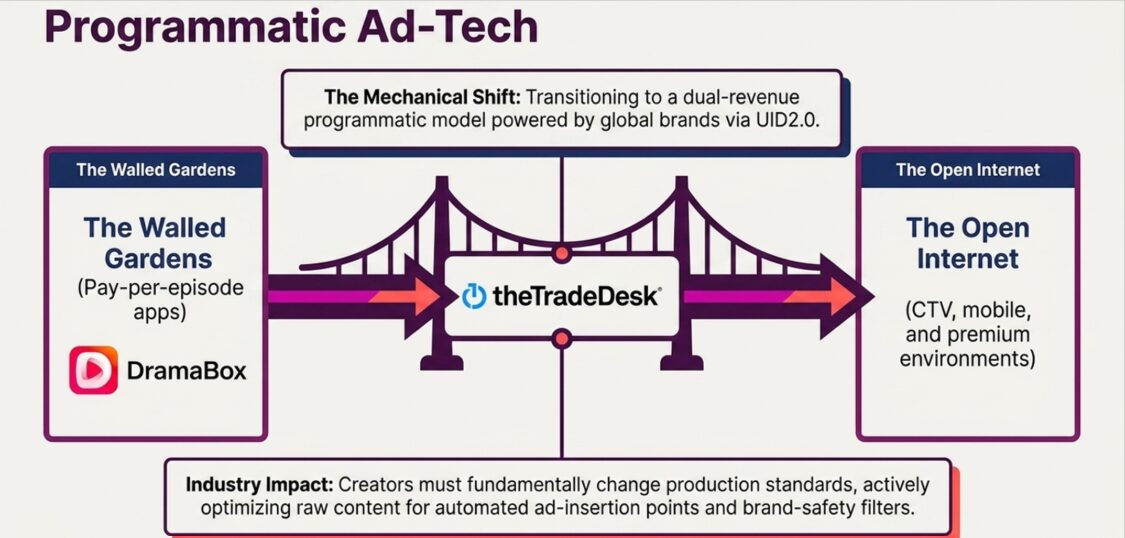
On April 26, 2026, The Trade Desk (TTD) announced it had become DramaBox’s first-ever demand-side platform (DSP) partner, giving advertisers programmatic access to DramaBox’s short-drama ad inventory across the open internet, per The Trade Desk’s own press release, which frames it as the first deal of its kind for any vertical-drama app. It marks a real shift: short-drama advertising inventory, previously locked inside app-specific ad systems, can now be bought the same way brands buy connected-TV inventory.
⚡ Key Takeaways
- TTD became DramaBox’s first-ever DSP partner on April 26, 2026, the first such deal for any vertical short-drama app, per the announcement.
- The release cites a combined ~250 million monthly active users across the top 20 short-drama apps globally, and a ~$3 billion global short-drama app market for 2025, with the US the largest market outside China at $1.3 billion.
- Deloitte’s 2026 TMT Predictions forecast in-app micro-series revenue more than doubling, from $3.8 billion (2025) to $7.8 billion (2026), with Q1 2025 revenue already up roughly 294% year-over-year.
- DramaBox’s own revenue grew from $8 million (2023) to $323 million (2024), per Media Partners Asia’s reporting; the companies’ own release frames the DSP deal itself as the first of its kind for any vertical short-drama app.
- The deal does not include any confirmed identity-resolution or AI-bidding product integration; claims that it uses TTD’s UID2 or Kokai platforms are not supported by the official announcement or any independent coverage found.
📋 Table of Contents
Deal Overview: What TTD and DramaBox Actually Announced
TTD became DramaBox’s first demand-side platform partner, giving its advertiser clients programmatic access to DramaBox’s short-drama ad inventory across the open internet, per the April 26, 2026 press release. DramaBox is operated by StoryMatrix Pte. Ltd., a Singapore-based subsidiary of Beijing’s Dianzhong Technology, and launched in April 2023, per DramaBox’s own company background.
Until this deal, short-drama apps monetized almost entirely through in-app purchases, users paying per episode or per app “coin” bundle to unlock later chapters of a serialized 60-to-90-second-episode drama. This partnership adds a second monetization layer: programmatic advertising sold and measured the way brands already buy connected-TV inventory, rather than through each app’s own closed ad system.
The Parties: DramaBox, TTD, and Who Said What
Wang Hefei, Head of Commercial at DramaBox, said the partnership reflects that “short drama has become a powerful new growth engine for the global open internet digital content market,” per the official press release. On TTD’s side, Douglas Choy, General Manager of Inventory Development for North Asia, is the executive publicly associated with the deal’s rollout, per the same release and his own professional profile, which lists prior APAC publisher-partnership work with companies including Baidu, iQiyi, and Tencent.
Neither the press release nor independent coverage in Benzinga or Yahoo Finance attributes any statement to CEO Jeff Green, and none of the coverage found ties the deal to a specific identity-resolution product (UID2) or AI-bidding product (Kokai). Readers evaluating this deal should treat any secondary write-up naming a specific TTD product as part of the integration with real skepticism unless it traces back to the official announcement.
How Big Is the Short-Drama Advertising Market, Really?
The companies’ own release puts the global short-drama app market at roughly $3 billion for 2025, with a combined ~250 million monthly active users across the top 20 short-drama apps globally, and the US as the largest market outside China at $1.3 billion, per the companies’ own release (also republished with the same figures by StockTitan). Latin America and Southeast Asia together account for roughly half of global short-drama app downloads, per the same release.
Deloitte’s 2026 Technology, Media & Telecommunications Predictions, based on its Digital Media Trends survey, forecasts global in-app micro-series revenue growing from $3.8 billion in 2025 to $7.8 billion in 2026, more than doubling in a single year, per Deloitte’s own report. Deloitte also found Q1 2025 revenue already running roughly 294% ahead of Q1 2024 ($178 million to approximately $700 million), and projects the US share of global revenue falling from about 50% in 2025 to roughly 40% in 2026 as international markets grow faster.
Readers should treat these two figures, the $3 billion 2025 app-market estimate and Deloitte’s $3.8 billion in-app-revenue figure for the same year, as broadly consistent given they use similar but not identical scopes, rather than as a contradiction. A separate figure sometimes cited elsewhere, Omdia’s ~$14 billion global 2026 estimate, uses a materially different scope that includes domestic Chinese “duanju” revenue outside app-store channels, so it should not be quoted interchangeably with either of the figures above.
DramaBox’s own revenue grew from $8 million in 2023 to $323 million in 2024, per Media Partners Asia’s (MPA) reporting. Figures for DramaBox’s 2025 revenue and current monthly active users vary meaningfully across secondary sources depending on measurement methodology and reporting quarter, so this article does not repeat a single 2025 figure as definitive.
What This Means for Producers and Distributors
A DSP deal of this kind gives short-drama producers a second, more predictable revenue channel beyond user micro-transactions, since programmatic ad inventory is sold against measurable audience data rather than depending entirely on how many viewers pay to unlock the next episode. Producers working with DramaBox or evaluating a similar platform relationship should ask specifically whether a given platform has, or plans to have, its own DSP or programmatic ad relationship, since that materially changes how a title’s advertising revenue is measured and shared.
Because this is confirmed as the first deal of its kind, per the coverage reviewed for this article, other major short-drama platforms including ReelShort and ShortMax had not announced a comparable programmatic advertising partnership as of this deal’s announcement. Platform operators should expect competitors to move toward similar deals if this one performs well, and should ask any platform partner directly about its own programmatic ad roadmap rather than assuming DramaBox’s new capability is now industry-standard.
Vitrina Perspective: Why This Deal, Not a Bigger Name, Went First
DramaBox becoming the first vertical-drama app to land a DSP partnership, rather than a larger competitor like ReelShort, is itself a signal worth reading. DramaBox’s documented revenue growth, from $8 million to $323 million in a single year, per MPA’s reporting, gave TTD a concrete, verifiable growth story to point to when building an advertiser case for a genuinely new ad-inventory category. Anyone evaluating which short-drama platform to work with should treat a platform’s willingness and ability to produce this kind of verifiable, audited growth data, not just its raw download or user numbers, as a meaningful signal of how investable and durable that platform’s business actually is.
Frequently Asked Questions
What is the TTD and DramaBox partnership?
Announced April 26, 2026, The Trade Desk became DramaBox’s first-ever demand-side platform (DSP) partner, giving advertisers programmatic access to DramaBox’s short-drama ad inventory across the open internet, per the official press release.
Is this the first programmatic advertising deal for a short-drama app?
Yes. Coverage of the announcement describes it as the first DSP partnership struck by any vertical short-drama platform; competitors including ReelShort and ShortMax had not announced a comparable deal at the time of this announcement.
Does this deal use TTD’s UID2 identity technology?
This is not confirmed. The official press release and independent coverage reviewed for this article do not mention UID2, Kokai, or OpenPath as part of this specific deal, even though all three are real products used elsewhere in its business.
How big is the global short-drama market?
Estimates vary by scope: the companies’ own release cites roughly $3 billion for the global short-drama app market in 2025, while Deloitte’s 2026 TMT Predictions puts global in-app micro-series revenue at $3.8 billion for 2025, forecast to reach $7.8 billion in 2026. A broader estimate from Omdia (~$14 billion for 2026) includes domestic Chinese revenue outside app-store channels and should not be treated as directly comparable.
How much revenue does DramaBox generate?
DramaBox’s revenue grew from $8 million in 2023 to $323 million in 2024, per Media Partners Asia’s reporting. Figures for 2025 vary across secondary sources depending on methodology.
What does this mean for short-drama producers?
It opens a second monetization channel, measurable programmatic advertising, alongside the existing per-episode micro-transaction model, giving producers and platforms a more diversified and potentially more predictable revenue base.
The Bigger Picture: A Real Deal, Not a Reason to Trust Every Adjacent Claim
TTD’s DSP partnership with DramaBox is a real, verified, first-of-its-kind deal that gives one short-drama platform a second, measurable revenue channel beyond in-app micro-transactions. It’s a meaningful data point for the format’s maturation, but readers should resist treating every adjacent claim, identity-resolution integrations, specific AI-bidding tools, or sweeping market-size figures, as confirmed just because it’s attached to real news. Verify each specific claim against the official record before repeating it.
✍️ Vitrina Research Team
Vitrina AI
