IHUB
IHUB
 Private Briefings (Webinars)


 LeaderSpeak Podcast
  Global Entertainment Digest (Newsletter)
  Premium Lists
 Membership Benefits
 About Vitrina
 Our Story
Published on: May 2026 | ⏱ 12 min read | ✍️ Senior Industry Analyst, Vitrina AI
The Executive Verdict
The strategic agreement between Disney Advertising and Lumee—the specialized ad sales joint venture formed by Hasbro Entertainment and Animaj—represents an industry shift toward collective inventory aggregation in premium digital media markets. Driven by a structural monetization crisis under regulatory frameworks in the kids’ and family sector, Disney is executing an intentional play to bypass YouTube’s native open-auction programmatic machinery. By consolidating premium digital advertising inventory from 65 major US channels, including global anchors like Disney Jr., Star Wars Kids, and Marvel HQ, this deal moves an aggregate footprint of over 100 billion annual views into a managed, reservation-only marketplace. This structural adjustment forces broadcast-tier CPM pricing from global brands that require strict compliance and verified brand safety, establishing a precedent for how legacy studios reclaim pricing power from dominant platform intermediaries.
Why This Matters: For media executives and content owners, this deal demonstrates that digital viewership scale alone cannot solve platform-driven yield erosion. It provides an operational blueprint for bypassing open-auction programmatic ad networks through multi-studio supply aggregation, restoring yield stability to premium digital-first IP portfolios.
⚡ Key Takeaways
- Bypassing the Auction Drain: Enterprise content creators are actively retreating from generic open programmatic spot markets on video platforms, establishing premium, human-curated ad sales layers to protect asset yields.
- Contextual Compliance Scaling: The implementation replaces standard cookie-based user targeting with advanced, frame-by-frame contextual matching to satisfy strict child privacy regulations while maintaining premium advertiser interest.
- Cooperative Supply Aggregation: Direct legacy intellectual property competitors are pooling their digital distribution footprints, creating unified media buys large enough to control regional ad pricing dynamics.
- Platform Intermediary Pressures: This model changes the functional role of hosting platforms from primary commercial gatekeepers to underlying technical infrastructure networks.
📋 Table of Contents
- Section 1 — Deal Overview: Mechanics and Market Catalysts
- Section 2 — The Dealmakers: Profiles and Strategic Intent
- Section 3 — Why is This Deal Unique? Departure from Standard Practice
- Section 4 — Supply Chain Impact: Structural Realignments
- Section 5 — Forward Looking: What Happens Next?
- Section 6 — Vitrina Perspective: The Definitive Conclusion
Section 1 — Deal Overview: Mechanics and Market Catalysts
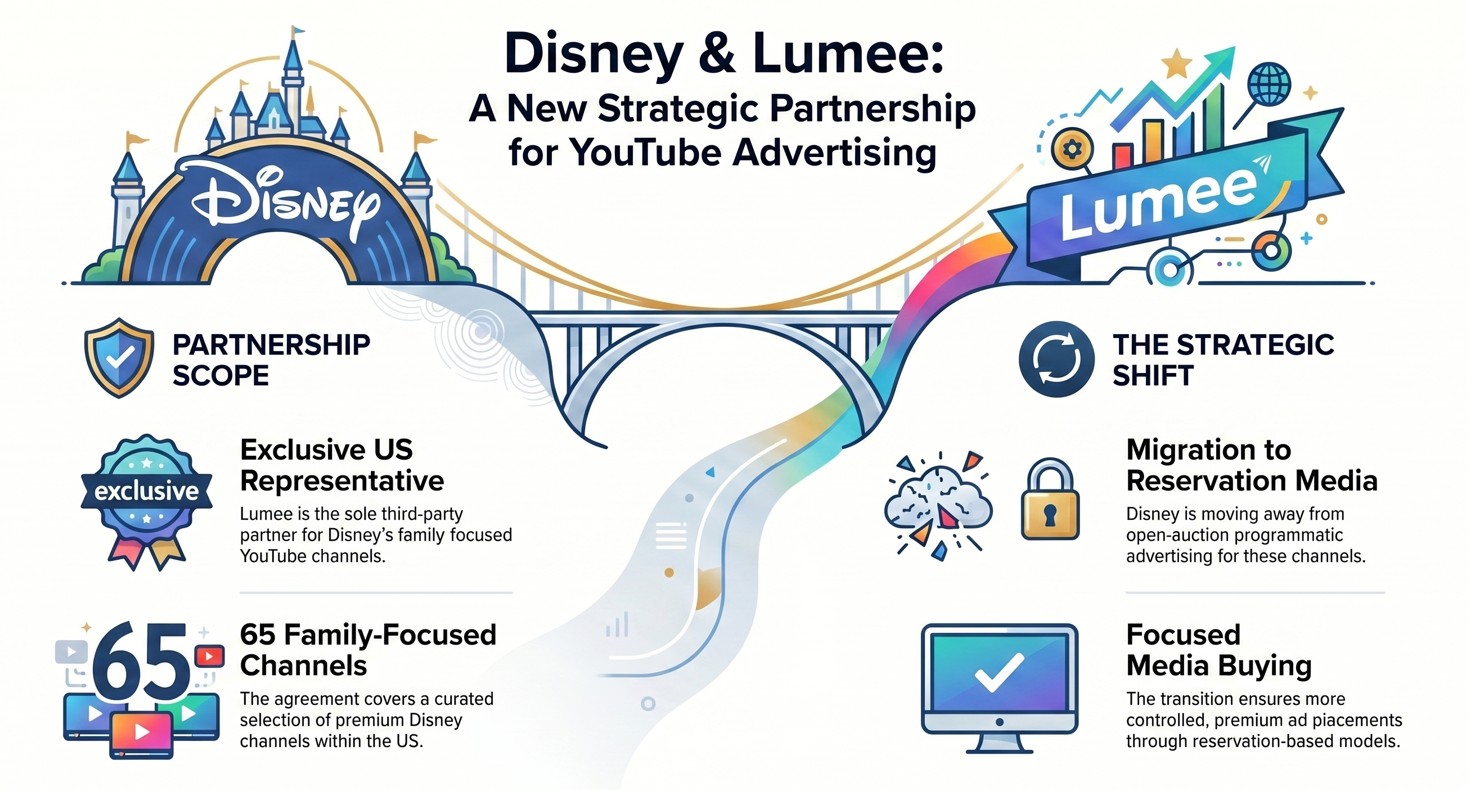
In May 2026, the partnership between Disney Advertising and Lumee structured a new commercial framework for institutional children’s content monetization across global platform networks. Under the terms of the transaction, Lumee functions as the exclusive third-party advertising representative for a portfolio of 65 core family-focused Disney video networks on YouTube inside the United States market.
The Technical Mechanics
Lumee moves Disney’s high-value digital ad inventory directly out of generic real-time bidding (RTB) open exchanges and pulls it into a consolidated, private ad sales environment alongside existing catalog inventory from Hasbro and Animaj. Instead of allowing automated ad engines to clear these impressions based on platform spot market pricing, Lumee packages the combined supply footprint into premium upfront commitments and Private Marketplace (PMP) programmatic guaranteed channels. Ad delivery verification utilizes Lumee’s customized contextual analytics layers, integrating manual verification procedures to guarantee brand safety parameters across all programmatic endpoints.
The Volume and Market Catalysts
The transaction is anchored by an aggregate digital audience footprint representing more than 100 billion annual views across the unified network catalog. Premium content assets transferred under this representation structure include dominant global family media touchpoints like Disney Jr., Star Wars Kids, Marvel HQ, and National Geographic Kids. The immediate market catalyst for this restructuring is the systemic decline in platform-native digital ad yields for children’s video inventories. As regulatory enforcement limits user tracking on younger audiences, standard algorithmic monetization has struggled to fund premium animation and scripting expenses. This collective shift establishes a higher-yield reservation-media alternative to combat declining ad-supported video-on-demand (AVOD) spot rates.
| Operational Parameter | Legacy Platform Model | New Aggregated Managed Model (Lumee) |
|---|---|---|
| Monetization Channel | Platform automated open programmatic auction | Direct upfront reservations & private PMP channels |
| Inventory Grouping | Fragmented, individual single-studio channels | Consolidated multi-studio media catalog bundle |
| Targeting Structure | Restricted behavioral tracking filters | Frame-by-frame compliant narrative contextual data |
| Yield Performance | Declining algorithm-driven spot CPMs[cite: 1] | Stabilized broadcast-parity premium pricing[cite: 1] |
Section 2 — The Dealmakers: Profiles and Strategic Intent
Lumee (Animaj & Hasbro Entertainment Joint Venture)
Formed in early 2026 as a dedicated ad tech and monetization house by Hasbro Entertainment and venture-backed kids’ media operator Animaj, Lumee designs privacy-compliant ad architecture for digital ecosystems. Backed by corporate capital via partner networks like HarbourView Equity Partners, Lumee manages ad revenue infrastructure for key intellectual properties including Peppa Pig, PJ Masks, and My Little Pony.
- Strategic Intent: Securing representation rights for Disney’s digital video portfolio turns Lumee into the primary media clearinghouse for family-oriented programmatic inventory, establishing substantial market leverage over brand agency holding companies. Gregory Dray, Chairman of Lumee, detailed this positioning:
By bringing together Disney, Hasbro, and Animaj, LUMEE delivers the ultimate trusted standard for family marketing on YouTube. We’ve built a high-quality sanctuary where brands can connect with families at scale, backed by uncompromised safety and integrity.”
The Walt Disney Company
Disney operates as a global entertainment conglomerate spanning streaming platforms (Disney+), linear cable networks, experiences, and consumer products. Despite maintaining an internal ad sales tech stack via Disney Advertising, long-tail platform optimization presented manual sales overhead limits.
- Strategic Intent: Disney offloads operational sales overhead for open-platform inventories while insulating its premier properties from ad exchange depreciation. Joe Blount, Senior Vice President, Business Operations, Disney Global Entertainment Networks, explained the alignment:
“Disney is committed to remaining the most trusted storyteller for families – on YouTube and all the touchpoints where our stories and characters appear. This new agreement with LUMEE reflects our continued focus on brand safety and creating high-quality experiences families can trust.”
| Stakeholder | What They Bring | What They Gain | Power Shift Post-Deal | Role |
|---|---|---|---|---|
| Lumee | Contextual ad stack, automated tracking insulation | Unprecedented digital volume, transaction commissions | Captures primary gatekeeping leverage over family ad budgets | Deal Initiator |
| The Walt Disney Company | 65 premium networks, 100B+ annual view asset baseline | Yield security, minimized direct operational sales costs | Insulates premium inventory from generic algorithmic price drops | Strategic Enabler |
| FTC & COPPA Regulators | Privacy enforcement mandates, tracking constraint rules | Enforced data compliance across digital-first platforms | Forces corporate operations to adapt to contextual compliance paradigms | Silent Stakeholder |
| YouTube (Google) | Hosting framework, core content distribution engine | Traffic retention, infrastructure utility fee collections | Concedes direct commercial pricing control of premium tier channels | Incumbent Under Pressure |
Section 3 — Why is This Deal Unique? Departure from Standard Practice
Standard industry practice dictates that global streaming and video hosting platforms retain centralized control over ad inventory monetization inside their apps. Content owners traditionally operate as price-takers, relying on automated native ad servers (such as Google AdSense) to match advertisers with content through real-time spot market auctions. This classic system commingles high-budget institutional programming with amateur user-generated videos inside standard bidding pools, resulting in value deflation across top-tier media portfolios.
The Strategic Departure
This agreement alters standard operating frameworks by seeing direct corporate rivals—Disney and Hasbro—pool their high-value intellectual properties under a single specialized third-party ad sales umbrella. By forming an aggregated supply consortium inside an open ecosystem, these media companies are executing an explicit structural change:
The Long-Held Industry Convention Being Discarded: Media conglomerates managing their digital platform footprints through isolated, single-studio sales divisions, separating themselves from their market competitors.
Application of Aggregation Theory
This deal provides a clear demonstration of Aggregation Theory inside digital video ecosystems. By grouping premium, brand-safe inventory pools, Lumee creates sufficient supply footprint scale to establish an independent commercial gatekeeper layer. This layout allows them to effectively bypass automated platform auction rules and sell directly to premium brand networks at broadcast-parity valuations.
The Contrarian Angle — The Consensus Trap
The consensus view among sector observers frames this agreement as a basic win for baseline brand safety verification. This analysis is incomplete. In reality, this partnership represents a major structural counter-move against the operational degradation of automated ad exchanges under shifting child data privacy landscapes. By building an exclusive reservation-media ecosystem inside an open hosting framework, Disney and Hasbro are acknowledging that unmanaged programmatic web models cannot finance high-quality children’s programming. This arrangement creates an internal tier divide on open video platforms, separating institutional content assets from standard user-generated video streams.
Total Addressable Market (TAM) Metrics
- Primary Market Baseline: The global digital advertising market for verified kids and family content across open streaming platforms and CTV environments is evaluated at $3.8 Billion (Analyst Estimate).
- Serviceable Segment Size: The brand-safe, contextual reservation media and private programmatic marketplace layer accounts for **$1.2 Billion** of the aggregate total.
- Growth Projections: Driven by corporate capital shifting away from web cookie tracking and into context-driven network architectures, this specialty premium inventory block is tracking an estimated 8.4% CAGR through fiscal 2028.
Section 4 — Supply Chain Impact: Structural Realignments
Content Creation & Financing
The deployment of this managed ad sales architecture alters upstream creation economics. By providing predictable direct ad monetization that isolates content assets from platform auction fluctuations, production companies can secure upfront project debt financing against structured corporate media commitments rather than speculative platform views. This structural shift stabilizes long-term development capital for independent animation studios.
Distribution & Windowing
This model redefines how open-network streaming fits into multi-platform distribution maps. Instead of treating third-party video platforms solely as marketing funnels designed to push viewers into paid subscription streaming services (SVOD), studios can confidently run primary or parallel window releases inside ad-supported models, capturing structural profitability while maximizing global audience reach.
Delivery Infrastructure & Tech
Lumee’s technical framework relies on contextual analysis engines that strip out identity tracking data entirely. Video libraries are indexed at the metadata level, automatically mapping content themes directly to ad server pipelines via secure private marketplace APIs. This layout eliminates standard profile tracking requirements while maintaining precise brand matching capabilities.
Monetization Model
The commercial paradigm shifts away from platform-controlled real-time auctions toward consolidated multi-studio upfront pools. This adjustment limits automated price drops and protects the asset portfolio’s baseline commercial value.
The Core Friction Point Resolved: The systemic devaluation of enterprise studio intellectual properties caused by automated real-time bidding exchanges commingling premium content with unverified user videos.
| Supply Chain Stage | Disrupted? | Nature of Disruption | Severity Tag |
|---|---|---|---|
| Content Creation & Financing | Yes | Shifts production budgeting tracking from speculative view targets to secure upfront reservation metrics[cite: 1] | Medium |
| Distribution & Windowing | Yes | Stabilizes ad-supported open networks as primary release channels, decreasing reliance on subscription windows | Medium |
| Delivery Infrastructure & Tech | Partially | Deploys external contextual metadata filtering frameworks over traditional platform-native ad engines | Low |
| Monetization Model | Yes | Replaces platform-controlled programmatic spot rates with direct, human-curated private exchange setups[cite: 1] | High |
The Industry Ripple Effects
- Automated Metadata Structuring: Creative content houses will adjust post-production asset exports to systematically output frame-by-frame contextual tags, ensuring seamless ingestion into Lumee’s premium ad servers.
- Consolidation Drivers for Independent IPs: Mid-tier intellectual property owners lacking direct enterprise scale will face pressure to join consolidated sales syndicates like Lumee to protect their baseline platform ad revenues.
The Practitioner’s Playbook
How to optimize contextual ad targeting for COPPA compliant kids media
Action Step 1: Transition internal campaign definitions away from user-level cookie identification models and reallocate engineering workflows toward narrative contextual mapping architectures.
Action Step 2: Review all open programmatic ad buying pools to isolate and remove non-curated user-generated inventory blocks, prioritizing verified, multi-studio private marketplace (PMP) channels.
How to transition YouTube distribution from open programmatic to reservation sales
Action Step 1: Group separate, long-tail niche video distribution profiles into aggregated inventory segments to establish the baseline volume metrics required for direct institutional brand placement.
Action Step 2: Re-examine platform distributor frameworks to enable external third-party ad sales house representation within your high-performing organic channels.
Section 5 — Forward Looking: What Happens Next?
90-Day Near-Term Triggers
Brand media planners will actively move remaining Q3/Q4 2026 digital family marketing budgets out of generic open programmatic spot exchanges and reallocate them into Lumee’s premium Disney Private Marketplace (PMP) windows. This shift occurs ahead of the final execution of institutional winter upfront campaigns.
1-Year Market Landscape Shift
Corporate competitors across the family entertainment and consumer product landscape (such as Mattel and WildBrain) will likely introduce similar ad supply aggregation partnerships to match Lumee’s regional market scale advantages.
2 to 3 Year Strategic Scenarios
Scenario A — If the Aggregation Strategy Succeeds: Consolidated multi-studio private networks establish themselves as the standard framework for premium open-web digital distribution, managing more than 35% of all non-walled-garden children’s media transactions as brands seek verified compliance layers.
Scenario B — If the Aggregation Strategy Fails: Video hosting platform operators deploy algorithmic or policy-driven adjustments to their primary content recommendation filters, prioritizing channels that maintain native automated ad engine utilization (AdSense), which would challenge independent sales network volume metrics.
Section 6 — Vitrina Perspective: The Definitive Conclusion
The Verdict
The foundational market assumption that massive digital viewership scale automatically creates premium advertising value has officially cracked. Under modern data compliance laws, open-market programmatic tools turn high-value digital media footprints into cut-rate commodities.
With this agreement, market power shifts directly from platform automation algorithms back to consolidated content owner alliances. Media practitioners must immediately stop evaluating open digital ecosystems as single-source automated monetization engines; high-value video assets must be grouped and managed via reservation platforms to protect their underlying financial value.
The Vitrina AI Read:
The partnership between Disney and Lumee goes far beyond a simple corporate sales alignment; it represents an institutional rescue mission for premium digital content economics. As regulatory privacy borders tighten across the globe, the value of unverified open programmatic advertising will continue to decrease.
By building a specialized, human-vetted media network on top of open hosting services, Disney, Hasbro, and Animaj have created a template for modern digital distribution survival.
The Insight: Scale without control is an exercise in funding someone else’s platform infrastructure; the future belongs to those who re-erect walls around their digital kingdoms.
This alliance goes beyond basic ad monetization adjustment; it provides a structural response to data privacy constraints affecting global entertainment supply chains. As regulatory frameworks restrict traditional user-level cross-device tracking, the commercial yield of open-auction programmatic ad networks will continue to decline. By introducing a multi-brand private clearinghouse framework inside third-party tech platforms, legacy media giants are defining a new operational model for content monetization.
The long-term value of digital intellectual property is no longer determined by platform platform-native algorithms, but by the clean structure of the private marketplace layers built on top of them.
Frequently Asked Questions
What is the Disney and Lumee agreement?
Announced in May 2026, Lumee became the exclusive third-party ad sales representative for 65 family-focused Disney YouTube channels within the United States market, moving premium digital inventory out of open programmatic spot auctions and pulling it into structured, brand-safe contextual networks.
Why did Disney choose to hand over these ad sales if they manage their own internal ad platforms?
While Disney Advertising handles premium linear networks and centralized streaming assets (like Disney+), managing highly fragmented, long-tail digital platform environments demands high operational sales overhead. Partnering with Lumee provides collective market scale alongside Hasbro and Animaj properties.
How does Lumee’s technology stack bypass traditional cookie tracking?
Lumee uses proprietary contextual tracking frameworks and manual curation layers instead of individual behavioral tracking. This setup ensures complete COPPA compliance by matching brand messaging directly to real-time video narrative data rather than individual user profile histories.
What properties are included within Lumee’s broader operational network?
The unified portfolio groups major family franchises from Animaj, Hasbro, and Disney, including global properties such as Peppa Pig, My Little Pony, Transformers, Pocoyo, Disney Jr., Star Wars Kids, and Marvel HQ.
What is the projected market size for this sector?
The brand-safe, premium contextual reservation inventory segment accounts for an estimated $1.2 Billion TAM globally, tracking an 8.4% CAGR through fiscal 2028 as brand budgets move away from standard tracking models and shift toward privacy-compliant, context-driven architectures.
Senior Industry Analyst Vitrina AI