IHUB
IHUB
 Private Briefings (Webinars)


 LeaderSpeak Podcast
  Global Entertainment Digest (Newsletter)
  Premium Lists
 Premium Reports
 Membership Benefits
 About Vitrina
 Our Story
Published on: May 2026 | ⏱ 15 min read | ✍️ Senior Industry Analyst, Vitrina AI
Overview
The official festival selection of Dreams of Violets establishes fully synthetic live-action features as an institutionalized asset class, collapsing traditional development costs while forcing a foundational restructuring of IP provenance, independent distribution models, and structural festival gatekeeping
Why This Matters
For media executives, financiers, and distributors, this event demonstrates that feature-length narrative content with high visual fidelity can now be generated, rendered, and delivered directly to a Class-A festival slate for under $2,000. This completely decouples long-form cinematic storytelling from physical production infrastructure, shifting the ultimate commercial value entirely to downstream gatekeeping and upstream prompt engineering
The Executive Verdict
The official selection of Dreams of Violets for its world premiere at the 2026 Tribeca Festival marks the formal institutionalization of fully synthetic live-action feature films within Class-A festival programming. Driven by the rapid maturity of generative video stacks like Kling AI, this structural model shift allows Fountain 0 to bypass physical production pipelines completely. Strategically, this collapses independent feature film financing barriers down to an ultra-low benchmark of under $2,000. For global media executives, this marks the pivot point where generative video transitions from a short-form technical novelty into a scalable, long-form narrative asset class.
⚡ Key Takeaways
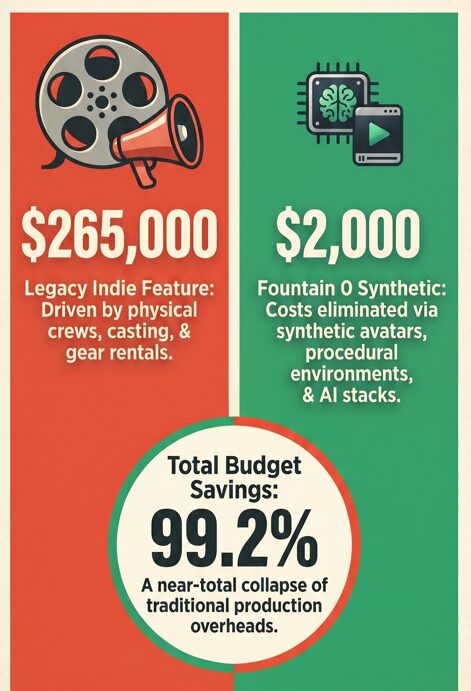
- Capital Dematerialization: Feature-length independent film production costs have collapsed from a baseline low of $250,000 to less than $2,000, fundamentally breaking the legacy equity-and-debt financing stack.
- Festival Gatekeeping as Brand Validation: Class-A festivals are pivoting from marketplace hubs into structural authenticators, certifying that a fully synthetic film possesses the narrative and cultural baseline required for premium commercial distribution.
- Content Velocity Compression: Bypassing physical production shortened the end-to-end production lifecycle of a 75-minute historical docudrama to just 90 days, enabling studios to respond to real-world geopolitical events almost in real time.
- Provenance and E&O Vulnerability: Independent distributors taking on fully synthetic assets face unmapped chain-of-title risks, as current Errors and Omissions (E&O) insurance frameworks are unequipped to underwrite model-generated human likenesses.
📋 Table of Contents
- Section 1 — Deal Overview: Mechanics, Cost Matrices, and Curation Catalysts
- Section 2 — The Dealmakers: Profiles, Platforms, and Strategic Motives
- Section 3 — Why is This Deal Unique? The Dematerialization of Physical Production
- Section 4 — Supply Chain Impact: Upstream Disruption and the Practitioner Playbook
- Section 5 — Forward Looking: Observable Triggers and 3-Year Scenarios
- Section 6 — Vitrina Perspective: The Definitive Conclusion
Section 1 — Deal Overview: Mechanics, Cost Matrices, and Curation Catalysts
In May 2026, the Tribeca Festival announced the official inclusion of the feature film Dreams of Violets within its high-profile Special Events lineup for its 25th anniversary edition. The transaction mechanics do not follow a traditional studio acquisition; instead, it operates as a high-stakes programming agreement between the festival’s curation body and the AI-native creative studio Fountain 0. The world premiere is scheduled for June 10, 2026, in New York City.
The Mechanics in Full
Unlike conventional acquisitions that involve upfront minimum guarantees against theatrical backend percentages, this arrangement guarantees Fountain 0 a high-visibility physical theatrical screening platform, press curation, and direct access to domestic and international buyers. The film’s structural parameters represent a complete compression of traditional indie timelines. It has a confirmed running time of 75 minutes, was written, generated, and delivered in under 90 days, and incurred a total production expenditure of less than $2,000. Fountain 0 retains 100% of the worldwide distribution, streaming, and merchandising rights, using the festival solely as an institutional launchpad to secure multi-territory SVOD licensing deals.
The Catalysts
The timing of this programming decision is tied directly to the massive acceleration of text-to-video foundation models between late 2025 and early 2026. Prior generative platforms lacked the temporal consistency required to maintain facial geometry and environmental lighting across a sustained narrative format. By deploying optimized iterations of Kling AI, the creators demonstrated that synthetic characters could carry structural narrative loads over 75 minutes without showing distracting visual artifacting or clipping. Furthermore, the film’s subject matter—dramatizing the highly sensitive real-world civilian protests in Iran from January 2026—demanded a rapid production response that physical camera crews, location scouting, and talent casting pipelines could not physically execute within a 90-day window.
Comparative Cost Breakdown: Legacy Low-Budget Indie vs. Fountain 0 Synthetic Feature
| Cost Category | Legacy Low-Budget Indie Feature | Fountain 0 Synthetic Feature Model | Structural Cost Variance |
|---|---|---|---|
| Development & Scripting | $15,000 (WGA minimums) | $0 (Internal LLM Script Pipeline) | -100% |
| Talent Casting & Crew Wages | $120,000 (SAG Low-Budget Ultra) | $0 (Synthetic Avatars) | -100% |
| Location & Gear Rental | $65,000 (Panavision/Trucks/Permits) | $0 (Procedural Synthesis) | -100% |
| Compute & Model Subscriptions | $0 (Not Applicable) | $1,200 (Commercial API Compute) | New Cost Line |
| Post-Production Audio & Voice | $45,000 (Sound Stage/Coloring) | $600 (Desktop DAW / Voice Cloning) | -98.6% |
| Legal, Clearances, & Title | $20,000 (Script Clearance/E&O) | $200 (Copyright Filings Only) | -99.0% |
| Total Production Budget | $265,000 | $2,000 | -99.2% |
Section 2 — The Dealmakers: Profiles, Platforms, and Strategic Motives
Tribeca Festival (Tribeca Enterprises)
Tribeca Enterprises, backed by James Murdoch’s Lupa Systems, operates as a premier platform for media discovery and independent acquisition in North America. The festival draws an annual audience exceeding 150,000 attendees and serves as a major marketplace for domestic independent film buyers.
- Strategic Context & Intent: Under the operational leadership of co-founder Jane Rosenthal, Tribeca has consistently sought to establish an absolute first-mover advantage over traditional fall festivals (Toronto, Venice) by embracing technology-driven narrative formats. By programming Dreams of Violets within its high-visibility lineup, Tribeca cements its position as the definitive institution validating synthetic cinematic intellectual property, attracting international trade attention and software-native creators to its platform.
Fountain 0 (Fountain O)
Fountain 0 is an agile, London-headquartered creative studio and technology sandbox founded by Iranian-British creative technologists. The outfit specializes in developing end-to-end synthetic asset pipelines that replace traditional physical camera capture with multi-modal generative networks.
- Strategic Context & Intent: For an independent software-native studio, capturing a slot at a Class-A film festival provides the ultimate validation required to scale. Fountain 0’s objective is to show that premium long-form feature storytelling can be executed with minimal overhead. This festival platform allows them to demonstrate their proprietary workflow stack directly to legacy production companies seeking to compress their upstream development budgets.
Ash Koosha & Pooya Koosha (Co-Directors & Co-Producers, Fountain 0)
Ash Koosha is an established electronic musician, multi-disciplinary artist, and technologist who has spent over a decade developing AI-driven composition pipelines and virtual reality systems. Alongside co-director Pooya Koosha, he has focused on using technology to challenge traditional production economics.
- Agency in Deal: The Koosha brothers wrote, directed, and generated the entirety of Dreams of Violets over a 90-day production cycle, acting as the sole creators managing the multi-modal text-to-video models. Rather than coordinating camera, lighting, and physical acting departments, their role involved controlling prompt seeds, diffusion parameters, and temporal continuity engines directly from their terminal interfaces.
“We are proving that the capital required to tell a high-stakes, feature-length story has dropped to near-zero. Curation and creative prompt architecture are the new studio system.”
— Ash Koosha, Co-Director, Fountain 0
Stakeholder Influence Map
| Stakeholder | What They Bring | What They Gain | Power Shift Post-Deal | Role |
|---|---|---|---|---|
| Fountain 0 | Fully synthetic 75-minute feature IP | Class-A festival validation and visibility | Gains massive leverage over mid-tier indie studios. | The Catalyst |
| Tribeca Festival | Premium curation and buyer network | Global first-mover status in AI feature curation | Becomes less dependent on legacy studio output. | Strategic Enabler |
| Traditional Indie Producers | Legacy equity and debt financing stacks | Nothing — face extreme cost pressure | Lose structural control over low-budget greenlights. | Incumbent Under Pressure |
| Below-the-Line Physical Crew | Specialized physical on-set labor | Nothing — completely bypassed in workflow | Suffers structural drop in narrative labor demand. | The Unintended Victim |
Section 3 — Why is This Deal Unique? The Dematerialization of Physical Production
Standard Practice — What Was Normal Before
Historically, independent feature filmmaking required a rigid, sequential capital accumulation model. Producers spent 12 to 24 months securing equity investments, pre-sales, and tax incentives to clear a minimum cash baseline of $250,000. This capital was immediately consumed by the physical mechanics of capture: hiring crew, booking physical locations, renting camera packages (ARRI/RED), and compensating human actors under strict union day-rates. AI was strictly siloed in post-production as an isolated visual effects (VFX) utility or restricted to short-form experimental showcases.
Why This Deal Stands Out
The premiere of Dreams of Violets breaks this model by achieving the absolute dematerialization of physical production. Fountain 0 abandoned the entire physical capture phase. There were no casting calls, no cameras on set, no location permits filed, and no physical sets constructed. Every frame was synthesized on local desktop hardware and cloud server clusters. This is the first instance where a Class-A film festival has accepted a live-action aesthetic feature where the entire human cast and physical landscape are completely synthetic, abandoning the industry’s historical definition of cinema as a medium fundamentally rooted in physical camera capture.
Historical Parallel
The closest historical parallel occurs in the late 1990s with the emergence of consumer-grade digital video (DV) formats, which catalyzed the Dogme 95 movement (Festen) and The Blair Witch Project. Those events collapsed production costs by eliminating expensive 35mm film processing. However, that shift was merely incremental; it still required physical actors, locations, sets, and real-time capture. The Fountain 0 model represents a total structural departure because it eliminates the physical asset layer entirely, moving independent film into a regime of Zero Marginal Cost production.
The Contrarian Angle — The Consensus Trap
The dominant market consensus views the Dreams of Violets premiere as a threat to actors and physical crews. This interpretation is lazy and misses the true operational bottleneck. The real crisis is not in production labor, but in distribution and validation. When the cost of producing a feature drops to $2,000, the market will face an unprecedented supply shock of long-form content. Consequently, the value of production drops to zero, while the economic value of distribution gatekeeping (Class-A festival curation) and brand validation skyrockets. Tribeca is not just programming a movie; it is demonstrating that in an era of infinite synthetic content, the festival itself becomes the ultimate arbiter of value.
Total Addressable Market (TAM) Analysis
According to data compiled from the 2025 MPA and Omdia market indexes, the global independent film production and distribution market stands at $42.3 Billion. The serviceable segment—defined specifically as the low-budget narrative indie sector operating below a $5 million production threshold—accounts for $8.4 Billion of that total.
While the physical independent film sector is contracting due to rising debt costs and collapsing international pre-sales, the synthetic narrative feature segment is projected to scale from a negligible baseline in 2025 to $1.8 Billion by 2028, representing an estimated CAGR of 142%. This growth is driven by software-native outfits deploying highly automated translation, multi-lingual audio synthesis, and cloud rendering pipelines to capture global multi-platform long-tail revenues.
Section 4 — Supply Chain Impact: Upstream Disruption and the Practitioner Playbook
Upstream — Content Creation & Financing
The legacy indie financing stack—built on complex webs of senior debt, bridge loans, completion bonds, and regional tax credits—is rendered completely obsolete for this tier of content. When a feature requires under $2,000, the producer entirely bypasses institutional financiers. The leverage in the commissioning room shifts completely from the executive holding the capital to the prompt architecture team holding the optimized model workflows. Creative control is absolute; there are no studio notes, no investor interference, and no completion bond mandates restricting the narrative choices.
Upstream — Production
Physical production infrastructure is entirely bypassed. The geographic flow of spend shifts from traditional film hubs (Atlanta, London, Vancouver) directly to cloud compute centers (AWS, Google Cloud, regional GPU clusters). The traditional on-set hierarchy—DP, gaffer, costume designer, key grip—is replaced by a single unified technical director managing terminal commands, prompt seeds, and diffusion parameters.
Downstream — Distribution & Windowing
The role of the film festival is structurally realigned. In the legacy pipeline, festivals operate as standard marketplaces where distributors buy finished physical assets. For synthetic features, the festival operates as a critical provenance filter and cultural legitimator. Because a synthetic film can be compiled in 90 days, the traditional release windows can be heavily compressed. A studio can catch a shifting cultural or political trend and have a validated feature in distribution within a single quarter, bypassing the standard two-year theatrical gestation period.
Downstream — Delivery Infrastructure & Tech
The technology stack deployed by Fountain 0 moves beyond basic text-to-video utilities into a complex multi-modal orchestration pipeline:
- Video Generation: Kling AI acted as the core foundation model for generating photorealistic human textures and maintaining multi-shot temporal consistency.
- LLM Orchestration: Customized Claude 3.5 Sonnet pipelines were used to generate structural prompt variables, managing camera movement variables (pan, tilt, zoom syntax) across sequential scene IDs.
- Compute Footprint: Local hardware execution was localized on desktop workstations equipped with dual NVIDIA RTX 4090 GPUs, paired with high-throughput cloud rendering API nodes to scale parallel frame processing.
M&E Supply Chain Disruption Map
| Supply Chain Stage | Disrupted? | Nature of Disruption | Severity |
|---|---|---|---|
| Content Creation & Financing | Yes | Eliminates institutional debt/equity stack; slashes greenlight capital requirements by 99%. | High |
| Production | Yes | Replaces physical crew, cameras, and location sets with cloud-rendered GPU compute pipelines. | High |
| Distribution & Windowing | Partially | Compresses time-to-market down to 90 days; festivals act as legal and narrative filters. | Medium |
| Delivery Infrastructure & Tech | Yes | Mandates native multi-modal model integration (Kling AI, Claude) for feature-length narrative coherence. | High |
The Ripple Effects
- The Proliferation of Instant Geopolitical Mimetic Media: Because Dreams of Violets responded to protests occurring just months prior, its festival inclusion will trigger a massive wave of immediate historical docudramas. Independent studios will deploy synthetic pipelines to rapidly dramatize breaking news events, creating a hyper-accelerated market for reactive narrative features that functions at the speed of social media trends rather than traditional multi-year studio cycles.
- The Rise of “Prompt-Sovereignty” Legal Challenges: As tech-native studios generate photorealistic features depicting real-world political figures and civilian settings without on-the-ground filming, legacy international media laws will face an immediate crisis regarding sovereignty and likeness rights. Foreign states will find themselves entirely unable to block the production of highly critical narrative films via traditional local censorship or filming permit denials, as the entire production infrastructure exists outside their physical borders.
The Practitioner’s Playbook
How can independent distributors underwrite Errors and Omissions (E&O) insurance for fully synthetic features?
- Establish Model Provenance Logs: Mandate that the production team deliver comprehensive, timestamped metadata logs detailing every foundation model API call, random seed value, and text prompt sequence used to construct the feature. This acts as the definitive chain-of-title proving no copyrighted source imagery was ingested via targeted image-to-image prompts.
- Execute Deflationary Likeness Cleansing: Run all finalized video assets through automated facial geometry scanners to verify that synthetic characters do not cross acceptable statistical thresholds of facial similarity with living actors or public figures, mitigating right-of-publicity claims.
- Isolate Compute Indemnity Clauses: Restructure standard distribution contracts to include specific compute indemnity terms, shifting any structural copyright liabilities originating from the underlying foundation model training data directly back onto the software developers (e.g., Kling AI), rather than the distributor or festival platform.
How must entertainment law firms restructure independent IP chain-of-title validation?
- Deconstruct the Traditional Screenplay Option: Move away from standard copyright options based on WGA-registered treatments. Lawyers must draft agreements that secure ownership over the specific custom-trained LoRA (Low-Rank Adaptation) weights and structural prompt files that define the unique visual identities of the characters and digital environments.
- Draft Prompt-Discretion Restraints: Insert explicit clauses that prevent creative partners from utilizing public multi-modal models that retain user inputs for training data, ensuring the proprietary story world assets do not leak into the public domain during the generation phase.
Section 5 — Forward Looking: What Happens Next?
90-Day Pulse
- June 10, 2026 (The Tribeca World Premiere): The immediate indicator to watch is the critical and buyer reaction inside the screening room. The key metrics are audience retention (walkout rates) and the specific language used in distribution reviews regarding visual artifacting and narrative empathy.
- The Guild Response: Watch for formal joint statements from SAG-AFTRA and the DGA condemning Tribeca’s programming strategy. This will serve as a clear indicator of the legal boundaries legacy union talent plans to enforce against festivals opening their gates to synthetic slates.
1-Year Horizon
- The Replication Influx: By the mid-2027 festival submission cycle (Sundance/Slamdance 2027), expect submission volumes for fully synthetic features to scale by an estimated 10x. Festivals will be forced to implement explicit technical disclosure frameworks and automated AI detection pipelines within their submission portals to manage the influx of zero-marginal-cost content.
- Insurance Standardization: The arrival of the first specialized “Synthetic E&O” insurance product from major boutique entertainment underwriters, establishing formal pricing baselines for bonding films that feature zero physical camera capture.
2 to 3-Year Scenarios
-
Scenario A: The Strategy Succeeds (The Democratization Matrix)
If Dreams of Violets secures a viable global streaming acquisition and demonstrates strong consumer completion rates, the independent film landscape will experience structural bifurcation by 2029. The under-$2 million micro-budget indie layer will shift entirely to synthetic pipelines. Independent creators globally will command premium narrative fidelity without seeking institutional financing, completely breaking the historical monopoly of Western capital over international cinematic distribution.
Scenario B: The Strategy Fails (The Aesthetic Rejection Trigger)
If the premiere is met with widespread critical panning, box-office/streaming avoidance, and severe user-backlash regarding the ethical implications of using synthetic actors to depict a real human tragedy, the model will experience a swift retreat. The trigger condition will be a coordinated boycott of the festival by prominent live-action directors and actors, forcing Class-A curators to ban fully synthetic live-action features from main-slate competitions and relegate them permanently to isolated technical side-slates.
Section 6 — Vitrina Perspective: The Definitive Conclusion
The Verdict
-
The Changed Market Assumption: The long-held industry axiom that a live-action aesthetic narrative feature fundamentally requires physical camera capture, real-world location staging, and human physical performance has been completely shattered. Cinema is being redefined from a medium of recording physical reality to a medium of executing procedural synthesis.
-
The Power Shift: Power has shifted decisively away from the traditional capital consolidators (equity funds, completion bonders, regional film commissions) and concentrated entirely in the hands of downstream cultural curators (festivals) and upstream concept architects. The gatekeeper’s brand is now infinitely more valuable than the producer’s camera package.
-
The Imperative Action: Practitioners must immediately cease treating generative video as a superficial visual effects tool. Studio executives and distributors must build dedicated internal pipelines to audit, evaluate, and legally clear synthetic model metadata assets with the same administrative rigor they currently apply to traditional chain-of-title documentation.
The Vitrina AI Read
The premiere of Dreams of Violets at Tribeca marks the inevitable arrival of the software-defined studio. For a decade, the media and entertainment supply chain has treated technology as an efficiency layer designed to accelerate existing workflows. This deal proves that technology is no longer an accelerator—it is a complete replacement.
When the marginal cost of feature-length production drops to absolute zero, the industry’s historical structural barriers crumble. The future belongs not to the companies that own the infrastructure of capture, but to the intelligence networks that command the architectures of curation.
Frequently Asked Questions
What exactly is *Dreams of Violets* and how was it produced?
Dreams of Violets is a 75-minute live-action aesthetic docudrama written, directed, and produced by Fountain 0 that has been selected to premiere at the 2026 Tribeca Festival. The film was created over a 90-day period for under $2,000 without any physical production infrastructure. Every character, location, and camera movement was generated entirely via text-to-video foundation models like Kling AI and multi-modal software stacks.
Why is its programming at the Tribeca Festival considered historical?
This is the first time a major Class-A international film festival has programmed a fully synthetic live-action narrative feature within its official main-slate lineup. Previously, AI content was restricted to short-form tech demos, experimental installations, or isolated post-production VFX. This formalizes synthetic film as an institutionalized category of commercial cinema.
What models and hardware did Fountain 0 use to create the film?
The production team utilized Kling AI as their primary text-to-video foundation model to achieve high photorealism and multi-shot temporal consistency across characters. They orchestrated scene structures and prompt schemas using Claude 3.5 Sonnet, executing the local processing workloads on high-end consumer desktop hardware featuring dual NVIDIA RTX 4090 GPUs scaled via cloud-rendering nodes.
How does this event affect traditional independent film financing?
The deal demonstrates that the traditional independent financing stack—which relies on equity investments, foreign pre-sales, senior debt, and completion bonds to clear a minimum baseline of several hundred thousand dollars—is completely bypassed for this tier of narrative content. Creators can execute feature-length concepts using personal capital, shifting the primary bottleneck from fundraising to downstream distribution curation.
What are the primary legal and insurance risks associated with this model?
The core risk centers on chain-of-title and Errors and Omissions (E&O) insurance vulnerabilities. Because current copyright and insurance frameworks are completely unequipped to manage potential training data liabilities or right-of-publicity claims stemming from accidentally generated human likenesses, independent distributors face unmapped legal terrain when acquiring fully synthetic long-form assets.