

 IHUB
IHUB
 Private Briefings (Webinars)


 LeaderSpeak Podcast
  Global Entertainment Digest (Newsletter)
  About Vitrina
 About VIQI
 Our Story
 Our Solutions 🔥
 Film+TV Projects Tracker 🚀
Published on: April 2026 | ⏱ 10 min read | ✍️ Santosh Abhyankar
The Executive Verdict
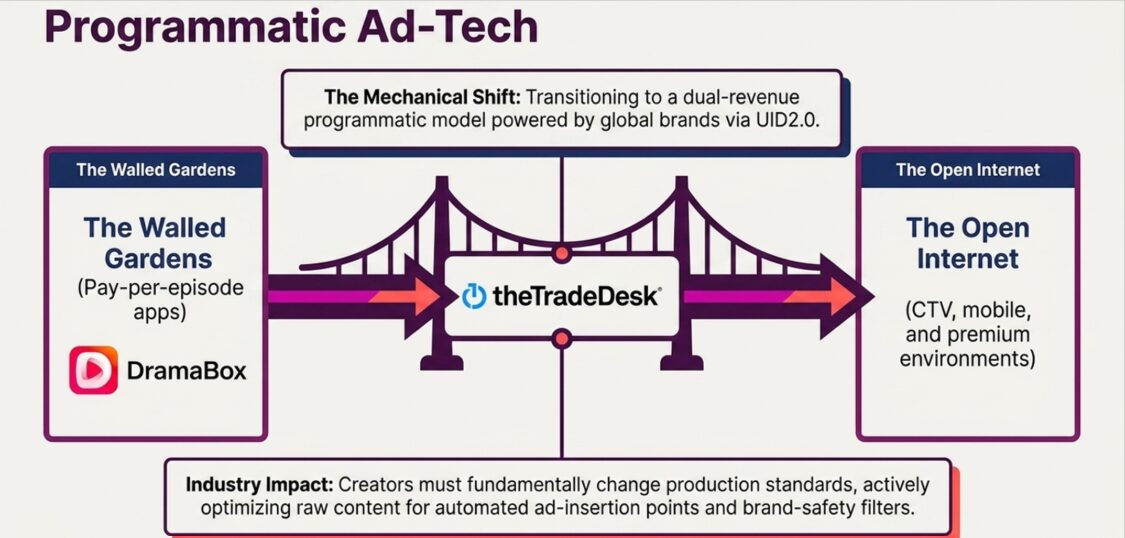
The partnership between The Trade Desk (TTD) and DramaBox marks the formal institutionalization of vertical short-drama as a premium media category. By becoming the first demand-side platform (DSP) to integrate DramaBox’s inventory, TTD is effectively legitimizing the “90-second episode” format for global brands. This move reallocates budgets from social media “walled gardens” toward the open internet, offering high-completion rates and “lean-forward” engagement without sacrificing programmatic transparency. For the industry, this is the pivot point where mobile-first episodic content matures into a measurable, brand-safe alternative to traditional 30-minute broadcast windows.
⚡ Key Takeaways
- Format Parity: Vertical short-drama is now being bought and measured alongside CTV, breaking the technical silo between “mobile social” and “premium entertainment.”
- Walled Garden Leakage: Brands can now use independent data to target short-form viewers, reducing reliance on TikTok and Meta’s proprietary (and often opaque) attribution models.
- Monetization Shift: The deal accelerates the transition of short-drama from a “pay-per-episode” micro-transaction model to a high-yield ad-supported (AVOD/FAST) hybrid.
- Supply Chain Pressure: High-quality “vertical-first” production is now a prioritized investment for studios seeking to tap into programmatic ad dollars.
📋 Table of Contents
- Section 1 — Deal Overview: Mechanics and Market Catalysts
- Section 2 — The Dealmakers: Profiles and Strategic Intent
- Section 3 — Why is This Deal Unique? Departure from Standard Practice
- Section 4 — Supply Chain Impact: The “YES” Stages
- Section 5 — Forward Looking: What Happens Next?
- Section 6 — Vitrina Perspective: The Definitive Conclusion
Section 1 — Deal Overview: Mechanics and Market Catalysts
The technical core of this partnership is the direct integration of DramaBox’s global inventory into The Trade Desk’s buying platform. DramaBox, operated by STORYMATRIX, has seen explosive growth by specializing in highly addictive, serialized vertical dramas—typically 60 to 90 seconds per episode.
The Mechanics
Through this deal, TTD’s clients can programmatically bid on ad breaks within these episodes. Unlike standard “in-feed” social ads that users scroll past, these ads are placed within a narrative flow where completion rates for the content often exceed 80%. This provides a “forced-view” or “incentivized-view” environment that mirrors the high-impact nature of traditional TV, but optimized for the mobile screen.
The Catalysts
- The “Short-Soap” Phenomenon: Apps like DramaBox and ReelShort have proven that audiences are willing to binge-watch dozens of micro-episodes, creating a high-density ad environment.
- Identity Resolution: With the decline of cookies, TTD’s UID2.0 framework allows for precise targeting within the DramaBox app environment, providing a privacy-compliant way to reach specific demographics that social platforms often keep behind their own data curtains.
Section 2 — The Dealmakers: Profiles and Strategic Intent
The Trade Desk (TTD)
Under CEO Jeff Green, The Trade Desk has positioned itself as the champion of the “Open Internet.” Their strategy is built on the belief that the best advertising happens outside of closed ecosystems.
- The Intent: TTD needs to find “CTV-like” engagement on mobile devices to satisfy global agency holding companies. Short-drama provides the narrative “stickiness” that standard mobile display advertising lacks.
DramaBox
DramaBox is a leader in the “Chinese-style” short-drama export wave. They have successfully adapted the high-frequency production model—filming 80-100 episodes in under two weeks—for global audiences.
- The Intent: While in-app purchases (IAP) provide initial revenue, scaling to a billion-dollar valuation requires a robust advertising layer. Wang Hefei, Head of Commercial at DramaBox, noted that this partnership “connects our high-quality content with the world’s leading brands through a transparent, data-driven channel.”
Section 3 — Why is This Deal Unique? Departure from Standard Practice
Historically, vertical video has been the exclusive domain of social media platforms (TikTok, Instagram Reels, YouTube Shorts). Advertisers wanting to reach vertical-video consumers had to use the platform’s own tools and accept their metrics. This deal is a structural departure because it treats vertical video as a broadcast asset.
Historical Parallels
This resembles the early 2010s when Netflix and Hulu began moving away from “experimental digital” into “premium video.” We estimate the Total Addressable Market (TAM) for programmatic vertical drama could reach $5B globally by 2027, driven by the conversion of social video budgets to premium programmatic spend.
Section 4 — Supply Chain Impact: The “YES” Stages
- Development & Financing: The move incentivizes production companies to create higher-quality short-form content now that consistent, high-yield programmatic revenue is a viable exit.
- Licensing & Distribution: DramaBox now serves as a high-value distribution endpoint that can “window” content similarly to traditional SVODs, but with programmatic agility.
- Localization & Multi-platform: As TTD clients demand global reach, the pressure on DramaBox to localize its Chinese-origin and English-original content for 200+ markets intensifies.
- Marketing & Audience Engagement: Advertisers can now target audiences based on narrative genre (e.g., “CEO revenge”) within a unified dashboard.
- Monetization & Analysis: This is the core impact. It moves monetization from opaque in-app systems toward transparent, measurable programmatic CPMs.
Section 5 — Forward Looking: What Happens Next?
90-Day Pulse
Expect a surge in “Private Marketplace” (PMP) deals where specific Fortune 500 brands test exclusive “takeovers” of trending DramaBox series. We anticipate case studies highlighting the “Attention Metric” of short-drama vs. standard pre-roll.
2-Year Horizon
By 2028, “Vertical Drama” will be a standard line item in annual Upfront/Newfront negotiations. The success of this deal will force competitors like ReelShort and ShortMax to build similar programmatic bridges or risk losing out on “Open Internet” budgets.
Section 6 — Vitrina Perspective: The Definitive Conclusion
The Trade Desk’s move into DramaBox is a calculated bet on the professionalization of the vertical screen. For years, the industry treated vertical video as “social noise.” This partnership proves that the format, not the platform, is what matters to the modern consumer.
By applying the same programmatic rigor to a 90-second soap opera as they do to a live sports broadcast, TTD is effectively ending the “experimental” phase of mobile video. The message to content owners is clear: if you produce scripted, vertical, bingeable content, the programmatic engines of the world are now ready to fund you.
Frequently Asked Questions
What is The Trade Desk and DramaBox partnership?
Announced in early 2026, The Trade Desk became the first demand-side platform (DSP) partner for DramaBox. This allows global advertisers to buy vertical short-form drama inventory programmatically through the open internet, using the same tools they use for Connected TV (CTV).
Why is this deal considered a “Walled Garden” challenger?
Previously, vertical video was locked inside social platforms like TikTok or Meta. This partnership allows brands to reach the same high-engagement vertical video audience on the open internet, using their own data and third-party measurement instead of relying on the social platforms’ proprietary metrics.
What is the “Short-Soap” or Micro-Drama format?
Micro-dramas are professionally produced, scripted series consisting of 60 to 100 episodes, each lasting 60–90 seconds. They are specifically filmed for vertical (9:16) viewing on mobile devices and typically feature high-intensity narrative “cliffhangers.”
How does UID2.0 benefit this partnership?
The Trade Desk’s Unified ID 2.0 (UID2.0) allows DramaBox to identify and target specific audiences across different devices without using cookies. This provides advertisers with better attribution and cross-device frequency control than standard social media ads.
What is the projected market size for this sector?
With the professionalization of the format through deals like this, the programmatic vertical drama segment is projected to reach an estimated $5 billion globally by 2027, as budgets shift from social media “experiments” to premium programmatic spend.
How does this affect traditional TV producers?
It creates a new high-yield revenue stream. Producers can now create content optimized for programmatic “ad-breaks” rather than relying solely on user micro-transactions (coins), leading to higher production values and more sustainable financing models.
Santosh Abhyankar Vitrina AI
