IHUB
IHUB
 Private Briefings (Webinars)


 LeaderSpeak Podcast
  Global Entertainment Digest (Newsletter)
  Premium Lists
 Membership Benefits
 About Vitrina
 Our Story
Published on: July 2026 | ✍️ Santosh Abhyankar
The pivot: Disney just traded exposure data for agency leverage — and Netflix just proved it won’t make the same trade.
Why This Matters: Disney and Omnicom just cracked open a data door that CTV publishers have kept shut for years. The fallout isn’t really about repetitive ads — it’s the first hard evidence of which theory of streaming-ad value wins: transparency as a premium feature, or scale as its own defense. Every publisher, agency, and buyer with a stake in the $38 billion U.S. CTV market needs to know which side of that line they’re standing on.
The Executive Verdict:
Disney Advertising and Omnicom Media just did something no major CTV publisher has done before. They let an agency’s Creative ID reach inside Disney’s walled garden and track a specific ad, across a specific session, in real time. Disney’s press release calls it a sequencing tool. The deeper story is a holding company converting acquisition scale into a data asset, and CTV frequency capping is the mechanism that makes that conversion visible.
The primary driver is Omnicom’s absorption of Interpublic, which closed in late 2025 and handed Omnicom the Acxiom identity graph it needed. That graph is what got three competing publishers to agree to something they’d each resisted individually. This isn’t Disney choosing Omnicom over the rest of the ad-tech stack — Disney still sells through Amazon DSP like everyone else. It’s Disney choosing to open a second, more exclusive door that Netflix has explicitly declined to open.
U.S. CTV ad spend is on pace to hit roughly $38 billion in 2026. The fight over who controls measurement inside that market is a fight over billions of reallocated dollars, not a UX fix for annoying ads.
⚡ Key Takeaways
- The transaction layer of CTV advertising is already solved and nearly universal — Amazon DSP now carries inventory from Disney, NBCUniversal, Paramount, Warner Bros. Discovery, Netflix, Roku and Tubi. The real contest has moved to a second layer: measurement and identity, where trust, not liquidity, is the price of entry.
- Disney’s move only works because Omnicom got bigger. The Acxiom identity graph that makes CTV frequency capping possible at scale came from the Interpublic acquisition — the leverage belongs to Omnicom’s size, not to any inherent new goodwill from publishers.
- Netflix and Disney face the identical financial pressure — an ad tier that has to carry more of the P&L — and they’re running it into opposite strategic bets. Only one of those bets can be right by the next upfront cycle.
- Smaller VOD and FAST platforms get folded into Omnicom’s clean room as line items with none of Disney’s negotiating leverage. This “fix” for the industry actually widens the gap between publishers who can extract concessions and publishers who can’t.
- The identity infrastructure fight — Omnicom/Acxiom vs. WPP/InfoSum vs. Publicis/LiveRamp — is the real battlefield behind this specific announcement. Disney-Omnicom is simply the first publicly visible proof point of who’s ahead.
Table of Contents
- Deal Overview
- The Dealmakers
- Why Is This Deal Unique?
- Supply Chain Impact
- Forward Looking
- Vitrina Perspective
Deal Overview
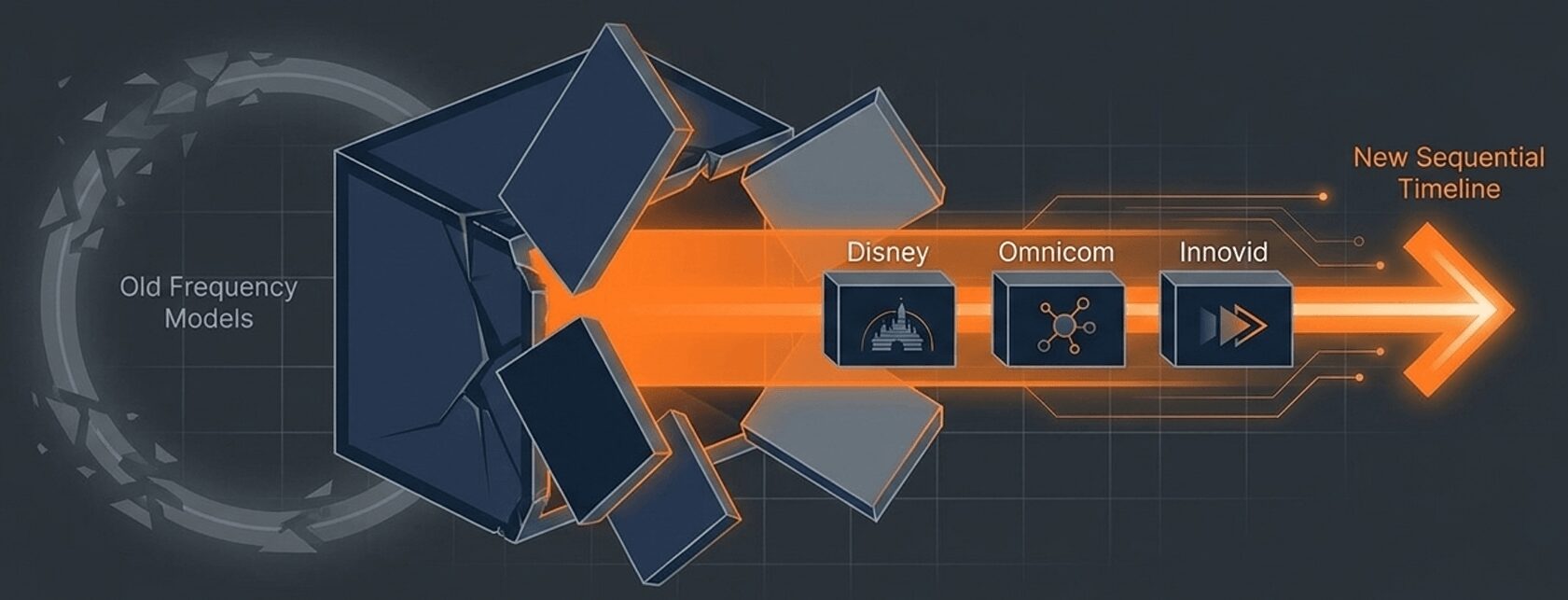
In June 2026, CTV frequency capping got its first real crack in the wall. At Cannes Lions on June 23, Omnicom Media and Disney Advertising announced a connected TV advertising solution, powered by Innovid, that triggers dynamic delivery of new ad content across both video-on-demand and live sports and entertainment. The mechanics matter more than the marketing copy — this is not a new ad format, it’s an identity-and-measurement integration wearing an ad-sequencing product as its retail face.
Deal Mechanics
The system understands audience exposure by session and delivers a sequence of complementary creative messages — 15, 30, and 60-second formats — that build on one another rather than repeating. It combines Disney’s content and audience data, engaged through its proprietary Audience Graph, with Omnicom’s Acxiom identity solution and Innovid’s creative-sequencing technology. For video-on-demand activations, Disney Advertising layers in AI and machine learning to match brand messaging to program content in real time.
Classify this precisely: it’s a technology integration with an embedded data-sharing agreement. Not a licensing deal, not an output deal, not an acquisition. Technology integrations create dependency without transferring ownership — exactly the kind of leverage relationship playing out here.
Volume and Territories
- First advertisers: Home Depot and State Farm, both Omnicom clients
- Campaign spend, CPM premium, or contract duration: not publicly disclosed
- Live now in: the United States
- European Union rollout: planned for late 2026
- Latin America rollout: to follow
No campaign spend, CPM premium, or contract duration has been disclosed by either company as of this writing. That gap is worth flagging rather than filling with a guess.
Why This Deal Happened Now
The obvious catalyst — reducing repetitive, brand-damaging ad exposure — is real, but it’s not sufficient on its own to explain why this happened now, with these two parties, in this structure. Omnicom Media Intelligence’s April 2026 research on “negative reach” found that overexposure to identical ad creative frustrates consumers and damages brand perception, even though those same consumers don’t object to seeing multiple different creative executions from the same brand. That study gave Omnicom the internal case for building a solution, but it doesn’t explain the timing.
The reason Disney agreed to open this door now, rather than in 2023 or 2024, comes down to one structural fact: Omnicom only had the identity infrastructure to make this technically possible after it absorbed Interpublic’s Acxiom asset at the end of 2025. That acquisition made Omnicom the largest holding company in the industry, and the largest holding company got the concession.
Legacy CTV Ad Delivery vs. the New Sequenced/Measured Model
| Dimension | Legacy CTV Ad Delivery | New Sequenced/Measured Model |
|---|---|---|
| Frequency visibility | Measured only within a single platform | Measured across Disney, NBCUniversal, Paramount and other VOD/FAST platforms within one clean room instance |
| Creative exposure tracking | Publisher-side only, not shared with agencies | A Creative ID is passed back into the clean room — the first time major CTV publishers have allowed this |
| Ad delivery within a session | Same spot repeats across ad breaks | Sequenced 15/30/60-second creative that builds across the session |
| Who controls the measurement | Publisher, siloed | Agency-controlled clean room (Omnicom), cross-publisher |
The Dealmakers
Omnicom Media (NYSE: OMC)
Omnicom Media describes itself as the world’s largest global media management network, leveraging $75.6 billion in billings and 40,000-plus specialists across more than 70 markets. That scale is recent, not historical — Omnicom’s first-quarter 2026 revenue jumped to $6.2 billion, up sharply from $3.7 billion a year earlier, primarily due to the Interpublic acquisition, which closed on November 26, 2025.
Role in this deal: Enters as the party with the most to prove, and the newest scale to prove it with. Omnicom didn’t build this clean room capability from scratch this year — it introduced the underlying multi-party clean room with Snowflake and Albertsons back in 2023. The IPG deal is what turned a retail-media pilot into an industry-wide identity asset.
Strategic context: The Acxiom identity graph absorbed from Interpublic is the specific asset that made this technically possible at scale — leverage that belongs to Omnicom’s size, not to any inherent new goodwill from publishers.
Specific impact: Omnicom’s own agencies, including the former IPG shops it just absorbed, gain a comparison tool none of their direct competitors currently have.
Power shift: Gains significantly more leverage than before, and specifically more than WPP or Publicis currently hold in this exact capability.
Disney Advertising
Disney’s streaming services generated more than $5 billion in revenue in the quarter ended December 27, 2025, with Entertainment SVOD operating income up 72% year-over-year to $450 million. Disney’s DTC ad sales have been shifting hard toward automation — programmatic sales were up 30% year-over-year and total biddable ad revenue was up 41%, the fastest-growing channel in Disney’s addressable sales segment.
Role in this deal: The primary publisher party, and simultaneously the most exposed and the most compensated party in this deal. Disney brings premium content and audience data; it receives a first-mover marketing position and a deeper Omnicom relationship in return.
Strategic context: Disney is the first named publisher willing to let Creative ID data leave its walled garden for a third-party clean room, consistent with a multi-year Disney strategy of ceding manual control for programmatic scale.
Specific impact: Changes Disney’s negotiating position with every other agency that doesn’t have equivalent access.
Power shift: Gains leverage as a differentiator among publishers, but cedes some data control it can’t easily claw back once other publishers see it done — a trade of data control for agency leverage whose net effect is unproven.
Innovid / Mediaocean
Innovid — operating under Mediaocean since a 2025 merger with Flashtalking — supplies the creative-sequencing technology, but occupies an uncomfortable strategic position worth naming plainly. Innovid markets itself as an independent, transparent alternative to big-tech, walled-garden, and point solutions across CTV, digital, linear, and social channels.
Role in this deal: Technology supplier providing the creative-sequencing engine that powers the sequencing product.
Strategic context: Its most visible use case this month is embedded exclusively inside one holding company’s proprietary infrastructure. That’s not quite a contradiction — it’s a fork in the road. Innovid’s technology is neutral, but its highest-profile deployment right now isn’t.
Specific impact: Gains revenue and a marquee use case.
Power shift: Ambiguous — gains visibility but risks its “neutral platform” positioning the longer its flagship deployment is exclusive to one holdco.
Named Individuals
Megan Pagliuca, Chief Product Officer, Omnicom Media
“a huge unlock for improving the consumer experience and eliminating waste.” — Megan Pagliuca, Chief Product Officer, Omnicom Media, June 2026
She’s the connective figure across both the Disney sequencing announcement and the broader clean room capability announced the day before — framing the commercial case for both products publicly, while internally driving the “negative reach” research that justified building them.
Jamie Power, SVP of Addressable Sales, Disney Advertising
“a fundamentally more powerful approach to storytelling.” — Jamie Power, SVP of Addressable Sales, Disney Advertising, June 2026
She’s the publisher-side decision-maker who signed off on framing this as a consumer-experience story rather than a data-access one. Her prior public comments on Disney’s push toward automation signal this deal is consistent with a multi-year strategy, not a one-off decision.
Jarrod Martin, Chief Transformation Officer, Omnicom Media / CEO, Acxiom
Represents the infrastructure layer underneath both announcements. His stated priority is turning the new frequency and exposure signals into actionable intelligence — understanding which messages resonate and where. No comparably framed statement has surfaced yet from Disney’s technology or data leadership on the identity-sharing mechanics specifically — Disney’s public voice on this deal stays consistently on the consumer-experience narrative, not the data-infrastructure one.
Stakeholder Influence Table
| Stakeholder | Brings | Gains | Power Shift | Role |
|---|---|---|---|---|
| Omnicom Media | Acxiom identity graph, client relationships | A measurement asset no rival holdco currently matches | Gains leverage over WPP, Publicis and non-aligned agencies | Initiator |
| Disney Advertising | Premium inventory, Audience Graph, first-mover consent | Deeper agency dependency, marketing differentiation | Trades data control for agency leverage — net effect unproven | Enabler |
| Innovid / Mediaocean | Creative-sequencing technology | Revenue and a marquee use case | Ambiguous — gains visibility, risks its “neutral platform” positioning | Technology supplier |
| Smaller CTV publishers | Inventory, folded into the clean room | Access without negotiating leverage | Loses ground relative to Disney’s terms | Unintended casualty |
Why Is This Deal Unique?
Precursor Analysis
This didn’t come from nowhere. Omnicom built its first multi-party clean room with Snowflake and Albertsons Media Collective back in 2023, and integrated with NBCUniversal’s own clean room, the Audience Insights Hub, that same year. Those were single-partner pilots.
Omnicom’s April 2026 “negative reach” research gave the internal justification for going further. The May 2026 Video Content Cross-Screen Planner, built with VideoAmp and Trade Desk bid-stream data, brought Amazon, AMC, Disney, Fox, NBCU, Roku, Samsung and Paramount into a shared planning tool — but that was planning, not post-campaign measurement. The Disney deal is the fourth link in that chain, and each link only exists because the one before it did.
What Standard Practice Looks Like — and Where This Departs
Until this month, the industry norm was that frequency capping happened inside a single publisher’s walls, full stop. Buyers accepted that comparing exposure across Disney, Paramount, and NBCUniversal simultaneously simply wasn’t possible, because streaming platforms don’t typically share granular data with advertisers about which content their ads ran in or how often specific households were served.
What this deal does differently, precisely: it’s the first time major CTV publishers have allowed a Creative ID to be passed back into a multiplatform clean room environment. The holy grail being abandoned is the idea that exposure data never leaves the building.
Historical Parallels — Including Failures
The closest parallel is the clean room land-grab of 2022–2023, when Disney, Google, Meta, and NBCUniversal all began rolling out or testing proprietary clean rooms with agencies like Omnicom. That wave mostly stalled at single-publisher integrations — useful, but not cross-publisher. Publishers themselves complained about needing to support incompatible clean room formats, and the fragmentation problem simply repeated itself one layer down.
Watch for the same failure mode here: if every holding company builds its own incompatible clean room — Omnicom/Acxiom, WPP/InfoSum, Publicis/LiveRamp — the industry could replicate exactly the walled-garden fragmentation it’s trying to escape, just at the agency layer instead of the publisher layer.
The Contrarian Angle
The dominant read on this announcement is that Disney and Omnicom solved the annoying-repetitive-ads problem. That’s premature. The more interesting and less comfortable read: Disney didn’t solve a consumer problem — it made a bet, specifically, that data transparency is now worth more to Disney than data control, a reversal of a decade of publisher behavior.
Netflix, chasing the exact same ad-revenue pressure, made the opposite bet at the same moment. It stayed closed on IP-level data even as it opened up programmatic access through Amazon DSP and Yahoo DSP. Nobody knows yet which theory of value survives contact with the next upfront cycle.
Total Addressable Market
The primary TAM is U.S. CTV ad spend, projected at approximately $38 billion in 2026, up from $33.35 billion in 2025. The serviceable segment is the inventory base this measurement layer sits on top of — Disney, combining Hulu and Disney+, already captures roughly 10.8% of CTV ad sales. Growth trajectory: CTV ad spend is expected to reach $46.89 billion by 2028, surpassing traditional TV advertising for the first time. These are industry forecast figures, not audited actuals — read them directionally, not to the decimal.
Pros and Cons
Pros:
- Real cross-platform frequency visibility: Advertisers using Omnicom’s clean room get real cross-platform frequency visibility for the first time. Benefit accrues to Omnicom’s clients, realised within the current campaign cycle.
- A differentiation story for the next upfront: Disney gets a differentiation story heading into the next upfront. Benefit accrues to Disney, realised over the next 12 months.
Cons:
- Eroding leverage for outside publishers: Publishers outside this specific clean room lose relative negotiating position the longer this becomes the industry’s reference case — risk borne by smaller VOD/FAST platforms, triggered specifically if Omnicom expands the roster of publishers who grant Creative ID access.
- Reputational exposure for Innovid: Innovid’s “neutral, independent platform” positioning takes on reputational risk the longer its most visible product lives inside one holdco’s exclusive infrastructure — risk borne by Innovid, triggered if rival holding companies begin publicly citing this deal as evidence Innovid favors Omnicom.
Competitive Landscape
Winner: Omnicom, specifically because its Acxiom-powered clean room is now live with named publishers before WPP’s InfoSum integration or Publicis’s still-closing LiveRamp acquisition can match it.
Loser: WPP and Publicis — not because they’re standing still (WPP acquired InfoSum in April 2025 and Publicis is paying $2.5 billion for LiveRamp, expected to close by year-end 2026) — but because Omnicom got a named publisher live first.
Industry reaction: If this succeeds commercially for Disney, rivals will likely respond by opening similar Creative ID access to whichever holding company offers the most favorable terms — turning today’s exclusive advantage into next year’s baseline expectation.
Supply Chain Impact
Delivery Infrastructure and Rights
The clean room runs on Acxiom identity infrastructure, layered with Snowflake’s data collaboration technology and VideoAmp’s automatic content recognition and set-top-box data for linear TV. Disney’s sequencing product specifically requires Disney’s Audience Graph, Omnicom’s identity resolution, and Innovid’s creative-delivery engine to talk to each other in near real time — a technical dependency that didn’t exist as an integrated stack before this year.
Monetisation Model
This is the center of gravity for the whole deal. Consumer research underlying the launch found that a bad ad experience reflects more poorly on the advertised brand than on the platform serving it, and that most consumers rate bad ads as worse than no ads at all. That reframes frequency management from a nice-to-have optimization into a brand-safety necessity, and changes what advertisers are willing to pay for verified frequency control. Practically, it shifts value capture toward whichever party can prove exposure was managed well — currently Omnicom’s clients, not the broader market.
The Friction Point: Publishers wouldn’t share exposure data with anyone, and this deal is the first case of a publisher sharing it with one specific agency instead of nobody.
Supply Chain Disruption Map
| Stage | Disrupted? | Nature of Disruption | Severity |
|---|---|---|---|
| Delivery Infrastructure & Tech | Partially | New cross-publisher identity and Creative ID pipeline required | Medium |
| Monetisation Model | Yes | Frequency proof becomes a sellable, premium-justifying asset | High |
Ripple Effects Across the Industry
1. Agencies without equivalent identity infrastructure face a harder pitch. Independent shops and mid-market holding companies will struggle to sell “we can prove frequency was managed” as a pitch differentiator, even on unrelated accounts.
2. Innovid’s neutrality positioning gets harder to sustain. The longer its flagship visible use case is exclusive to one holding company, the harder it is to sustain publicly — a reputational cost that has nothing to do with the underlying technology.
3. Publishers who haven’t opened Creative ID access face growing pressure. Netflix among them, from performance-focused, mid-market advertisers specifically — buyers who are already reallocating programmatic spend toward platforms that deliver better data quality.
The Practitioner’s Playbook
How do I get cross-platform CTV frequency data?
Workflow 1: Ask your current agency of record directly whether they have Acxiom, InfoSum, or LiveRamp access live with your specific media mix — not just a stated capability, but a live integration with the publishers you’re actually buying.
Workflow 2: If your agency doesn’t have this yet, request a comparison of frequency-management claims across your three largest CTV publishers before your next renewal. The gap itself is now negotiable.
Is my streaming ad data being shared with agencies? (Rights & Legal)
Workflow 1: Request written confirmation from any publisher partner on whether Creative ID or household-level exposure data is being passed to a third-party clean room, and under what data-processing terms.
Workflow 2: Review your brand’s data-sharing consent language against Acxiom’s Real ID identity-resolution mechanics specifically. Household-level matching raises different privacy considerations than aggregate reporting.
Forward Looking
90 Days
Watch for Omnicom’s stated plan to expand the clean room to additional named streamers beyond Disney, NBCUniversal and Paramount. Omnicom has already said more integrations are expected in the coming months. That expansion list will show which publishers are following Disney’s lead and which are holding out like Netflix.
1 Year
The structural signal to track is whether WPP’s InfoSum integration or Publicis’s LiveRamp acquisition — expected to close by year-end 2026 — produces a comparable publisher-level Creative ID unlock. If either does, this stops being an Omnicom advantage and becomes an industry standard.
2–3 Years
Scenario A, if the transparency bet succeeds: Disney’s measurement access translates into measurably higher CPMs or larger upfront commitments specifically from Omnicom’s client roster. Other major publishers open comparable access to stay competitive for the same ad dollars.
Scenario B, if it fails: Advertisers don’t reward the added transparency with premium pricing. Disney’s data concession earns no measurable commercial return, and the next major publisher to consider a similar move points to Disney’s experience as the reason to hold data closer instead.
Vitrina Perspective
Which Market Assumption Has Changed?
Publishers assumed exposure and creative-ID data never had to leave their walls to compete for ad dollars. That assumption just broke for Disney, NBCUniversal and Paramount specifically — not for the industry as a whole yet.
Who Holds Power Now That Didn’t Before?
Omnicom, specifically because it’s the only holding company with a live, cross-publisher Creative ID integration today. WPP and Publicis are still building toward the same position.
What Should a Practitioner Monitor?
Whether Disney’s data concession converts into measurably higher ad pricing or larger commitments from Omnicom’s clients within the next two upfront cycles. If it doesn’t, the whole “transparency as premium feature” thesis collapses, and Netflix’s closed-door strategy looks correct in retrospect.
The Vitrina AI Read
Every wave of clean room consolidation in this industry has looked like a transparency win on the surface. Underneath, it’s turned out to be a scale consolidation every time — this one is no different, except the scale in question just changed hands mid-deal, from publishers to whichever holding company got big enough first. Disney didn’t get more transparent because publishers evolved. Disney got more transparent because Omnicom got big enough to make opening the door the profitable move.
The honest uncertainty here: nobody, including Omnicom, yet knows whether advertisers will actually pay more for provable frequency management, or whether this becomes an expensive proof-of-concept that Netflix’s closed strategy quietly outlasts.
Frequently Asked Questions
Is this deal about a new ad format?
Not primarily. The visible product is sequenced 15/30/60-second creative that builds across a viewing session instead of repeating. The underlying and more consequential piece is the data-sharing infrastructure that makes that sequencing measurable across publishers — a cross-platform clean room built on Omnicom’s Acxiom identity graph.
Does this mean Disney dropped other ad-tech partners like Amazon DSP?
No. Disney’s inventory is still sold through Amazon DSP alongside Disney’s own direct sales and this new Omnicom-exclusive measurement layer. These serve different functions — Amazon DSP handles the transaction and reach layer used by nearly every major streamer, while Omnicom’s clean room handles measurement and identity for a smaller set of publishers. Disney is running both simultaneously, not choosing one over the other.
Why didn’t Netflix do a similar deal?
Netflix has taken a different strategic position, staying open on programmatic reach — through Amazon DSP, Yahoo DSP, and other buying platforms — while keeping IP-level exposure data closed to third-party clean rooms. That’s a bet that scale and reach remain Netflix’s core asset, rather than measurement transparency.
What made this technically possible now, when it wasn’t before?
Omnicom’s acquisition of Interpublic, which closed in November 2025, gave it access to Acxiom’s identity infrastructure at a scale it didn’t previously have. That infrastructure, combined with Snowflake’s data collaboration technology, is what convinced Disney, NBCUniversal and Paramount to allow Creative ID data into a shared clean room for the first time.
Who is actually disadvantaged by this deal?
Smaller and independent VOD and FAST platforms, which get included in Omnicom’s clean room as line items but lack Disney’s scale to negotiate favorable terms. Rival holding companies without an equivalent identity asset live today are also at a temporary disadvantage, though both WPP and Publicis are actively building toward parity.
Will advertisers pay more for this kind of measurement?
That’s genuinely unresolved. The deal is too new for pricing data to exist, and the entire thesis behind Disney’s decision — that transparency becomes a premium feature advertisers will pay for — is unproven. It’s the single most important thing to watch over the next several upfront cycles.
Byline: Vitrina AI M&E Intelligence
Bio: Santosh Abhyankar is a Senior Industry Analyst at Vitrina AI specialising in branded content, distribution strategy, and supply chain dynamics across digital and social platforms. Vitrina AI provides supply chain intelligence and market analysis to media and entertainment companies globally.