IHUB
IHUB
 Private Briefings (Webinars)


 LeaderSpeak Podcast
  Global Entertainment Digest (Newsletter)
  Premium Lists
 Membership Benefits
 About Vitrina
 Our Story
Published on: June 2026 | | ✍️ Santosh Abhyankar
The Executive Verdict
Sony’s Cosm investment is not an exhibition play. It is a windowing strategy — and it changes who controls premium physical distribution in the next content cycle.
Sony Pictures now holds equity in two physical exhibition formats that sit outside the multiplex system — Alamo Drafthouse and Cosm. That is not a coincidence. It is a deliberate construction of a proprietary distribution layer that rivals cannot access on equal terms. For distribution heads and chief content officers at competing studios, the question is no longer whether immersive venue experiences constitute a real window. Sony just answered that with $100 million. The question now is whether you are licensing into a window your competitor owns — or building one of your own.
⚡ Key Takeaways
- Sony’s Cosm stake signals that immersive dome venues are hardening into a recognised content window — not a marketing activation — with direct implications for windowing sequencing across the industry.
- Ravi Ahuja joining Cosm’s board places Sony’s content decision-making inside the venue operator. This is not a passive investment. It gives Sony structural influence over which IP gets featured and how the format develops.
- Fox is already a Cosm investor. Two major studios now hold equity in the same venue platform — creating a competitive dynamic where content access, not just capital, is the real prize.
- IMAX’s premium large-format partnership model faces a structural threat: if Sony channels priority IP to Cosm venues, IMAX loses the content advantage that sustains its per-screen economics.
- Post-production pipelines for Sony IP routed to Cosm will require new spatial audio, resolution, and aspect-ratio workflows — a cost centre that will shape which titles actually reach the format
Table of Contents
- Deal Overview
- The Dealmakers
- Why Is This Deal Unique?
- Supply Chain Impact
- Forward Looking
- Vitrina Perspective
Section 1 — Deal Overview
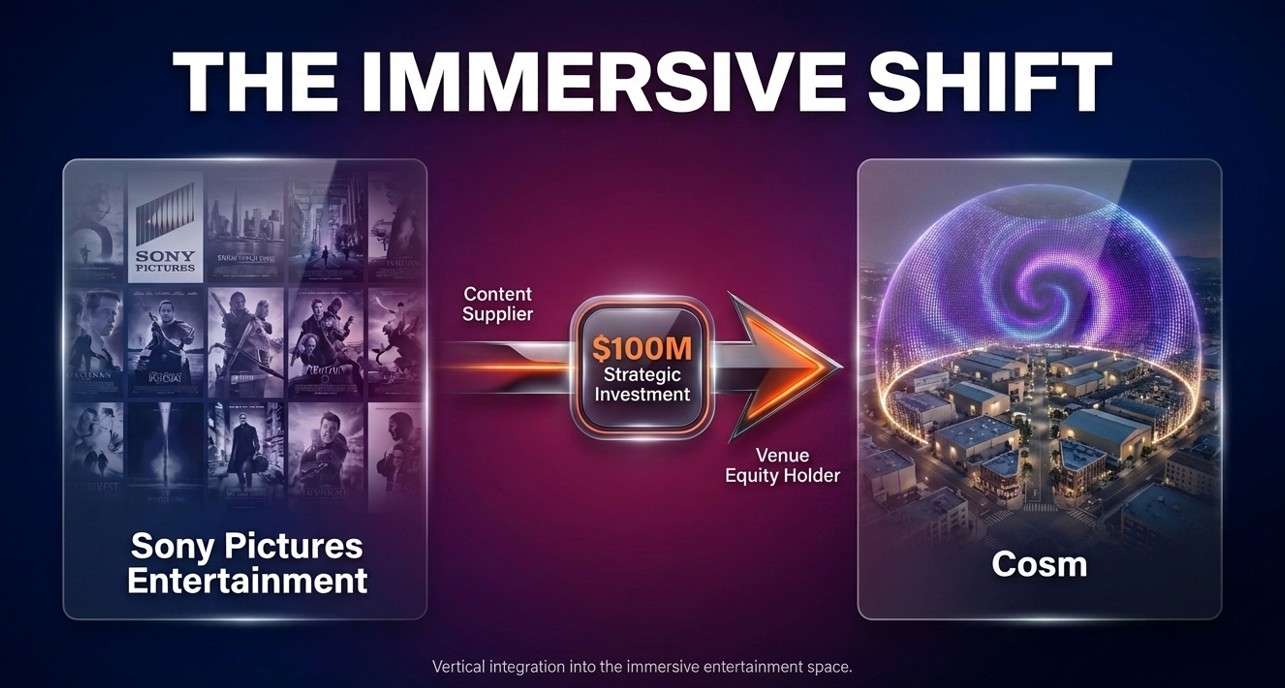
In June 2026, Sony Pictures Entertainment’s $100 million strategic investment in Cosm marked the moment a major studio moved from content supplier to venue equity holder in the immersive entertainment space.
Mechanics
This is a minority equity stake via a lead investment in Cosm’s Series C financing round. It is not an output deal. It is not a content exclusivity arrangement. The press release language — Sony “can explore new ways to extend its world-class IP” — deliberately leaves the content relationship undefined. What is defined is the governance relationship: SPE Chairman and CEO Ravi Ahuja joins Cosm’s Board of Directors. That board seat is the operational mechanism. It places Sony at the table where venue expansion strategy, content programming priorities, and technology development are decided.
The deal type is: strategic minority equity stake with board governance rights. The absence of a named content agreement is itself a signal — Sony is buying optionality, not committing to a supply arrangement it cannot yet price.
Volume
- Investment: $100 million
- Round: Series C
- Sony’s position: Lead investor, minority stake
- Board representation: Ravi Ahuja (SPE Chairman & CEO)
- Other named investors: Fox Corporation, Kroenke Sports and Entertainment, Marc Lasry, Bolt Ventures
- Financial advisors (Cosm-side): Goldman Sachs & Co. LLC and Allen & Company LLC
Cosm’s post-money valuation is not publicly disclosed. The Goldman Sachs and Allen & Company advisory mandate signals a transaction sized for institutional capital markets — not a seed-stage venture bet.
Territories and Footprint
Cosm currently operates three venues: Inglewood (Los Angeles, Hollywood Park), North Dallas (Grandscape), and Atlanta (Centennial Yards). Detroit opens September 2026. Cleveland opens early 2027. International locations are described as forthcoming but not named. The US footprint is concentrated in major metro markets — each venue anchored to a mixed-use real estate development.
Operational Catalysts
Three forces converge to make this deal logical now.
First, the theatrical premium window is under structural compression. Box office recovery post-2020 has been uneven. Premium large-format screens — IMAX, Dolby — have outperformed standard screens on a per-screen basis, but remain dependent on the same multiplex operators. Sony has been seeking a differentiated physical channel since the Alamo Drafthouse acquisition in 2024.
Second, Cosm has demonstrated audience proof of concept. Live sports events — FIFA World Cup, NBA Finals, UFC — have driven attendance that validates the dome format as a destination, not a novelty. Entertainment content (The Matrix, Harry Potter, Willy Wonka) fills the calendar between sports rights windows. The format works across both use cases.
Third, the presence of Fox as an existing investor created a competitive signal Sony could not ignore. Two studios holding equity in the same venue platform concentrates content access risk. Sony’s investment neutralises Fox’s first-mover advantage and installs Sony at governance level.
Comparative: Legacy Exhibition vs. Cosm Model
| Dimension | Traditional Multiplex / PLF | Cosm Shared Reality Venue |
|---|---|---|
| Venue count (US) | 5,000+ screens (IMAX: ~400 US) | 3 open, 5 by early 2027 |
| Studio relationship | Licensing — revenue share ~50% | Equity — board governance |
| Content type | Primarily theatrical first-run | Live sports + entertainment programming |
| Ticket price positioning | $20–30 IMAX premium | Premium experiential (undisclosed; est. $30–75+) |
| Studio control over programming | None — exhibitor decides | Board-level influence |
| Home substitution risk | High (streaming day-and-date pressure) | Low (format unreplicable at home) |
| IP lifecycle stage used | Theatrical first-run window | Post-theatrical or concurrent event format |
Ticket price for Cosm is an analyst estimate — not publicly confirmed. All other figures sourced from public filings and company announcements.
Section 2 — The Dealmakers
Sony Pictures Entertainment
Sony Pictures Entertainment is the filmed entertainment arm of Sony Group Corporation, the Tokyo-headquartered technology and entertainment conglomerate. SPE’s content portfolio spans theatrical films, television production (Sony Pictures Television), and home entertainment. It owns or controls IP across franchises including Spider-Man, Ghostbusters, Jumanji, and Uncharted, alongside anime distribution through Crunchyroll and gaming-adjacent IP through its PlayStation relationship.
Role in this deal: Lead Series C investor. Board representation through Ravi Ahuja. Strategic content partner — relationship currently exploratory, not contracted.
Commercial scale: Sony Group Corporation reported revenue of approximately ¥13 trillion (~$87 billion USD) in FY2024, with its entertainment segment contributing meaningfully to operating income. SPE’s theatrical revenue has recovered post-pandemic but remains subject to structural pressures — declining home entertainment physical sales, streaming margin compression, and audience fragmentation that makes wide-release theatrical economics increasingly unpredictable.
Strategic context: The Alamo Drafthouse acquisition in 2024 established Sony’s intent to hold physical exhibition assets directly. Cosm is the second move in that sequence. What connects them is the logic of premium differentiation: Alamo competes on curation, food and beverage, and repertory programming; Cosm competes on technological immersion. Neither threatens the multiplex. Both carve out audience segments willing to pay more for a format unavailable at home.
Specific impact: Sony gains board-level influence over Cosm’s venue expansion and content programming roadmap. It gains an alternative exhibition channel for IP that may be more valuable in an experiential format than in a standard SVOD window. It gains a competitive hedge against Fox’s pre-existing Cosm position.
Power shift: More leverage. Sony moves from content licensor — dependent on third-party exhibition decisions — to equity partner with governance rights. The dependency relationship with traditional exhibitors weakens marginally.
Cosm
Cosm describes itself as a global technology, media, and entertainment company. Its core product is the Shared Reality venue — a large-format LED dome environment that delivers immersive live and recorded content. The dome format uses custom camera rigs for live events and proprietary rendering pipelines for entertainment content.
Role in this deal: Investee and venue operator. Receives $100 million in Series C capital to fund venue expansion and technology development.
Commercial scale: Cosm is a private company. Revenue and valuation are not publicly disclosed. Goldman Sachs and Allen & Company as financial advisors indicate a transaction scale consistent with institutional Series C rounds — likely $300–500 million+ in total capital raised across rounds, though this is an analyst estimate.
Strategic context: Cosm entered the live sports market first — FIFA, NBA, UFC — to establish the format’s credibility and drive initial attendance. Entertainment content fills the non-sports calendar. The Sony partnership expands the entertainment content supply while providing a studio equity partner who can validate the format to the broader industry.
Specific impact: $100 million in capital to accelerate venue openings. Detroit and Cleveland are already announced. The board seat for Sony’s CEO is a double-edged tool — strategic credibility and partnership signal, but also a governance voice from a content partner whose interests may not always align with venue operator independence.
Power shift: More capital, more credibility, more content optionality. Governance dilution to a major content supplier is the latent trade-off.
Ravi Ahuja — Chairman & CEO, Sony Pictures Entertainment
Role in this deal: Lead investor principal; joins Cosm’s Board of Directors. Ahuja’s board seat is the operational mechanism of this investment — not passive capital allocation, but Sony’s governance presence inside Cosm’s strategic decision-making.
“Cosm sits at the intersection of several trends shaping the future of entertainment. We’ve followed Cosm since before launch and have been impressed with the quality of the experience and the enthusiasm it’s generating with audiences. We’re excited to support Cosm’s next phase of growth and help bring these experiences to more fans around the world.” — Ravi Ahuja, Chairman & CEO, Sony Pictures Entertainment
The phrase “we’ve followed Cosm since before launch” is notable. It signals that this investment was not reactive to Fox’s position or to competitive pressure. Sony tracked this company through its concept phase. That due diligence window — pre-launch to Series C — suggests the $100 million is the culmination of a deliberate assessment, not an opportunistic move.
Why his involvement matters: Ahuja’s biography is rooted in finance and strategy — he came to Sony Pictures through the financial and business affairs track. His board seat at Cosm is not a ceremonial gesture. It is a capital-markets-trained executive taking a governance role at a venue operator. That combination — content CEO plus exhibition board seat — is the structural mechanism through which Sony influences which IP reaches Cosm venues and when.
Jeb Terry — President & CEO, Cosm
Role in this deal: Deal principal, venue operator side. Led the Series C raise. Responsible for executing Cosm’s expansion roadmap with the new capital.
“Sony Pictures shares our passion for innovation and the future of the fan experience, and this investment represents that. We will use this capital to fuel Cosm’s growth as we expand our venue network and advance our technology initiatives across both Sports and Entertainment. Sony is one of the most storied technology and entertainment companies in the world with IP spanning across films, TV, music and games. Together, we’re positioned to bring more of the world’s most iconic IP to life in Shared Reality as we continue to super serve our fans around the world.” — Jeb Terry, President & CEO
Why his involvement matters: Terry has positioned Cosm as a technology company that happens to operate venues — not a venue operator that uses technology. That framing matters for how Sony’s investment is deployed: the $100 million funds both concrete (dome construction) and abstract (rendering pipeline, camera technology) assets. The distinction matters for rights and licensing conversations down the line.
Stakeholder Influence Table
| Stakeholder | Brings | Gains | Power Shift | Role |
|---|---|---|---|---|
| Sony Pictures Entertainment | $100M capital, IP library, board governance | Exhibition equity, windowing channel, competitive hedge vs. Fox | Gains leverage over immersive window — reduces dependence on third-party PLF partners | Catalyst / Lead Investor |
| Cosm (Jeb Terry) | Venue network, Shared Reality technology, live sports content | Capital for expansion, studio IP credibility, Sony board legitimacy | More capital, more content optionality; governance dilution to content partner is latent trade-off | Strategic Enabler |
| Ravi Ahuja | Strategic vision, Sony institutional authority | Board seat, direct influence over content roadmap | Gains governance role in physical exhibition — expands mandate beyond studio operations | Deal Architect |
| Fox Corporation | Existing Cosm equity, content IP | Watches a direct competitor gain board control of shared asset | Loses first-mover advantage; must now compete for Cosm programming priority from equal equity position | Silent Stakeholder / Incumbent Pressure |
| IMAX Corporation | Established PLF network, brand equity, ~400 US screens | Nothing from this deal | Loses: if Sony directs priority IP to Cosm venues, IMAX’s content advantage and per-screen economics weaken | Unintended Victim |
Section 3 — Why Is This Deal Unique?
Precursor Analysis
Sony did not arrive at Cosm unprepared. The strategic sequence is traceable.
In 2024, Sony Pictures acquired Alamo Drafthouse — a US theatre chain known for curated programming, food and beverage, and an anti-multiplex audience identity. That acquisition established Sony’s willingness to hold physical exhibition assets directly, absorb the operational complexity of venue management, and accept that premium physical exhibition is a durable business, not a declining one.
Cosm was, by Ahuja’s own account, on Sony’s radar before the venue operator opened its first location. The Series C investment is the second step in a deliberate two-format physical exhibition strategy — one format competing on curation (Alamo), one competing on immersive technology (Cosm).
Simultaneously, Fox Corporation’s prior Cosm investment created a competitive signal. When a rival studio holds equity in a distribution channel, the strategic logic of matching that position intensifies — not because the channel is definitively proven, but because ceding it entirely to a competitor carries asymmetric risk if the format does scale.
Standard Practice vs. the Departure
The standard practice in studio-exhibition relationships is transactional and arm’s-length. Studios produce content. Exhibitors book it. Revenue splits are negotiated per title. The studio has no governance role in the exhibitor’s business and the exhibitor has no claim on the studio’s content strategy. PLF partnerships — IMAX, Dolby — are licensing and technology arrangements, not equity relationships.
What this deal abandons: the assumption that studios and exhibitors are structurally separate businesses with no ownership overlap.
Sony is now simultaneously a content producer, a traditional exhibitor (Alamo), and an equity holder in a technology-driven venue operator (Cosm). The holy grail being abandoned is studio-exhibition separation — the industry norm that content creators should not own the screens their content plays on.
That norm existed partly for regulatory reasons. The Paramount Consent Decrees governed studio ownership of theatre chains in the US from 1948 until their termination in 2020. With those decrees gone, the legal barrier to vertical re-integration is removed. Sony is the first major studio to move at scale on both ends of the premium physical exhibition market simultaneously.
Historical Parallels — Including Failures
The closest structural parallel is the pre-1948 studio system, when major studios owned theatre chains outright. That model collapsed under antitrust pressure — the Paramount Decrees forced divestiture and separated production from exhibition for 70 years.
The current move is different in three ways. First, Sony is taking minority equity in a single-format operator, not acquiring a broad exhibition chain. Second, Cosm is not a conventional theatre — it serves a format that does not directly compete with multiplex exhibition. Third, the Paramount Decrees are terminated; the regulatory environment has structurally changed.
A closer recent parallel is NBCUniversal’s construction of Peacock as an owned streaming window — an attempt to internalise distribution rather than licence it to third parties. The Peacock parallel is instructive for the risk case: owning a distribution channel guarantees access but not audience. Cosm’s dome venues, like Peacock, face the challenge of converting novelty attendance into habitual behaviour at scale.
The Contrarian Angle
The dominant market interpretation of this deal is that immersive dome venues are the next premium exhibition frontier — a category that commands IMAX-style per-screen economics with a format immune to home streaming substitution.
That reading is premature. Cosm currently operates three venues. The financial returns on those three venues have not been publicly disclosed. The live sports content that drives Cosm’s audience is rights-dependent — FIFA, NBA, and UFC relationships are not equity holdings. They are negotiated access arrangements that can be repriced, terminated, or competed for by other venue operators. If live sports rights become Cosm’s primary audience driver, the “immersive entertainment” thesis depends substantially on third-party rights that Cosm does not control.
Sony’s investment accelerates Cosm’s venue expansion before the format’s unit economics are publicly validated. That may be the rational move — first-mover equity is cheapest before proof of scale. But the $100 million is also being deployed into a business whose long-term economics remain opaque.
TAM — Total Addressable Market
Primary TAM: The US premium theatrical and live entertainment experience market is estimated at $4.5–5.5 billion annually (Ampere Analysis, 2025 estimate; inclusive of PLF screens, premium live event venues, and experiential entertainment). The global figure is substantially larger — PwC’s Global Entertainment and Media Outlook 2025–2029 projects the cinema market at approximately $33 billion globally by 2027, with premium format share growing.
Serviceable segment for Cosm: With five US venues by early 2027, Cosm’s serviceable market is narrow. Assuming 250–300 event days per venue annually at 1,500–2,500 capacity per dome, the near-term revenue base is a small fraction of the total market. The investment thesis is not current scale — it is option value on a format that could replicate IMAX’s ~400-screen US network over a decade.
Growth trajectory: The premium and experiential segment of physical entertainment is the only sub-category outperforming the broader cinema market. This is a structural trend, not a cycle — audience behaviour data consistently shows willingness to pay more for formats that cannot be replicated at home.
Methodology: Figures above combine Ampere Analysis market sizing, PwC E&M Outlook projections, and analyst estimation for Cosm-specific unit economics. Cosm’s venue-level financials are not publicly available.
Pros and Cons
Pros:
- Windowing control: Sony gains a proprietary physical window with board-level influence — captured by Sony Pictures, not licenced to a third party. Timeframe: immediate.
- Competitive hedge: Fox’s first-mover Cosm position is neutralised. Timeframe: immediate.
- Format immunity: Cosm venues cannot be replicated in the home — the premium is structurally durable in a way SVOD-adjacent theatrical cannot be. Timeframe: long-term.
- IP lifecycle extension: Sony IP that has aged out of theatrical relevance (catalogue titles, franchise anniversaries) finds a new premium platform. Timeframe: 12–24 months.
Cons:
- Live sports rights dependency: Cosm’s audience driver is sports content Sony does not own. Trigger: if major sports leagues establish competing immersive venue partnerships or raise rights fees to uneconomic levels, Cosm’s programming calendar deteriorates regardless of Sony IP supply.
- Post-production cost burden: IP routed to Cosm requires custom spatial audio and resolution mastering. Trigger: if per-title post costs exceed licensing revenue at current ticket volumes, the content pipeline narrows to only Sony’s highest-value franchises.
- Governance conflict risk: Board presence from a content supplier creates latent tension if Sony’s IP priorities conflict with Cosm’s venue economics or competing content partners. Trigger: materialises at scale when programming decisions create real winners and losers among equity holders.
Competitive Landscape
Winner: Sony Pictures. Board-level access to the format, equity upside if Cosm scales, and a differentiated physical channel built outside the multiplex system.
Loser: IMAX Corporation. Sony routing priority IP to Cosm reduces the content advantage that supports IMAX’s per-screen fee model and its per-title marketing integration. IMAX cannot replicate the dome format; it can only deepen its own technology differentiation in response.
Industry reaction: If Cosm’s Detroit and Cleveland venues demonstrate strong economics, rivals will move. Warner Bros. Discovery, NBCUniversal, and Lionsgate do not currently hold Cosm equity. If Sony’s investment validates the format, expect competing equity approaches to Cosm or to alternative dome operators.
Section 4 — Supply Chain Impact
Content Creation & Financing
The board seat changes the greenlight calculus. When Sony’s CEO sits on Cosm’s board, the question “does this IP work in a dome format?” moves from a post-hoc licensing consideration to a development-stage variable. Projects with strong visual spectacle, spatial audio potential, or live-event extensions become marginally more attractive to greenlight with a Cosm window in the financial model.
This is a subtle shift — Sony is not building Cosm-native content yet. But the financial model for specific IP packages will begin to include immersive venue revenue as a line item, which raises the projected value of certain projects at the financing stage.
Who gains leverage: Sony’s internal creative development team, which can now pitch Cosm-window value as part of a project’s commercial case. Who loses: third-party producers and co-financiers who do not hold relationships with the venue operator and cannot include that window in their own recoupment models.
Post-Production
Cosm’s dome format is not standard theatrical delivery. The venue uses large-format LED displays across a curved dome surface — this requires:
- Aspect ratio mastering: Content must be formatted for the dome’s geometric projection characteristics, which differ fundamentally from both flat screen and IMAX.
- Spatial audio mixing: Dolby Atmos or equivalent spatial mixes must be adapted for dome acoustics — a different sound environment from conventional theatrical.
- Resolution upscaling: Dome surfaces require significantly higher resolution source material to maintain visual quality across the full display area.
- Metadata and QC: New delivery specifications for Cosm’s ingest pipeline mean a new QC pass for every title.
For Sony, this creates a new post-production workflow line for any title heading to Cosm venues. At three to five venues, the per-title cost is difficult to justify for catalogue titles below a certain commercial threshold. The practical effect: only Sony’s higher-value IP will reach Cosm in the near term — flagship franchises, anniversary releases, content with demonstrable dome audience appeal.
The vendor ecosystem for dome mastering is nascent. Technicolor, Deluxe, and DNEG have capabilities in specialised format delivery. Cosm’s own technology team likely handles some ingest conversion. The standard is not yet codified.
Distribution & Windowing
This is the central disruption.
Cosm creates a new physical window that sits between theatrical first-run and SVOD. It is not a theatrical window — Cosm venues do not typically programme first-run films simultaneously with multiplex release. The format is closer to a post-theatrical premium experience — catalogue titles, anniversary releases, event screenings, IP-adjacent experiences.
But that positioning is not fixed. Sony’s board presence gives it influence to push Cosm toward earlier windows if the economics justify it. A scenario where selected Sony titles receive a Cosm-exclusive premium window before standard SVOD release is commercially coherent — particularly for visually spectacular content where the format differential is most pronounced.
The windowing sequence this deal makes possible — and that traditional exhibitors cannot block — is:
Theatrical → [Cosm premium window] → SVOD → AVOD/FAST
Sony partially owns two of the brackets in that chain (Cosm and, via content licensing control, its own SVOD relationships). The Alamo Drafthouse layer sits alongside theatrical. Sony now has equity or ownership interests across theatrical curation (Alamo), post-theatrical immersive (Cosm), and SVOD distribution. The multiplex is the one bracket where Sony holds no ownership.
For IMAX, this is the specific threat: if Sony inserts a Cosm window between IMAX-enhanced theatrical and SVOD, IMAX loses its position as the only premium physical experience in a title’s post-theatrical lifecycle.
Delivery Infrastructure & Technology
Cosm’s technology stack is the asset Sony is buying equity into — not just the physical venues.
The Shared Reality platform includes: proprietary LED dome display hardware, custom live-event camera rigs, a rendering pipeline for immersive content conversion, and content management systems for dome-formatted delivery. Sony’s investment funds “technology initiatives” (Jeb Terry’s language) alongside physical expansion.
This has implications for the broader delivery infrastructure market. If Cosm’s rendering pipeline becomes the industry standard for dome venue content — as IMAX’s Digital Re-Mastering (DMR) process became the standard for PLF — then Sony, as an equity holder, has an interest in that standard’s adoption. Content mastered for Cosm venues using Cosm’s pipeline generates per-title revenue for Cosm, in which Sony holds equity.
The vendor ecosystem to watch: post-production houses building dome mastering capabilities, cloud rendering platforms capable of handling dome-format conversion at scale, and spatial audio specialists.
Monetisation Model
Cosm’s revenue model differs fundamentally from theatrical box office splits:
- Ticket pricing: Cosm venues are positioned at a premium above standard theatrical — analyst estimates suggest $30–75+ per ticket depending on event type, versus $15–20 for standard theatrical and $25–35 for IMAX. This is not confirmed by public disclosure.
- Event vs. run: Cosm programmes events rather than running a film across multiple sessions per day for weeks. This concentrates revenue into shorter windows at potentially higher per-session yield.
- Equity participation: As an equity holder, Sony participates in Cosm’s venue-level economics — not just in licensing fees from specific titles. This aligns Sony’s financial interests with Cosm’s overall attendance and yield performance.
The structural shift: a flat licensing fee — what a studio typically receives for a title in an exhibition window — is replaced, at least partially, by equity participation in venue economics. If Cosm’s per-ticket yield is materially higher than the licensing fee Sony would otherwise receive, the equity model is superior over time.
The Friction Point: This deal resolves the specific inefficiency of Sony IP cycling through the post-theatrical window into SVOD without a premium physical stop — leaving revenue and audience engagement on the table between theatrical close and streaming availability.
Supply Chain Disruption Map
| Stage | Disrupted? | Nature of Disruption | Severity |
|---|---|---|---|
| Content Creation & Financing | Partially | Cosm window enters financial models at greenlight for high-spectacle IP; changes project valuation for select titles | Medium |
| Post-Production | Yes | New dome mastering, spatial audio, and resolution workflows required for every Cosm-routed title; nascent vendor ecosystem; per-title cost creates selection filter | Medium |
| Distribution & Windowing | Yes | New post-theatrical premium window inserted before SVOD; Sony holds partial governance over window access; IMAX PLF exclusivity challenged | High |
| Delivery Infrastructure & Tech | Partially | Cosm’s proprietary rendering pipeline becomes a delivery standard Sony holds equity in; dome mastering ecosystem is nascent | Medium |
| Monetisation Model | Yes | Equity participation replaces flat licensing for Cosm-routed titles; per-ticket yield premium changes IP valuation calculus | High |
Ripple Effects
1. IMAX’s content pipeline compresses. IMAX depends on exclusive or priority access to premium Sony titles for its PLF positioning. If Sony’s board role at Cosm generates a programming preference — even informal — for Cosm venues over IMAX for high-value IP events, IMAX’s per-screen economics weaken. IMAX cannot acquire a comparable equity position in Sony’s content pipeline in response. It can only deepen technology differentiation, which takes time and capital.
2. The Series C investor roster becomes a content access map. Fox and Sony now both hold Cosm equity. When a third major studio considers a Cosm investment — or when Cosm raises a Series D — the investor table will directly reflect which studios have privileged access to the format. Studios without equity positions will negotiate content access from outside. This transforms Cosm’s cap table into a de facto content governance structure.
3. Competing dome venue operators emerge with studio backing. If Cosm’s Detroit and Cleveland venues demonstrate strong economics, rival operators will seek studio capital. The dome venue format is not proprietary to Cosm — the hardware is buildable, the format is conceptually replicable. A second dome venue operator with Warner Bros. Discovery or NBCUniversal equity behind it would directly fragment the immersive premium window and reduce Cosm’s leverage in future content negotiations.
The Practitioner’s Playbook
How does Sony’s Cosm equity stake change my IMAX partnership terms?
For distribution executives managing PLF relationships, the immediate action is to model the scenario where Sony routes two or three major 2027–2028 releases through Cosm in lieu of or alongside IMAX. Quantify the revenue impact of losing priority window access for those titles. Use that model as the basis for renegotiating IMAX partnership terms — specifically, minimum content commitment clauses and per-title advance structures. The leverage window is now, before Sony has established a Cosm programming pattern.
Workflow 1: Pull Sony’s last five major releases that received IMAX treatment. Model per-screen IMAX yield versus estimated Cosm dome yield at current venue counts. Identify the crossover point where Cosm economics match IMAX on a per-title basis.
Workflow 2: Review existing PLF partnership agreements for exclusivity language — specifically whether any clause restricts the studio from simultaneously programming a title in a competing premium physical format. If no such language exists, insert it in the next renewal.
Workflow 3: Open a direct conversation with IMAX’s content partnerships team about co-investment or co-programming structures that would make IMAX more difficult to displace as Sony’s preferred physical premium channel.
What post-production capabilities do I need to build for dome venue delivery?
For post-production executives, the Sony-Cosm deal signals that dome format delivery will enter the standard content delivery specification set within 18–24 months — at least for major studio IP. Building capability now, before the specification is standardised, positions your facility as the default for early-adopter clients.
Workflow 1: Contact Cosm’s technology team directly to obtain current dome delivery specifications — aspect ratio requirements, resolution minimums, spatial audio format preferences, and metadata standards. These are not yet published as an industry standard but are obtainable through direct outreach.
Workflow 2: Audit your current spatial audio mixing capability against dome acoustic requirements. Dolby Atmos is a starting point but dome acoustic profiles differ from flat-screen theatrical. Identify the gap and the vendor partnerships needed to close it.
Workflow 3: Build a dome mastering rate card. The market does not yet have established pricing for this workflow. Early movers who price competitively will capture the initial Sony, Fox, and future studio volume before competitors do.
Rights & Legal: What content rights do I need to clear for a Cosm window?
For rights and legal teams, the Cosm window raises a specific set of clearance questions that existing theatrical and SVOD agreements do not address.
Workflow 1: Audit existing distribution agreements for “immersive venue” or “dome exhibition” language. Most agreements written before 2024 will not contain specific Cosm or dome venue rights carve-outs. Determine whether existing theatrical exhibition grants cover dome venues or whether a separate clearance is required.
Workflow 2: Identify music and underlying rights clearances in your current content library that are scoped to “theatrical exhibition.” Dome venue screenings may fall outside the geographic or format scope of existing theatrical music licences — a material clearance risk for catalogue titles.
Workflow 3: For any new production or co-production in development, insert dome venue exhibition as a named distribution right in the initial rights package. Clearing this at development stage eliminates the retroactive clearance cost for every title that eventually reaches a Cosm or competing dome venue.
Section 5 — Forward Looking
90 Days
The specific observable trigger in the near term is the Detroit venue opening in September 2026. This is the first venue launch post-Sony investment and will be the first test of whether the new investor relationship translates into a Sony IP programming announcement. Watch for: (a) any Sony-branded content event or IP-adjacent experience announced for Detroit’s opening calendar; (b) any public statement from Ravi Ahuja at a conference or earnings call — Sony Group’s Q2 FY2026 earnings likely fall within this window — that quantifies the Cosm investment thesis or names a content integration timeline.
A second 90-day signal: Fox Corporation’s response. Fox holds existing Cosm equity and now shares the cap table with a direct competitor holding a board seat. Whether Fox seeks to match Sony’s governance position or increase its own equity stake in a follow-on is a meaningful indicator of how seriously Fox views the Cosm platform as a strategic channel.
1 Year
By June 2027, Cleveland will be open and Cosm will operate five US venues. The critical structural question at the one-year mark is whether Cosm announces international locations — and whether Sony’s IP library, which carries strong international franchise recognition particularly in Asia and Europe, is part of that international expansion pitch.
The second structural indicator: whether any Sony title receives a Cosm-specific programming window as part of its distribution release strategy, rather than as a post-theatrical add-on. That would signal the Cosm window has been formally integrated into Sony’s distribution planning — a structural shift, not an experiment.
IMAX’s response at the one-year mark will also indicate the severity of the threat. If IMAX announces a new studio equity partnership, deepens technology investment, or restructures its content minimum commitments with major studios, it is responding directly to the Sony-Cosm model.
2–3 Years
Scenario A — If the strategy succeeds:
The condition that must hold: Cosm’s Detroit and Cleveland venues demonstrate attendance economics that validate premium-tier ticket pricing at consistent utilisation. If per-venue economics are positive and scalable, Cosm raises a Series D at a materially higher valuation, accelerates international expansion, and Sony’s equity position appreciates. More importantly, the Cosm window becomes a standard line item in major studio distribution plans — and studios without Cosm equity negotiate content access as third parties. The immersive dome format joins IMAX, Dolby Cinema, and 4DX as a recognised premium exhibition category, but with the structural difference that Sony and Fox hold equity, not just content licensing relationships.
Scenario B — If the strategy fails:
The trigger: live sports rights costs escalate as leagues recognise Cosm venues’ premium pricing and demand a larger share, compressing margin on the format’s highest-attendance events. Simultaneously, entertainment content fails to drive sufficient organic demand without live sports. Venue utilisation drops below economic thresholds. Sony’s equity position carries an impairment. The Detroit and Cleveland openings are delayed or scaled back. In this scenario, the Cosm model survives as a niche luxury experience operating in three to five major US markets indefinitely — rather than scaling to the 30–40 venue network that would justify the current investment thesis. Sony absorbs the loss but retains Alamo Drafthouse as its primary physical exhibition play.
Section 6 — Vitrina Perspective
The Verdict
1. Which market assumption has changed?
The assumption that studio-exhibition separation is the natural structure of the content industry has changed. For 75 years — effectively since the Paramount Consent Decrees — major studios accepted that they could not own the screens their content played on. The decrees terminated in 2020. Sony has now moved twice in two years to hold direct equity in physical exhibition formats. The assumption before this deal: studios own content; exhibitors own screens; the relationship is commercial, not structural. The assumption after: studios can and will own equity in exhibition formats that serve their distribution strategy — particularly premium formats where audience willingness-to-pay exceeds what a standard licensing arrangement captures.
2. Who holds power now that did not before?
Sony Pictures Entertainment holds governance power inside a physical exhibition format it previously had no structural claim on — and IMAX, which built its premium exhibition position on exclusive content partnerships with studios, now faces a rival format where one of its most important studio partners holds an equity interest.
3. What is the single most important thing a practitioner should do?
If you are a distribution executive at a studio without Cosm equity — or at a company that supplies content to premium physical venues — map your current content pipeline against the emerging Cosm window and identify which titles are most at risk of being routed away from your platform. Do this before Sony announces its first Cosm programming slate. Once that slate is public, the negotiating leverage has already shifted.
The Vitrina AI Read
Across the supply chains Vitrina AI tracks, the pattern this deal represents is a compression of the space between content ownership and audience access — studios are no longer willing to hand the last mile of physical distribution to third parties and accept a revenue-share negotiated from outside the room. Sony’s $100 million Cosm stake is the clearest demonstration yet of that compression: the most important sentence in this post is not about the investment size, but about what it enables — a world where the studio that made the film also owns the room it plays in, sets the ticket price, sits on the board that decides what comes next, and collects the equity upside when the audience shows up.
That is a structurally different business from the studio model of the last three decades. It will not happen overnight, and it will not happen to every format. But the direction is set — and every executive in physical distribution who is not asking “which rooms do we need equity in?” is already operating with yesterday’s map.
FAQs
What is Cosm and how does its venue format work?
Cosm operates large-format LED dome venues — physical spaces where audiences watch live sports and entertainment content in an immersive environment that wraps the full field of view. The venues use custom camera rigs for live events to capture angles unavailable in standard broadcast, and proprietary rendering pipelines to convert entertainment content into dome-compatible formats. Current venues are in Inglewood (Los Angeles), North Dallas, and Atlanta, with Detroit opening September 2026 and Cleveland in early 2027. Ticket pricing is positioned above standard theatrical, with the format competing on a “you cannot get this at home” experience proposition.
Why did Sony Pictures invest $100 million in Cosm specifically?
Three factors converged. First, Sony’s 2024 Alamo Drafthouse acquisition established a strategic appetite for premium physical exhibition equity. Second, Fox Corporation’s prior Cosm investment meant a direct competitor already held a position in the format — ceding the space entirely carried asymmetric risk. Third, Cosm’s audience proof of concept through live sports events — FIFA World Cup, NBA Finals, UFC — demonstrated that the dome format drives premium attendance before Sony IP was in the mix. The investment buys equity, board governance, and optionality over a distribution window Sony does not currently control.
What does Ravi Ahuja’s board seat at Cosm actually mean operationally?
It means Sony’s content decision-maker has a voice in Cosm’s venue expansion strategy, technology development roadmap, and content programming priorities. This is not a ceremonial appointment. A board seat at a Series C-stage company carries real governance weight — Ahuja will participate in decisions about which markets Cosm enters, how capital is allocated between venue construction and technology, and which content partnerships Cosm pursues. For competing content suppliers, this means the person who decides which Sony IP goes to Cosm is the same person who sits on Cosm’s board.
How does this deal affect IMAX’s business model?
IMAX’s PLF model depends on premium studio IP to drive per-screen economics and justify its technology licensing fees to exhibitors. Sony is one of IMAX’s significant content partners. If Sony’s board role at Cosm generates a preference — even informal — for routing high-value IP events through Cosm venues, IMAX loses content priority without any mechanism to recover it through its own equity position. IMAX cannot acquire a comparable stake in Sony’s content pipeline; it can only deepen technology differentiation. The threat is not immediate — Cosm has five US venues versus IMAX’s approximately 400 — but the directional pressure is set.
Does this deal include a content exclusivity agreement between Sony and Cosm?
No. The publicly disclosed terms do not include a content licensing agreement, an output deal, or an exclusivity arrangement. The press release language — Sony “can explore new ways to extend its world-class IP” through Cosm — is deliberately non-committal on content terms. The investment secures equity and governance rights; content integration is exploratory at this stage. The content pipeline is an option, not an obligation — and its activation depends on per-title economics that have not yet been established.
What post-production work is required to get content into a Cosm venue?
Content for Cosm dome venues requires mastering that differs from standard theatrical delivery. The dome’s curved LED surface requires custom aspect-ratio formatting, resolution upscaling beyond standard 4K theatrical, and spatial audio mixing adapted for dome acoustics. These are not insurmountable technical challenges — the post-production industry has managed analogous IMAX and Dolby format requirements for years — but the workflow is not yet standardised, the vendor ecosystem is nascent, and the per-title cost creates a selection filter. In practical terms, only Sony’s higher-value IP will reach Cosm in the near term. The post-production infrastructure for dome delivery will develop in parallel with venue expansion.
How does the Alamo Drafthouse acquisition connect to the Cosm investment?
They are two steps in the same strategy. Alamo Drafthouse — acquired by Sony in 2024 — competes on curation, food and beverage, and a repertory programming identity. Cosm competes on technological immersion. Together they give Sony equity positions in two premium physical formats that sit entirely outside the standard multiplex system. Neither threatens conventional theatrical exhibition. Both address audience segments willing to pay more for experiences unavailable at home. Sony is not building a theatre chain — it is constructing a premium physical distribution layer, one format at a time.
Byline: Vitrina AI M&E Intelligence
Bio: The Vitrina AI Intelligence team specialises in supply chain analysis across the global Media and Entertainment industry, covering content financing, distribution, windowing strategy, and delivery infrastructure. Vitrina AI provides supply chain intelligence and market analysis to media and entertainment companies globally.