About Innovation Hub
 Global Content Pulse (Webinars)


 Global Production Financing
(Webinars)
Global Production Financing
(Webinars)  LeaderSpeak Podcast
  Global Entertainment Digest (Newsletter)
  About Vitrina
 About VIQI
 Our Story
 Our Solutions 🔥
 Film+TV Projects Tracker 🚀
 Case Studies
 Our Profile
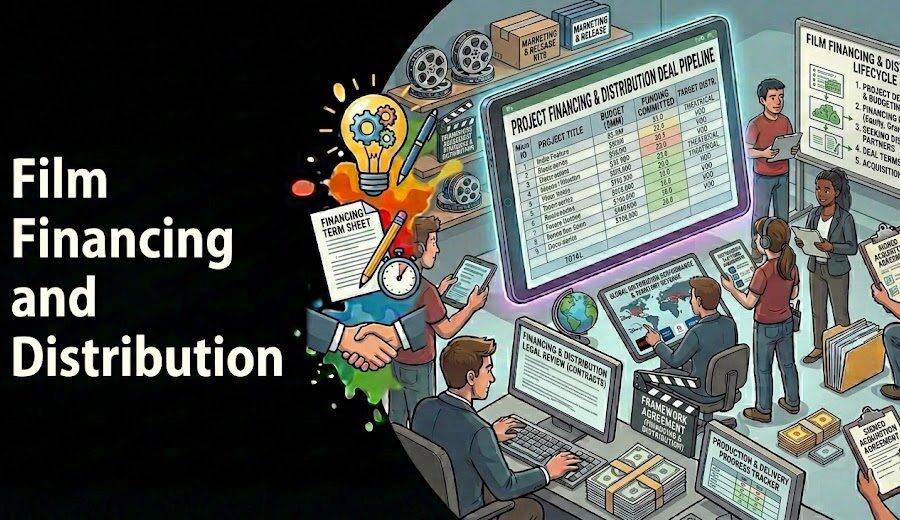
Film financing and distribution aren’t two separate conversations. They’re one conversation—and the producers who understand that are closing better deals, faster, with less dilution. Right now, the independent film market is in what Phil Hunt, founder and CEO of Head Gear Films, calls a “big crunch.” Getting movies off the ground is harder. Getting them sold is harder. And the capital stack strategies that worked in 2019 need rethinking.
This guide breaks down the full picture: how to structure your capital stack, when pre-sales make sense, which tax incentives you should be stacking, how distribution strategy defines your financing options, and where the smart money is flowing in 2025. Whether you’re packaging a $5M thriller or navigating a $30M co-production, the mechanics here apply.
Here’s what we’re seeing on the ground—the gap between producers who close financing in 6 weeks and those stuck in 18-month development limbo often comes down to one thing: real-time intelligence on who’s buying, who’s lending, and which territories are hot right now.
Ask VIQI: Get Instant Film Financing Intelligence
Trusted by Netflix, Warner Bros, and 140,000+ entertainment companies. Ask VIQI which distributors are actively acquiring your genre right now—no credit card required.
Get answers in 48 hours, not 6 weeks.
200 free credits. No commitment.
Why Film Financing Is Harder Than Ever Right Now
The post-COVID production surge created a hangover nobody wants to talk about. Streamers overcommitted. Revenue windows collapsed. Banks tightened. And the result? What Hunt described in October 2025 as an industry where it’s “much, much harder in terms of getting movies off the ground and getting movies sold.”
Head Gear Films—which has financed 550+ films since 2002 and currently closes 35–40 deals per year—is arguably the most active independent film financier in the UK. When Hunt says the market is tough, you listen. But tough doesn’t mean closed. It means disciplined.
The real dynamic right now is a bifurcated market. Projects with strong commercial packaging—recognizable cast, proven genre, clear distribution path—still close. Everything else fights for scraps. So your job isn’t just to raise money. It’s to de-risk your project so aggressively that saying no becomes difficult.
According to Variety, independent film production volume contracted significantly in 2024 as streaming platforms reduced their content commitments following the WGA and SAG-AFTRA strikes. That market shift didn’t reverse in 2025—it restructured. The lenders who remained active got more selective. The MGs got smaller. And the producers still closing deals are the ones who understand all four pillars of a solid capital stack.
The 4 Pillars of a Film Financing Capital Stack
A healthy film financing capital stack for an independent project typically draws from four sources: equity (20–40%), pre-sales (30–50%), tax incentives (15–30%), and gap financing (10–30%). The math needs to hit 100% before cameras roll. And the order in which you layer these matters—because each layer affects your recoupment waterfall and how attractive your project is to the next lender in line.
Here’s why that order matters practically. Your equity investors sit at the back of the waterfall—after senior debt, gap loans, and P&A recoupment. That means they’re taking the highest risk for the highest potential return. If you show up to an equity conversation with $0 in pre-sales and no tax incentive confirmed, you’re asking someone to take a bet with almost no de-risking. That’s a hard sell.
Flip it. Build your pre-sales first. Lock your incentives. Then approach gap lenders with 65–80% of your budget secured. Now the conversation changes. You’re not asking for a leap of faith—you’re asking a lender to close a well-structured deal with real collateral behind it.
The capital stack isn’t just about raising money. It’s a signal. Sophisticated financiers read your stack before they read your script. A weak stack structure says your project isn’t ready. A strong one—even at a small budget—shows you understand how the business actually works.
Your distribution strategy defines your capital stack more than anything else—including the quality of your project. Don’t lose sight of that.
Find Your Film’s Financing Partners in the Next 48 Hours
140,000+ verified entertainment companies. Track which financiers are actively closing deals in your genre and territory—right now.
Warner Bros, Paramount, and Google TV trust Vitrina’s intelligence.
How Pre-Sales Actually Work—And When to Use Them
Pre-sales—distribution deals signed before production begins—can cover 30–50% of your budget if your package is right. The mechanics: your sales agent approaches territorial distributors at markets like Cannes, AFM, or EFM. Distributors commit a minimum guarantee (MG) for their territory. You use those executed contracts as collateral to borrow against—typically 70–90% of MG value from an entertainment bank.
The catch? Banks rate distributors by territory. Germany’s Constantin Film and France’s Pathé are A-list—banks will lend aggressively against their paper. Lesser-known distributors in smaller territories may not qualify for financing at all. Know your buyer before you build your budget around their MG.
Payment structure is also where producers get surprised. A typical MG breaks down as 10% on signature and 90% on delivery. That 90% gap between signature and delivery is why you need gap financing. The pre-sale doesn’t fund production—the loan against it does, and you’re paying 8–15% annually for the privilege while you shoot.
The streaming era changed pre-sale dynamics in ways that cut both ways. Netflix, Amazon, and Apple can buy worldwide rights—eliminating the territorial sales process entirely and potentially offering a single, clean deal. But they can also cherry-pick key territories, leaving your sales agent to assemble the rest. What’s actually happening in the market: streamers are buying selectively, and the territories they skip (Eastern Europe, Southeast Asia, certain MENA markets) are increasingly valuable to the right package. Understanding the pre-sale ecosystem by territory is now a competitive advantage, not just a financing mechanic.
Strategic advice: target 50–70% of your budget through pre-sales plus incentives before you even consider gap financing. If you can’t get there, your project probably isn’t packaged well enough for gap lenders anyway—and that’s useful information to have early.
Stop Guessing Who’s Financing. Get Targeted Outreach.
Stop searching and start getting funded. We identify the exact decision-makers currently backing projects like yours, turning raw data into risk-aligned capital partnerships.
Major Studios
Scouting early stage projects, IP, and Regional partners for global studio pipelines.
IP Owners & Leads
Connecting creative leads with qualified financiers and major streaming platforms.
Streamers
Securing high-value pre-buy content and discovering early-stage global IP for platforms.
Indie Producers
Bridging the gap for indie filmmakers to reach executive production partners and capital.
Global Financing Ecosystems
Mapping complex markets and pairing projects with disciplined, risk-aligned capital across global territories worldwide.
Tax Incentives: The Soft Money Most Producers Leave on the Table
Global tax incentive rates range from 20% (US states like New York) up to 50% (Abu Dhabi). The UK’s Audio-Visual Expenditure Credit (AVEC) sits at 34% for high-end film. Georgia runs 30% transferable. Saudi Arabia moved to a 40% cash rebate in 2024. These aren’t marginal savings—they’re structural components of your capital stack.
Stacking is where the real ROI lives. Film in Georgia and you’re at 30% state plus potentially local incentives. Structure a UK-Canada treaty co-production and you’re accessing federal Canadian incentives, provincial programs, and AVEC simultaneously. Some combinations can push your effective incentive rate past 40% of qualified spend—which fundamentally changes your project’s risk profile for every other capital source in the stack.
But here’s what the trades don’t report on incentive stacking: the timing problem. Most incentives are backend money. You qualify, you shoot, you file, you wait—6 to 18 months from wrap to payment is typical. Your production cash flow can’t wait. That’s where rebate loans come in: banks lending 80–90% of your approved incentive value during production, charging interest until the incentive pays. Factor that cost into your net benefit calculation before you set your shoot location.
The eligibility details also vary dramatically. Above-the-line (ATL) cost inclusion—whether your star’s fee qualifies—can swing your incentive value by 15–20% alone. Cultural point systems in the UK and Canada require advance planning. And certain jurisdictions cap annual program funds, meaning your application timing affects whether you get anything at all.
Film and TV tax credits and incentives deserve dedicated analysis per project, not generic rules of thumb. The details are where the money is.
Gap Financing: Bridging the Final 10–30% of Your Budget
Gap financing is a debt facility secured against a film’s unsold territorial distribution rights. It sits in a mezzanine position in your waterfall—senior to equity, subordinate to your production bank loan. Typical coverage: 10–30% of total budget at 8–15% annual cost, plus origination fees of 1–2%.
Joshua Harris, President and Managing Partner of Peachtree Media Partners, made a point about the current gap financing landscape worth understanding: City National Bank’s retreat from entertainment lending created a market opening that private capital firms like Peachtree filled. As Harris put it, Peachtree lends against film IP and takes a collateral position—they’ll even advance against future territory value before distribution agreements are executed. That’s a meaningful capability when you’re trying to close a stack before the market moves.
To qualify, you typically need 60–80% of your budget already secured. Your sales agent needs a credible track record. Sales estimates must run 1.5–2x the gap amount. And a completion bond is non-negotiable—gap lenders won’t close without one. That bond costs 3–6% of your production budget and must be built into your budget from day one.
The King’s Speech case is instructive. $15M budget. Gap financing used to close a $3M shortfall. $400M worldwide gross. Best Picture Oscar. Gap loan repaid quickly. It’s not a template—it’s proof of concept for well-structured gap deals on commercial projects. Your $5M indie thriller and your $30M action film can both use gap financing, but the eligibility bar is proportional to your package’s commercial credibility.
One common mistake: treating gap financing as a solution to a weak package rather than a bridge on a strong one. If you’re using gap to cover 30%+ of your budget, that’s a signal—not necessarily a fatal one, but a signal that your pre-sales and incentives aren’t doing enough work. Fix the stack structure before you go to gap. Understand gap financing mechanics in detail before you’re sitting across from a lender.
Track Active Film Financing Deals in Real Time
400,000+ projects tracked. See which gap lenders, equity funds, and pre-sale buyers are closing deals in your genre right now. Vitrina maps the full supply chain so you walk into every financing conversation with current intelligence—not 6-month-old trade data.
Start Tracking — 200 Free Credits
No credit card required. Cancel anytime.
How Your Distribution Strategy Defines Your Capital Stack
Most producers think about distribution after they’ve closed financing. That’s backwards. Your distribution strategy should inform your capital structure from the first conversation—because how you plan to monetize the film determines how much of the budget you can collateralize upfront.
A film destined for a single worldwide streamer deal has a fundamentally different capital stack profile than one going territory-by-territory through traditional sales. The streamer deal may offer a higher total MG but eliminates territorial pre-sale flexibility. The traditional sales approach may take longer to close your stack but preserves backend revenue in unsold territories. Neither is wrong—but they’re not interchangeable financing strategies.
Distribution fees also eat into your recoupment faster than most producers model. Sales agent commissions run 15–25% of MG. Theatrical P&A can exceed production budget on wider releases. International distribution fees vary by territory—some markets run 30–35%. These aren’t surprises if you know the market. International film distribution fees deserve a line item in your financial model from the start, not an afterthought discovered in closing documents.
The producer’s dilemma in 2025: hold back premium territories and bet on post-completion sales at higher prices, or pre-sell conservatively to close the stack now. There’s no universal answer. But the decision should be driven by real-time buyer intelligence—who’s actually active in your genre right now, what MGs are clearing in which territories, and whether the post-completion premium you’re banking on is realistic given current market conditions.
Find the Financiers Backing Your Genre
Stop searching and start getting funded. We identify the exact decision-makers currently backing projects like yours, turning raw data into risk-aligned capital partnerships.
Co-Production Treaties: Access Multiple Markets at Once
Official co-productions under bilateral or multilateral treaties give your project national status in each co-producing country—which means access to local incentives, national film funds, cultural quotas, and distribution advantages in every participating territory simultaneously. Canada maintains 60+ bilateral treaties and closes $500M CAD in official co-productions annually. France has 61 bilateral treaties. The European Convention covers 43 countries under a single multilateral framework.
Phil Hunt (Head Gear Films) discusses the financing mechanics of international co-productions—and why the structure of your co-production arrangement matters as much as the territories involved—in this Vitrina LeaderSpeak interview:

Phil Hunt, Founder & CEO of Head Gear Films, on why film financing is harder than ever and what serious producers are doing about it.
The financial contribution requirements are where co-productions get complex. Bilateral treaties typically require each partner to contribute 10–80% of the budget, in proportion to their creative contribution. You can’t take 80% of a UK partner’s incentives while providing 5% of the creative—the cultural test and contribution rules are interlinked. Plan your partner contribution ratios before you start treaty applications, not after.
What makes treaties genuinely valuable isn’t just the incentive stacking—it’s the distribution relationships. Your co-production partner in Germany or Australia brings local distributor relationships, cultural credibility in their market, and sometimes pre-sale leverage you couldn’t generate alone. That’s not just soft money. That’s market access.
According to Screen International, co-production volumes in Europe have grown steadily as independent producers pursue incentive combinations that single-territory productions can’t access. The complexity is real—but so is the financial upside for properly structured deals.
Sovereign Content Hubs—And What They Mean for Your Project ROI
The Sovereign Content Hub™ model is reshaping where production capital originates. Saudi Arabia’s Public Investment Fund has committed $71.2B to entertainment—including $4B+ film-specific infrastructure, 17 studios, Film AlUla, and a 40% cash rebate. UAE’s Abu Dhabi offers up to 50% incentives plus 50-year zero-tax free zone status. South Korea’s KOFIC-backed ecosystem attracted $2.5B in Netflix commitments. These aren’t emerging markets. These are operational production centers with export ambition.
What this means for your capital stack: incentive rates in Sovereign Hubs often run 40–50%—materially higher than traditional Western markets. If your project can qualify for Saudi’s cash rebate while legitimately achieving cultural clearance, your soft money position improves dramatically. Your ROI improves. Your gap financing need drops. And your equity investors face a meaningfully de-risked position.
The Fragmentation Paradox™ is particularly acute in Sovereign Hubs. 140,000+ active film and TV suppliers globally—and thousands more coming online in MENA and APAC—create an information environment where capability verification, pricing benchmarks, and deal history are invisible without real-time intelligence. Strategic players understand that the hub advantage you can’t access because you don’t know who to call isn’t really an advantage at all. It’s an opportunity waiting for better information.
India deserves its own mention here. The largest film output globally, multiple language markets, and a domestic streaming market growing faster than any Western equivalent. Netflix’s India slate, Amazon Prime’s regional content commitments, and Jio Cinema’s AVOD scale are creating co-production demand that didn’t exist three years ago. Your APAC strategy can’t treat India as a single market—it’s a collection of distinct content economies.
How to Use Real-Time Intelligence to De-Risk Film Financing
Here’s the capital reality: information asymmetry is the single biggest margin eroder in independent film financing. Producers overpay for services they can’t benchmark. They miss co-production partners because they don’t know they exist. They approach lenders who aren’t actively buying their genre in their territory. Each inefficiency compounds—adding weeks to deal closure, basis points to financing costs, and real dollars to P&A overspend.
The Fragmentation Paradox™ quantifies this: 600,000+ companies operating in opaque silos creates 15–20% margin leakage through legacy markup structures and information deficit. That’s not theoretical. It’s the difference between a project that recouped and one that didn’t.
Vitrina maps 140,000+ active film and TV companies, 400,000+ projects, and real-time deal flow across every major production territory. When you need to know which gap lenders are actively closing deals in action films right now—not six months ago in a trade article—that’s the kind of intelligence that accelerates recoupment and protects your EBITDA. Producers using Vitrina have identified co-production partners in markets like the UK in under 48 hours. That’s not a pitch—it’s the practical value of real-time supply chain intelligence over relationship-dependent access.
Frequently Asked Questions: Film Financing and Distribution
What is film financing and distribution?
Film financing is the process of raising production capital through a combination of equity investment, pre-sales, tax incentives, and gap financing. Distribution is the process of monetizing the completed film across theatrical, streaming, broadcast, and ancillary markets. The two are deeply connected—your distribution strategy determines how much of your budget you can collateralize through pre-sales, which defines how your entire capital stack is structured. Producers who plan distribution before financing close faster and at better terms.
What does a typical film financing capital stack look like?
A typical independent film capital stack draws from four sources: equity (20–40% of budget), pre-sales or distribution advances (30–50%), tax incentives and soft money (15–30%), and gap financing (10–30%). For a $10M film, this might look like $2M equity, $4.5M pre-sales, $2M tax incentives, and $1.5M gap financing. The goal is securing 60–80% of your budget through confirmed sources before approaching gap lenders, who require strong collateral in the form of unsold territorial rights and verified sales estimates.
How do film pre-sales work in 2025?
Pre-sales are distribution agreements signed before production starts. Your sales agent pitches territorial distributors at markets like Cannes, AFM, or EFM. When distributors commit a minimum guarantee (MG) for their territory, you use those contracts as collateral for a bank loan—typically 70–90% of MG value. Payment splits 10% on signing and 90% on delivery, which is why gap financing is needed to bridge production. Streaming platforms have changed this landscape—they can buy worldwide rights outright, but may also leave smaller territories open for traditional pre-sale strategies.
What tax incentives are available for film production globally?
Global film tax incentive rates range from approximately 20% to 50% of qualified production expenditure. Notable programs include the UK’s AVEC at 34%, Georgia (USA) at 30% transferable, Saudi Arabia’s 40% cash rebate, Abu Dhabi at up to 50%, and Canada’s federal plus provincial stacking which can reach 40%+ effectively. Incentive stacking across jurisdictions through co-production treaties can compound these benefits significantly. Most incentives are backend money, requiring producers to finance against them through rebate loans during production.
How does gap financing work in film?
Gap financing is a loan secured against a film’s unsold territorial distribution rights, typically covering 10–30% of the production budget at 8–15% annual interest plus 1–2% origination fees. It sits in a mezzanine position in the recoupment waterfall—senior to equity, subordinate to senior production debt. To qualify, you typically need 60–80% of your budget already confirmed, a reputable sales agent with sales estimates 1.5–2x the gap amount, and a completion bond. Gap financing bridges the funding shortfall between secured capital and total budget, to be repaid from future distribution revenues.
What are co-production treaties and how do they help film financing?
Co-production treaties are bilateral or multilateral agreements between countries that grant a film national status in each co-producing territory. This unlocks access to local tax incentives, national film funds, cultural quotas, and distribution advantages simultaneously in every participating country. Canada maintains 60+ bilateral treaties and processes approximately $500M CAD in annual co-productions. France has 61 bilateral treaties. Properly structured treaty co-productions can stack incentives across jurisdictions—sometimes pushing combined effective incentive rates above 40%—while also opening distribution relationships in each co-producing market.
How are Sovereign Content Hubs changing film financing?
Sovereign Content Hubs—government-backed production centers in Saudi Arabia, UAE, South Korea, and India—are offering incentive rates of 40–50%, outpacing traditional Western markets. Saudi Arabia’s Vision 2030 has committed $71.2B to entertainment, including $4B+ in film infrastructure and a 40% cash rebate. Abu Dhabi offers up to 50%. These hubs are not emerging markets—they’re operational production centers with global export ambition. For producers, they represent a genuine capital stack improvement: higher soft money percentages mean lower gap financing needs, reduced equity dilution, and better project-level ROI.
What does Vitrina do for film financing and distribution professionals?
Vitrina is a real-time market intelligence platform that maps 140,000+ active entertainment companies and 400,000+ film and TV projects globally. For financing and distribution professionals, it provides real-time deal flow data, verified company capabilities, active buyer intelligence by genre and territory, and co-production partner matching. Where traditional market intelligence relies on 6-month-old trade reports and relationship networks, Vitrina surfaces current activity—which gap lenders are closing deals now, which distributors are actively buying in which territories, and which Sovereign Hubs have verified infrastructure for your production needs.
Conclusion: Structure First, Then Close
Film financing and distribution come down to structure—how well you build your capital stack before you approach any single lender or buyer. The producers closing deals in this market aren’t necessarily the ones with the best scripts. They’re the ones who walk in with 70% of their budget confirmed, a clear distribution path, stacked incentives, and current intelligence on exactly who’s buying their genre right now.
The market is tighter than it’s been in a decade. But tight markets reward preparation. Build your pre-sales before you need them. Lock your incentives before you approach equity. Know your gap lender before you’re desperate for one. And understand which territories and Sovereign Content Hubs can materially improve your ROI before you set your shoot location.
- Capital stack sequencing matters: Pre-sales and incentives before equity and gap, not the other way around.
- Distribution defines financing: Your sales strategy determines how much you can collateralize—plan it first.
- Incentive stacking compounds: Treaty co-productions can push effective incentive rates well past 40%.
- Gap financing requires a strong package: 60–80% of budget confirmed, a credible sales agent, and a completion bond—non-negotiable.
- Real-time intelligence accelerates everything: The producers moving fastest have current data, not yesterday’s trades.
Ready to Close Your Film’s Financing Faster?
Vitrina’s Concierge Service connects you directly with verified financiers, co-production partners, and distribution buyers—matched to your specific project. No cold outreach. No wasted meetings.
Used by Netflix, Paramount, Warner Bros and 140,000+ entertainment companies worldwide.
Get Concierge Matching
Start Free — 200 Credits
No credit card required.
Find Film+TV Projects, Partners, and Deals – Fast.
VIQI matches you with the right financiers, producers, streamers, and buyers – globally.
Join Industry Briefings Trusted by Leaders

Film & TV Production Financing: 2026 Trends
Production financing conditions are changing quickly. Understanding where money is moving and what buyers are backing is key to getting projects approved and funded in 2026.

Unreleased Film+TV Projects: Opportunities & Showcase
A curated view of unreleased Film and TV projects open for financing and collaboration
The Mid-Budget Comeback: Why Mid-Budget Films Is the Smartest Bet in the Room
Mid-budget films are attracting new capital. See why this segment is becoming one of the strongest bets in Film today.
Franchise Fatigue vs. IP Dependency: What Studios Should Be Betting On Now
s franchise performance softens, where will the next generation of valuable IP come from? Join the briefing.