About Innovation Hub
 Global Content Pulse (Webinars)


 Global Production Financing
(Webinars)
Global Production Financing
(Webinars)  LeaderSpeak Podcast
  Global Entertainment Digest (Newsletter)
  About Vitrina
 About VIQI
 Our Story
 Our Solutions 🔥
 Film+TV Projects Tracker 🚀
 Case Studies
 Our Profile
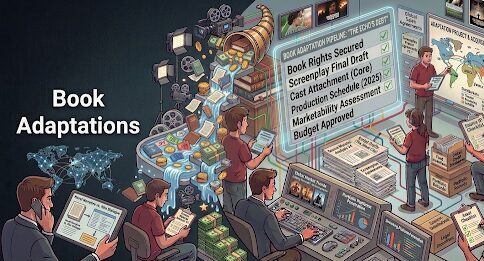
The relationship between publishing and screen production has always been transactional — a rights holder sells, a studio buys, a production begins. What is changing in 2026, and changing quickly, is where in that chain the power sits, who captures it, and how far upstream the deals are now being struck.
This report draws on data from Vitrina's tracking of global book adaptation activity across January 2025 to March 2026 to map the structural shifts underway: the studio-agency consolidation locking up premium IP before it reaches the open market, the genre preferences driving acquisition decisions region by region, and the distinct strategic logic each major platform is applying to book IP. For producers and financiers evaluating where to place their bets on literary source material, the picture is more complex — and more urgent to understand — than it has been at any point in the streaming era.
This article covers the full landscape. For a deeper look at any single dimension, see the cluster pieces linked throughout: the upstream IP consolidation deals reshaping access, the genre trends by region, and the platform-by-platform strategy playbooks.
The State of Book Adaptation in 2026: Structure, Strategy, and Where the Deals Are Being Made
1. Upstream Consolidation: How Premium IP Is Being Locked Away Before It Hits the Market
1. Upstream Consolidation: How Premium IP Is Being Locked Away Before It Hits the Market
The most consequential development in book-to-screen adaptation right now is not a genre shift or a platform pivot — it is a structural change in how premium literary IP is being accessed. Two landmark deals from early 2026 illustrate the direction clearly.
Sony Pictures Entertainment's multi-year first-look agreement with Aevitas Creative Management gives Sony exclusive access to ACM's global literary catalogue of over 800 authors and estates, spanning journalism and true story (Marty Baron, Heidi Blake, April Balascio), prestige non-fiction (Safiya Sinclair, Hunter Biden, Marina Abramovic), and international fiction (Federico Axat, Kylie Lee Baker, Tara Moss). The strategic intent is explicit: by moving the acquisition point to the manuscript stage, Sony bypasses the competitive bidding that drives up option costs and gains the ability to de-risk its IP pipeline through exclusive access before titles build public profile or generate competing interest.
The Fox Entertainment Studios and HarperCollins Productions arrangement goes a step further. Rather than a one-directional first-look on published titles, Fox and HarperCollins have constructed a two-way reciprocal deal: Fox gets first rights to adapt titles from the Avon A imprint — focusing on YA, romance, and horror — while HarperCollins gains first rights to publish novels and tie-ins based on Fox original IP. The Avon A imprint serves as both a content pipeline and a market validation tool: low-cost book launches test character traction before committing to high-cost screen production. The model eliminates what both parties describe as the 12-18 month hit-lag typically seen in opportunistic licensing, where a successful screen property only generates publishing interest after broadcast.
authors and estates in the Aevitas Creative Management catalogue — now under Sony's exclusive first-look access at the manuscript stage
For independent producers, the implication is direct: a growing share of the literary IP that would previously have reached the open market is now being pre-contracted to studio partners before it enters the acquisition cycle. The access barriers are structural, not cyclical. Understanding this shift — and knowing which IP remains genuinely available — is the starting point for any viable acquisition strategy in the current market.
● VIQI
Do you know which book rights are still available in your genre and budget range?
VIQI maps active literary IP acquisition activity across studios, streamers, and independent producers — so you can identify what is already under option and where the gaps remain.
Explore active book IP on VIQI2. Genre Trends by Region: What Is Actually Getting Commissioned
Platform strategy documents and analyst reports tend to describe genre trends in aggregate. The reality, when you track active commissioning across regions, is considerably more differentiated. The genre preferences driving adaptation decisions in the Americas look nothing like those in EMEA, and the APAC market has its own internal logic that is frequently misread through a Western lens.
In the Americas, commissioning activity across 2025-2026 clusters around two poles: high-concept genre anchors and identity-driven romance. The genre side is led by Eldritch and graphic horror — treated as franchise seeders with strong merchandising potential — and political defiance Romantasy, the exiled-royalty and arranged-marriage sub-genre that has become the defining fiction trend of the BookTok era. The romance commissioning logic is about Gen-Z subscriber acquisition rather than broad entertainment, with meta-celebrity PR romance and corporate noir performing strongly with digital-native audiences.
In EMEA, the data reveals tension between two strategic priorities: British heritage prestige content for global retention, and hyper-localised European noir for regional market entry. The espionage heritage vault remains active — bureaucratic conspiracy drama, high-octane assassin procedurals — but there is growing commissioning energy around Nordic isolationist thrillers, Central European psychological realism drawing on historical memory, and interconnected domestic suspense. Active commissioners including Channel 4, ZDF, Arte, and Netflix's European arms illustrate both ends of the spectrum.
The APAC picture, particularly Manga and Korean Webtoon and Web-novel adaptations, rewards more careful parsing than it typically receives. Japanese Manga adaptation in 2026 is splitting across four distinct sub-genres: transgressive psychological melodrama (toxic domesticity and identity erasure, acting as high-volume retention content), supernatural absurdist genre-bending, sentimental human-condition realism centred on mortality and vocational healing, and kinetic martial arts noir designed explicitly as export content for international action audiences. Korea, meanwhile, has pivoted aggressively from traditional melodrama toward high-concept genre blending from Webtoon and Web-novel IP — transmigration and temporal justice narratives, medical-noir, bio-mechanical romance, and a well-developed Boys' Love commissioning strand.
Americas, EMEA, APAC/Manga, Korean Webtoon — each with its own commissioning logic that generic pitches fail to address
3. Platform Strategy Playbooks: How the Major Streamers Are Using Book IP
Understanding why a platform is commissioning a particular type of book adaptation — not just what it is commissioning — matters significantly if you are a producer or financier trying to pitch or package literary IP. Each of the four major players has a legible strategic logic, and matching your project to that logic is as important as matching the genre.
Netflix is operating a Targeted Fandom Capture strategy: acquiring hyper-specific sub-genres with pre-existing, high-engagement digital communities — communities that arrive with built-in marketing infrastructure in the form of social media followings, fan content, and algorithmic reach. Its two primary acquisition vectors are Global Noir (hyper-local procedurals, high-stakes heist, psychological and domestic noir) and Viral Romance (spicy digital-first fiction, destination romance, seasonal titles). The underlying premise is that pre-qualified fandom reduces acquisition risk and drives immediate engagement spikes on release.
Prime Video's approach is more structurally complex — a bimodal strategy that simultaneously pursues viral Romantasy content for Gen-Z acquisition (Fourth Wing, Babel) and aggressive regional realism for market dominance (the Vimal Khanna series, The Boys from Biloxi). Walt Disney is executing a genre diversification play, balancing high-volume romance for retention with elevated cultural Gothic for brand positioning and prestige procedural content that sustains brand authority. WBD is the most bifurcated: its Track 1 titles carry high critical risk for prestige reward, while Track 2 titles prioritise consistent viewership — and pitching to WBD requires a clear understanding of which track your book IP belongs to.
● VITRINA CONCIERGE
You understand the platform logic — but does your outreach reflect it?
Vitrina Concierge reaches the right commissioning executives and co-production partners on your behalf, with outreach built around your project's genre, structure, and target platform.
Talk to a Vitrina Solutions Expert4. What This Means for Independent Producers and Financiers
The structural picture that emerges from this data is challenging for independent producers in specific, concrete ways. Premium literary IP is increasingly pre-contracted before it reaches the open market. The genre windows that remain open are narrowing, and the commissioning preferences of the major platforms are more defined than they were two years ago — which means undifferentiated pitches land less often.
None of this closes the market for independents. It reshapes it. The genres where studio-agency vertical integration is weakest — European regional noir, Korean Webtoon adaptations, niche Manga sub-genres, literary fiction with authentic regional voices — remain genuinely open. The platforms acquiring in these categories are often actively seeking production partners with cultural fluency that studio systems cannot easily replicate.
The intelligence advantage, in this environment, is not simply knowing what is being commissioned. It is knowing which IP is still available, which financiers are active in the relevant budget range, which production partners have the right territorial relationships, and which platform track a project realistically fits. The producers and financiers moving efficiently through the current market are the ones who have that picture before they begin.
the hit-lag that integrated studio-agency deals are now eliminating — the window in which independent producers previously had competitive access to premium IP
Which commissioning executives are actively acquiring in your genre right now?
VIQI gives you live data on active buyers, recent deals, and production partner activity across every major market — updated continuously so your intelligence reflects what is actually happening.
Search active commissioners on VIQI →This guide is part of the Vitrina LeaderSpeak blog programme. All content is drawn from direct tracking of industry activity and practitioner insights. No commentary has been layered over practitioner insight.
Related Reading: How Studios Are Locking Up Book IP Before It Reaches the Open Market · The 2026 Genre Intelligence Guide: What Book IP Are Streamers Commissioning by Region · Netflix vs. Prime vs. Disney vs. WBD: Platform IP Strategy Playbooks