About Innovation Hub
 Global Content Pulse (Webinars)


 Global Production Financing
(Webinars)
Global Production Financing
(Webinars)  LeaderSpeak Podcast
  Global Entertainment Digest (Newsletter)
  About Vitrina
 About VIQI
 Our Story
 Our Solutions 🔥
 Film+TV Projects Tracker 🚀
 Case Studies
 Our Profile
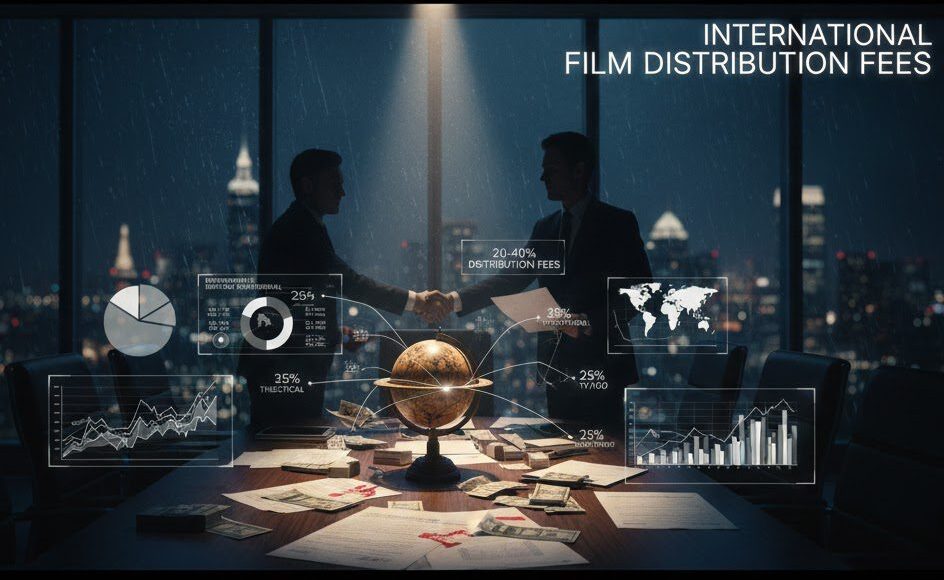
International film distribution fees are the percentage-based commissions and administrative charges levied by distributors to bring a film to market across global territories.
This process involves navigating complex cross-collateralization clauses, Print & Advertising (P&A) recoupment schedules, and varying territorial tax structures.
According to industry analysis from the Vitrina Intelligence Platform, unmonitored “soft costs” and administrative markups can erode up to 15-20% of a film’s net revenue before a producer sees their first dollar.
In this guide, you will learn to identify these “hidden” expenses—from excessive marketing overheads to opaque technical service fees—and how to leverage supply chain intelligence to secure more transparent, equitable deals.
While traditional advice focuses on the headline commission percentage, legacy distribution models often hide the true cost of business in fine-print deductions and unverified expense reports.
This analysis fills the gap by providing a data-driven framework for vetting distribution partners based on historical transparency and verified performance metrics.

Your AI Assistant, Agent, and Analyst for the Business of Entertainment
VIQI AI helps you plan content acquisitions, raise production financing, and find and connect with the right partners worldwide.
- Find active co-producers and financiers for scripted projects
- Find equity and gap financing companies in North America
- Find top film financiers in Europe
- Find production houses that can co-produce or finance unscripted series
- I am looking for production partners for a YA drama set in Brazil
- I am looking for producers with proven track record in mid-budget features
- I am looking for Turkish distributors with successful international sales
- I am looking for OTT platforms actively acquiring finished series for the LATAM region
- I am seeking localization companies offer subtitling services in multiple Asian languages
- I am seeking partners in animation production for children's content
- I am seeking USA based post-production companies with sound facilities
- I am seeking VFX partners to composite background images and AI generated content
- Show me recent drama projects available for pre-buy
- Show me Japanese Anime Distributors
- Show me true-crime buyers from Asia
- Show me documentary pre-buyers
- List the top commissioners at the BBC
- List the post-production and VFX decision-makers at Netflix
- List the development leaders at Sony Pictures
- List the scripted programming heads at HBO
- Who is backing animation projects in Europe right now
- Who is Netflix’s top production partners for Sports Docs
- Who is Commissioning factual content in the NORDICS
- Who is acquiring unscripted formats for the North American market
Table of Contents
Key Takeaways for Independent Producers
-
Audit the Fine Print: Hidden administrative fees and unvetted P&A expenses often account for 20% of revenue erosion in international deals.
-
Verify Distribution Track Records: Producers using Vitrina’s company intelligence identify high-transparency partners 5x faster by tracking historical deal behaviors.
-
Target Regional Specialists: Global deals aren’t always optimal; regional distributors often provide lower overheads and more localized marketing efficiency.
What Are Standard International Film Distribution Fees?
Standard international distribution fees typically range from 15% to 35% of gross receipts, depending on the territory and medium (theatrical vs. streaming). However, this headline number is often just the tip of the iceberg in a complex financial structure.
Sales agents and international distributors also deduct “direct expenses” before calculating the producer’s share. These include physical shipping of materials, localized dubbing or subtitling, and legal fees associated with territorial contracts.
Find distribution partners with verified fee transparency:
Why Do Marketing and P&A Fees Often Overrun?
Print and Advertising (P&A) costs are the most volatile category in any distribution deal. In the theatrical model, these costs are often “off-the-top” deductions, meaning the distributor recoups every dollar spent on marketing before the producer receives any participation.
The “hidden” element here is the administrative markup. Many distributors charge a 10% to 15% “overhead fee” on top of actual marketing spend to cover their internal staff’s time. Without a strict cap on these overheads, a producer can find themselves paying for the distributor’s office rent rather than the film’s promotion.
Industry Expert Perspective: The Big Crunch: Phil Hunt on Why Film Finance is Harder Than Ever
Phil Hunt, CEO of Head Gear Films, explains how the collapse of traditional revenue windows has forced a complete rethink of distribution economics. This video highlights why transparency in recoupment schedules is now the primary survival tool for independent producers.

Phil Hunt discusses the challenging independent film landscape, highlighting the industry’s shift away from pre-sales and the collapse of revenue windows. He emphasizes the demand for low-cost, high-concept genres where distribution fees must be lean to ensure project viability.
How Does Cross-Collateralization Impact Your Net Profits?
In multi-territory deals, distributors often include “cross-collateralization” clauses. This means that if your film is a hit in France but flops in Germany, the distributor can use the profits from France to cover the losses and marketing overruns from Germany.
For a producer, this is a major financial risk. It effectively guarantees the distributor’s overheads are covered across all territories before a single profit-share check is cut. Producers are increasingly using supply chain data to fight for “territorial silos,” ensuring that successful markets pay out independently of underperforming ones.
Analyze recent territorial licensing trends:
How to Use Supply Chain Intelligence to Vet Distributors
The era of relying on “good vibes” and film festival parties for distribution deals is over. In 2026, leading producers use data-driven vetting. Vitrina’s platform provides a central source of truth, mapping 140,000+ companies and their actual deal histories.
By analyzing a distributor’s “Supply Chain Reputation Score,” producers can see if a company has a history of excessive marketing deductions or late reporting. This intelligence allows you to walk into a negotiation with leverage, knowing the distributor’s actual performance metrics across previous projects.
Case Study: Reducing Distribution Leakage by 30%
A London-based indie production house recently faced a common dilemma: a global sales offer with a 25% commission and a “standard” $200,000 cap on international marketing expenses. Previous projects with this sales agent had returned zero net profits despite strong sales in Asia.
Using Vitrina’s Deals Intelligence, the team discovered the agent was consistently over-reporting “technical service fees” by 40% compared to market rates for dubbing and delivery. By presenting this data, the producer negotiated a 5% reduction in commission and replaced the vague marketing cap with a line-item verified budget.
The result: The producer secured their first net profit check within 12 months of release, reducing financial leakage by an estimated 30% compared to their previous project slates.
Moving Forward
The international distribution landscape is shifting from relationship-driven networking to data-driven partnership strategy. By identifying the hidden costs of distribution fees early, you transform your project from a financial risk into a sustainable asset.
Whether you are an independent producer seeking to protect your first-dollar participation, or a sales agent looking to differentiate through transparency, the path to success in 2026 is built on supply chain intelligence.
Outlook: Over the next 18 months, expect a “flight to quality” where transparent, data-driven distributors command the most premium independent slates, leaving opaque legacy models behind.
Frequently Asked Questions
Quick answers to distribution fee challenges.
What is a fair distribution fee for independent film?
What are “off-the-top” expenses?
How can I audit a distributor’s marketing spend?
What is cross-collateralization?
About the Author
Written by the Vitrina Editorial Team. With decades of experience mapping the global entertainment supply chain, we provide data-driven insights to help producers and distributors navigate the modern market. Connect on Vitrina.
Find Film+TV Projects, Partners, and Deals – Fast.
VIQI matches you with the right financiers, producers, streamers, and buyers – globally.
Producers Seeking Financing, Co-Pros, or Pre-Buys?
Vitrina Concierge helps producers reach the right financiers, commissioners, distributors, and co-production partners — with precision outreach, not cold pitching.
Join Industry Briefings Trusted by Leaders

Books, Novels & Comics Adaptations: Global Trends
Books, webtoons, and manga driving the next global screen hits. Discover how in this webinar.

Micro-Dramas & Mobile-First Storytelling
Micro-dramas are building real audiences and revenue. Understand the platforms, buyers, and economics behind the growth.

Navigating Global Content Licensing Trends
How global content licensing is shifting beyond flat fees to flexible, deal-driven models.