IHUB
IHUB
 Private Briefings (Webinars)


 LeaderSpeak Podcast
  Global Entertainment Digest (Newsletter)
  Premium Lists
 Membership Benefits
 About Vitrina
 Our Story
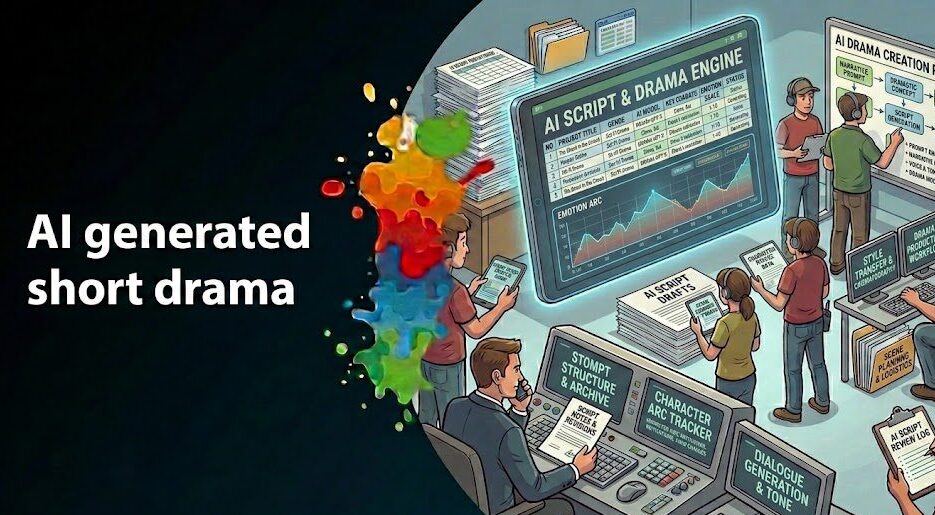
AI generated short drama production companies are no longer a niche curiosity. They’re a supply chain category — and in 2026, they’re attracting Fox Entertainment equity deals, open-sourced video generation models, and production pipelines that compress a traditional eight-day shoot into a single laptop session.
The global microdrama market is racing toward $26 billion in annual revenue by 2030, according to Variety. And AI is the mechanism changing who gets to produce it, at what cost, and at what volume.
Here’s the real dynamic: the original Chinese short drama model — “Duanju” — scaled from zero to $7 billion in domestic revenue within four years using live-action production at $150,000-$300,000 per series.
AI is compressing that again. Judian Short Dramas, one of China’s largest micro-drama producers, reports that AI-assisted production has dropped their per-drama cost to 100,000-150,000 yuan — roughly a third of the traditional short drama cost — while running a 70-person AI team producing 20-30 dramas per month.
But this isn’t just a Chinese story anymore. Korean studios are deploying AI across full production pipelines. A Ukrainian company backed by Fox Entertainment is targeting 100 AI-generated short series per month by end-2026.
Indian micro-drama ecosystems are taking shape. And Turkish content powerhouses are making their entry. The Fragmentation Paradox™ is hitting this sector hard — buyers, commissioners, and acquisitions teams need real-time intelligence on who’s actually producing, at what quality, and with what distribution reach. This guide maps the key players.
Table of Contents
- Why AI Short Drama Is a Legitimate Production Category in 2026
- The Chinese AI Short Drama Companies Leading Production Volume
- Western and Hybrid Players: Holywater, Fox, and the Vertical Drama Push
- South Korea’s AI Short Drama Studios
- Emerging Markets: India, Turkey, and MENA
- The AI Infrastructure Powering Short Drama Production
- What This Means for Buyers and Acquisitions Teams
- FAQ
- Conclusion
Ask VIQI: Which AI Short Drama Studios Are Actively Seeking Acquisition Partners Right Now?
VIQI is trained on 1.6 million+ titles, 300,000+ companies, and 3 million+ entertainment professionals. Ask it which AI short drama producers are in active distribution mode, what their catalog looks like, and which territories they’re targeting.
✓ 200 free credits | ✓ No credit card needed
Why AI Short Drama Is a Legitimate Production Category in 2026
Four years ago, the microdrama industry as we know it didn’t exist. The format — serialized episodes typically under two minutes, shot vertically for mobile, designed for binge consumption — was still a Chinese domestic experiment. Today it’s a global supply chain with a distinct producer ecosystem, its own financing logic, and a $4 billion North American market built in under three years.
AI’s role within that ecosystem has passed through two distinct phases already. In 2024-2025, AI functioned as a production support layer — used primarily for dubbing, subtitles, VFX enhancement, and localization. The storytelling and production remained human-led. But 2026 marks the inflection. Full-stack AI production tools from Yuewen Group, Chinese Online, and ByteDance have compressed the short drama pipeline from 11 manual steps to 3, enabling non-professional teams to produce broadcast-quality micro-dramas at scale. In-app revenue from short drama apps in the U.S. alone grew 20% quarter-on-quarter to nearly $350 million in Q1 2025, according to Sensor Tower. This is now real money — and AI is the production architecture scaling the supply side to meet it.
But there’s a genuine tension in the market. Not everyone is deploying AI the same way, and the distinction matters for buyers. Rolla Karam, SVP Content Acquisition at OSN — covering 23 MENA countries — observed this directly during her Istanbul visit to a Turkish vertical drama studio in 2025: “it can be expensive. And for me to license the one minute or the series, I would feel very bad because my fees would be very different compared to a proper scripted series.” That licensing economics problem is real for purely AI-generated content. The micro-series supply chain is maturing, but the valuation frameworks haven’t caught up. The companies navigating that gap most intelligently are the ones worth tracking in 2026.
The Chinese AI Short Drama Companies Leading Production Volume
China remains the category’s production center — and the AI deployment is at a scale that Western markets simply haven’t matched yet.
COL Group (Reelshort)
COL Group’s Reelshort remains the benchmark platform for Western-market micro-drama distribution — and its stance on AI is deliberately conservative. Reelshort’s content chief has been explicit that AI has “no place” in its writers’ room. The platform uses AI for VFX enhancement and post-production speed, but the creative process is entirely human-led. That discipline is part of the brand: Reelshort’s top series have individually hit over 350 million views, and the company has established partnerships with Paramount. Reelshort has also established partnerships with major studios. For buyers, Reelshort represents the premium end of the micro-drama licensing market — human-produced, high-concept, and priced accordingly.
iQIYI Micro-Drama
iQIYI — China’s largest streaming platform — rebranded its iQIYI Express app to iQIYI Micro-Drama in 2025, signaling a strategic shift at board level. Chief content officer Wang Xiaohui identified “short” as the keyword for the year, while the platform’s AI deployment goes deep: nearly 1,000 AI-driven IP characters have held over one billion conversations with users through its “Tao Dou World” system. AI is embedded across script workshops, virtual production infrastructure, and digital asset libraries. iQIYI is a major commissioning source for AI short drama producers targeting the Chinese domestic market and Chinese diaspora globally.
Judian Short Dramas
One of the clearest examples of AI as a production-volume engine. Judian has built a dedicated AI short drama team of more than 70 people producing 20-30 AI-assisted dramas per month — roughly 10 times the output of traditional short drama production at their scale. Their AI pipeline covers dynamic comics, “cat-and-dog” short dramas (AI-animated animal characters re-enacting drama tropes), and hybrid live-AI formats. Their global distribution brand, Lingju Animation, is extending this supply into international markets. For acquisition teams, Judian represents high-volume supply at compressed cost — the licensing economics are different from premium human-produced content, but the volume and frequency of output is unmatched.
Kunlun Tech (SkyReels)
Kunlun Tech took the most audacious positioning move in the AI short drama space when it open-sourced SkyReels-V1 in early 2025 — China’s first dedicated video generation model for short dramas, paired with the first SOTA-level emotion-and-motion control algorithm. The company has declared the arrival of the “one user, one drama” era. It posted a net loss of approximately $220 million in 2024, attributing this to R&D investment, with profitability projected for 2027. Kunlun isn’t primarily a content producer — it’s building the picks-and-shovels infrastructure for the entire AI short drama supply chain. But its platform ambitions and distribution relationships make it a significant force for producers seeking AI-native production infrastructure.
CreativeFitting
Founded in 2021, CreativeFitting is betting that “Short Drama + AI + Globalization” is a distinct product category — not just a technology upgrade. Founder Zhu Jiang’s thesis is that AI short dramas solve the three constraints that have historically prevented Chinese-format drama from scaling internationally: long shooting cycles, high production costs, and a shortage of skilled crews in target markets. With AI, a single creator can produce a complete episode and deploy it simultaneously to global markets. The company’s production capacity is reportedly fully booked through 2026, and a financing round is in progress. This is one to track for international licensing pipeline.
📺 Asher Loy (TransPerfect APAC) on Micro-Series, AI Localization, and the Global Short Drama Supply Chain
TransPerfect’s Chief Business Officer for APAC discusses the localization economics of micro-series at scale — a critical factor for AI short drama companies expanding from China and Korea into English-language markets. His perspective on AI dubbing and cultural nuances is directly relevant to any buyer or producer evaluating international AI short drama catalog.
Track AI Short Drama Studios Across 160,000+ Companies in Real Time
Trusted by Netflix, Warner Bros, Paramount, and Google TV. Track 1.6 million+ active titles, follow production company deal flow, and surface AI short drama producers before they hit the mainstream market.
✓ 200 free credits | ✓ No credit card required | ✓ Full platform access
Western and Hybrid Players: Holywater, Fox, and the Vertical Drama Push
Holywater (MyDrama / MyMuse)
The most significant Western-market story in AI short drama right now. Ukrainian company Holywater — founded by Bohdan Nesvit and Anatolii Kasianov — operates two distinct platforms: MyDrama for human-produced vertical series, and MyMuse as a dedicated AI-generated content hub. Kasianov’s stated goal is 100 AI-generated short series per month from MyMuse by end-2026, using AI specifically to test storylines that then get produced with actors for MyDrama. It’s a smart two-speed strategy: AI for volume and concept testing, human production for the premium catalog that major platforms will actually pay licensing fees for.
Fox Entertainment’s equity stake in Holywater — announced in October 2025 — changes the calculus entirely. Fox has committed to creating and producing more than 200 vertical video titles for MyDrama over the next two years, helping Holywater hit its target of 300 series by 2026. Holywater is already generating 2 billion social impressions per month from its AI-generated and original content. The Fox deal gives them Hollywood IP to adapt, co-branded distribution credibility, and US audience reach they couldn’t build organically. Co-founder Nesvit is direct about the strategy: “To make it mainstream, we need to appeal to U.S. audiences. That’s why we’re partnering with Hollywood.” Worth watching closely for licensing opportunities on both the AI and live-action sides of their catalog.
South Korea’s AI Short Drama Studios
South Korea has entered AI short drama production with the discipline you’d expect from the country that industrialized K-drama exports. The difference here is pipeline depth — Korean studios are deploying AI across every stage of production, not just post-production efficiency.
Vigloo (Spoon Labs)
Vigloo is the most technically ambitious AI short drama operation in Korea. Its production of “My Savior from Hell” and “Seoul: 2053” used AI integrated from concept and script development through to VFX and post-production — cutting location and VFX costs by more than 90% and reducing overall production time by half. “Seoul: 2053”, a dystopian sci-fi collaboration with Johnny Bros, used AI to render humanoids and environmental elements that would have been prohibitively expensive at short drama budgets with traditional production. Vigloo’s content team includes alumni from Disney and CJ ENM. The platform is targeting 100+ original U.S. series by end-2025 with nearly half its revenue now coming from the American market. Its AI infrastructure also spans translation, dubbing, content classification, and personalized recommendations — an end-to-end vertical play. Vigloo is actively engaging in global co-productions, making it a priority partner-track for acquisitions teams in English-language markets.
EOContents Group
Known for established micro-drama hits including “My Perfect Secretary,” EOContents is building an AI-native production arm producing two series — “Soon, It’s Night” and “Soon, It’s Work” — using AI-generated human characters capable of natural emotional expression. The company plans to release 127 episodes across its “Soon” franchise using AI-guided performance and micro-production cycles optimized for international export. These projects have already initiated global co-production discussions. For Korean Wave-oriented buyers, EOContents represents the intersection of proven IP track record with AI production scale — a licensing proposition with more credibility than a pure AI-first studio.
Westworld Story
Supported by the Korea Creative Content Agency, Westworld Story is experimenting with AI as a narrative tool — not just a production efficiency layer. Their short dramas “Single Hell” and “The Uninvited Guest at My Wedding” use AI to construct unconventional narrative elements, pushing genre experimentation in ways that standard production budgets wouldn’t support. It’s early-stage relative to Vigloo and EOContents, but Westworld Story is worth monitoring for acquisitions teams interested in the creative frontier of AI-native Korean drama.
Emerging Markets: India, Turkey, and MENA
Phase three of the global microdrama expansion — countries developing their own ecosystems with local cultural content — is now underway. Three markets stand out for their specific entry dynamics.
India is the most structurally significant emerging market. Balaji Telefilms joining Story TV to build India’s micro-drama ecosystem signals that the established Bollywood and TV production infrastructure is taking this format seriously rather than treating it as a side channel. India’s 1.4 billion person domestic market, combined with the massive Hindi-speaking diaspora globally, creates a specific and potentially enormous distribution base for Hindi-language AI short drama. The micro-drama market in India is described by regional analysts as still “exploratory” — but with Balaji’s production infrastructure and Story TV’s platform reach, the foundation for rapid scaling exists.
Turkey is already producing premium vertical drama at professional cost levels — as Rolla Karam’s Istanbul visit confirmed. The energy and production quality she witnessed firsthand positions Turkish vertical drama closer to the premium end of the licensing spectrum. Inter-Medya’s entry into the vertical drama market is particularly significant: Inter-Medya is one of Turkey’s largest international content distributors, with established relationships across Europe, MENA, and Latin America. Their vertical drama play isn’t primarily about AI cost reduction — it’s about format adaptation of Turkey’s already globally proven drama IP into a mobile-first delivery model.
MENA remains emerging but directionally clear. Rolla Karam’s observation that “two Arabic platforms in the region now have vertical dramas” reflects a market in formation rather than an established ecosystem. OSN itself shelved its vertical drama initiative for 2025 while evaluating platform priorities — a pragmatic decision given the licensing economics challenge. But the audience appetite Karam describes — young viewers watching 22 one-minute episodes per sitting — is there and growing. The vertical production supply chain impact on MENA will accelerate when Arabic-language AI dubbing and localization quality reaches the threshold that regional platforms need.
The AI Infrastructure Powering Short Drama Production
Understanding who’s producing AI short dramas requires understanding the tools that are making it possible. The production stack has consolidated significantly in 2026.
Kuaishou’s Keling AI and ByteDance’s Seedance 2.0 are the two video generation models now anchoring most Chinese AI short drama production. Seedance 2.0, engineered specifically for the short drama market, addresses the “character consistency” problem that made earlier AI video unsatisfying — frequent visual breaks in character appearance across episodes. Their “character digital identity binding” system maintains visual continuity across a full series, which is the minimum requirement for serialized drama consumption.
Jimeng AI (ByteDance/Douyin) launched the AIGC Short Drama Joint Recruitment Program in early 2026, providing funds and traffic incentives for creators producing AI-native micro-dramas on the platform. This demand-side subsidy is accelerating supply-side production company formation faster than any organic market incentive could.
The workflow compression is real: Yuewen Group and Chinese Online have released full-stack AI short drama tools that compress production from 11 sequential manual steps to 3. According to Oriental Securities research, 2026 is expected to be the first year of large-scale AI short drama deployment — the transition from technology validation to production-at-scale. TikTok’s maximum 20x incentive policy for AI short drama content is the commercial accelerant. And Kunlun Tech’s open-sourcing of SkyReels-V1 means the production infrastructure is no longer locked behind proprietary platforms — it’s available to any producer with the technical capability to deploy it.
Need Direct Introductions to AI Short Drama Producers Seeking Licensing Partners?
Vitrina Concierge connects you directly with the right companies — no cold outreach, no wasted calls. We’ve connected producers to Netflix UK in 48 hours and to Legendary Pictures within a week.
- Acquisition team → AI short drama catalog from Korean producers (week one)
- Platform → Chinese AI production studios seeking Western licensing (48 hours)
- Distributor → Turkish vertical drama rights holders (direct access)
What This Means for Buyers and Acquisitions Teams
The licensing economics challenge that OSN’s Rolla Karam identified — AI short drama content commanding fees that “don’t justify” the production cost relative to premium scripted series — is real. But it’s also evolving. The smart acquisitions play isn’t to dismiss AI short drama as a licensing category. It’s to understand the differentiated tiers within it.
Tier one is human-produced micro-drama with AI post-production support — platforms like Reelshort (with Paramount partnerships) and Holywater’s MyDrama (with Fox backing). These carry licensing fees closer to traditional short-form scripted content and come with distribution credibility that platforms can defend to their boards. Tier two is hybrid AI — human script and concept, AI-accelerated production, as Vigloo and EOContents are doing in Korea. Lower licensing costs than tier one, but higher than tier three, with creative quality that matches premium mobile viewing expectations. Tier three is pure AI generation — the Judian and CreativeFitting output, MyMuse content, and the emerging one-person studio productions enabled by Seedance 2.0. These require specific platform contexts — social, AVOD, or FAST — where volume rather than prestige is the acquisition logic.
But here’s what acquisition executives tracking this space consistently miss: the speed of change. A studio that was tier three in Q4 2025 may be tier two by Q2 2026 as character consistency technology improves. The Fragmentation Paradox™ is severe here — there are now thousands of AI short drama production companies globally, and static directories or market reports that are six months old are effectively useless for identifying who’s ready for platform-level licensing deals right now.
Frequently Asked Questions: AI Generated Short Drama Production Companies
What is an AI generated short drama and how is it different from a traditional micro-drama?
An AI generated short drama uses generative AI tools — video generation models, AI-written scripts, AI-voiced characters, or AI-rendered environments — to produce some or all of the content, replacing or supplementing traditional live-action filming. Traditional micro-dramas are filmed with actors, crews, and physical production infrastructure at costs of $150,000-$300,000 per series. Full AI generation compresses this to 100,000-150,000 yuan per production in the Chinese market. The distinction matters for licensing: purely AI-generated content typically commands different licensing economics than human-produced content, though this gap is narrowing as production quality improves.
Which AI short drama production companies are the most commercially active in 2026?
The most commercially active include Holywater/MyMuse (Ukraine — Fox-backed, targeting 100 AI series/month), Judian Short Dramas (China — 70-person AI team, 20-30 dramas/month), Vigloo/Spoon Labs (South Korea — Disney and CJ ENM alumni, 100+ U.S. series targeted), iQIYI Micro-Drama (China — 1,000+ AI IP characters, one billion user conversations), EOContents Group (South Korea — 127 episodes planned under the “Soon” franchise), and CreativeFitting (China — fully booked production capacity through 2026, financing round in progress). Kunlun Tech (SkyReels) is also significant as AI infrastructure provider and platform operator.
How large is the AI short drama market and where is it growing fastest?
The global microdrama market is projected to reach $26 billion in annual revenue by 2030, according to Variety. The format’s domestic Chinese market scaled from zero to $7 billion in four years. North America grew from zero to $4 billion in just two and a half years. In-app revenue from short drama apps in the U.S. reached nearly $350 million in Q1 2025 alone, growing 20% quarter-on-quarter. Japan is forecast to exceed $1.2 billion by 2030. Southeast Asia — particularly Thailand’s dual monetization model across OTT and mobile networks — is identified as a critical growth region. India and Turkey are emerging ecosystems. South Korea, China, and the U.S. are the three most active production markets in 2026.
What AI tools are powering short drama production in 2026?
The dominant video generation models are Kuaishou’s Keling AI and ByteDance’s Seedance 2.0, which is engineered specifically for the short drama format and addresses character consistency across episodes. Kunlun Tech open-sourced SkyReels-V1 — China’s first dedicated AI video model for short dramas — in early 2025. For full-stack production pipelines, Yuewen Group and Chinese Online have released tools compressing the production workflow from 11 steps to 3. ByteDance/Douyin’s Jimeng AI is providing creator incentives through its AIGC Short Drama Joint Recruitment Program. TikTok’s 20x maximum incentive policy is accelerating AI short drama supply-side formation globally.
Do all micro-drama producers use AI to generate content?
No — and the distinction is commercially significant. Reelshort’s content leadership is explicit that AI has “no place” in its writers’ room, using the technology only for VFX enhancement and post-production efficiency. Holywater’s MyDrama uses AI for dubbing and subtitles but not storytelling for its main platform — MyMuse is the dedicated AI-generated content hub. Korean studio Vigloo deploys AI across the full pipeline. The market is segmented into human-produced, hybrid AI-assisted, and fully AI-generated production — each with distinct cost structures, content volume potential, and licensing economics.
What happened with Quibi — and why are short dramas succeeding now where it failed?
Jeffrey Katzenberg’s Quibi launched in 2020 with $1.75 billion in funding and A-list talent including Steven Spielberg and Guillermo del Toro, producing episodes under 10 minutes for mobile. It shut down six months later, having burned over $1 billion and reaching fewer than 1 million subscribers. The difference between Quibi’s failure and the current microdrama boom is format. Quibi used expensive Hollywood talent and production values while failing to understand the core short drama format: serialized episodes under two minutes, vertically shot, designed for binge consumption on social and app platforms — not the premium TV-on-a-small-screen model Quibi attempted. The Chinese “Duanju” model solved this, and the global industry is now scaling the proven format rather than reinventing it.
What are the licensing economics for AI generated short drama content?
The licensing economics are structured differently from traditional scripted content. Production budgets for micro-drama series range from $150,000-$300,000 for human-produced content, dropping to the equivalent of $14,000-$21,000 for AI-generated series in the Chinese market. This production cost compression means licensing fees are proportionally lower — a challenge that platform buyers like OSN have identified explicitly, noting that AI short drama fees don’t compare to scripted series or feature films. But the volume logic is different: AI-native platforms seek high frequency content rotation rather than premium catalogue titles. As character consistency and narrative quality improve, the licensing economics for higher-tier AI short drama are expected to converge with hybrid-production content by 2027-2028.
Which major studio deals signal mainstream validation for AI short drama production?
Fox Entertainment’s equity stake in Holywater — announced October 2025 — is the most significant mainstream validation deal. Fox has committed to producing more than 200 vertical video titles for MyDrama over two years, plus Holywater gains access to Fox IP for vertical format adaptation. ReelShort has established a partnership with Paramount for content collaboration. Vigloo’s CJ ENM-alumni team signals Korean industry establishment buy-in. Balaji Telefilms’ partnership with Story TV in India brings one of Bollywood’s most established production houses into the micro-drama ecosystem. These aren’t experiments — they’re strategic positions by major entertainment companies who see the format’s audience scale as structurally real.
Conclusion: The Supply Side of Short Drama Is Being Rebuilt Around AI — Before Most Buyers Are Ready
The Fragmentation Paradox™ is nowhere more acute than in the AI generated short drama production company landscape right now. Thousands of production entities have formed globally — from 70-person Chinese studios pumping out 30 AI dramas per month to Korean teams using AI to cut production costs by 90% while targeting the U.S. market. The Quibi lesson has been learned. The format works. AI is the cost-compression mechanism enabling a supply explosion. And the acquisition infrastructure most platforms are using to navigate this — static databases, conference relationships, six-month-old trade reports — is completely mismatched to the speed of change.
Key Takeaways:
- The market is heading toward $26B by 2030: North America grew from zero to $4 billion in under three years. U.S. in-app revenue hit nearly $350M in Q1 2025 alone, growing 20% quarter-on-quarter.
- Not all AI short drama is the same: Holywater’s MyDrama (Fox-backed, human-produced), Vigloo (AI pipeline, CJ ENM alumni), and Judian (pure AI volume) represent three distinct licensing tiers with different economics.
- The infrastructure is democratizing production: ByteDance’s Seedance 2.0 and Kunlun’s open-source SkyReels-V1 mean character-consistent AI short drama is now accessible to small teams — compressing the cost floor to $14,000-$21,000 per series.
- Phase three is underway: India (Balaji/Story TV), Turkey (Inter-Medya’s vertical entry), and MENA are building domestic AI short drama ecosystems. The supply is going to expand faster than buyers expect.
- Real-time intelligence is the only viable tracking strategy: A studio’s quality tier in Q4 2025 may have changed materially by Q2 2026. Static directories are useless for AI short drama acquisitions in 2026.
Surface AI Short Drama Producers Before They Hit the Mainstream Market
Trusted by Netflix, Warner Bros, Paramount, and Google TV. Track 1.6 million+ titles and 160,000+ verified companies in real time. Don’t wait for the trade reports — see what’s moving now.
✓ 200 free credits | ✓ No credit card required | ✓ Cancel anytime
Need direct introductions to AI short drama producers actively seeking licensing partners? Explore Concierge Service →