About Innovation Hub
 Global Content Pulse (Webinars)


 Global Production Financing
(Webinars)
Global Production Financing
(Webinars)  LeaderSpeak Podcast
  Global Entertainment Digest (Newsletter)
  About Vitrina
 About VIQI
 Our Story
 Our Solutions 🔥
 Film+TV Projects Tracker 🚀
 Case Studies
 Our Profile
South Korean anime isn’t a niche anymore. It’s a strategic acquisition target—and the executives who figure that out first are locking in deals their competitors won’t see until it hits the trades.
Here’s the thing: Korea’s animation sector has quietly built something extraordinary. Studios like Studio Mir produced The Legend of Korra and Voltron: Legendary Defender for Western platforms before most acquisition teams had even mapped the Korean supply chain. CJ ENM’s TVING has formalized a landmark content partnership with Disney Japan—a signal that K-animation’s trajectory isn’t slowing. And KOFIC (the Korean Film Council) is backing co-productions with real incentive infrastructure.
But knowing all that isn’t enough. You need a systematic process to actually move from “we should look at Korean anime” to a closed deal. That’s what these 5 steps give you—a framework for sourcing, vetting, and accelerating South Korean anime partnerships using data, not just relationships.
Table of Contents
- What Makes South Korean Anime Different—And Why It Matters Right Now
- Step 1: Map the South Korean Anime Ecosystem Before You Approach Anyone
- Step 2: Identify the Right South Korean Anime Studio Partners for Your Goals
- Step 3: Understand How South Korean Anime Deals Actually Close
- Step 4: Accelerate South Korean Anime IP Discovery with Real-Time Data
- Step 5: De-Risk Your South Korean Anime Investment Before You Commit Capital
- Conclusion
- Frequently Asked Questions
Find South Korean Anime Partners in 48 Hours
140,000+ companies tracked on Vitrina—including verified Korean animation studios, IP holders, and co-production partners. Netflix, Warner Bros, and Paramount use Vitrina to discover what their competitors miss.
Ask VIQI About Korean Anime Now
200 free credits · No credit card required
What Makes South Korean Anime Different—And Why It Matters Right Now
Korean animation doesn’t fit the easy “Asian anime” box. It’s genuinely distinct from Japanese anime in production structure, commercial model, and rights architecture—and if you approach it the same way, you’ll misread the deal.
A few things separate South Korean anime from its regional counterparts. First, Korea has a deep service-for-hire legacy—studios spent decades producing animation for Disney, Cartoon Network, and DreamWorks. That’s given the industry extraordinary technical capability. The best Korean studios can execute at Western quality standards with Asian cost efficiency. That’s a rare combination.
Second—and this is where it gets commercially interesting—Korean studios are increasingly moving from service to IP ownership. Studios that used to work-for-hire are now developing original manhwa-based properties and pitching them globally. The rights picture is more complex than it was 10 years ago, but the upside is real original IP with built-in fan bases.
Third, Korea’s Hallyu effect gives Korean animation a distribution tailwind no other regional market can match. A Korean anime with genuine cultural grounding can ride the same wave that put Squid Game in 94 countries. That’s not a small thing.
But here’s what most acquisition teams get wrong: they treat “Korean animation” as monolithic. It isn’t. And that’s where the 5-step process below earns its keep.

Your AI Assistant, Agent, and Analyst for the Business of Entertainment
VIQI AI helps you plan content acquisitions, raise production financing, and find and connect with the right partners worldwide.
- Find active co-producers and financiers for scripted projects
- Find equity and gap financing companies in North America
- Find top film financiers in Europe
- Find production houses that can co-produce or finance unscripted series
- I am looking for production partners for a YA drama set in Brazil
- I am looking for producers with proven track record in mid-budget features
- I am looking for Turkish distributors with successful international sales
- I am looking for OTT platforms actively acquiring finished series for the LATAM region
- I am seeking localization companies offer subtitling services in multiple Asian languages
- I am seeking partners in animation production for children's content
- I am seeking USA based post-production companies with sound facilities
- I am seeking VFX partners to composite background images and AI generated content
- Show me recent drama projects available for pre-buy
- Show me Japanese Anime Distributors
- Show me true-crime buyers from Asia
- Show me documentary pre-buyers
- List the top commissioners at the BBC
- List the post-production and VFX decision-makers at Netflix
- List the development leaders at Sony Pictures
- List the scripted programming heads at HBO
- Who is backing animation projects in Europe right now
- Who is Netflix’s top production partners for Sports Docs
- Who is Commissioning factual content in the NORDICS
- Who is acquiring unscripted formats for the North American market
Step 1: Map the South Korean Anime Ecosystem Before You Approach Anyone
The Korean animation market has roughly 4 distinct layers—and you need to understand all of them before you contact a single producer.
Layer 1: Original IP Studios. These are companies developing and owning their own animated properties—often drawn from manhwa (Korean comics) or webtoon platforms. CJ ENM sits at the top of this hierarchy with full-stack production and distribution capability. But there are dozens of mid-tier studios building IP that hasn’t broken internationally yet. That’s where the real acquisition opportunity lives, if you move early enough.
Layer 2: Co-Production Partners. Studios like Studio Mir and Satellite Studio that have established international co-production track records. These companies understand Western contracts, delivery schedules, and Errors & Omissions requirements. Working with them is lower friction than approaching a pure IP studio that’s never closed a foreign deal.
Layer 3: Service-for-Hire Animation Houses. Dongwoo Animation, Rough Draft Korea, and similar studios that do world-class execution work but don’t own IP. Critical for your production supply chain—not your acquisition pipeline.
Layer 4: Government and Industry Bodies. KOFIC (Korean Film Council) actively supports international co-productions and provides financing support. KOCCA (Korea Creative Content Agency) specifically funds animation development. If you’re structuring a co-production, engaging these bodies early can materially change your capital stack.
Why does this mapping matter before outreach? Because the fragmentation paradox hits hard in Korea—600,000+ companies operate across the global entertainment supply chain in information silos. Without a clear map, you’ll burn 3-6 months of relationship-building with the wrong contacts before realizing the IP you want is held by an entity two degrees away from who you’ve been talking to.
Step 2: Identify the Right South Korean Anime Studio Partners for Your Goals
Not every Korean animation studio is right for every mandate. And picking the wrong partner—regardless of their reputation—is one of the fastest ways to blow your acquisition budget on a deal that stalls at delivery.
Here’s what you’re actually evaluating when you vet a Korean anime studio:
IP ownership clarity. Does the studio own all rights to the property you want, or are there manhwa platform licenses, co-production residuals, or government fund recoupment obligations that complicate the chain-of-title? This isn’t hypothetical—several high-profile Korean animation deals have stalled because the IP ownership wasn’t clean at the point of foreign licensing.
International delivery track record. Have they closed deals with foreign platforms before? Studio Mir’s work on Netflix productions and Voltron: Legendary Defender for DreamWorks/Netflix demonstrates that the studio can operate to Western delivery standards. A first-time exporter presents a very different risk profile. Neither is automatically wrong for your slate—but you need to price the risk correctly.
Genre and format fit. Korean anime is strongest in specific categories: action/adventure driven by manhwa source material, slice-of-life drama with high emotional resonance, and children’s content (Korea is one of the world’s top producers of kids animation, with titles in 150+ countries). Your mandate dictates which part of the ecosystem you should be targeting.
For an in-depth guide to Korean anime producers and how to categorize them by mandate fit, Vitrina tracks 400,000+ active projects globally—including Korean animation in development and production stages.
Track Korean Anime Projects Before They Hit the Market
Vitrina surfaces South Korean anime in active development—letting you approach studios 6 weeks ahead of public announcements. Join 140,000+ companies already using Vitrina’s intelligence to accelerate deal flow.
No credit card required · Start tracking Korean anime today
Step 3: Understand How South Korean Anime Deals Actually Close
The deal mechanics for Korean animation differ from Japanese anime and from Western co-production structures—and if you model the wrong thing, you’ll mis-structure the offer from the first conversation.
There are 3 primary transaction types you’ll encounter:
Format licensing. You license specific territorial rights to an existing Korean animated property. This is the fastest path to content—but your MG needs to reflect realistic audience performance data for that genre in your territory. Korean slice-of-life outperforms in Southeast Asia and parts of Europe. Action/manhwa adaptations have shown stronger traction in North America through Netflix.
International co-production. You co-develop and co-finance an original Korean anime, sharing creative input and territorial rights. This is where KOFIC’s co-production treaty framework becomes financially significant—Korea has bilateral treaties with 11 countries, which can unlock additional soft money and reduce your net capital exposure by 15-25% depending on the structure. That’s real EBITDA protection built into the deal architecture.
Full IP acquisition. You buy global or multi-territory rights to a finished or in-production Korean anime property. These deals are rarer but happening at increasing frequency—particularly as streaming platforms compete for differentiated animation that doesn’t look like anything in their existing catalog. According to Variety, Netflix’s K-content investment has expanded significantly beyond live-action into animation, reflecting platform-level conviction in Korean IP performance across global audiences.
One thing that catches Western acquirers off guard: Korean studios—particularly those with KOFIC backing—often have government recoupment obligations embedded in the IP. Before you sign a format license, you need to know whether government soft money comes with territorial restrictions or right-of-first-refusal clauses that could constrain your distribution strategy later.
Step 4: Accelerate South Korean Anime IP Discovery with Real-Time Data
This is where most acquisition teams lose 6 months of runway—and don’t realize it until a competitor announces the deal you were still “evaluating.”
Traditional Korean anime discovery looks like this: industry contacts, festival circuits (TIFFCOM, ACFM), agent referrals, and a lot of cold outreach that goes unanswered for weeks. It’s slow, relationship-dependent, and opaque by design. The fragmentation paradox means that even experienced Korean market buyers are only seeing 10-15% of what’s actually in development.
But here’s the insider advantage: real-time supply chain intelligence flips that equation. Instead of waiting for a Korean studio to submit to your acquisition process, you surface them before they’ve finished their pitch deck.
Vitrina tracks Korean animation’s global rise in real time—indexing Korean anime studios, their active projects, deal histories, and co-production track records across 400,000+ entertainment projects worldwide. You can filter by genre, production stage, rights availability, and budget range. What used to take 3 months of relationship-building takes 48 hours.
Netflix’s UK team found a verified co-production partner in 48 hours using Vitrina’s intelligence platform. The same approach applies to Korean anime—you’re not discovering faster by working harder. You’re discovering faster by working with better data.
And the window matters. Korean anime that’s in late development but hasn’t hit a market yet is priced differently than a property that’s screened at MIPCOM. If you’re approaching 6 weeks ahead of public announcement, you negotiate from a fundamentally different position.
Get Expert Help Sourcing Korean Anime Partners
Vitrina’s Concierge Service puts a dedicated analyst on your Korean anime sourcing mandate—delivering a verified shortlist of studio partners, IP opportunities, and deal contacts within 5 business days. Used by Paramount, Warner Bros, and leading streamers.
Talk to a Korean Anime Specialist
No commitment · Tailored to your acquisition mandate
Step 5: De-Risk Your South Korean Anime Investment Before You Commit Capital
Korea’s animation industry has global credibility. But credibility at the sector level doesn’t mean every individual studio can execute on your timeline and budget. You need to de-risk the specific deal—not just the market.
Here’s what to verify before you sign:
Chain-of-title. For manhwa-based properties specifically, the rights chain runs through the original webtoon or comic publisher (often Naver Webtoon, Kakao Entertainment, or Lezhin), then to the animation studio, then to you. Each link needs to be verified. A property that “cleared IP” in the Korean domestic market may have outstanding claims in international territories. Don’t assume clearance unless you’ve seen the documentation.
Delivery track record. Ask for verified delivery history on prior international projects. How many episodes? What was the original schedule vs. actual delivery? Were there completion bond claims? This data isn’t always easy to surface through relationship networks—but it’s precisely the kind of verified operational intelligence that separates a smart acquisition from an expensive lesson.
Co-production history. According to Deadline, Korean studios with prior Western co-production experience—particularly those that have closed deals with Netflix, DreamWorks Animation, or major European broadcasters—consistently outperform first-time international exporters on delivery compliance. It’s a signal worth weighting heavily when you’re comparing 2-3 shortlisted studios.
And don’t overlook the talent layer. South Korea is a sovereign content hub with genuine technical depth—but the best directors and animation supervisors are in high demand. If you’re co-producing, confirm that the key creative talent is contracted to your project before the greenlight, not just attached loosely to the development package.
The upshot? De-risking a Korean anime deal isn’t about being skeptical of Korean studios—it’s about applying the same professional diligence you’d apply to any cross-border acquisition. The market’s global credibility makes it tempting to skip steps. Don’t. The studios that consistently deliver are the ones who welcome the vetting, because they’ve passed it before.
The Bottom Line on South Korean Anime Acquisition
South Korean anime is one of the clearest IP acquisition opportunities in global animation right now. The sector has technical credibility, Hallyu distribution tailwinds, government support infrastructure through KOFIC, and a growing cohort of studios moving from service-for-hire into original IP ownership. That’s a rare convergence.
But you can’t capture that opportunity by accident. You need a systematic process—ecosystem mapping, studio vetting, deal structure literacy, data-driven discovery, and rigorous pre-commitment diligence. The executives who are winning Korean anime deals right now aren’t just the ones with the best relationships. They’re the ones with the best intelligence.
Key takeaways:
- South Korean anime has 4 distinct ecosystem layers—map them before outreach to avoid 3-6 months of misdirected effort.
- IP ownership clarity (especially for manhwa-based properties) is the single most critical due diligence step before any Korean anime deal.
- KOFIC’s co-production treaty framework can reduce net capital exposure by 15-25% on structured co-productions—engage them early.
- Real-time data intelligence surfaces Korean anime opportunities 6 weeks ahead of market, fundamentally changing your negotiating position.
- Verify delivery track record and chain-of-title before committing capital—sector credibility doesn’t guarantee studio-level execution.
Frequently Asked Questions About South Korean Anime
What is South Korean anime and how is it different from Japanese anime?
South Korean anime refers to animated content produced by Korean studios—often adapted from manhwa or webtoon source material—that shares stylistic similarities with Japanese anime but has distinct commercial origins. Korean animation studios have a deep service-for-hire background producing for Western platforms like Netflix and DreamWorks, which gives them technical quality that matches international standards. The primary structural difference lies in rights ownership: Korean anime increasingly involves separate webtoon platform licenses, KOFIC government funding obligations, and co-production arrangements that require more complex due diligence than typical Japanese anime licensing.
Which South Korean anime studios should acquisition executives know?
Studio Mir is arguably the most internationally recognized Korean animation studio, with credits including The Legend of Korra and Voltron: Legendary Defender for Netflix/DreamWorks. Satellite Studio has a strong co-production track record with Western platforms. CJ ENM is Korea’s dominant entertainment conglomerate with full-stack production and distribution capability—their TVING streaming service recently announced a landmark K-content partnership with Disney Japan. Dongwoo Animation and Rough Draft Korea are world-class service studios, important for production supply chain vetting but not IP acquisition. For a current verified list of South Korean animation studios, Vitrina tracks 140,000+ companies including their active projects and deal histories.
How does KOFIC support South Korean anime co-productions?
KOFIC (Korean Film Council) administers bilateral co-production treaties with 11 countries, allowing qualifying international co-productions to access Korean government financing support and potentially reduce net capital exposure by 15-25%. KOCCA (Korea Creative Content Agency) provides separate animation development funding. For international executives, engaging KOFIC early in deal structuring—before a term sheet is circulated—can materially change the capital stack and accelerate recoupment timelines. Government recoupment obligations attached to KOFIC-backed properties may include territorial restrictions or right-of-first-refusal clauses that must be addressed in the chain-of-title review.
What are the main deal structures for acquiring South Korean anime rights?
There are three primary transaction types: format licensing (territorial rights to an existing Korean anime property), international co-production (joint development and financing with shared territorial rights), and full IP acquisition (global or multi-territory rights purchase for a finished or in-production property). Co-production through KOFIC treaty frameworks often offers the best risk-adjusted structure for executives new to the Korean market. Format licensing is fastest to close but requires careful MG calibration against audience performance data by territory and genre. Full IP acquisitions are rarer and increasingly competitive as Netflix and other streamers move into Korean animation beyond live-action.
How can I find South Korean anime in active development before it reaches the market?
Real-time supply chain intelligence is the most effective approach. Vitrina tracks 400,000+ active projects globally—including Korean animation in development and pre-production stages—allowing acquisition executives to surface opportunities 6 weeks ahead of public announcement. Traditional discovery through TIFFCOM, ACFM, and agent networks is slow and opaque, leaving most acquisition teams seeing less than 15% of available Korean anime supply. Vitrina’s platform lets you filter by genre, production stage, budget range, and rights availability to build a targeted shortlist in 48 hours rather than 3-6 months. Start with 200 free credits at app.vitrina.ai—no credit card required.
What due diligence is required before acquiring South Korean anime IP?
Minimum due diligence for Korean anime acquisition covers three areas: chain-of-title verification (particularly for manhwa-based properties where rights run through webtoon platforms like Naver Webtoon or Kakao Entertainment before reaching the animation studio), delivery track record (episode count, schedule vs. actual delivery dates, any completion bond claims on prior international projects), and talent attachment (confirming key creative personnel are contractually committed to your project before greenlight). Studios with prior Netflix, DreamWorks, or major European broadcaster experience tend to outperform first-time international exporters on delivery compliance—weight this heavily when selecting between shortlisted partners.
Is South Korean anime a good investment for international streaming platforms?
The data points strongly in that direction. Netflix has significantly expanded its K-content investment beyond live-action into animation, reflecting platform-level conviction in Korean IP’s global performance. The Hallyu (Korean Wave) distribution tailwind—demonstrated most visibly by Squid Game’s 94-country reach—applies to Korean animation with cultural grounding. Korea’s government incentive infrastructure through KOFIC reduces risk-adjusted cost of capital versus unsubsidized markets. And Korean studios’ technical quality, developed through decades of service-for-hire work for Western platforms, means production risk is lower than in many emerging animation markets. The window for early-mover advantage in Korean anime acquisition is narrowing as competition increases—but it’s not closed yet.
Discover South Korean Anime Partners in 48 Hours
Vitrina’s intelligence platform tracks Korean animation studios, active projects, deal histories, and co-production opportunities across 400,000+ entertainment projects. Netflix, Paramount, and Warner Bros use Vitrina to source what their competitors miss.
No credit card required · Cancel anytime
Find Film+TV Projects, Partners, and Deals – Fast.
VIQI matches you with the right financiers, producers, streamers, and buyers – globally.
Join Industry Briefings Trusted by Leaders
Film & TV Production Financing: 2026 Trends
Production financing conditions are changing quickly. Understanding where money is moving and what buyers are backing is key to getting projects approved and funded in 2026.
Unreleased Film+TV Projects: Opportunities & Showcase
A curated view of unreleased Film and TV projects open for financing and collaboration

The Mid-Budget Comeback: Why Mid-Budget Films Is the Smartest Bet in the Room
Mid-budget films are attracting new capital. See why this segment is becoming one of the strongest bets in Film today.
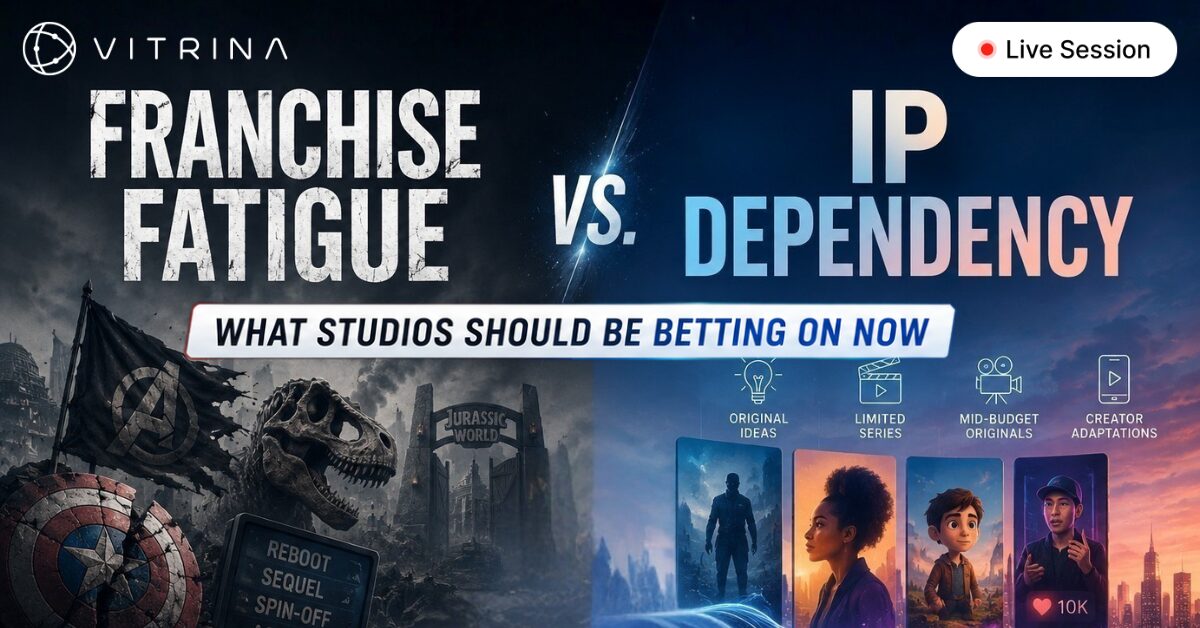
Franchise Fatigue vs. IP Dependency: What Studios Should Be Betting On Now
s franchise performance softens, where will the next generation of valuable IP come from? Join the briefing.