IHUB
IHUB
 Global Content Pulse (Webinars)


 Global Production Financing
(Webinars)
Global Production Financing
(Webinars)  LeaderSpeak Podcast
  Global Entertainment Digest (Newsletter)
  About Vitrina
 About VIQI
 Our Story
 Our Solutions 🔥
 Film+TV Projects Tracker 🚀
 Case Studies
 Our Profile
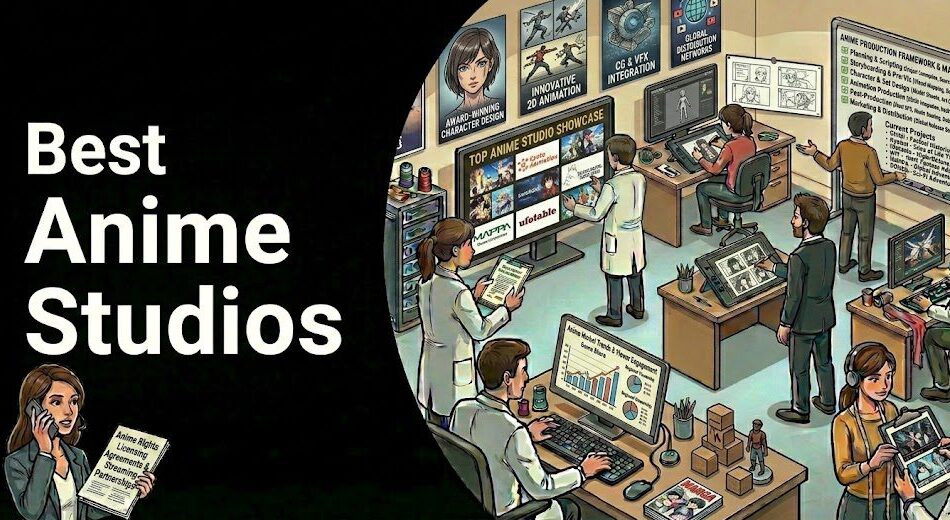
The best anime studios in 2026 aren’t just making great content — they’re reshaping how streaming platforms build their global slates, how IP gets monetized across merchandise, gaming, and theatrical, and where the real money in animation is moving. And if you’re on the acquisition or co-production side of this industry, you need more than a list of big names. You need to understand which studios are actually driving deal flow right now, which ones have the platform relationships to accelerate your distribution, and where the Fragmentation Paradox is hiding real opportunity.
Here’s the context that matters: the global anime market hit $28.6 billion in 2023 and is projected to reach $47 billion by 2030, according to research from Precedence Research. Netflix alone has invested over $2.5 billion in anime content since 2019. Crunchyroll — now owned by Sony Pictures Entertainment — has crossed 13 million paid subscribers globally. This isn’t a niche category anymore. It’s a premium global content vertical, and the studios producing the hits are negotiating from a position of genuine strength.
But — and this is the part most acquisition teams discover too late — Japan’s 140+ active anime studios operate in a deeply opaque ecosystem. The committee production model (seisaku iinkai) means rights are fragmented across multiple rightsholders before a single frame is animated. Production partnerships shift constantly. And the studios doing the best creative work aren’t always the ones with the loudest international PR. This guide cuts through that noise.
In This Guide
- Why Anime Studios Matter More Than Ever for Global Buyers
- Top 7 Japanese Anime Studios Driving Global Hits in 2025
- 5 Rising Anime-Style Studios Outside Japan You Need to Know
- What Makes an Anime Studio Acquisition-Ready in 2025?
- The Rights Fragmentation Problem — and How to Navigate It
- How to Find and Connect with Anime Studios Using Vitrina
- Frequently Asked Questions
- Key Takeaways
Find Active Anime Studios and Their Current Production Slate in Minutes
Ask VIQI — Vitrina’s AI intelligence layer — to surface verified anime studios filtered by platform relationships, genre specialization, and active rights availability. Used by Netflix, Crunchyroll, and major content buyers globally.
✔ 200 free credits | ✔ No credit card required | ✔ 140,000+ companies indexed
Why Anime Studios Matter More Than Ever for Global Content Buyers
Let’s be direct about what’s happening. Anime has broken out of its cult-following category and into the mainstream acquisition strategy of every major streamer. When Demon Slayer: Mugen Train grossed over $500 million globally in 2021 — outperforming virtually every Hollywood theatrical release that year — the industry took notice. But that was just the loudest signal. The structural shift has been building for years.
What does that mean for your acquisition strategy? It means the studios producing the most commercially viable anime aren’t just creative vendors — they’re strategic partners with leverage. MAPPA, which produced Attack on Titan’s final season alongside Jujutsu Kaisen, can choose its streaming partners rather than accepting the first deal on the table. Ufotable controls its own IP relationships so tightly that landing a first-look deal requires navigating relationships that don’t show up in any public directory. And Toei Animation — with One Piece now approaching its live-action second season on Netflix — is actively expanding its international co-production ambitions in ways that create real opportunities for the right partners.
As reported by Variety, anime titles now account for over 20% of the most-watched content on Netflix globally — a figure that has more than doubled since 2020. But the competition for the best studio relationships has gotten brutal. If you’re not tracking which studios are in active production, which ones have streaming rights encumbered by existing deals, and which ones are genuinely available for your co-production structure — you’re making acquisition decisions on incomplete data.
That’s exactly the data gap that Vitrina’s platform is built to close. But before we get there — let’s map the actual landscape. Our global anime trends and market insights guide provides the macro context you’ll want alongside this studio-by-studio breakdown.

Your AI Assistant, Agent, and Analyst for the Business of Entertainment
VIQI AI helps you plan content acquisitions, raise production financing, and find and connect with the right partners worldwide.
- Find active co-producers and financiers for scripted projects
- Find equity and gap financing companies in North America
- Find top film financiers in Europe
- Find production houses that can co-produce or finance unscripted series
- I am looking for production partners for a YA drama set in Brazil
- I am looking for producers with proven track record in mid-budget features
- I am looking for Turkish distributors with successful international sales
- I am looking for OTT platforms actively acquiring finished series for the LATAM region
- I am seeking localization companies offer subtitling services in multiple Asian languages
- I am seeking partners in animation production for children's content
- I am seeking USA based post-production companies with sound facilities
- I am seeking VFX partners to composite background images and AI generated content
- Show me recent drama projects available for pre-buy
- Show me Japanese Anime Distributors
- Show me true-crime buyers from Asia
- Show me documentary pre-buyers
- List the top commissioners at the BBC
- List the post-production and VFX decision-makers at Netflix
- List the development leaders at Sony Pictures
- List the scripted programming heads at HBO
- Who is backing animation projects in Europe right now
- Who is Netflix’s top production partners for Sports Docs
- Who is Commissioning factual content in the NORDICS
- Who is acquiring unscripted formats for the North American market
Top 7 Japanese Anime Studios Driving Global Hits in 2025
Tokyo remains the Sovereign Hub of global anime production. But it’s not monolithic. Different studios specialize in different genres, production models, and international deal structures. Here’s what actually matters for acquisition professionals.
1. MAPPA — The Prestige Powerhouse
MAPPA (Maruyama Animation Produce Project Association) has become arguably the most commercially important anime studio in the world right now. Founded by Masao Maruyama in 2011, the studio’s slate reads like a streaming platform’s wish list: Attack on Titan Final Season, Jujutsu Kaisen (both seasons), Chainsaw Man, and Hajime no Ippo’s continued run. What makes MAPPA strategically interesting — beyond the obvious quality — is their willingness to take on IP that other studios pass on and push it to a quality level that commands global streaming premiums.
MAPPA’s deal structure typically involves the seisaku iinkai committee model, which means streaming rights run through a rights consortium rather than MAPPA directly. If you’re approaching them for co-production conversations, understand that the creative relationship is with MAPPA, but the rights conversation is with the committee — and those are two very different negotiations requiring two different relationship tracks.
2. Ufotable — Quality Control at Scale
Ufotable operates one of the most vertically integrated production pipelines in Japanese animation. They run their own catering chain (Cafe Ufotable in Tokushima) to fund operations — which tells you something about how seriously they take margin control and independence. Their animation quality on Demon Slayer: Kimetsu no Yaiba set a visual standard that every other studio is now scrambling to match. The Demon Slayer franchise — including the theatrical films — has generated over ¥300 billion (~$2 billion USD) in total revenue globally, making it one of the highest-grossing anime IP in history.
Ufotable’s international partnerships are deliberately limited. They don’t chase every streaming deal. But that exclusivity is precisely what makes an Ufotable relationship strategically valuable — if you can get in front of the right people with a serious proposal.
3. Toei Animation — The IP Fortress
Toei Animation is the longest-running and largest anime studio by output — responsible for Dragon Ball, One Piece, Sailor Moon, Digimon, and Precure. Revenue for fiscal year 2024 came in at approximately ¥60 billion (~$400 million USD), the majority driven by international licensing rather than domestic broadcast. Toei’s international strategy has become notably more aggressive since the One Piece Netflix live-action success — they’re actively looking for co-production structures that amplify their IP globally without surrendering creative control.
But here’s what most buyers miss: Toei’s rights landscape is more complex than it appears. Individual titles have different rights structures, different international distribution windows, and different MG expectations. Approaching Toei without understanding which titles are available in which territories — and at what stage in their distribution cycle — is a guaranteed waste of everyone’s time.
4. Studio Ghibli — The Cultural Institution
Studio Ghibli, under Hayao Miyazaki, remains in a category of its own. The Boy and the Heron won the Academy Award for Best Animated Feature in 2024 — the studio’s second Oscar — validating what the industry already knew: Ghibli’s work is prestige cinema, not category content. The studio’s partnership structure changed significantly when Nippon TV acquired a 42.3% stake in 2023, creating a new institutional relationship that’s reshaping how Ghibli’s catalog and future productions get packaged for international buyers.
For buyers, the key insight is that Ghibli’s streaming rights landscape has stabilized — Netflix holds streaming rights in most non-North American territories — but theatrical and physical rights remain more fluid. If your acquisition strategy includes prestige theatrical or premium VOD, Ghibli’s catalog still has available windows depending on territory.
5. A-1 Pictures — The Volume Play
A-1 Pictures (a subsidiary of Aniplex/Sony Music Entertainment Japan) is the studio behind Sword Art Online, Fairy Tail, Blue Exorcist, and the culturally significant Kaguya-sama: Love Is War. Their volume and consistency make them one of the most reliable production partners for streamers that need a steady content pipeline rather than just tentpole titles. The Sony connection means their international distribution relationships are built-in — and that their deal structures tend to be more standardized than boutique studios, which streamlines the rights negotiation process.
6. Wit Studio — The Creative Disruptor
Wit Studio spun out of I.G. Port (Production I.G’s parent) in 2012 and has built a reputation for taking on high-risk, high-reward projects. They launched Attack on Titan before handing the finale seasons to MAPPA. Their recent work — including Spy x Family (co-produced with CloverWorks) and Vinland Saga — demonstrates a consistent ability to adapt complex manga IP into globally streaming-viable series. For acquisition teams, Wit represents an interesting mid-tier opportunity: not as expensive or encumbered as the biggest studios, but producing at a quality level that can anchor a platform’s prestige anime slate.
7. Bones — The Action & Sci-Fi Specialist
Bones (the studio behind Fullmetal Alchemist: Brotherhood, My Hero Academia, and Carole & Tuesday) has carved a specific niche in action and sci-fi anime that performs consistently well in Western markets. My Hero Academia’s global fanbase has supported 4 theatrical films and 7 seasons, with the franchise generating over $500 million in merchandise revenue annually. Bones’s deal structure tends to be more accessible than the top-tier studios — making them a realistic entry point for international buyers looking to build an anime co-production portfolio without the IP competition that surrounds MAPPA or Ufotable.
Track Which Anime Studios Are in Active Production — and What’s Available
Join 140,000+ entertainment companies on Vitrina. Filter anime studios by genre specialization, production status, and streaming platform relationships — and see active deal flow in real time across 159,223 tracked productions.
✔ 200 free credits | ✔ No credit card required | ✔ Full platform access
5 Rising Anime-Style Studios Outside Japan You Need to Know
Japan dominates, but it doesn’t monopolize. The anime aesthetic has become a global production language — and studios in Korea, India, France, and the USA are producing content that platforms are acquiring specifically because it delivers anime-quality storytelling at different cost structures and with different IP ownership dynamics.
Jayakumar P (CEO, Toonz Media Group) discusses the global expansion of anime-style animation, AI integration in production, and how studios outside Japan are positioning for the international streaming market:
1. Production I.G (Korea via Collaboration) & Korean Anime Studios
South Korea has been producing subcontracted animation for Japanese studios for decades — but the equation is shifting fast. Studios like DR Movie, JM Animation, and Sunwoo Entertainment have been key production partners for everything from Naruto to Bleach. Now they’re leveraging those production skills to develop original Korean-originated anime IP for global streaming. As reported by The Hollywood Reporter, Korean animation studios saw a 34% increase in international co-production inquiries in 2024 — driven primarily by SVOD platforms looking for anime-quality content with cleaner rights structures. Our guide to Korean anime producers maps the most active studios in this emerging market.
2. Toonz Media Group — India’s Animation Powerhouse
Toonz Media Group, headquartered in Kerala and Trivandrum, India, has been producing animation for international clients for over two decades — working with Disney, Netflix, Nickelodeon, and dozens of other global buyers. Jayakumar P, CEO of Toonz Media Group, has been actively expanding into original IP development, AI-integrated animation pipelines, and co-production partnerships that give international buyers genuine creative equity rather than just work-for-hire service. Japan’s 50% content production incentive cap and India’s cost structure together create an interesting stacking opportunity for co-productions that develop IP with Japanese creative partners and produce through Indian studios.
3. DLE Inc. — Japan-Adjacent with Global Ambitions
DLE Inc. (Dream Link Entertainment) is a Tokyo-based studio that doesn’t fit neatly into traditional anime categories — which is precisely why it’s interesting for international buyers. DLE operates across animation, live-action, and licensing with a notably aggressive approach to international expansion. Their production house model allows for faster iteration and cleaner IP ownership than the committee-heavy seisaku iinkai system, making DLE-sourced content easier to clear rights on for multi-territory deals. Vitrina has worked directly with DLE on global expansion strategy, giving us visibility into their deal flow that most platforms don’t have.
4. Science SARU — The Auteur Alternative
Science SARU, co-founded by Masaaki Yuasa and Eunyoung Choi, occupies a unique space: prestige auteur anime with international co-production DNA. Their work on Keep Your Hands Off Eizouken! and Inu-Oh demonstrates a willingness to push artistic boundaries that makes their content ideal for the platform positioning strategies of Apple TV+ and MUBI-adjacent streamers looking for culturally prestigious animation rather than pure mainstream volume. Choi, as co-founder, brings Korean animation expertise into the studio’s DNA — making Science SARU one of the few genuinely bicultural production entities in the anime space.
5. Cartoon Saloon (Ireland) — The Western Anime-Aesthetic Studio
Cartoon Saloon, based in Kilkenny, Ireland, has earned 5 Academy Award nominations with a visual style that draws heavily from Celtic art and global animation traditions. They’re not technically an anime studio — but for acquisition executives building a premium animated content strategy, Cartoon Saloon is producing exactly the category of content (artistically distinctive, globally themed, adult-skewing animated features) that anime fans and premium platform subscribers respond to. Their co-production model is built for international partners, and Ireland’s 32% Section 481 tax relief makes the economics genuinely attractive.
What Makes an Anime Studio Acquisition-Ready in 2025?
Not all anime studios are created equal from an acquisition standpoint. Creative quality is the obvious filter — but it’s not the only one. If you’re sourcing content for a streaming platform or structuring a co-production deal, you’re evaluating studios across at least four dimensions that rarely make it into the trades.
Rights clarity is the first question. Does the studio hold or have access to the international rights you need? For original anime — studio-originated IP rather than manga adaptations — rights are typically cleaner. For manga adaptations, you’re navigating a rights landscape that includes the manga publisher, the original creator, the seisaku iinkai committee, and potentially existing licensing deals that may block your territory. Knowing this before you start the conversation saves months of dead-end negotiation.
Production capacity and reliability matters more than people acknowledge. Anime production schedules are notoriously tight — many shows are delivered episode-by-episode during the broadcast season, with animators working under intense pressure. A studio with a reputation for on-time delivery and consistent quality across a full season is worth more to a platform buyer than a studio that produces brilliant occasional episodes but misses windows. MAPPA’s production challenges on some projects are well-documented in the industry — brilliant work, but the production process creates risks that a streaming partner’s content slate management has to account for.
IP franchise depth is what converts a single acquisition into a content ecosystem. Studios like Toei, with their Dragon Ball and One Piece libraries, have decades of content to support theatrical events, merchandise licensing, gaming IP, and catalog streaming revenue. When you’re evaluating a studio relationship, ask what’s behind the title you’re acquiring — because the smartest content buyers in 2025 are building franchise ecosystems, not just filling programming slots.
International co-production experience is the final filter — and it’s where many Japanese studios still have room to grow. Studios accustomed to domestic broadcast and domestic committee structures don’t always have the legal, financial, and creative infrastructure to run a clean international co-production. That’s not a dealbreaker, but it means you need either a strong intermediary relationship (an experienced producer or rights agent with deep Japan roots) or you’re doing that structural work yourself. See our detailed breakdown of anime licensing and distribution strategy for a full walkthrough of deal structuring best practices.
The Rights Fragmentation Problem — and How Smart Buyers Navigate It
Here’s what nobody tells you until you’re three months into an anime acquisition conversation: the studio didn’t make the show. A committee did.
The seisaku iinkai (production committee) model is the dominant financing structure in Japanese anime. A typical committee for a major anime series might include the manga publisher, a music label, a toy company, a streaming platform, the animation studio, and a broadcast network — each holding a percentage stake in the IP and a slice of the rights pie. The studio is the creative engine, but the rights are owned collectively. That means “calling the studio” doesn’t solve your rights problem. You need to know who’s on the committee, what they hold, and whether their share of your target territory is available.
The Fragmentation Paradox is real here: the most commercially valuable anime IP tends to have the most complex rights structures, because more stakeholders bet on it early. Demon Slayer’s rights involve Shueisha (the manga publisher), Aniplex (production and distribution), ufotable (animation studio), and multiple other committee members. Navigating that without pre-existing relationships at each level — or without intelligence about the current rights status of each territory — is genuinely hard.
But it’s not impossible. The buyers closing the best anime deals in 2025 are doing three things: they’re maintaining deep relationships with key rights aggregators like Aniplex of America, Funimation (now part of Crunchyroll/Sony), and independent Japanese sub-agents. They’re using platform intelligence to track which titles have streaming rights encumbered versus available in specific territories. And they’re moving faster than their competitors — because the window between a title’s rights availability and the next platform securing them is often just 6–8 weeks.
Vitrina’s platform tracks rights activity across 159,223 productions globally — including anime titles currently in negotiation, titles where streaming windows are expiring, and studios actively seeking co-production partnerships. That’s the intelligence layer that turns a cold outreach into a warm conversation before the deal is already done. For a deeper understanding of how the committee model works and how to structure around it, our guide to how anime studios shape global entertainment covers the full picture.
De-Risk Your Anime Acquisition with Verified Rights and Studio Intelligence
Vitrina’s Concierge team can map your anime studio shortlist in 48 hours — drawing from live production data and rights tracking across 159,223 active projects globally. Trusted by Netflix, Warner Bros, and Paramount procurement teams.
✔ Verified rights status | ✔ Active production tracking | ✔ Platform relationship mapping
How to Find and Connect with the Best Anime Studios Using Vitrina
The traditional approach to finding anime studio partners — conference circuits, intermediary introductions, cold emails to public addresses — still works. Slowly. And in an acquisition landscape where the best titles get committed before they’re publicly announced, “slowly” is a strategy that costs you deals.
Vitrina’s Smart Pairing intelligence changes that equation. Our platform indexes 140,000+ entertainment companies globally — including verified anime studios with data on their current production slate, active platform relationships, rights structures, and co-production history. You can filter by genre specialization (action shonen versus isekai versus seinen), by territory rights availability, by production scale, and by current activity status. If a studio has a title in production that fits your slate, you’ll see it. If they have a rights window opening in your territory in the next quarter, you’ll know before most of your competitors do.
VIQI — Vitrina’s AI query interface — takes that one step further. Ask it “which anime studios have sci-fi original IP with available streaming rights in Southeast Asia and Europe?” and it surfaces a qualified, verified list — not a directory result that may be outdated, but active intelligence drawn from live production tracking. That’s the difference between intelligence and information. And in a market as competitive and opaque as anime rights, intelligence is the asset that closes deals.
For teams that need managed research — mapping the full studio and rights landscape across multiple target territories for a significant slate investment — Vitrina’s Concierge service delivers a curated, verified briefing built from real production data. The kind of briefing that would take an in-house team 6–8 weeks to compile manually, built in 48 hours from live data. Explore the broader landscape of Japanese anime acquisition strategy to understand how to structure your approach before you start making calls.
Frequently Asked Questions: Best Anime Studios 2025
Key Takeaways: Winning the Anime Acquisition Race in 2025
The best anime studios in 2025 are operating from a position of creative and commercial strength that’s reshaping global content economics. MAPPA, Ufotable, Toei, and Wit Studio are producing content that every major streaming platform is actively competing for. And outside Japan, Korea, India, and Europe are building anime-quality animation capabilities with cleaner IP ownership dynamics that make them increasingly attractive co-production partners.
But opportunity without intelligence is just noise. The acquisition teams closing the best anime deals aren’t the ones with the biggest budgets — they’re the ones who move fastest on verified intelligence, who understand the rights landscape before they make first contact, and who’ve built the studio relationships before the IP is ready to be licensed. That’s the competitive advantage you can build with Vitrina.
Key Takeaways
- The anime market is a $28.6 billion industry projected to reach $47 billion by 2030 — it’s no longer a niche category, it’s a premium global content vertical that every major streamer is competing in.
- MAPPA, Ufotable, Toei, and Studio Ghibli lead the Japanese market, but each has very different rights structures, deal dynamics, and international partnership openness — understanding those differences before you approach is essential.
- The seisaku iinkai committee model fragments rights across multiple stakeholders — rights negotiations require identifying every committee member holding your target territory, not just the studio that animated the show.
- Studios outside Japan — Korea’s DR Movie, India’s Toonz, Ireland’s Cartoon Saloon — offer anime-quality production with cleaner IP ownership, faster rights negotiation, and often more competitive co-production economics.
- Vitrina’s 140,000+ company database and VIQI intelligence layer let you identify active anime studios, track rights availability, and surface co-production opportunities in minutes — not the months a traditional research approach requires.
Start Tracking the Anime Studios Shaping Global Content Right Now
Join Netflix, Warner Bros, and Paramount in using Vitrina to track the global entertainment supply chain. Get 200 free credits and full platform access — no credit card required.
✔ 140,000+ companies indexed | ✔ 159,223 projects tracked | ✔ No credit card required
Find Film+TV Projects, Partners, and Deals – Fast.
VIQI matches you with the right financiers, producers, streamers, and buyers – globally.
Producers Seeking Financing & Partnerships?
Book Your Free Concierge Outreach Consultation
(To know more about Vitrina Concierge Outreach Solutions click here)
Join Industry Briefings Trusted by Leaders

Unscripted Is Eating the World: The Multi-Billion Reality and Format Boom
Unscripted is the new prestige — inside the $19.8B global format boom reshaping how streaming platforms compete.

Scripted Without Borders
As global drama evolves, which stories travel, which stay local, and how are they getting financed?
What Film & TV Financiers Actually Want in 2026
What do Film and TV financiers look for before they invest? Join the briefing to understand how capital decisions are changing in 2026.
From Prompt to Production: How AI Is Rewriting the Rules of Filmmaking
AI is reshaping every stage of filmmaking. Discover where it delivers real value across development, production, and distribution.