IHUB
IHUB
 Private Briefings (Webinars)


 LeaderSpeak Podcast
  Global Entertainment Digest (Newsletter)
  Premium Lists
 Membership Benefits
 About Vitrina
 Our Story
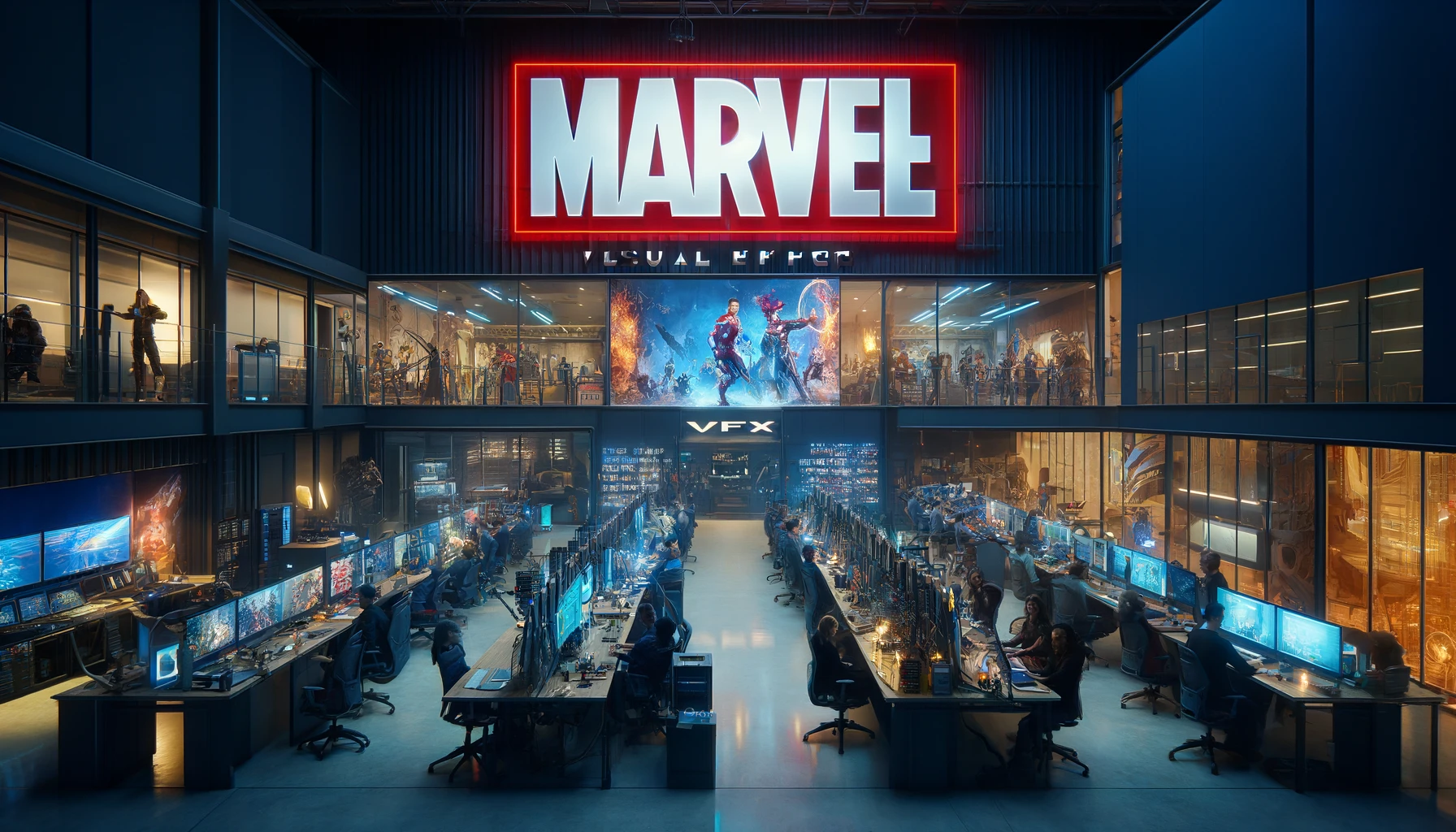
Marvel VFX is the most closely watched visual effects program in Hollywood — and for good reason. The Marvel Cinematic Universe has grossed over $30 billion at the global box office across 33 films, and the visual effects on those films represent some of the most technically ambitious work ever commissioned in a single franchise. But here’s what most people don’t know: Marvel doesn’t rely on one studio to do it.
They distribute VFX work across a rotating roster of vendors — sometimes 10 to 15 studios per film — each assigned specific sequences, characters, or environments based on their particular strengths. It’s a sophisticated supply chain model, not a monolithic relationship. And understanding how it works tells you a lot about how blockbuster-level VFX actually gets made — and what any production, big or small, can learn from it.
Whether you’re a studio executive benchmarking your own VFX pipeline, a VFX producer trying to understand how the top tier operates, or an independent producer looking for the right partner for your next project, the Marvel VFX vendor model is worth studying closely. It’s a masterclass in multi-vendor orchestration — and the Fragmentation Paradox™ in reverse: Marvel has the intelligence and relationships to navigate 10,000+ VFX companies and select exactly the right ones. Most productions don’t. Let’s change that.
In This Article
Which VFX Studios Work on Productions Like Yours Right Now?
VIQI — trained on 1.6 million titles, 300,000+ companies, and 5 million professionals — identifies and vets VFX vendors by specialty, territory, budget range, and credit history in seconds. Skip the 3-month search cycle.
Used by teams at Netflix, Warner Bros, and Paramount | 200 free credits | No credit card required
How Marvel’s VFX Model Actually Works
Marvel Studios sits at the center of one of the most complex VFX supply chains in the world. A single MCU film typically involves 2,000 to 3,000 VFX shots — some recent entries pushed that to 3,500+. No single studio can execute that volume at the required quality level and timeline. So Marvel distributes.
The model works like this: Marvel’s in-house VFX team (led by a Visual Effects Executive and supported by multiple VFX supervisors) acts as the integrating intelligence. They hold the creative vision, manage vendor relationships, provide reference material, and maintain quality control across all studios. Individual vendors receive specific sequences — ILM might handle a climactic battle, Weta FX takes hero character work, DNEG delivers environments, and boutique shops handle cleanup or secondary characters.
But it’s not just about dividing labor. Marvel also uses vendor specialization strategically. Certain studios have built reputations for specific capabilities — creature effects, crowd simulation, photoreal environments, facial capture. Assigning work based on genuine expertise rather than availability alone is one reason the MCU’s VFX quality has (mostly) held across a slate this massive.
The flip side? The model has created well-documented strain. Multiple VFX workers have spoken publicly — and according to Variety — about compressed schedules, late creative changes, and the financial pressure placed on vendor studios that operate on thin margins. The VFX union organizing movement that gained traction in 2022-2023 was, in significant part, a response to conditions on major franchise productions including Marvel. It’s worth understanding — not to relitigate, but because it affects vendor capacity and pricing dynamics that every production navigating this market needs to account for.
Understanding who the key studios are, what they do best, and how they operate is foundational intelligence — whether you’re benchmarking your own VFX program or looking for vendors who’ve built their capabilities on the most demanding work in the industry. The post-production and VFX industry guide provides additional context on how these vendor ecosystems function at scale.
Industrial Light & Magic (ILM): The Legacy Anchor
Industrial Light & Magic is the oldest and arguably most consequential VFX studio in existence. Founded by George Lucas in 1975 for the original Star Wars, ILM has VFX credits spanning nearly every major blockbuster franchise of the last five decades — including, crucially, much of the MCU.
ILM’s Marvel work includes hero-level assignments on films like Iron Man, Captain America: Civil War, and Avengers: Infinity War. They’re typically assigned sequences where absolute photorealism is paramount — crowd simulations at scale, environment extensions, and character VFX that needs to hold up on a 60-foot IMAX screen.
What sets ILM apart from most competitors is their technology infrastructure. Their proprietary tools — including StageCraft (the real-time LED volume stage technology also used on The Mandalorian) and Ziva Dynamics for simulating realistic digital tissue — represent decades of R&D investment. VFX veteran Joseph Bell, who built much of his expertise at ILM before moving into advisory and leadership roles, has noted that the studio’s proprietary toolset creates capabilities that aren’t available off-the-shelf — a technical moat that’s difficult to replicate even as AI tools democratize the industry.
But scale and prestige come with implications for productions beyond Marvel. ILM’s rate cards reflect their position. If you’re sourcing VFX for a $40-80M film that doesn’t have the Marvel stamp, you’re competing for capacity with franchise productions that often lock up ILM’s pipeline quarters in advance. Knowing this is the kind of market intelligence that prevents wasted outreach — and protects your greenlight timeline.
Joseph Bell — a veteran of Industrial Light & Magic (ILM) with over two decades in the VFX landscape — breaks down current industry trends, the dynamics of major franchise VFX programs, and how the market is evolving for studios at every level:
Weta FX: Character Work at the Highest Level
Weta FX (formerly Weta Digital, following its acquisition by Unity in 2021 and subsequent restructuring) occupies a specific niche in the MCU supply chain: they’re the go-to for character simulation and creature work that needs to feel genuinely physical.
Founded in Wellington, New Zealand by Peter Jackson alongside Weta Workshop for the Lord of the Rings trilogy, Weta has delivered VFX for MCU entries including Thor: Ragnarok and multiple phases of Avengers work. Their simulation tools — particularly for cloth, muscle, and skin dynamics — set a standard that even ILM acknowledges as best-in-class for organic character work.
New Zealand’s incentive structure has historically supported Weta’s operations. The country offers a base incentive of 20% for international productions with a 5% uplift for significant economic benefit — and domestic productions can access up to 40% via the New Zealand Production Grant. That soft money doesn’t directly subsidize Weta’s rates, but it’s part of why Wellington became a global VFX hub that can sustain a studio of Weta’s caliber outside a major production center.
Weta’s acquisition by Unity changed their trajectory somewhat — the focus shifted toward real-time tools and gaming applications alongside traditional VFX. But their feature film capabilities remain intact, and their reputation for hero character work means they’re in demand well beyond the MCU. Getting access to them for a non-franchise production requires lead time — and the kind of early vendor engagement that most productions don’t start soon enough.
Track VFX Studios by Specialty, Capacity, and Credit History
300,000+ verified companies on Vitrina — filter by VFX type (creatures, environments, compositing), territory, and current availability. No more cold outreach to fully-booked studios.
200 free credits · No credit card required · Used by Netflix, Paramount, and Warner Bros teams
DNEG: The Global Pipeline Powerhouse
DNEG (Double Negative) is one of the largest VFX studios in the world by headcount and revenue — with facilities in London, Mumbai, Chennai, Los Angeles, Vancouver, and Sydney. That global footprint isn’t accidental. It’s a strategic response to the reality of modern blockbuster production, which requires 24-hour pipeline capability and the ability to draw on talent pools across different labor markets and incentive territories.
DNEG’s MCU credits include work on Avengers: Endgame, Doctor Strange in the Multiverse of Madness, and multiple Disney+ series. Their scale means they can absorb very high shot counts — a critical capability when a Marvel production needs to distribute 800+ shots to a single vendor and trust they’ll all come back on time.
But scale is only part of the DNEG story. Their acquisition of Metaphysic — the AI company behind photorealistic face synthesis — via their Brahma AI and content technology division created a combined entity of 800 experts focused on AI-driven content creation. That’s a deliberate pivot: DNEG is betting that AI-accelerated pipelines will be the competitive differentiator for the next decade of franchise VFX work, not just headcount.
For producers sourcing VFX work, DNEG occupies a specific position: they’re big enough to handle franchise-scale volume, technically sophisticated enough for hero work, and geographically distributed enough to optimize for incentive territories. Their India operations — particularly in Mumbai and Chennai — benefit from India’s 40% federal VFX incentive (increased from 30% in 2024), with a $3.6M cap and an additional 5% bonus for significant Indian content. That’s stackable with state incentives, which means a production that routes VFX work through DNEG’s Indian facilities can access meaningful soft money. As we explored in our guide to India’s VFX market, the country’s incentive landscape has made it a genuine competitor to traditional VFX hubs.

Your AI Assistant, Agent, and Analyst for the Business of Entertainment
VIQI AI helps you plan content acquisitions, raise production financing, and find and connect with the right partners worldwide.
- List the top commissioners at the BBC
- List the post-production and VFX decision-makers at Netflix
- List the development leaders at Sony Pictures
- List the scripted programming heads at HBO
- Find active co-producers and financiers for scripted projects
- Find equity and gap financing companies in North America
- Find top film financiers in Europe
- Find production houses that can co-produce or finance unscripted series
- Who is backing animation projects in Europe right now
- Who is Netflix’s top production partners for Sports Docs
- Who is Commissioning factual content in the NORDICS
- Who is acquiring unscripted formats for the North American market
- Show me recent drama projects available for pre-buy
- Show me Japanese Anime Distributors
- Show me true-crime buyers from Asia
- Show me documentary pre-buyers
- I am looking for production partners for a YA drama set in Brazil
- I am looking for producers with proven track record in mid-budget features
- I am looking for Turkish distributors with successful international sales
- I am looking for OTT platforms actively acquiring finished series for the LATAM region
- I am seeking localization companies offer subtitling services in multiple Asian languages
- I am seeking partners in animation production for children's content
- I am seeking USA based post-production companies with sound facilities
- I am seeking VFX partners to composite background images and AI generated content
Framestore: The Episodic Specialist Making Moves in Features
Framestore built its reputation on advertising and feature films before making a deliberate move into episodic television — a shift that’s paid off significantly as streaming platforms became the primary buyers of high-VFX content. Their Marvel work spans both worlds: feature contributions to the MCU alongside significant Disney+ series work.
John Kilshaw, Framestore’s Creative Director and VFX Supervisor, has described the company’s episodic-first philosophy as a genuine competitive differentiator. Episodic VFX demands different skills than feature work — faster turnaround, more consistent visual language across many episodes, and the ability to integrate seamlessly with a director’s vision on a week-to-week basis. Framestore built those muscles deliberately, and it’s visible in their Disney+ output across shows including WandaVision, where their compositing and environment work required tight integration with practical production.
The UK’s VFX incentive landscape has supported Framestore’s London operations. The UK’s Visual Effects Tax Relief (VETR) — enhanced in 2024 to provide a 39% rebate on qualifying VFX spend — is one of the most competitive in the world. A production that assigns VFX work to Framestore’s London facility can access that rebate, subject to qualification thresholds, creating meaningful budget protection on a major VFX line item.
Framestore also operates significant capabilities in Montreal and New York, giving them geographic flexibility. For producers who want world-class VFX capabilities with strong incentive territory access, Framestore’s multi-site model is worth understanding in detail. See our overview of the top independent VFX studios in the UK for more context on the competitive landscape.
The Rising Studios: Luma Pictures, Pixomondo, Crafty Apes, and Rising Sun Pictures
Marvel’s vendor roster goes well beyond the four major studios above. Here’s the reality: boutique and mid-tier studios often deliver some of the most technically precise work in any given MCU film — they’re just not the ones writing the press releases.
Luma Pictures is a Santa Monica-based studio that has quietly accumulated an impressive run of MCU credits — Avengers: Endgame, Black Widow, Shang-Chi — handling environments, digital humans, and effects simulations. They’re known internally for tight client relationships and a senior-heavy team structure that minimizes the junior-heavy mistakes that plague some larger studios under pressure.
Pixomondo — with operations in Germany, Canada, and the US — brings geographic flexibility and strong effects simulation capabilities. They’ve worked on MCU-adjacent productions and major franchise work including the Game of Thrones dragon sequences, which remain some of the most complex creature effects work in television history. Their German and Canadian locations give them access to European and Canadian incentive territories.
Crafty Apes operates differently: they’ve positioned themselves as a production-friendly studio that specializes in invisible effects — wire removal, set extensions, cleanup — the unglamorous work that makes every frame of a blockbuster clean and camera-ready. It’s not headline work, but it’s essential, and Crafty Apes has built a reputation for doing it at speed without sacrificing quality. On a film with 3,000 VFX shots, you need vendors who can execute the secondary work reliably while the hero studios focus on the marquee sequences.
Rising Sun Pictures brings Australian operations and access to Australia’s 30% PDV (Post, Digital, and Visual Effects) offset alongside a 30% Location Offset that makes Australian VFX work genuinely cost-competitive for the right productions. Their credits include work across the MCU and multiple major franchise titles, and their Adelaide facility has become a recognized destination for international VFX work routed through Australia for incentive optimization.
Need Direct Access to Top-Tier VFX Studios for Your Production?
Vitrina’s Concierge team has pre-verified relationships with studios at every tier — from ILM and DNEG to boutique specialists. Tell us your brief and budget. We’ll identify the right match and facilitate the introduction within 48 hours.
The Economics Behind Marvel’s VFX Spend
Let’s talk about what this actually costs. MCU films typically carry total production budgets in the range of $150-250 million. VFX typically represents 30-45% of the total production budget on a heavily visual film — so we’re looking at $50-100M in VFX spend per title for a major MCU entry. That’s the number that makes the major studios’ capacity possible and the multi-vendor model necessary.
But the economics are more complicated than the headline number suggests. Each vendor is operating on a fixed bid — they quote a price for their assigned sequences, lock in, and then manage to that number regardless of what changes Marvel requests during the process. And Marvel is known for late creative changes. That’s not a criticism — it’s a reality of franchise filmmaking where creative decisions at the top ripple into VFX schedules downstream. But it does mean VFX vendors absorb change orders that can erode their margins significantly.
According to Screen International, the tension between studios and VFX vendors over change orders and timeline compression has intensified as production volumes increased post-pandemic. The result? Several mid-tier studios that relied heavily on Marvel work — including Rhythm & Hues (which filed for bankruptcy even after delivering the VFX-heavy Life of Pi) and Modus FX — couldn’t sustain the pressure model. The industry is still reckoning with this dynamic.
For productions outside the MCU, this has a practical implication: understanding a VFX studio’s financial health and current capacity utilization matters as much as their reel. A studio that’s over-leveraged on franchise work — or recovering from a difficult production — may not be the reliable partner you need. This is exactly the kind of intelligence gap that the Fragmentation Paradox™ creates: there are 10,000+ VFX companies globally, but without verified data on their current status, you’re making expensive decisions in the dark.
What Producers Can Learn From Marvel’s Vendor Strategy
Most productions aren’t MCU films. But the principles Marvel applies to VFX vendor management translate directly to productions at any budget level. Here’s what the model teaches:
Specialize Your Vendor Assignments
Marvel doesn’t ask ILM to do what Weta does better, and they don’t ask Crafty Apes to do what DNEG handles at scale. Specialization-based assignment is more efficient than convenience-based assignment — even if it means managing more vendor relationships. Your production’s creature work, environment generation, and cleanup shouldn’t all go to the same studio by default. Match the work to the capability.
Engage VFX Vendors Before You’re Desperate
The biggest mistake non-franchise productions make is starting the VFX sourcing process too late. Top-tier studios are typically booked 6-12 months in advance. If you’re reaching out to ILM or DNEG after your greenlight, you’ve missed your window. Marvel starts vendor conversations during development — not post-production. You should too.
Use Incentive Territory Logic in Your Vendor Selection
Marvel doesn’t just pick studios based on quality — they factor in geographic location and the incentive implications. Your production should too. Routing VFX work through Australia (30% PDV offset), the UK (39% VETR), India (40% federal + 5% bonus), or Canada (variable provincial incentives) can deliver meaningful cost reduction without sacrificing quality. A VFX supervisor who understands incentive territory optimization is a genuinely valuable hire.
Protect Against Vendor Concentration Risk
Marvel distributes work precisely because concentrating 3,000 VFX shots in a single vendor creates catastrophic risk if that vendor struggles. Even productions with more modest VFX programs benefit from distributing work across 2-3 vendors — it creates negotiating leverage, reduces single-point-of-failure risk, and often produces better results as studios compete on quality. The VFX company selection guide covers the evaluation framework in detail.
Frequently Asked Questions
Which companies do Marvel’s VFX?
Marvel distributes VFX work across a rotating roster of 10-15 studios per film. The primary studios include Industrial Light & Magic (ILM), Weta FX, DNEG, and Framestore for hero and high-complexity work. Secondary and specialized vendors include Luma Pictures, Pixomondo, Crafty Apes, Rising Sun Pictures, Method Studios, and others depending on the specific film’s requirements. Marvel’s in-house VFX team orchestrates all vendor relationships and maintains creative control across the full supply chain.
How much does Marvel spend on VFX per film?
MCU films carry total budgets typically in the $150-250 million range, with VFX representing roughly 30-45% of total production costs on the most visual-effects-heavy titles. That translates to approximately $50-100 million in VFX spend per major MCU entry. Individual vendor contracts vary significantly — a studio handling 800+ hero shots will command a very different fee than a boutique studio delivering 150 cleanup shots. The multi-vendor model means no single studio receives the full VFX budget.
Why does Marvel use so many VFX studios on a single film?
Volume, specialization, and risk management. A single MCU film can involve 2,000-3,500 VFX shots — no single studio can execute that volume at the required quality level within the production timeline. Marvel also assigns work based on studio specialization: different studios have developed distinct expertise in creature work, environments, crowd simulation, compositing, and cleanup. Distributing work by specialization produces better results than forcing a generalist studio to cover everything. It also reduces concentration risk — if one vendor struggles, the rest of the production isn’t compromised.
What VFX company did the most work on Avengers: Endgame?
Avengers: Endgame involved contributions from multiple major studios including ILM, DNEG, Weta FX, Framestore, and Luma Pictures, among others — with different studios handling specific sequences. ILM and DNEG handled significant portions of the climactic battle sequences, while Weta contributed character simulation work and Luma Pictures delivered environment and digital human work. The credits reflect the full roster of studios involved, each credited for their specific contributions.
How does Marvel’s VFX model compare to other major studios?
Marvel’s model is more decentralized and vendor-intensive than most studios. Disney overall (which owns Marvel) has historically used a similar multi-vendor approach. Warner Bros and Universal also distribute VFX across multiple vendors on major productions, but the sheer volume of MCU work — with multiple films per year at high VFX intensity — means Marvel’s procurement operation is more systematized than most. The MCU’s scale has also driven Marvel to develop stronger in-house VFX supervision capabilities than studios producing fewer franchise titles.
What VFX challenges has Marvel faced publicly?
Marvel has faced public criticism for VFX quality on some Phase 4 and Phase 5 titles, with specific shots on She-Hulk, Thor: Love and Thunder, and Ant-Man and the Wasp: Quantumania drawing negative attention. Industry commentary attributes these issues to a combination of compressed production timelines, late creative changes, and the sheer volume of output. The underlying cause — as covered by Variety and The Hollywood Reporter — is structural: requesting ambitious VFX on abbreviated schedules creates quality risk that even the best studios struggle to avoid.
Can non-Marvel productions work with the same VFX studios?
Yes — ILM, DNEG, Framestore, Weta FX, and the other studios in Marvel’s ecosystem all take on non-franchise productions. The key variables are capacity and lead time. Major franchise work often locks up the top-tier studios’ pipelines quarters in advance. Non-franchise productions need to begin vendor outreach earlier than most do — ideally 9-12 months before VFX delivery — and should verify current availability before building a budget around a specific vendor. Vitrina’s platform tracks 300,000+ entertainment companies including VFX studios with current availability and credit history, which helps avoid outreach to fully-booked studios.
How do I find VFX studios with similar capabilities for a smaller production?
The most efficient approach is to use verified market intelligence rather than word-of-mouth recommendations. Vitrina’s platform allows you to filter 300,000+ companies by VFX capability type, budget range, territory, and credit history — surfacing verified options that match your actual requirements rather than the studios everyone already knows. VIQI, Vitrina’s AI intelligence tool, can answer specific sourcing questions (e.g., “which studios have creature VFX credits on productions under $30M?”) in seconds. Vitrina’s Concierge team also provides direct introductions to pre-qualified vendors within 48 hours.
Conclusion: The Intelligence Behind the Spectacle
Marvel’s VFX vendor strategy isn’t magic. It’s systematic. It’s the result of building and maintaining real-time intelligence on who can do what, at what quality level, with what timeline constraints — and then deploying that intelligence across a production slate that demands more visual effects output than any studio in history.
But here’s the thing: Marvel has the internal team and the market power to build that intelligence over decades. Most productions don’t. And in a market with 10,000+ VFX companies, navigating from your existing rolodex — knowing Weta, ILM, and Framestore while being blind to 9,997 others — is the Fragmentation Paradox™ working against you.
The productions that accelerate their VFX sourcing and protect their budgets are the ones that start early, think strategically about specialization, factor in incentive territories, and draw on verified market intelligence to find the right vendor — not just the most famous one.
Key Takeaways
- Marvel uses 10-15 VFX studios per film. ILM, Weta FX, DNEG, and Framestore anchor the roster, with specialists like Luma Pictures, Crafty Apes, and Rising Sun Pictures handling secondary sequences by capability.
- VFX spend is 30-45% of major MCU budgets. On a $200M production, that’s $60-90M in VFX — distributed across studios based on specialization, not convenience.
- Incentive territory logic drives vendor geography. Australia (30% PDV offset), UK (39% VETR), India (40% federal incentive), and Canada all create meaningful budget protection when factored into vendor selection.
- Capacity is the hidden variable. Top-tier studios book 6-12 months out. Non-franchise productions that start VFX sourcing late are competing for what’s left after the major franchises have claimed their capacity.
- The Fragmentation Paradox™ costs producers 15-20% margin. With 10,000+ VFX companies in the market, relying on relationship-network referrals leaves the best-value options invisible. Verified intelligence is the structural advantage.
Find the Right VFX Studio for Your Production — Without the 6-Month Search
Join 300,000+ companies using Vitrina to source, vet, and connect with verified VFX vendors. Start with 200 free credits — no credit card required.
Get 200 Free Credits — Start Sourcing Now
Or let our Concierge match you with pre-qualified VFX studios in 48 hours →