IHUB
IHUB
 Global Content Pulse (Webinars)


 Global Production Financing
(Webinars)
Global Production Financing
(Webinars)  LeaderSpeak Podcast
  Global Entertainment Digest (Newsletter)
  About Vitrina
 About VIQI
 Our Story
 Our Solutions 🔥
 Film+TV Projects Tracker 🚀
 Case Studies
 Our Profile
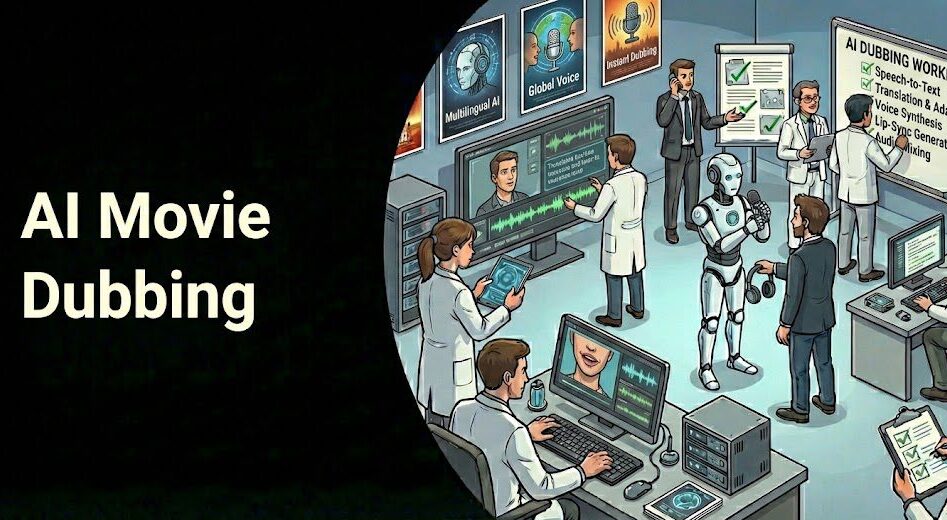
The video localization market sits at $6.5 billion—and AI dubbing is reshaping how that money gets spent, who captures it, and how fast content reaches new audiences. If you’re a filmmaker, producer, or distributor trying to figure out whether AI movie dubbing belongs in your post-production pipeline, you’ve landed in the right place.
Here’s the thing: traditional dubbing has always been expensive, slow, and deeply territorial. A 90-minute feature dubbed into Spanish, French, German, Italian, and Portuguese could easily run you $80,000–$150,000 in talent and studio fees alone, with a 6–12 week production window.
AI changes that calculus—but not always in the ways you’d expect. This guide covers what actually works, what doesn’t, which vendors to consider, and how to build a pipeline that protects both your budget and your creative intent.
In This Guide
- What AI Movie Dubbing Actually Is (and What It Isn’t)
- How the Technology Works: The Pipeline from Audio to Delivery
- AI vs. Traditional Dubbing: The Honest Cost and Quality Comparison
- Top AI Dubbing Vendors: Who’s Doing What
- When to Use AI Dubbing—and When to Stick with Human Voice Talent
- How to Build an AI Dubbing Pipeline for Your Production
- Rights, Ethics, and What Every Filmmaker Needs to Know
- Frequently Asked Questions
- Key Takeaways
Find Verified AI Dubbing Vendors for Your Production—In Minutes
Ask VIQI, Vitrina’s AI intelligence layer, to surface the right dubbing and localization vendors for your specific project. Filter by language pair, delivery spec, budget, and turnaround. Netflix, Warner Bros, and 140,000+ companies in the global supply chain already use Vitrina to find partners.
No credit card required. Instant access.
What AI Movie Dubbing Actually Is (and What It Isn’t)
AI movie dubbing uses machine learning models to translate source dialogue, synthesize voice performances in a target language, and—in more advanced implementations—synchronize that audio to the original actor’s lip movements. The tech stack typically combines automatic speech recognition (ASR), machine translation, text-to-speech (TTS) voice synthesis, and in some cases, visual face re-rendering to match mouth movements.
But here’s what it isn’t: a one-click solution that produces broadcast-ready dubbing without human review. The best AI dubbing vendors on the market right now operate a hybrid model—AI generates the first pass, human linguists and voice directors review and correct, and final QC happens before delivery. The AI handles the heavy lifting; trained humans catch the nuances that models still miss.
Ofir Krakowski, CEO and Co-Founder of DeepDub, has framed this well—his company’s approach centers on emotional voice modeling, not just linguistic translation. The argument is that a voice actor’s emotional performance is as important as the words. A flat synthetic voice that’s phonetically accurate but emotionally wrong is still bad dubbing—and audiences notice, even if they can’t name exactly why.
That’s the distinction that separates serious AI dubbing vendors from the noise. Emotional fidelity, not just textual accuracy, is the bar you should be applying.
For a broader picture of how AI localization fits into the global post-production chain, our analysis of AI localization in the film industry covers the strategic context worth understanding before you pick a vendor.
Your AI Assistant, Agent, and Analyst for the Business of Entertainment
VIQI AI helps you plan content acquisitions, raise production financing, and find and connect with the right partners worldwide.
- Find active co-producers and financiers for scripted projects
- Find equity and gap financing companies in North America
- Find top film financiers in Europe
- Find production houses that can co-produce or finance unscripted series
- I am looking for production partners for a YA drama set in Brazil
- I am looking for producers with proven track record in mid-budget features
- I am looking for Turkish distributors with successful international sales
- I am looking for OTT platforms actively acquiring finished series for the LATAM region
- I am seeking localization companies offer subtitling services in multiple Asian languages
- I am seeking partners in animation production for children's content
- I am seeking USA based post-production companies with sound facilities
- I am seeking VFX partners to composite background images and AI generated content
- Show me recent drama projects available for pre-buy
- Show me Japanese Anime Distributors
- Show me true-crime buyers from Asia
- Show me documentary pre-buyers
- List the top commissioners at the BBC
- List the post-production and VFX decision-makers at Netflix
- List the development leaders at Sony Pictures
- List the scripted programming heads at HBO
- Who is backing animation projects in Europe right now
- Who is Netflix’s top production partners for Sports Docs
- Who is Commissioning factual content in the NORDICS
- Who is acquiring unscripted formats for the North American market
How the Technology Works: The Pipeline from Audio to Delivery
Understanding the actual pipeline matters because it tells you where the quality risks sit—and where human oversight earns its keep. Here’s what a modern AI dubbing workflow looks like from source file to delivery:
Step 1 — Transcript Extraction and Source Preparation
The AI ingests your source audio and generates a timestamped transcript via ASR. Quality here depends heavily on audio cleanliness—ambient noise, overlapping dialogue, and heavy accents can introduce errors that cascade through the entire pipeline. You need clean stems (M&E track separated from dialogue) before you start. Don’t attempt AI dubbing on a mixed final without clean stems. You’ll spend more time fixing ASR errors than you saved on voice talent.
Step 2 — Translation and Script Adaptation
Machine translation handles the base pass. Better vendors apply dubbing-adapted translation—meaning the translated script is optimized for lip sync timing and natural delivery, not just semantic accuracy. A sentence that reads perfectly in print can be a disaster when a voice actor has to deliver it in 2.3 seconds matching a 1.8-second mouth movement. Human linguists typically review and adapt this pass, especially for culturally specific dialogue, humor, or idiomatic phrasing.
Step 3 — Voice Synthesis
This is where the vendor differentiation really shows up. Some platforms use generative TTS voices from a pre-built library—you pick a voice profile that matches your character. More advanced vendors clone the original actor’s voice (with consent) and render the translated dialogue in that voice, preserving timber, emotional register, and character identity. Respeecher, for example, has built significant capability in synthetic voice replication specifically for entertainment applications—their tech has appeared in high-profile productions where re-creating a specific voice performance was the requirement.
Step 4 — Lip Sync and Visual Reconciliation
Neural Garage (operating as VisualDub) has specifically attacked the visual discord problem—where dubbed audio doesn’t match the actor’s on-screen mouth movements. Their approach uses generative AI to subtly rerender lip and mouth movements to match the dubbed audio, rather than just hoping the translated timing is close enough. This is what makes the difference between dubbing that feels slightly “off” and dubbing that’s genuinely invisible to casual viewers. Not every AI dubbing vendor offers this capability—it’s worth asking specifically about visual sync as part of your vendor evaluation.
Step 5 — QC and Final Delivery
Human review catches what the model missed. A trained dubbing director listens against picture, flags synchronization issues, adjusts timing, and ensures the emotional performance reads correctly in the target language. The final deliverable—typically a separate dialogue track mixed back with your M&E—then gets conformed to your delivery spec (IMF, ProRes, or broadcast format depending on the distributor’s requirements).
Ofir Krakowski (CEO & Co-Founder, DeepDub) explains the emotional voice AI stack his company built and why emotional fidelity—not just linguistic accuracy—is the real measure of AI dubbing quality:
AI vs. Traditional Dubbing: The Honest Cost and Quality Comparison
Let’s run the actual numbers—because the cost story is more nuanced than most vendor pitches suggest.
Traditional dubbing for a 90-minute feature into a single language typically breaks down as follows: adaptation/translation at $3,000–$8,000, voice casting and studio time at $15,000–$40,000, mix and QC at $5,000–$12,000. Add five languages and you’re looking at a localization budget north of $120,000 before delivery costs. Timeline runs 8–14 weeks per language, often in parallel but constrained by studio availability and talent scheduling.
AI dubbing, through a quality vendor with human review, typically runs 40–70% less per language—with turnaround times measured in days rather than weeks for the AI generation phase. Full production including human QC can compress to 2–4 weeks per language, or faster for high-priority deliveries. Anton Dvorkovich, CEO of Dubformer, has positioned his company’s platform specifically around this speed-cost advantage—they target video creators who need professional localization at a price point that was previously inaccessible.
But quality? The gap is real and worth naming honestly.
For content where character voice performance is central—prestige drama, character-driven comedy, animation—traditional dubbing with skilled voice actors still produces measurably better results. The emotional texture that a trained voice actor brings, the micro-timing of comedic delivery, the way a villain’s voice carries menace—AI synthesis approximates these, doesn’t replicate them. For streaming platforms with theatrical ambitions or content targeting premium distribution windows, human voice talent remains the standard worth paying for.
Where AI dubbing genuinely wins: documentary content, educational programming, factual and news formats, content libraries requiring rapid market expansion, and streaming originals targeting mid-tier budget windows. The strategic players understand this distinction—they’re not using AI dubbing across the board, they’re applying it selectively where the quality differential doesn’t create a commercial or reputational risk.
Track Which Productions Are Localizing—Before They’re Announced
Vitrina tracks 159,223 active projects globally, including localization status and vendor assignments. Know which titles are in the AI dubbing pipeline before your competitors do. Join 140,000+ companies already tracking deals on the platform.
Start Tracking — 200 Free Credits
No credit card required. Cancel anytime.
Top AI Dubbing Vendors: Who’s Doing What
The Fragmentation Paradox™ applies hard here. There are dozens of companies claiming AI dubbing capability—but the quality distribution is steep, and many have entered the market without the entertainment-grade delivery specs that streamers and theatrical distributors require. Here’s the honest breakdown of the vendors worth knowing.
DeepDub
DeepDub (founded by Ofir Krakowski, former Israeli Air Force AI unit) has built its architecture around emotional voice modeling—the idea that synthetic dubbing must capture not just phonetics but emotional register and vocal character. They offer both pre-built voice profiles and custom voice modeling, targeting premium entertainment content where character voice is commercially significant. Their live dubbing capability (real-time AI dubbing for broadcast applications) is a differentiator that most competitors haven’t matched.
Papercup
Papercup (SVP Commercial: Abhirukt Sapru) positions around accessible AI dubbing at commercial scale—their sweet spot is video content, streaming series, and documentary programming where turnaround speed and cost efficiency are the primary requirements. They’ve built a strong track record in factual and educational content, where the quality bar for voice performance is somewhat less demanding than prestige drama. If you’re distributing a documentary library into new language markets, Papercup should be on your shortlist.
Dubformer
Dubformer (CEO: Anton Dvorkovich) approaches the market from a platform-as-a-service angle—enabling record studios, language service providers, and localization companies to offer AI dubbing as a service layer on top of their existing workflows. This model is interesting for producers who want to work through their existing localization relationships rather than switching to a new primary vendor. Dubformer’s B2B distribution strategy means you may encounter their technology without knowing it, embedded in a service from a traditional dubbing house.
Respeecher
Respeecher (CEO: Alex Serdiuk) has a narrower but deeper focus: synthetic voice replication for entertainment. Their technology clones specific voice performances with high fidelity—a capability used in award-winning productions for both historical voice recreation and multilingual character continuity. If your project requires a specific actor’s voice to carry across languages, Respeecher is the vendor with the most proven track record in that specific application. The ethical standards they’ve built around consent and licensing are also worth noting—they’ve been deliberate about creating contractual frameworks that protect talent.
Neural Garage (VisualDub)
Neural Garage specifically targets the visual synchronization problem—the moment where dubbed audio doesn’t match on-screen lip movements and breaks the viewer’s immersion. Their generative AI rerenders mouth movements to match the dubbed track rather than just hoping the timing lands close enough. This is the most technically specialized play in the market. For theatrical-quality dubbing where visual fidelity matters, their capability is worth the conversation even if you’re using a different vendor for the audio generation phase.
TransPerfect
TransPerfect (Chief Business Officer APAC: Asher Loy) brings a different profile—a major language services provider that has integrated AI dubbing into a full localization offering including subtitling, metadata translation, and accessibility services. If you want a single vendor relationship covering all localization deliverables from dubbing to closed captions to metadata, TransPerfect’s scale and existing entertainment client relationships make them worth including in your RFP process.
For a broader view of how dubbing studios sit within the global localization supply chain, our strategic guide to dubbing studios and content localization covers vendor selection frameworks worth applying before you issue your first brief.
When to Use AI Dubbing—and When to Stick with Human Voice Talent
Here’s what we’re seeing in terms of actual production decisions—not the marketing positioning of AI vendors, but how producers are actually allocating dubbing budgets in 2026.
Use AI dubbing when: you have a content library that needs rapid market expansion into 5+ languages and quality consistency matters more than character performance depth. Documentary series, factual programming, educational content, reality formats, and news magazine shows are all strong AI dubbing candidates. The dialogue in these formats is functional rather than performative—meaning the voice carries information, not dramatic weight.
Use AI dubbing when: your distribution window is short and speed matters more than perfect quality. A streaming original that needs to launch simultaneously in 12 markets doesn’t have 14 weeks for traditional dubbing per language. AI gets you to market. You can invest in human re-dubbing for markets that prove out commercially.
Stick with human voice talent when: your content is character-driven drama, prestige narrative, or animation where voice performance is an integral part of the creative work. The capital reality here is that audiences in strong dubbing markets—Germany, France, Italy, Brazil, Spain—have high expectations and will notice quality gaps. A poorly dubbed prestige drama won’t just underperform; it can damage the title’s commercial life in that territory.
Consider a hybrid model when: you have a mixed content slate with both premium and mid-tier titles. Run your library catalog through AI dubbing to expand reach cheaply. Keep human dubbing for your commercial tentpoles and prestige acquisitions. As reported by Deadline, major streamers including Netflix and Amazon Prime Video have moved toward exactly this hybrid approach—AI for catalog expansion, human talent for originals and premium acquisitions. Insiders recognize this is where the cost savings really compound: you’re not choosing one approach, you’re deploying each where the ROI justifies it.
How to Build an AI Dubbing Pipeline for Your Production
Getting the workflow right from the start de-risks the whole project. Here’s the practical sequence.
1. Prepare Clean Audio Before You Need It
Your M&E track needs to be clean and separated from the dialogue stem before any AI dubbing work starts. This means dialogue, music, and effects tracked separately. If you’re in production now, build this into your audio post workflow—it costs almost nothing upfront and saves significant time when you’re ready to localize. Productions that hand over a mixed stereo file and expect AI dubbing to work cleanly are setting themselves up for problems.
2. Define Your Territory and Language Priority
Not all languages have equal AI dubbing quality—yet. Spanish, French, German, Italian, Portuguese, and Mandarin are where the major vendors have the deepest voice libraries and translation models. Hindi and Arabic have improved rapidly. Smaller languages have thinner voice library coverage and translation accuracy issues that require more human correction. Know this before you budget. A 10-language dubbing brief isn’t 10 identical cost items; quality and timeline vary by language.
3. Issue a Proper Technical Brief
Your vendor brief should specify: source file format and specs, target languages with territory notes (Latin American Spanish vs. Castilian Spanish is a real distinction), delivery format requirements for your distributor, timeline constraints, quality review rights, and revision scope. Don’t let a vendor scope from a conversation—get it in writing with format specifications. This is where cost surprises happen.
4. Build a QC Review Stage Into Your Timeline
Even with the best AI dubbing vendor, you need a review pass before delivery. Identify a native speaker with production experience in each target language—or contract a localization QC service—to review against picture before you accept delivery. What you’re checking: timing sync, translation accuracy for culturally specific references, emotional register consistency, and technical audio quality. Budget 1–3 days per language for this review stage. It’s not optional if your content is going to a distributor with delivery standards.
5. Get Your Rights Position Straight Before You Start
Your underlying agreements—with talent, writers, and any third-party IP holders—may have specific provisions about AI use. Some talent deals now include explicit AI usage clauses following SAG-AFTRA negotiations. Check your chain of title and talent agreements before you authorize any AI voice synthesis, particularly if the vendor’s model involves training on or synthesizing your actors’ specific vocal performances. This isn’t theoretical risk management—it’s a real contract exposure that productions have already encountered.
For how localization fits into broader international distribution strategy, our guide to movie localization for global reach covers the distribution economics worth understanding before you commit to a language strategy.
Rights, Ethics, and What Every Filmmaker Needs to Know
The ethical and legal dimensions of AI dubbing are moving fast—and the industry hasn’t fully settled on standards. Here’s the current state of play.
Voice actor consent is the central issue. If you’re using a vendor that clones your actors’ specific voice performances for dubbing into other languages, you need explicit consent—ideally written into your original talent agreements. The SAG-AFTRA agreements reached in 2023 established baseline protections for performers, and those provisions are being referenced increasingly in individual talent negotiations. Producers who assume historical agreements cover AI voice synthesis are taking on real liability.
Training data transparency is the next frontier. Some vendors have built their voice models on licensed data with clear provenance; others haven’t been transparent about what their models were trained on. Authorized AI™—meaning voice synthesis built on properly licensed training data—is a standard worth demanding from any vendor you’re working with. Ask specifically what consent framework governs the voice models you’ll be using.
What’s actually happening at the distributor and platform level: Netflix, Paramount, and major streamers are actively developing internal AI usage policies that govern how localization vendors can use AI in their supply chains. Some are requiring specific disclosures. If you’re producing content for platform delivery, check whether your distribution agreement has AI localization provisions—because some now do, and they can affect which vendors you’re permitted to use.
As covered by The Hollywood Reporter, the talent community’s position on AI dubbing is nuanced—not blanket opposition, but strong insistence on consent frameworks and residual structures that ensure performers share in the value created when their voice is used beyond the original performance. Producers who build those frameworks in from the start are de-risking their productions against future disputes; those who don’t are accumulating quiet liability.
Need a Curated AI Dubbing Vendor Shortlist for Your Title?
Vitrina’s concierge team matches productions to verified localization and AI dubbing vendors by language pair, delivery spec, budget, and timeline. Used by producers and distributors across 60+ countries—including titles distributed through Netflix, Warner Bros, and Paramount.
No commitment. Typical turnaround: 48 hours.
Frequently Asked Questions About AI Movie Dubbing
The Bottom Line on AI Movie Dubbing
AI movie dubbing isn’t a replacement for traditional dubbing—it’s a different tool for a different part of your content strategy. The productions getting this right are the ones treating AI and human dubbing as a portfolio decision: AI for speed, scale, and catalog expansion; human talent for prestige titles where voice performance is part of the creative and commercial value proposition.
The $6.5 billion video localization market is being reshaped by this shift—not because AI is better than human dubbing across the board, but because it makes localization economically viable for content that previously couldn’t justify the cost. That’s a genuine expansion of the market, not a substitution story. Smart players structure their pipeline to capture both sides of it.
Get your audio prep right, build consent and rights frameworks into your production agreements, pick vendors with demonstrated entertainment-grade delivery records, and don’t skip the QC review stage. Those four habits separate productions that successfully deploy AI dubbing from those that pay twice—once for the AI pass that didn’t work and once for the human re-dub they needed anyway.
Key Takeaways
- Cost and speed: AI dubbing runs 40–70% less than traditional dubbing and compresses timelines from weeks to days—but requires human QC to reach broadcast-acceptable quality.
- Content type matters: AI dubbing is strongest for documentary, factual, and catalog content. Prestige drama and character-driven narrative still justify human voice talent for premium distribution windows.
- Emotional fidelity is the quality bar: The best vendors (DeepDub, Respeecher) are building toward emotional voice modeling, not just phonetic accuracy. This is the standard that separates broadcast-quality AI dubbing from tools that produce uncanny valley audio.
- Rights and consent aren’t optional: Voice cloning requires explicit talent consent. Check your underlying agreements before authorizing any AI voice synthesis from your cast’s performances.
- Audio prep is everything: Clean M&E stems with separated dialogue are non-negotiable for quality AI dubbing output. Build this into your production workflow, not your post-production problem list.
Find Your AI Dubbing Partner in 48 Hours—Not 4 Weeks
Vitrina surfaces verified AI dubbing and localization vendors matched to your project—language pair, delivery spec, budget, and timeline. Netflix, Paramount, and indie producers across 60+ countries use the platform to find partners before going to market.
No credit card required. 14-day free trial available.
Find Film+TV Projects, Partners, and Deals – Fast.
VIQI matches you with the right financiers, producers, streamers, and buyers – globally.
Producers Seeking Financing & Partnerships?
Book Your Free Concierge Outreach Consultation
(To know more about Vitrina Concierge Outreach Solutions click here)
Join Industry Briefings Trusted by Leaders
Unscripted Is Eating the World: The Multi-Billion Reality and Format Boom
Unscripted is the new prestige — inside the $19.8B global format boom reshaping how streaming platforms compete.
Scripted Without Borders
As global drama evolves, which stories travel, which stay local, and how are they getting financed?
What Film & TV Financiers Actually Want in 2026
What do Film and TV financiers look for before they invest? Join the briefing to understand how capital decisions are changing in 2026.
From Prompt to Production: How AI Is Rewriting the Rules of Filmmaking
AI is reshaping every stage of filmmaking. Discover where it delivers real value across development, production, and distribution.