IHUB
IHUB
 Private Briefings (Webinars)


 LeaderSpeak Podcast
  Global Entertainment Digest (Newsletter)
  Premium Lists
 Membership Benefits
 About Vitrina
 Our Story
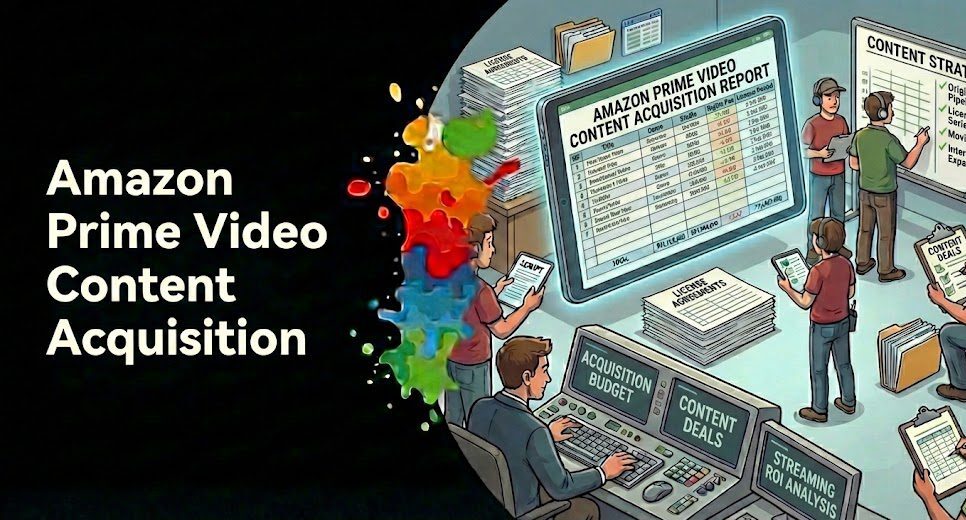
Amazon Prime Video spent approximately $7 billion on content in 2025. Not content marketing. Content. And yet most independent producers, international studios, and rights holders approach Amazon’s acquisition pipeline the same way they approached it in 2019—with a blind pitch deck and a prayer. That’s not a strategy. It’s a lottery ticket.
Here’s what’s actually changed. The $8.5 billion MGM acquisition wasn’t just a library deal. It fundamentally restructured how Amazon thinks about Prime Video content acquisition—layering IP-driven franchise strategy on top of an already complex mix of originals, licensed content, live sports, and international co-productions. Understanding that layered architecture is the difference between positioning your content where Amazon’s acquisition teams are actually looking and burning 6 months on a pitch that never had a chance.
This guide unpacks Amazon Prime Video’s 2026 content acquisition strategy in full: the pillars, the priorities, the gaps you can exploit, and what the platform’s deal-making behavior tells you about where its content budget is actually going.
Ask VIQI: Is Amazon Prime Video Actively Acquiring Your Content Type Right Now?
VIQI is Vitrina’s AI assistant—trained on 1.6 million titles, 300,000+ companies, and 5 million entertainment professionals. Ask it which streamers are actively acquiring your genre, format, or territory—and what they’ve recently commissioned.
✓ Included with 200 free credits | ✓ No credit card needed
Understanding Amazon’s 3-Pillar Content Acquisition Architecture
Most people treat Amazon Prime Video as a single buyer. It’s not. Amazon’s content acquisition engine in 2026 runs on three distinct pillars—each with its own mandate, budget logic, and acquisition team. Conflating them is why most pitches land in the wrong inbox.
Pillar 1: Amazon Studios Originals
Amazon Studios is the originals machine—commissioning scripted drama, comedy, film, documentary, and animation for global audiences. This is where the flagship tentpoles live: The Rings of Power, Reacher, The Boys, Citadel. These are high-cost, high-visibility bets designed to drive Prime membership—not just streaming hours. The economics here are fundamentally different from Netflix or HBO. Amazon’s content acquisition ROI calculation includes incremental Prime subscription value, advertising revenue from Prime Video Ads, and cross-ecosystem shopping data. That means Amazon can justify content spend that doesn’t make pure streaming economics sense—because the content is doing work across the entire Amazon flywheel.
For producers approaching Amazon Studios, the key thing to understand is that scale matters more than niche. Amazon’s originals mandate still skews toward titles with mass-market potential—the kind of show that makes a Prime subscriber feel their membership fee was justified. Niche prestige works at A24 or MUBI. At Amazon’s budget scale, every greenlight has to move the needle on a platform with 200 million+ Prime subscribers globally.

Your AI Assistant, Agent, and Analyst for the Business of Entertainment
VIQI AI helps you plan content acquisitions, raise production financing, and find and connect with the right partners worldwide.
- List the top commissioners at the BBC
- List the post-production and VFX decision-makers at Netflix
- List the development leaders at Sony Pictures
- List the scripted programming heads at HBO
- Find active co-producers and financiers for scripted projects
- Find equity and gap financing companies in North America
- Find top film financiers in Europe
- Find production houses that can co-produce or finance unscripted series
- Who is backing animation projects in Europe right now
- Who is Netflix’s top production partners for Sports Docs
- Who is Commissioning factual content in the NORDICS
- Who is acquiring unscripted formats for the North American market
- Show me recent drama projects available for pre-buy
- Show me Japanese Anime Distributors
- Show me true-crime buyers from Asia
- Show me documentary pre-buyers
- I am looking for production partners for a YA drama set in Brazil
- I am looking for producers with proven track record in mid-budget features
- I am looking for Turkish distributors with successful international sales
- I am looking for OTT platforms actively acquiring finished series for the LATAM region
- I am seeking localization companies offer subtitling services in multiple Asian languages
- I am seeking partners in animation production for children's content
- I am seeking USA based post-production companies with sound facilities
- I am seeking VFX partners to composite background images and AI generated content
Pillar 2: MGM Studios — The IP and Library Engine
The MGM acquisition gave Amazon something Netflix still doesn’t have: a deep, franchise-ready IP library. And the full strategic value of that deal is only now materializing. MGM’s library includes over 4,000 film titles and 17,000 TV episodes—covering franchises like James Bond, Rocky/Creed, RoboCop, Stargate, Legally Blonde, and the entire United Artists catalog. That IP isn’t just sitting there. It’s being actively developed into sequels, prequels, format adaptations, and live-action spin-offs.
But MGM isn’t just a catalog play. MGM Alternative—the unscripted division led by Barry Poznick—controls some of television’s most durable formats. Shark Tank. Survivor. The Voice (US format rights). Are You Smarter Than a Fifth Grader? These are evergreen monetization assets running a slate of 35+ shows worldwide. For content sellers with unscripted formats or IP with remake/adaptation potential, MGM Alternative is frequently the right first conversation—not Amazon Studios. The acquisition teams operate with different mandates, and knowing which door to knock on before you knock saves weeks.
Barry Poznick, President of MGM Alternative, shares a frank inside view of how MGM Alternative is reshaping unscripted television economics for the streaming era—and what’s actually driving Amazon’s format acquisition strategy:
Pillar 3: Third-Party Licensing and Channel Aggregation
Here’s the acquisition channel most independent rights holders actually have access to—but underestimate. Amazon Prime Video’s third-party licensing and Channels program is a substantial business in its own right. Amazon licenses content from independent distributors, studios, and rights holders to fill out its catalog across genres, territories, and languages. And through Prime Video Channels—where subscribers can add HBO Max, Paramount+, Starz, and dozens of others directly through Amazon—the platform is also the world’s largest aggregator of streaming subscriptions, generating licensing and distribution revenue from every channel it houses.
For independent content sellers, this third pillar is the most accessible entry point. But it requires understanding Amazon’s data-driven acquisition logic. Amazon doesn’t license content on gut instinct—it licenses content its behavioral data suggests will generate watch hours, reduce churn, or attract new demographics. Positioning your title with evidence of audience demand isn’t just helpful; for third-party licensing conversations, it’s essentially required.
Amazon Prime Video’s Genre and Format Acquisition Priorities in 2026
Amazon’s content acquisition behavior in 2024–2025 tells a clearer story than their public-facing announcements. Here’s where the budget is actually going—and where the gaps are.
Premium Scripted Drama — High-Budget, IP-Adjacent
Amazon’s most visible scripted bets remain in the $150M+ per-season range for its biggest titles. But the pattern that’s emerged is clear: Amazon de-risks premium drama investment by anchoring it to known IP, franchise potential, or literary adaptation. The Rings of Power (Tolkien), Reacher (Lee Child novels), Jack Ryan (Tom Clancy). Even Citadel—an original concept—was built around the Russo Brothers’ global franchise ambitions rather than a single-story premise.
The lesson for producers: A high-concept original is a harder sell to Amazon’s scripted team in 2026 than an adaptation of proven IP—even IP with a smaller built-in audience. If you’re pitching scripted drama to Amazon, your strongest position is a clean, acquirable IP with demonstrated audience reach in at least one major market. That’s the capital stack logic applied to content: de-risk the greenlight decision before you walk in the room.
Unscripted and Reality Formats — High ROI, Low Relative Risk
This is where MGM Alternative’s integration into the Amazon ecosystem matters most for independent format sellers. Amazon—through MGM Alternative—is one of the most active buyers of proven unscripted formats globally. And it’s not just about new acquisitions. MGM Alternative’s 35+ show slate demonstrates Amazon’s appetite for long-running format IP that delivers consistent audience engagement across multiple seasons without the per-episode production cost of scripted drama.
But here’s the thing: format acquisition at Amazon isn’t just about finding the next Shark Tank. Amazon’s unscripted team also actively acquires internationally proven formats for US adaptation—and vice versa, selling US format rights internationally. If you’re sitting on a reality or competition format with a verified audience in one territory, the MGM Alternative acquisition team is a live conversation right now.
Live Sports — The Strategic Anchor
Amazon’s live sports strategy is the most significant structural shift in its content acquisition approach since the MGM deal. The multi-year NFL Thursday Night Football exclusive was the opening move. The NBA deal—part of the landmark 11-year, $76 billion NBA broadcast rights package signed in 2024—expanded Amazon’s live sports footprint substantially. By 2026, live sports represents Amazon’s most powerful subscriber acquisition and retention tool—content that can’t be time-shifted, can’t be pirated effectively, and drives real-time engagement that all other content types can’t match.
For rights holders with sports content, the strategic implication is clear: Amazon isn’t just a destination for film and TV. It’s become a genuine competitor to traditional broadcast networks for premium sports rights. And according to Variety, Amazon’s live event strategy is expanding beyond sports into live music and cultural events—signaling a broader shift toward real-time, communal viewing experiences that Prime Video can own exclusively.
International Content — The Underallocated Budget Line
Don’t mistake Amazon’s originals emphasis on English-language content as the whole picture. Prime Video has become one of the most aggressive buyers of international content in the streaming market—with active commissioning in India, Spain, Germany, Brazil, Japan, and South Korea. The Amazon-MX Player merger in India gave Prime Video a massive free-streaming footprint in the world’s largest digital audience market—one that’s producing significant local content acquisitions to feed both the SVOD and AVOD tiers.
In Germany, Spain, and Italy, Amazon Originals teams operate semi-independently from the US studio. The same is true in Japan, where Amazon has invested heavily in local anime and drama production. For international producers, this decentralized acquisition model means your pitch needs to land with the right regional team—not the US acquisition department—for local-language content. As we detailed in our guide to Amazon Prime Video co-production strategy, the regional originals teams have genuine greenlight authority and separate development budgets.
Track Amazon Prime Video’s Active Acquisition Mandates Before They’re Public
Trusted by Netflix, Warner Bros, and Paramount. Join 300,000+ companies using Vitrina to track greenlit projects, commissioning activity, and buyer mandates across 195 countries—before they hit the trades.
✓ 200 free credits | ✓ No credit card required | ✓ Full platform access
How Amazon’s Ad-Supported Tier Is Restructuring Content Acquisition Economics
The launch of Prime Video Ads in early 2024—making the ad-supported tier the default for Prime subscribers—wasn’t just a monetization decision. It fundamentally changed the economic logic behind Amazon’s content acquisition.
Here’s the insider truth: in an ad-supported model, content value isn’t calculated purely by subscriber retention. It’s calculated by watch hours—because watch hours are what generate advertising impressions. That changes the acquisition calculus in ways most content sellers haven’t absorbed yet. Amazon now has a financial incentive to acquire high-volume, high-engagement content—not just prestige hits that drive a single week of subscriber sign-ups and then sit unwatched. Reality TV, procedural drama, game shows, documentary series—content that people watch regularly and re-watch—carries more EBITDA value in an ad-supported model than a culturally acclaimed limited series that generates press coverage but gets watched once.
What this means practically: if you’re selling content to Amazon in 2026 and you’re only talking about critics’ ratings and festival buzz, you’re speaking the wrong language. Amazon’s acquisition teams want to see engagement metrics—watch completion rates, session frequency, return viewing data. That’s the ROI framing they’re using internally, and it’s the framing that moves budget decisions.
The Prime Video Ads Windfall and Its Content Implications
Amazon’s advertising business generated over $50 billion in revenue in 2024—and Prime Video Ads is one of the fastest-growing segments within it. Unlike Netflix’s ad tier (which launched later and with a smaller subscriber base), Amazon’s ad-supported streaming sits inside the Prime ecosystem that already has 200 million+ members. That’s a massive advertising inventory base—and it’s incentivizing Amazon to acquire or commission content that generates high-frequency viewing rather than single-watch events.
The practical output of this model shift: Amazon is buying more series—particularly procedural and returnable formats—and fewer one-off feature films relative to 2021–2022. The theatrical window experiment has largely been resolved: Amazon still acquires films for awards-season play and cultural credibility, but the bulk of its content investment has shifted decisively toward serialized content that generates recurring engagement.
How to Position Your Content for Amazon Prime Video Acquisition in 2026
Let’s be direct. Amazon’s acquisition process is not designed to make it easy for independent sellers. It’s designed to manage volume—thousands of unsolicited submissions—and filter decisively for what fits their data-driven mandate. The producers who close deals with Amazon aren’t necessarily those with the best content. They’re the ones who arrive in the right room, with the right positioning, at the right time.
Route 1: Through Amazon Studios Development
Amazon Studios develops scripted and unscripted originals through established relationships with showrunners, writers’ rooms, and production companies. The unsolicited pitch rarely gets through. Your path in is via a producer or showrunner with an existing first-look or overall deal at Amazon—or through an agent or manager with active Amazon relationships. The list of production companies with production deals at Amazon Studios is published, current, and navigable with the right market intelligence. That’s your roadmap, not Amazon’s public submissions page.
Route 2: Through MGM Alternative for Unscripted Formats
MGM Alternative maintains active acquisition relationships with independent format developers and production companies globally. Barry Poznick’s team actively scouts international formats for US adaptation—which means there’s a live brief and a live budget. But it also means the competition is real. You need to arrive with audience proof, not concept. Ratings data from a local run, social engagement metrics, or a competitive territory sale in a major market all constitute proof. A deck alone isn’t enough.
Route 3: International Content via Regional Amazon Originals Teams
If you’re a non-English language producer, your first target should be Amazon’s regional originals teams—not the US studio. Amazon Originals operates semi-independent commissioning units in India, Japan, Germany, Spain, Italy, Brazil, Australia, and Mexico. Each has its own greenlight authority and development mandate. Understanding what each regional team has recently commissioned, what’s in their development pipeline, and what they’re publicly seeking is the foundation of a coherent pitch strategy—not a generic “international content” submission through Amazon’s public portal.
Route 4: Licensing Through Established Distributors
Amazon licenses third-party content through its relationships with established distributors and aggregators. If you’re an independent rights holder without a direct production relationship with Amazon, your fastest path to placement is through a distributor with an active Amazon licensing relationship—who can package your title within a broader deal rather than presenting it as a standalone cold call. Our guide to streaming distribution models and licensing strategies for 2026 covers how to structure this approach across multiple streamers simultaneously.
Route 5: Weapons-grade Data Before You Pitch
Regardless of which route you take, what you need before any Amazon conversation is live intelligence: which acquisition executives are currently active, what their current mandate looks like, which titles in your genre or territory Amazon has recently acquired or greenlit, and where the gaps in their current slate are. That’s not information you can reverse-engineer from press releases. It requires real-time tracking of deal activity, project greenlight announcements, and commissioning patterns. Producers who Weaponize that intelligence—knowing what Amazon’s acquisition teams need before they walk in the room—close deals. Everyone else is guessing.
Skip the Cold Pitch. Get a Warm Introduction to Amazon’s Acquisition Teams.
Vitrina Concierge is your Virtual Agent. We identify the right Amazon acquisition executive for your content type—then make the warm introduction so you’re not another cold submission in a queue.
- LA producer → Netflix UK, Fifth Season, Fox Entertainment (48 hours)
- Korean animation studio → Netflix Adult Animation (week one)
What Amazon Prime Video Has Stepped Back From—And Why It Matters
Understanding what Amazon’s acquisition strategy isn’t doing in 2026 is as strategically useful as understanding what it is. And the patterns are clear.
Prestige festival films at scale. Amazon’s theatrical and awards-season film strategy—which at its peak brought in films like Manchester by the Sea, Sound of Metal, and The Big Sick—has contracted significantly. According to Deadline, Amazon’s film acquisition budget at major festivals has declined as the platform has shifted resources toward serialized content that better serves its ad-tier watch-hour economics. The prestige acquisition market is now more competitive for fewer buyers—a dynamic that has compressed MGs for independent features at the top of the festival circuit.
Broad content volume plays. Amazon isn’t trying to be a Netflix-style content volume platform anymore. It’s not trying to win the “most titles” game. The content strategy is more deliberately curated—fewer total titles, higher visibility per title, more franchise potential per greenlight. That means the long tail of licensed content Amazon previously acquired to bulk up its catalog is being managed more selectively, and the MGs for catalog licensing have tightened accordingly.
Adult animation at scale. Despite early investments in animated originals, Amazon has scaled back its animated content acquisition significantly since 2022. The exception is children’s content—where Amazon remains an active buyer, particularly for preschool and family animation with international co-production economics already in place.
The Fragmentation Paradox: Why Most Sellers Miss Amazon’s Real Acquisition Window
Here’s the thing most independent producers don’t fully reckon with: Amazon’s acquisition pipeline isn’t a single entity. It’s a network of teams—Amazon Studios, MGM Alternative, Amazon Originals (India, Japan, Germany, Spain, Italy, Brazil), Amazon Freevee’s successor teams, the Channels acquisition team—each with their own mandates, budgets, and relationships. And the Fragmentation Paradox bites hard here. Most sellers know only the public-facing surface of Amazon’s content operation. They approach the wrong team, with the wrong positioning, 6 months after the acquisition window for their type of content has already been filled.
The producers who consistently close deals with Amazon do it by tracking commissioning patterns in real time—not by reacting to announcements after they’ve hit the trades. They know that Amazon’s German originals team is actively seeking crime drama before Amazon announces a German crime drama pick-up. They know that MGM Alternative is circling a specific format category because they’ve tracked what Barry Poznick’s team recently passed on, not just what it greenlit. That’s the intelligence layer that closes the gap between pitching and being pitched to. And it’s exactly what live market intelligence tools exist to provide—because this is fundamentally a data problem, not a relationship problem.
Key Takeaways: Amazon Prime Video Content Acquisition in 2026
Amazon is simultaneously the most complex and most consequential buyer in the streaming market right now. Here’s what you need to carry forward:
- Amazon’s content acquisition runs across three distinct pillars—Amazon Studios originals, MGM IP and library, and third-party licensing—each with separate teams, budgets, and mandates. Pitching the wrong pillar wastes both parties’ time.
- The $8.5B MGM acquisition made unscripted format IP one of Amazon’s most active and accessible acquisition categories. If you have a proven format with international audience data, MGM Alternative is a live conversation—not a cold pitch.
- The Prime Video Ads tier has shifted content value calculation from subscriber-acquisition to watch-hour generation—which means serialized, returnable, high-engagement content outperforms prestige one-off content in Amazon’s internal ROI model.
- Amazon’s international originals teams—in India, Japan, Germany, Spain, Brazil, and others—operate with genuine greenlight authority and separate budgets. Non-English language producers should target these teams directly, not the US studio.
- Live sports rights are now a strategic anchor for Amazon’s subscriber acquisition and retention. Prime Video is a genuine broadcast network competitor for premium sports rights—not just a sports documentary destination.
- The producers who close deals with Amazon arrive with watch-hour framing, engagement metrics, and live intelligence on what the acquisition team’s current mandate actually is—not just what it was 18 months ago.
Frequently Asked Questions: Amazon Prime Video Content Acquisition
How much does Amazon Prime Video spend on content acquisition annually?
Amazon Prime Video’s total content spend—covering originals production, third-party licensing, sports rights, and library acquisitions—was approximately $7 billion in 2025. This figure includes Amazon Studios originals, MGM content, live sports rights (including NFL Thursday Night Football and NBA), and international originals across its regional commissioning units. Amazon’s total content investment is lower than Netflix’s annual spend (which exceeded $17 billion in 2025), but it’s amplified by the MGM catalog and the broader Prime ecosystem economics that justify content investment beyond pure streaming ROI.
What content does Amazon Prime Video want to acquire in 2026?
In 2026, Amazon Prime Video’s acquisition priorities include: IP-driven scripted drama with franchise potential; proven unscripted formats via MGM Alternative (particularly reality competition and factual entertainment); local-language originals from key international markets (India, Japan, Germany, Spain, Brazil, South Korea); live sports rights; serialized content with strong watch-hour potential for its ad-supported tier; and children’s and family animation with international co-production economics. Amazon has largely stepped back from acquiring prestige festival films at scale and has tightened MGs on catalog licensing content.
How do I submit content to Amazon Prime Video?
Amazon Prime Video does not accept unsolicited content submissions from unrepresented creators. Submissions are accepted through licensed literary agents, established production companies, or talent managers with existing relationships at Amazon Studios or MGM Alternative. For third-party licensing, submissions typically go through content aggregators or distributors with active Amazon licensing relationships. For international originals, producers in key territories can approach Amazon’s regional originals teams directly at major content markets (MIPCOM, MipTV, Series Mania) or through established representation in their territory.
What did Amazon’s MGM acquisition mean for content strategy?
Amazon’s $8.5 billion MGM acquisition in 2022 fundamentally restructured its content strategy across three dimensions: it provided a deep franchise IP library (James Bond, Rocky, Legally Blonde, 4,000+ film titles, 17,000+ TV episodes) for adaptation and development; it established MGM Alternative as the unscripted/reality format powerhouse within Amazon’s content ecosystem; and it created significant cost efficiencies by internalizing content that Amazon was previously licensing from third parties. By 2026, the MGM integration has matured—and the franchise development pipeline (sequels, prequels, spin-offs from MGM IP) has become a consistent source of high-visibility Prime Video originals.
Does Amazon Prime Video acquire international content?
Yes—and increasingly so. Amazon operates regional originals commissioning units in India, Japan, Germany, Spain, Italy, Brazil, Australia, and Mexico, each with their own budgets and greenlight authority. Amazon India, in particular, has become one of the most active commissioners of local-language drama and comedy in the APAC region, amplified by the Amazon-MX Player merger which expanded its free-streaming reach across India. Amazon Japan is a significant commissioner of anime and live-action drama. These regional teams operate semi-independently and are the correct first point of contact for non-English language content producers.
How does Amazon’s ad-supported tier affect content acquisition?
Amazon’s ad-supported model—which became the default for Prime Video subscribers in early 2024—shifts content ROI calculation from subscriber acquisition toward watch-hour generation. Content that generates high-frequency viewing (reality formats, procedural drama, game shows, factual series) now carries stronger EBITDA value in Amazon’s internal model than prestige limited series that are watched once and rarely revisited. This has directly influenced Amazon’s acquisition appetite: more returnable series, fewer one-off theatrical films, greater emphasis on serialized formats with proven engagement metrics.
What is Amazon Prime Video’s live sports strategy?
Live sports has become a strategic anchor for Amazon’s subscriber acquisition and advertising revenue. Amazon holds exclusive streaming rights to NFL Thursday Night Football and is a participating broadcaster in the NBA’s 11-year, $76 billion rights deal through 2036. Beyond US sports, Amazon has acquired rights to Premier League football in the UK, Roland-Garros (French Open) in France, and various other regional sports properties. The live sports strategy serves multiple functions: driving real-time Prime member engagement, generating high-CPM advertising inventory, and creating appointment viewing that no competitor can replicate.
How does Amazon Prime Video compare to Netflix in content acquisition?
The key structural difference is scale and model. Netflix spent approximately $17 billion on content in 2025 and operates a pure content-subscription model—every acquisition decision is evaluated purely on subscriber acquisition/retention ROI. Amazon spends approximately $7 billion but operates content as part of a broader ecosystem flywheel: Prime membership, advertising, e-commerce data. This means Amazon can justify content investments that don’t make pure streaming economics sense, but it also means Amazon’s acquisition appetite is more selectively focused than Netflix’s volume-driven strategy. Netflix licenses more content; Amazon acquires more strategically.
Track Amazon Prime Video’s Acquisition Activity Before It Hits the Trades
Netflix, Warner Bros, and Paramount use Vitrina. Join 300,000+ entertainment companies tracking 1.6 million+ projects, buyer mandates, and deal activity across 195 countries.
✓ 200 free credits | ✓ No credit card required | ✓ Cancel anytime