IHUB
IHUB
 Private Briefings (Webinars)


 LeaderSpeak Podcast
  Global Entertainment Digest (Newsletter)
  Premium Lists
 Membership Benefits
 About Vitrina
 Our Story
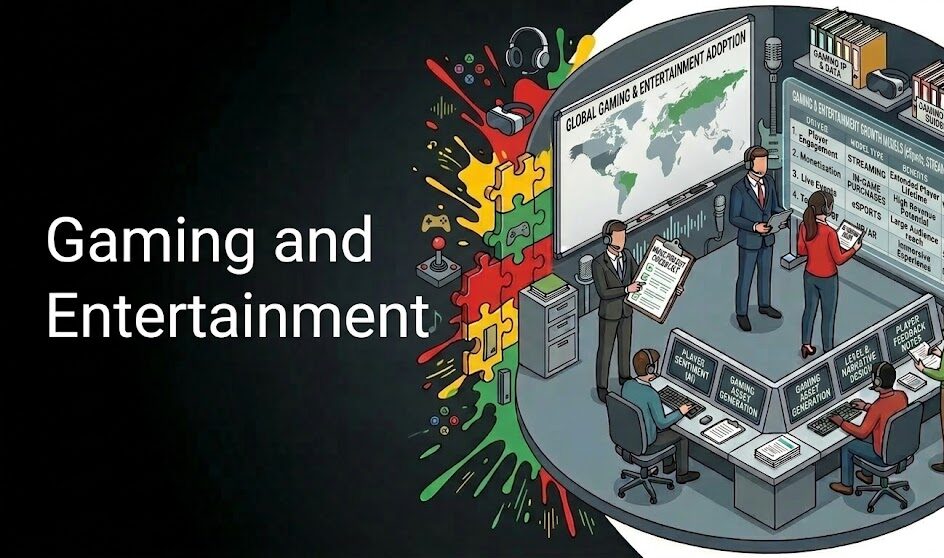
Gaming trends are converging with film and TV entertainment in ways that are structurally rewriting how stories get told, how audiences engage with IP, and where the money flows in the creative economy. This isn’t a metaphor.
Quick Answer
Gaming IP adaptations for film and TV reached a record 47 active projects in 2025 — up from 12 in 2020 — driven by The Last of Us, Fallout, and Arcane. Studios now treat gaming IP as pre-validated audience demand. In 2026, the convergence extends beyond adaptation: live in-game events, transmedia storytelling, and studio–publisher M&A are structurally integrating the two industries.
The Fallout TV series drove a 6,000% surge in active players on the original game within days of its Amazon Prime Video premiere. The Last of Us did the same for its PlayStation franchise. And Fortnite’s in-game concerts—Travis Scott’s Astronomical event drew 12.3 million concurrent players—generated cultural moments that no traditional entertainment format could replicate at that scale or engagement depth.
The convergence is real and it’s accelerating. Gaming companies are financing original film and TV content. Studios are building gaming divisions to extend their IP into interactive formats. Streaming platforms are acquiring gaming studios. And the audience—particularly under-35—doesn’t experience a meaningful difference between watching a cinematic game and watching a prestige TV series. The storytelling quality gap that separated those media has effectively closed.
Here’s what’s actually driving the convergence, what it means for IP strategy and content investment, and who’s positioned to win as the lines continue to dissolve.
Table of Contents
- The Game-to-Screen Adaptation Boom and What’s Driving It
- The IP Flywheel: Why Cross-Platform Strategy Is Now Table Stakes
- Interactive Storytelling Is Closing the Gap Between Games and Television
- In-Game Live Events Are Redefining What a Concert or Show Can Be
- The M&A Wave: Studios, Streamers, and Gaming Companies Are All Buying Each Other
- Esports as Live Entertainment: Still Searching for Its Sustainable Model
- AI and Procedural Generation: Where Gaming Technology Is Reshaping Film and TV Production
- Sovereign Hubs Are Investing in Gaming Infrastructure as Cultural Strategy
- FAQ
- Conclusion
Ask VIQI: How Does Gaming Convergence Affect Your IP or Distribution Strategy?
VIQI is Vitrina’s AI assistant—trained on 1.6 million titles, 300,000+ companies, and 5 million entertainment professionals. Ask it how gaming IP is being valued in film adaptation deals, which studios are most actively acquiring gaming content, or how cross-platform strategies are being structured in your region.
✓ Included with 200 free credits | ✓ No credit card needed
The Game-to-Screen Adaptation Boom and What’s Driving It
Hollywood has always strip-mined successful IP. What’s different in 2026 is the source material. Video games are no longer a second-tier adaptation category—they’re the primary IP battlefield. And the track record is finally good enough that studios and streamers are competing aggressively for gaming rights rather than treating them as development experiments.
The shift started clearly with The Last of Us (HBO, 2023)—which became one of the platform’s most-watched series debuts and demonstrated that game narrative could translate directly to prestige television without sacrificing the emotional specificity that defines both. Arcane (Netflix/Riot Games) had already proven the animated format in 2021. Fallout (Amazon Prime Video, 2024) extended the proof to action-adventure sandbox games, and the viewership numbers were substantial enough that Amazon confirmed a second season within weeks of premiere. The Witcher series, the Sonic film franchise, and the upcoming Mass Effect and Ghost of Tsushima productions indicate the pipeline is now industrial-scale, not experimental.
What’s driving the boom isn’t just IP hunger—it’s three structural factors that have converged simultaneously:
Pre-Built Audience Infrastructure
A game franchise with 10–50 million active players arrives in a streaming adaptation conversation with something film studios used to spend years and hundreds of millions of marketing dollars to build: a passionate, globally distributed audience that already knows and cares about the characters, world, and lore. That’s not a guarantee of viewership—plenty of game adaptations have failed to convert their install base into passive viewers. But it’s a dramatically lower-risk starting point for subscriber acquisition and press coverage than an original IP with zero existing recognition.
Game Narrative Quality Has Caught Film
The storytelling quality of major game franchises has legitimately converged with prestige television over the past decade. Games like The Last of Us, God of War, Red Dead Redemption 2, Disco Elysium, and Baldur’s Gate 3 deliver writing, character development, and emotional complexity that match or exceed most drama series. This isn’t a subjective claim—the screenwriters and directors now working on game adaptations regularly cite the source material as genuinely cinematic. That quality floor makes the adaptation job easier and raises the potential ceiling of what the translated product can achieve.
The Halo Effect on Game Revenue
The Fallout TV series driving a 6,000% increase in active players on the original game within its first week is the most dramatic proof of what studios and gaming publishers are now structuring deals around: successful adaptation generates direct, measurable commercial return for the original game IP. That creates genuine alignment between gaming publishers and streaming platforms that didn’t exist in the same way when games were niche and TV was mass market. According to Variety, Bethesda reported concurrent player records on Fallout 4 in the weeks following the Amazon series premiere—a commercial validation of the adaptation investment that gaming publishers are now explicitly building into their content licensing negotiations.
The business model implications for studios and gaming companies are significant. The traditional game adaptation deal—a studio licenses IP from a gaming publisher, produces content, retains distribution rights—is being replaced by more complex joint venture and co-production structures where gaming publishers participate in the upside of both the entertainment revenue and the downstream game commerce boost. Understanding the IP adaptation landscape in film and TV production is now inseparable from understanding the gaming IP market.

Your AI Assistant, Agent, and Analyst for the Business of Entertainment
VIQI AI helps you plan content acquisitions, raise production financing, and find and connect with the right partners worldwide.
- List the top commissioners at the BBC
- List the post-production and VFX decision-makers at Netflix
- List the development leaders at Sony Pictures
- List the scripted programming heads at HBO
- Find active co-producers and financiers for scripted projects
- Find equity and gap financing companies in North America
- Find top film financiers in Europe
- Find production houses that can co-produce or finance unscripted series
- Who is backing animation projects in Europe right now
- Who is Netflix’s top production partners for Sports Docs
- Who is Commissioning factual content in the NORDICS
- Who is acquiring unscripted formats for the North American market
- Show me recent drama projects available for pre-buy
- Show me Japanese Anime Distributors
- Show me true-crime buyers from Asia
- Show me documentary pre-buyers
- I am looking for production partners for a YA drama set in Brazil
- I am looking for producers with proven track record in mid-budget features
- I am looking for Turkish distributors with successful international sales
- I am looking for OTT platforms actively acquiring finished series for the LATAM region
- I am seeking localization companies offer subtitling services in multiple Asian languages
- I am seeking partners in animation production for children's content
- I am seeking USA based post-production companies with sound facilities
- I am seeking VFX partners to composite background images and AI generated content
The IP Flywheel: Why Cross-Platform Strategy Is Now Table Stakes
Behind the game-to-screen adaptation trend is a more fundamental strategic shift: entertainment companies have recognized that IP value is maximized not by protecting it within a single medium but by spinning it across multiple formats simultaneously to compound audience engagement and revenue generation.
Sony is the clearest proof of concept. Sony Pictures and PlayStation Studios are now structuring their IP development deliberately as multi-format flywheels: a game generates an audience and critical acclaim, which supports a film or TV adaptation, which drives game sales, which funds new game development, which generates new adaptation opportunities. The Uncharted film, the Gran Turismo film, the Ghost of Tsushima film in development, and the Horizon series in development at Netflix all represent deliberate execution of this flywheel logic. Sony’s strategic advantage: it controls both the studio and the gaming platform, meaning it captures value at every point in the cycle.
Nintendo demonstrated what the flywheel can look like at its most successful: The Super Mario Bros. Movie (2023) grossed over $1.3 billion globally—making it one of the highest-grossing animated films of all time—while simultaneously reinvigorating the Mario merchandise category, Nintendo Switch hardware sales, and franchise cultural relevance with audiences who weren’t born during Mario’s peak popularity. Nintendo’s IP flywheel is particularly instructive because it operates across gaming, film, theme parks (Universal Studios Nintendo World), and merchandise with deliberate brand discipline that keeps quality high enough to maintain premium IP value.
Microsoft, following its $68.7 billion acquisition of Activision Blizzard in 2023, now controls one of the most valuable gaming IP portfolios on the planet—Call of Duty, World of Warcraft, Diablo, Overwatch, Candy Crush—alongside Xbox’s own franchises including Halo, Forza, and Starfield. The entertainment strategy implications of that IP portfolio are still being worked out. But the deal explicitly positions Microsoft as a content company competing across gaming, film, TV, and potentially direct-to-consumer entertainment in ways that weren’t on the table before the acquisition.
For independent producers and content companies watching this from outside the platform ownership tier: the IP flywheel creates both competition and opportunity. Competition because the major players are increasingly vertical—Disney, Sony, Microsoft, and Netflix all have gaming-to-screen strategies that keep their IP in-house. Opportunity because the demand for gaming IP that the major platforms haven’t already optioned has never been higher—and gaming is a global industry with significant IP development happening outside the traditional US-centric markets that dominate Hollywood’s acquisition vision.
Joachim Laqueur and Thomas Thurston (General Partners, 432 Legacy) on the data-driven approach to identifying and investing in disruptive IP strategies across media, entertainment, and gaming value chains—including how transmedia and cross-platform content is reshaping investment frameworks:
Interactive Storytelling Is Closing the Gap Between Games and Television
The question of whether games and TV are converging is partly a question of where storytelling lives. And in 2026, the most ambitious storytelling is happening in both formats—with the line between them blurring at the narrative level in ways that matter commercially.
Narrative games—those that prioritize story, character, and emotional progression over traditional gameplay mechanics—have become a distinct and commercially significant category. Disco Elysium, What Remains of Edith Finch, Pentiment, Norco, and Citizen Sleeper are games that function, in practice, as interactive novels or films. Their audiences consume them in the same posture as prestige TV: evenings on the sofa, sustained attention, emotional investment in character arcs. The time-per-session and total completion rates mirror long-form TV viewing more than traditional gaming patterns.
At the other end of the production scale, Sony’s Detroit: Become Human, Heavy Rain, and Quantic Dream‘s catalog are explicitly cinematic games that allocate the majority of their runtime to cutscenes, dialogue choices, and narrative branching rather than mechanical gameplay. These productions cost tens of millions of dollars, involve professional Hollywood actors with motion capture performance, and are reviewed by critics alongside prestige TV series.
Netflix has been the most aggressive traditional entertainment company in exploring interactive format. Bandersnatch (2018) demonstrated consumer appetite and technical feasibility for interactive film. More recent experiments—interactive children’s content, choose-your-own-adventure documentary formats—indicate ongoing investment in the interactive layer of the viewing experience. The platform question isn’t if interactive entertainment scales but what format and narrative genre generates sufficient completion rates and subscriber retention to justify the production premium that interactive branching requires.
The commercial opportunity this creates for the entertainment supply chain: writers, directors, and production companies who can work fluently across interactive and linear narrative formats are developing a cross-format skill set that commands premium rates and access to deals that are structurally unavailable to format specialists. The content acquisition strategies driving platform investment increasingly include interactive format development alongside traditional scripted and unscripted commissioning—and the companies building capability in both simultaneously are generating the most interesting deal opportunities.
Track Gaming IP Deals, Studio Acquisitions, and Cross-Platform Content Partnerships Globally
Trusted by Netflix, Warner Bros, and Paramount. Join 300,000+ companies using Vitrina to monitor entertainment supply chain deals—including gaming IP licensing, studio acquisitions, and cross-platform co-production structures across 100+ markets.
✓ 200 free credits | ✓ No credit card required | ✓ Full platform access
In-Game Live Events Are Redefining What a Concert or Show Can Be
Travis Scott’s Astronomical event in Fortnite in April 2020 attracted 12.3 million concurrent players and over 27 million unique participants across its five showings. Ariana Grande’s Rift Tour in 2021 drew 78 million players across multiple events. These weren’t just novelties—they were genuine live entertainment experiences that generated merchandise revenue, social media engagement, and music streaming spikes comparable to major real-world festivals, without any of the logistical ceiling that physical venues impose.
In-game live events have evolved significantly since those early Fortnite experiments. What’s happening in 2026:
Artist-Branded Game Integrations
The in-game concert format has matured into a broader category of artist-branded game integration—where musicians, athletes, and entertainment brands appear within game environments as premium content events, limited-time cosmetic items, or narrative collaborations. These deals are now a standard line item in major artist touring and brand strategy, sitting alongside traditional endorsements, sync licensing, and merchandise as revenue diversification. The deals typically involve combination of upfront fee, virtual merchandise revenue share, and cross-promotional exposure to the game’s audience—which, in the case of titles like Fortnite, Roblox, or Minecraft, measures in the hundreds of millions of registered users.
Film and TV Premiere Events Inside Games
Studios are beginning to use gaming platforms as premiere and marketing vehicles for traditional entertainment content. Trailer debuts inside game environments, exclusive preview screenings as limited-time in-game events, and film-themed game content drops timed to theatrical releases are all being tested as marketing channels that reach gaming-first audiences more effectively than traditional advertising. The audience-matching logic is obvious: a film like a superhero adaptation has enormous overlap with gaming demographics—reaching them inside their own environment at lower customer acquisition cost than standard digital advertising.
Roblox as an Entertainment Platform
Roblox deserves specific attention because it represents a different model than Fortnite’s curated live events. With over 80 million daily active users—the majority under 18—Roblox functions as a user-generated entertainment platform where IP holders create branded experiences that persist rather than existing as one-time events. Warner Bros., Netflix, and dozens of major entertainment companies have built Roblox experiences around their film and TV IP. For reaching Generation Alpha audiences who are native to gaming environments, Roblox has become as important an entertainment marketing channel as Instagram or TikTok for older demographics. The implication for studios and IP holders: the audience that will be the primary film and TV consumer in 10–15 years is currently spending its leisure time in gaming environments, not watching traditional television. Understanding that user behavior now is a competitive intelligence advantage.
The M&A Wave: Studios, Streamers, and Gaming Companies Are All Buying Each Other
The convergence thesis is being validated in the most direct way possible: capital allocation. The mergers and acquisitions activity at the intersection of gaming and entertainment in the past three years represents one of the largest structural consolidations in media history—and it’s not finished.
The Microsoft/Activision Blizzard deal at $68.7 billion remains the largest gaming acquisition in history, but it’s part of a broader pattern:
- Netflix acquired Night School Studio, Boss Fight Entertainment, and several other gaming studios to support its gaming subscription offering—an acknowledgment that gaming is now a required feature of competitive streaming platforms, not an optional add-on.
- Amazon has invested heavily in gaming through Amazon Games (producing New World and Lost Ark publishing), Prime Gaming, and Twitch—positioning its entertainment and gaming infrastructure as an integrated ecosystem that competes with both Netflix and Microsoft Game Pass simultaneously.
- Apple has expanded Apple Arcade as a premium gaming subscription included with Apple One, accelerating its position as a gaming company that also operates in entertainment, rather than an entertainment company that offers gaming as a feature.
- Sony continues acquiring gaming studios globally while its PlayStation Studios increasingly function as an IP development arm for Sony Pictures adaptations—the most integrated example of gaming and entertainment operating as a unified content strategy.
What this consolidation means for independent producers, smaller studios, and content companies outside the platform ownership tier: the premium end of the gaming-to-entertainment IP pipeline is increasingly controlled by vertically integrated giants. But the mid-tier and independent gaming IP market—games with passionate niche fanbases, regional gaming companies, mobile gaming IP with under-explored adaptation potential—remains wide open. The demand from platforms for adaptation-ready gaming IP is not being satisfied by first-party development alone. According to The Hollywood Reporter, streaming platforms are actively increasing their acquisitions of independent gaming IP for adaptation development—and the deal structures being offered to independent gaming publishers have become significantly more favorable as competition for available IP intensifies. Knowing which studios and streamers are actively acquiring gaming IP, and where their acquisition interests are focused, is precisely the kind of global co-production partnership intelligence that separates reactive content businesses from strategic ones.
Esports as Live Entertainment: Still Searching for Its Sustainable Model
Esports deserves honest analysis rather than the hype cycle it’s been through. The peak valuation era of 2019–2021—when esports franchise slots were selling for $20–35 million, when venture capital was pouring into esports organizations expecting sports-like media rights deals, when comparisons to the NFL’s growth trajectory were commonplace—has been followed by a significant correction.
Several factors contributed. Broadcasting rights deals haven’t materialized at the scale the media rights model requires. The audience for esports is genuinely large—tens of millions of viewers for major events like League of Legends World Championship—but fragmented across streaming platforms and more interested in watching specific players than franchises in the way traditional sports fans support teams. Sponsorship revenue has grown but not fast enough to sustain the infrastructure costs of operating professional esports leagues at franchise ownership scale.
But here’s what’s actually working in esports as live entertainment, stripped of the early-period overvaluation:
- Individual creator economies. The most commercially successful entities in esports are individual streamers and content creators—people like Tyler “Ninja” Blevins, xQc, and Pokimane—who have built direct-to-fan businesses generating $10–50 million annually through streaming revenue, merchandise, sponsorships, and brand deals. These are individual media businesses that happen to use gaming as their content format.
- Event-based entertainment. Major esports events—Valve’s The International (Dota 2), Riot’s World Championship (League of Legends), Blizzard’s BlizzCon—draw live and online audiences that generate significant ticket, merchandise, and brand sponsorship revenue at the event level even when franchise ownership economics don’t pencil out.
- Talent as entertainment IP. Esports players are increasingly functioning as entertainment talent rather than athletes—with their personalities, brands, and content franchises extending far beyond competitive play into podcasting, merchandise, acting, and traditional media appearances. The talent management infrastructure that serves them looks more like entertainment talent agencies than sports management firms.
The honest 2026 assessment: esports as a franchise-ownership investment model is in a restructuring period. Esports as a content and talent category within the broader entertainment economy is healthy and growing—but it’s growing in ways that look more like the creator economy than traditional sports broadcasting. That distinction matters enormously for how you structure investment in the space.
AI and Procedural Generation: Where Gaming Technology Is Reshaping Film and TV Production
The technology flow between gaming and entertainment isn’t one-directional. Gaming has been developing AI and procedural generation tools for decades—generating infinite environments, NPC behavior trees, adaptive music systems, and real-time rendering at production scales—and those tools are now flowing into film and TV production workflows in ways that are structurally changing what’s economically possible.
Unreal Engine—Epic Games’ real-time rendering platform, originally built for game development—is now the backbone of the virtual production revolution in film and TV. LED volume stages running Unreal Engine allow directors to film actors against photorealistic digital backgrounds in real time, replacing location shoots, green screen compositing, and traditional VFX with in-camera visual effects that are simultaneously faster, cheaper, and more creatively flexible. The Mandalorian was the first major example. In 2026, Unreal Engine-based virtual production is standard infrastructure at every major studio facility.
Procedural generation—the algorithmic creation of content (environments, textures, crowds, backgrounds) that gaming companies have used for decades—is now being applied to VFX pipeline automation in entertainment. Background plates, digital crowd augmentation, and environmental detail generation that would previously require teams of artists for weeks are being generated procedurally in hours. The VFX companies that built AI-augmented pipelines around gaming technology—companies like ILM, Framestore, and several emerging AI-native VFX facilities—are delivering at speeds and cost structures that traditional process-based competitors can’t match.
For the entertainment supply chain, the practical implication is that the boundary between “game technology company” and “film production technology company” is dissolving at the infrastructure level. The same tools, the same engineers, and increasingly the same companies are building the technology that runs both industries. Vitrina’s supply chain intelligence confirms this: when producers are sourcing virtual production capability, AI-augmented VFX, or procedural environment generation, they’re frequently working with vendors whose core technology was developed for gaming and has been adapted for film and TV production. Understanding the AI and entertainment supply chain now requires fluency in gaming technology as much as traditional production workflows.
Sovereign Hubs Are Investing in Gaming Infrastructure as Cultural Strategy
The same government-backed investment strategy driving film and TV infrastructure development in Saudi Arabia, the UAE, South Korea, and India is now explicitly extending to gaming. This isn’t incidental—it reflects the recognition that gaming is cultural infrastructure, not just entertainment, and that the countries that build gaming development ecosystems now will control significant cultural export capacity in the next decade.
Saudi Arabia’s Vision 2030 entertainment strategy includes substantial gaming investment. The Public Investment Fund’s $38 billion gaming investment portfolio—which includes significant stakes in Nintendo, Activision Blizzard, EA, Take-Two Interactive, and Nexon—represents the most aggressive sovereign wealth fund accumulation of gaming equity in history. Alongside those investments, Saudi Arabia is developing domestic gaming infrastructure through Savvy Games Group, which has acquired ESL Gaming, FACEIT, and other esports infrastructure companies to build a vertically integrated gaming ecosystem that combines investment, studio development, and competitive gaming infrastructure.
South Korea is already the world’s most mature government-supported gaming ecosystem. Korean gaming companies—Nexon, NCSoft, Netmarble, Krafton (PUBG)—generate significant global revenue, and the Korean government actively supports game development through funding programs, tax incentives, and export promotion. The Hallyu Wave that drove Korean music and drama to global audiences is now explicitly being extended to Korean gaming IP, with government-backed support for game adaptation into film and TV formats.
India is earlier-stage but moving quickly. Mobile gaming has enormous penetration—India is one of the largest mobile gaming markets by user volume globally—and the Indian government is beginning to position gaming as part of its creative economy development strategy alongside film, TV, and animation. The domestic gaming development ecosystem is nascent, but the market access and the infrastructure investment signals suggest that India’s gaming industry will be significantly larger in 2030 than it is today.
For entertainment companies and producers, the sovereign hub gaming investment story creates partnership opportunities that didn’t exist five years ago. Co-production frameworks that span gaming development and film/TV adaptation, joint ventures with government-backed gaming companies, and access to sovereign incentive structures for transmedia projects are all emerging deal structures that require understanding both the gaming and entertainment financing landscape simultaneously. The content licensing strategies that have driven sovereign hub film and TV investment are now being directly applied to gaming IP development—and the cross-pollination creates commercial structures that benefit early movers.
Need Direct Introductions to Gaming IP Buyers, Studio Adaptation Teams, or Sovereign Hub Partners?
Vitrina Concierge makes warm introductions directly to decision-makers at streaming platforms, studios, and entertainment companies actively seeking gaming IP and cross-platform content partnerships—without months of relationship-building.
- Korean animation studio → Netflix Adult Animation (week one)
- LA producer → Netflix UK, Fifth Season, Fox Entertainment (48 hours)
- Middle Eastern studio → Legendary Pictures (direct access)
Frequently Asked Questions
How are gaming trends converging with film and TV entertainment in 2026?
Gaming and entertainment are converging across multiple dimensions simultaneously: game-to-screen adaptations are producing prestige TV and film at unprecedented volume and quality, interactive storytelling is blurring the line between games and television, in-game live events are redefining concert and entertainment formats, gaming technology like Unreal Engine is powering film production, and major studios and streamers are acquiring gaming companies to control IP flywheels that span both media. The driver is audience behavior—particularly under-35 demographics—who don’t experience a meaningful distinction between gaming and traditional entertainment.
Why are game-to-screen adaptations suddenly so commercially successful?
Three factors converged simultaneously: gaming narrative quality has legitimately caught prestige television, meaning the source material is now adaptation-ready without significant creative compromise; established game franchises arrive with pre-built global audiences that reduce subscriber acquisition costs for streaming platforms; and successful adaptations demonstrably drive commercial revenue back to the original game—the Fallout TV series drove a 6,000% surge in active players on the original game—creating genuine alignment between gaming publishers and streaming platforms that didn’t exist in the same way before.
What is the IP flywheel strategy in gaming and entertainment?
The IP flywheel refers to the deliberate cross-platform amplification of IP value: a game generates an audience and critical acclaim, which supports a film or TV adaptation, which drives game sales and merchandise revenue, which funds new game development, which generates new adaptation opportunities. Sony is the clearest example—PlayStation Studios game franchises become Sony Pictures adaptation projects, with value captured at every point in the cycle. Nintendo’s Super Mario Bros. Movie, which grossed over $1.3 billion globally while simultaneously boosting hardware sales and merchandise, demonstrates the flywheel working at its most commercially successful.
How big are in-game concert events and live entertainment?
Travis Scott’s Astronomical in-game concert in Fortnite drew 12.3 million concurrent players and over 27 million unique participants. Ariana Grande’s Rift Tour attracted 78 million players across multiple events. These numbers exceed most physical festival audiences by multiples, with none of the venue capacity ceiling that limits physical events. In 2026, in-game live events have evolved into a standard category of artist brand integration—including limited-time cosmetic items, narrative collaborations, and film and TV marketing events inside game environments that reach gaming-first audiences more effectively than traditional advertising.
Is esports a good investment opportunity in 2026?
The franchise-ownership investment model for esports is in a restructuring period following the 2019 to 2021 overvaluation era, when franchise slots were selling for $20 to $35 million based on sports-like media rights projections that haven’t materialized. However, individual creator businesses within esports—top streamers and content creators generating $10 to $50 million annually—and event-based entertainment remain commercially healthy. The sustainable opportunity in 2026 looks more like the creator economy than traditional sports broadcasting, which requires a fundamentally different investment and deal structure than the franchise ownership model many early investors pursued.
How is gaming technology being used in film and TV production?
Unreal Engine, Epic Games’ real-time rendering platform originally built for game development, is now the backbone of virtual production in film and TV. LED volume stages running Unreal Engine replace location shoots and traditional VFX with in-camera visual effects that are simultaneously faster, cheaper, and more creatively flexible. Procedural generation—the algorithmic creation of environments, crowds, and backgrounds that gaming companies have used for decades—is being applied to VFX pipeline automation in entertainment, allowing background generation and digital crowd augmentation that would previously require weeks of artist time to be completed in hours.
Which gaming companies are producing film and TV content?
Sony PlayStation Studios is the most integrated example, with multiple film and TV adaptations from PlayStation franchises in active development or release, including Uncharted, Gran Turismo, Ghost of Tsushima, and the Last of Us TV series via a co-development arrangement. Nintendo is producing animated films through its own studio partnership with Illumination. Riot Games co-produced Arcane with Netflix. Microsoft is developing multiple adaptation projects from its Activision Blizzard and Xbox IP library. Savvy Games Group in Saudi Arabia is building a vertically integrated gaming and esports entertainment company. These are no longer novelty projects—they’re core strategic development pipelines for gaming companies that view entertainment as a significant IP value multiplier.
How are sovereign wealth funds investing in gaming and entertainment convergence?
Saudi Arabia’s Public Investment Fund holds a $38 billion gaming investment portfolio including significant stakes in Nintendo, Activision Blizzard, EA, Take-Two Interactive, and Nexon. Through Savvy Games Group, Saudi Arabia has also acquired ESL Gaming and FACEIT to build domestic esports infrastructure. South Korea has long supported gaming development through government funding programs and tax incentives, with Korean gaming companies now explicitly targeting global adaptation of their IP into film and TV formats. India is an earlier-stage but growing gaming investment market, with government signals of support for gaming as part of the broader creative economy development strategy alongside film, TV, and animation.
Conclusion: The Convergence Isn’t Coming — It’s Already Here
The question of how gaming trends are converging with film and TV entertainment has been answered by the market itself. The Fallout halo effect, the Nintendo flywheel, the Fortnite concert figures, the Unreal Engine virtual production revolution, the Microsoft Activision deal—these aren’t signals of a future convergence. They’re evidence of a convergence that’s already structurally complete at the platform and IP strategy level, still working itself out at the production, financing, and rights management level.
Key Takeaways:
- Game-to-screen adaptations are now an industrial-scale pipeline: The quality of game narrative, the pre-built audience infrastructure, and the proven halo effect on game commerce have made gaming IP the primary acquisition battleground for streaming platforms.
- The IP flywheel is the strategic model: Companies that control IP across both gaming and entertainment—Sony, Nintendo, Microsoft—are generating compounding value at every point in the cycle in ways that single-medium operators cannot match.
- Gaming technology is now film production technology: Unreal Engine, procedural generation, and AI tools developed for gaming are running inside major film and TV production pipelines—the technology boundary between the industries has dissolved.
- In-game live events are genuinely new entertainment formats: Audience figures that exceed major physical festivals without venue capacity limits represent a format category that traditional entertainment companies haven’t fully absorbed into their commercial frameworks yet.
- Sovereign hubs are investing in gaming as cultural strategy: Saudi Arabia’s $38 billion gaming portfolio and South Korea’s sustained gaming support indicate that government-backed creative economy investment now explicitly includes gaming alongside film and TV.
- The opportunity in independent gaming IP is wide open: Major platforms’ demand for adaptation-ready gaming IP exceeds what first-party development can supply—the mid-tier and independent gaming market is where the most accessible deals are being made.
The entertainment companies that will lead the next decade aren’t thinking about gaming and traditional entertainment as adjacent businesses that sometimes collaborate. They’re thinking about a single audience that moves fluidly between interactive and passive experiences—and building IP strategies, technology infrastructure, and financial structures that meet that audience wherever they are. That’s not the future. That’s the present competitive framework, and the gap between companies that understand it and those still treating gaming as a separate industry is widening by the quarter.
Discover Gaming IP Deals, Studio Acquisitions, and Cross-Platform Partnerships Before They Hit the Trades
Trusted by Netflix, Warner Bros, Paramount, and Google TV. Track 1.6 million+ projects, access 3 million verified executives, and use VIQI to research gaming IP acquisition strategies, cross-platform deal structures, and sovereign hub investment activity across 100+ markets.
✓ 200 free credits | ✓ No credit card required | ✓ Cancel anytime
Need direct introductions to gaming IP buyers or studio adaptation teams? Explore Concierge Service →
Frequently Asked Questions
Why is gaming IP so attractive to film and TV studios?
Gaming IP offers studios a pre-validated audience, established lore, and proven global demand — reducing the creative risk of original development. Titles like The Last of Us, Fallout, and Arcane showed that gaming audiences will migrate to screen adaptations when the source material is respected. Studios also benefit from built-in merchandise, gaming sequel tie-ins, and transmedia revenue streams.
Which gaming companies are most active in film and TV deals?
Sony Interactive Entertainment (owner of PlayStation Studios), Microsoft (Xbox Game Studios via Activision Blizzard), and Nintendo lead gaming-to-screen partnerships. Independent studios like CD Projekt RED (The Witcher) and Riot Games (Arcane) have also driven major adaptations. Vitrina AI tracks 300,000+ M&E companies globally, including gaming studios actively pursuing screen partnerships.
How are streaming platforms approaching gaming convergence?
Netflix has the most aggressive gaming convergence strategy, with a dedicated gaming division producing both original games and screen adaptations of gaming IP. Amazon Prime Video (Fallout) and Apple TV+ are catching up. The strategic logic: gaming IPs attract subscription-age audiences (18–35) who are underserved by traditional studio development slates.
What is transmedia storytelling in the context of gaming and TV?
Transmedia storytelling distributes a narrative across multiple platforms — game, series, film, podcast, and merchandise — each adding unique content rather than simply adapting the same story. The Last of Us exemplifies this: the game, TV series, and expanded universe each offer distinct story beats that reward fans who engage with all formats while remaining accessible as standalone experiences.
How can producers find gaming IP for adaptation?
The most direct route is approaching gaming studios’ IP licensing teams directly. Mid-tier and indie gaming studios are often more approachable than major publishers. Vitrina AI’s database of 300,000+ M&E companies includes gaming publishers and studios with active licensing teams, allowing producers to identify partners by genre, territory, and deal history.