IHUB
IHUB
 Private Briefings (Webinars)


 LeaderSpeak Podcast
  Global Entertainment Digest (Newsletter)
  Premium Lists
 Membership Benefits
 About Vitrina
 Our Story
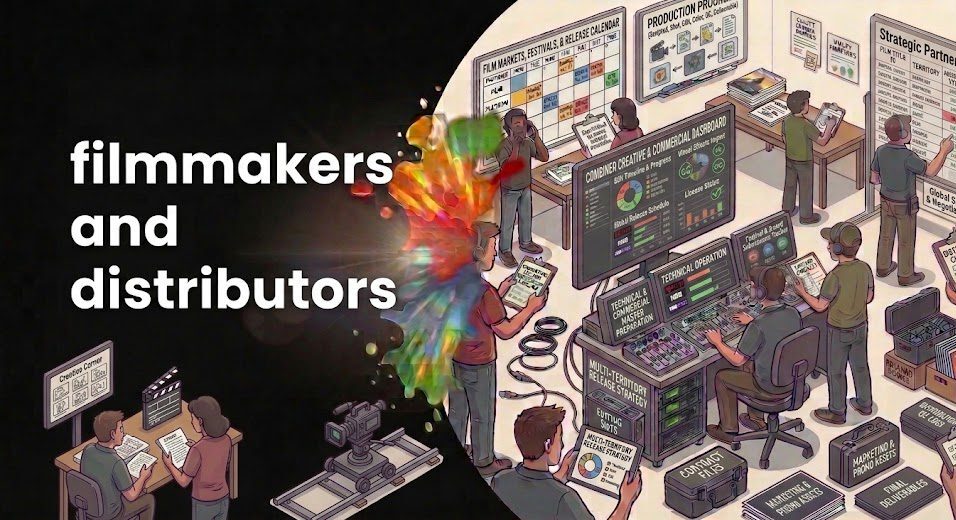
Every filmmaker eventually confronts the same sobering reality: the revenue split on a distribution deal isn’t a single number. It’s a cascade. By the time gross receipts flow through the filmmaker distributor revenue split waterfall—distribution fees, P&A recoupment, sales agent commissions, debt repayment—what reaches the producer can look shockingly small. Knowing the actual percentages at each stage isn’t academic. It’s the difference between structuring a deal that protects your recoupment and signing something that mathematically guarantees you never see backend.
This isn’t a topic the trades cover with enough precision. So let’s go through every layer—theatrical, home entertainment, SVOD, AVOD, and international licensing—with the real numbers, not the marketed ones. And we’ll show you exactly where the Fragmentation Paradox creates the information asymmetry that lets distributors extract more than they should.
In This Article
- Why Revenue Splits Matter More Than the Gross Number
- Theatrical Distribution: The Exhibition Cut Comes First
- The Distributor Fee Structure: 20–35% Off the Top
- Sales Agent Commissions: Another 10–15% Layer
- Digital & Streaming: SVOD, AVOD, TVOD Splits Compared
- The Full Recoupment Waterfall: What Producers Actually See
- The Net Profits Trap: Why “Net” Usually Means Nothing
- How to Negotiate Better Revenue Splits
- FAQ
- Key Takeaways
Find Out What Distributors Are Actually Paying Right Now
Ask VIQI—Vitrina’s AI intelligence layer—to surface active distribution deals by genre, territory, and deal type. Trusted by acquisition teams at Netflix, Warner Bros, and Paramount.
No credit card required · 140,000+ film and TV companies on Vitrina
Why Revenue Splits Matter More Than the Gross Number
There’s a persistent misconception—mostly among first-time producers—that a film’s box office gross or total licensing revenue tells you how much money the filmmaker makes. It doesn’t. Not even close. The gross number is what flows into the system. The filmmaker distributor revenue split determines what flows out to the people who actually made the film.
Here’s the capital reality: a $10M gross theatrical doesn’t mean $10M for your recoupment. After the exhibitor takes their cut, after the distributor deducts their fee and recoups P&A, after the sales agent collects commission and expenses, after debt is repaid in waterfall order—what reaches the producer of an independent film can be a fraction of that number. Or zero. This isn’t exceptional. It’s the industry standard.
Understanding every layer—and knowing the specific percentages at each stage—is how you model a realistic recoupment timeline before you sign anything. Let’s build the full picture from the top down.
For deeper context on how these layers connect to your financing structure, our guide on the recoupment waterfall in film finance walks through the full mechanics from production loan to profit participation.
Theatrical Distribution: The Exhibition Cut Comes First
Before your distributor sees a dollar, the exhibitor takes their share. And it’s substantial. Theatrical revenue splits between filmmakers and distributors start with the exhibitor-distributor split—often called the “film rental” or “rental terms”—which determines what percentage of box office gross flows back from cinemas to the distributor.
Standard exhibitor-distributor splits run roughly as follows:
For indie films without major studio distribution—where a flat-deal structure is common—expect the exhibitor to retain closer to 50% of the gross. That’s before your distributor has touched a cent.
But here’s what the headline split doesn’t show you: the “house nut” clause. Many theater agreements allow exhibitors to deduct their weekly operating costs before applying the split. On a slow-performing indie with limited screens, that nut can absorb most of what’s left. Theatrical, for most independent films today, is genuinely a loss leader—it’s the platform for P&A investment that drives ancillary value downstream, not a profit center in itself.
The Distributor Fee Structure: 20–35% Off the Top
Once box office revenues flow back from the exhibitor, your distribution company collects its fee before anything reaches the production. Standard distribution fees on independent films run 20–35% of gross revenues—not of profits. That distinction is critical.
The typical fee range by distribution type:
- US Theatrical Distribution: 25–35% of theatrical rental (what comes back from exhibitors)
- Home Entertainment / TVOD: 20–30% of net revenues from digital rentals and purchases
- SVOD Licensing: 20–25% of licensing fees paid by platforms
- International Sales: 20–30% per territory (handled by international sales agent, separate from domestic distributor)
- Television Licensing: 20–30% of broadcast license fees
After this fee, the distributor recoups P&A costs—prints and advertising—which can range from $500K to $5M+ for a wide theatrical release, or a more modest $50K–$200K for a limited or digital-first indie release. P&A is recouped entirely from revenues before a single dollar flows to the production. This is the second bite the distribution company takes—and it’s often bigger than the fee itself on theatrical releases.
The real dynamic here: many independent distributors structure their deals so that distribution fees are calculated on gross receipts, while P&A is fully recouped as an expense. Double-dipping? Some producers argue exactly that. Your entertainment attorney should push for a “cross-collateralization” carve-out that prevents the distributor from recouping expenses incurred in one revenue stream against income from another.
Model Your Film’s Real Recoupment Timeline
Vitrina tracks 159,223 active film and TV projects and live distribution deal activity. See what comparable films actually earned through distribution—and which buyers are paying competitive splits in your genre today.
Get 200 Free Credits — No Credit Card Required
Trusted by Netflix, Paramount, Google TV and 140,000+ entertainment companies
Sales Agent Commissions: Another 10–15% Layer
International distribution runs through a separate layer—the sales agent—who licenses your film territory by territory at film markets like Cannes, AFM, and EFM Berlin. Sales agent commissions are standard at 10–15% of the Minimum Guarantee on each territory deal, plus a recoupable expenses cap of typically $50,000–$75,000 for market attendance, screeners, and promotional materials.
But that commission is taken from the MG that territory distributors pay—so before any money reaches the production company, the sales agent has extracted their 10–15%. And their expenses come off the top too, often before the commission is even calculated. On a modest indie with $3M in total international MGs, a sales agent taking 12% commission and $60K in expenses would net the production roughly $2.58M—not $3M.
What actually matters in the sales agent relationship isn’t the commission rate—it’s the quality of their territory relationships and their ability to place films at major SVOD platforms. As Phil Hunt, CEO of Head Gear Films, describes the current landscape, most all-rights distributors are now using the pay-one SVOD sale as the anchor of their entire advance structure. The sales agent who has those platform relationships directly affects how much you’re actually paid upfront.
Hear Phil Hunt break down exactly how the post-COVID distribution revenue model has restructured the entire independent film value chain:
Phil Hunt (CEO, Head Gear Films) — “The Big Crunch: Why Film Finance Is Harder Than Ever”
For a detailed look at how sales agent deal terms are structured and what to negotiate, see our guide on sales agent commission structures in film distribution.
Digital & Streaming: SVOD, AVOD, and TVOD Splits Compared
Digital revenue is where most independent films now generate the bulk of their actual revenue—and where the split structure gets genuinely complex. There’s no single standard. Every platform has its own model, and the economics differ dramatically between SVOD, AVOD, and TVOD.
SVOD (Subscription Video on Demand)
SVOD platforms—Netflix, Amazon Prime Video, Apple TV+—typically license films for a fixed fee rather than a revenue share. There’s no ongoing royalty; you negotiate a license fee for a defined window (usually 18 months to 3 years) in specific territories. The fee is paid upfront or on delivery, making it the cleanest revenue stream in the ecosystem.
But that SVOD fee flows through your distributor first. If you’ve signed an all-rights deal, the distributor collects the SVOD license fee and deducts their 20–25% distribution fee before remitting the balance. A $500K Netflix license nets the production roughly $375–$400K after the distributor’s cut—before any P&A recoupment still outstanding against the title.
AVOD (Advertising Video on Demand)
AVOD platforms—Tubi, Pluto TV, The Roku Channel, Peacock free tier—generate revenue from advertising CPMs shared with content owners. The typical filmmaker share of AVOD revenue runs 50–70% of the net advertising revenue after the platform deducts its own take. CPMs on AVOD platforms currently range from $5 to $25 per thousand impressions depending on content genre and demographic.
The economics are modest for a single title. A film generating 2 million total AVOD views at a $10 average CPM and a 60% revenue share would return roughly $12,000 to the content owner. Over a catalog of multiple titles, AVOD builds a meaningful long-tail income stream—but it’s never a recoupment vehicle on its own.
TVOD (Transactional Video on Demand)
TVOD platforms—Apple TV, Fandango at Home, Google Play Movies—operate on rental and purchase transactions. The platform typically retains 30% of the transaction price, leaving 70% for the distributor or content owner. If your distributor is in the middle, they take their 20–25% fee from that 70%, leaving the production with roughly 50–55% of the retail transaction price.
On a $5.99 digital rental: the platform retains ~$1.80, the distributor takes ~$1.05, and the production sees roughly $3.15. Multiply that across thousands of transactions, and TVOD is a meaningful revenue stream for genre films with an active audience—but still not the pay-one SVOD anchor that once defined independent film financing.

Your AI Assistant, Agent, and Analyst for the Business of Entertainment
VIQI AI helps you plan content acquisitions, raise production financing, and find and connect with the right partners worldwide.
- List the top commissioners at the BBC
- List the post-production and VFX decision-makers at Netflix
- List the development leaders at Sony Pictures
- List the scripted programming heads at HBO
- Find active co-producers and financiers for scripted projects
- Find equity and gap financing companies in North America
- Find top film financiers in Europe
- Find production houses that can co-produce or finance unscripted series
- Who is backing animation projects in Europe right now
- Who is Netflix’s top production partners for Sports Docs
- Who is Commissioning factual content in the NORDICS
- Who is acquiring unscripted formats for the North American market
- Show me recent drama projects available for pre-buy
- Show me Japanese Anime Distributors
- Show me true-crime buyers from Asia
- Show me documentary pre-buyers
- I am looking for production partners for a YA drama set in Brazil
- I am looking for producers with proven track record in mid-budget features
- I am looking for Turkish distributors with successful international sales
- I am looking for OTT platforms actively acquiring finished series for the LATAM region
- I am seeking localization companies offer subtitling services in multiple Asian languages
- I am seeking partners in animation production for children's content
- I am seeking USA based post-production companies with sound facilities
- I am seeking VFX partners to composite background images and AI generated content
The Full Recoupment Waterfall: What Producers Actually See
Put it all together and the recoupment waterfall for a typical independently financed film looks like this—in strict priority order:
- Distribution / Sales Agent Fees (20–35%): Deducted from all gross revenues before anything else. First and permanent.
- P&A Recoupment: Marketing and release costs fully recouped—can be $50K to $5M+ depending on release strategy.
- Senior Production Debt + Interest: Bank production loans at prime + 3–5%, repaid in full before equity.
- Gap Financing + Interest: Mezzanine debt at effective rates of 15–22% per annum, sitting between senior debt and equity.
- Tax Credit / Soft Money Recoupment: If tax credits were used as collateral for loans, those loans repay here.
- Equity Recoupment: Investors recoup their principal (typically with a 120–125% liquidation preference) before any profit is distributed.
- Deferred Fees: Cast, crew, or director deferrals paid from profit after equity.
- Net Profit Participation: What remains—divided among profit participants, producers, and backend participants.
On a $5M independent feature that grosses $8M across all revenue streams over three years: after a 25% distribution fee ($2M), $800K in P&A recoupment, $600K in senior debt repayment, and $1.2M in equity recoupment (on a $1M investment at 120%), the “net profit pool” is roughly $3.4M—but only if all revenue streams have been collected and accounted for accurately. Producers working without real-time deal tracking often don’t know what’s been collected, in which territory, under which license—which is where the margin leakage from the Fragmentation Paradox compounds.
Protect Your Backend Before You Sign
Vitrina’s Concierge Service connects you with a dedicated distribution strategist who will audit your deal structure, identify where you’re giving up margin, and map your optimal territory-by-territory approach.
Talk to a Distribution Strategist
Trusted by producers with films at Netflix, Paramount, and global broadcast networks
The Net Profits Trap: Why “Net” Usually Means Nothing
Let’s be direct about this. “Net profits” in a film distribution contract is not the same word as “net profits” in any other industry. The way net profit is defined—after distribution fees calculated on gross, after fully loaded P&A, after distribution expenses that may include overhead allocations, after interest on any unpaid amounts—means the denominator grows while the numerator stays fixed.
The studio system perfected this mechanism over decades. But it’s not exclusive to majors. Many independent distributors apply the same logic on a smaller scale. A film that genuinely earns $10M gross can still show net losses on paper if the distribution fee, P&A, and allocated expenses total more than the retained revenue. Talent and producers on net profit participation—the famous “points”—often receive nothing.
What should you negotiate instead? Push for adjusted gross participation—a percentage calculated after distribution fees but before P&A expenses. That’s a far more meaningful number. Alternatively, insist on a defined gross with a hard cap on deductible expenses so the distributor can’t grow the cost base indefinitely. And always, always include an audit right—the contractual right to examine the distributor’s accounting records. Insiders know: the producers who get paid are the ones who actually exercise that right.
Our guide on negotiating film distribution contracts covers the specific clauses that protect against net profit erosion—including most-favored-nation provisions, expense caps, and accounting audit triggers.
How to Negotiate Better Revenue Splits in 2025
The distribution fee and waterfall structure aren’t fixed. They’re negotiated. But you can only negotiate effectively when you understand what’s standard—and when you have enough intelligence about the market to know whether the offer on the table is competitive or exploitative.
A few specific levers worth pushing on in every distribution negotiation:
- Capped distribution fees by revenue stream. Don’t accept a blanket 30% across all channels. Negotiate channel-specific rates—theatrical can sustain 30%, but SVOD licensing at a fixed fee doesn’t require 25% distributor overhead. Push theatrical to 25%, digital to 20%, SVOD pass-through to 15%.
- P&A cap with filmmaker approval above threshold. Set a maximum spend the distributor can commit to P&A without your written consent—say, $250K for a limited release. This prevents the distributor from running up costs that block your recoupment indefinitely.
- Minimum accounting statements. Require quarterly statements with territory-level revenue breakdowns. Monthly for the first year. Distribution companies that resist this level of transparency are telling you something important.
- Reversion clause for non-performance. If the distributor hasn’t generated a minimum revenue threshold within 18–24 months, rights revert to you. This is increasingly standard in better-negotiated indie deals and protects against the “shelf” scenario where a distributor acquires your film and then does nothing with it.
- Most-favored-nation status. If the distributor licenses comparable titles at better terms, your deal adjusts to match. Hard to get, but worth asking for every time.
The information asymmetry is the real problem. Distributors negotiate these deals dozens of times a year. Most producers negotiate them once or twice in a career. That’s the gap that Vitrina’s intelligence infrastructure is built to close—by surfacing live deal data, active acquisition terms, and comparable transactions so producers walk into negotiations with the same market visibility that distributors have had for decades. See our breakdown of international film distribution fees by territory for a market-by-market reference point before your next negotiation.
FAQ: Revenue Splits Between Filmmakers and Distributors
Key Takeaways: What the Filmmaker-Distributor Revenue Split Actually Looks Like
The filmmaker distributor revenue split isn’t a single agreement—it’s a stack of agreements, fees, and recoupment structures that collectively determine what a producer sees from their film’s commercial performance. The numbers aren’t secret. They’re just rarely presented in full, in sequence, before the deal is signed. That information asymmetry is exactly the kind of margin leakage the Fragmentation Paradox inflicts on independent filmmakers who don’t have access to live deal intelligence.
- Theatrical exhibitor cut: 25–50% of box office gross goes to cinemas before your distributor sees anything.
- Distribution fee: 20–35% of gross revenues across all channels, deducted first—before P&A recoupment.
- P&A is fully recoupable: Cap it contractually or it will delay recoupment indefinitely.
- Sales agent commission: 10–15% on international MGs, plus $50K–$75K in recoupable expenses—taken before you see foreign revenues.
- Net profits = almost nothing: Negotiate for adjusted gross or defined gross with expense caps instead.
De-Risk Your Distribution Deal With Live Market Intelligence
Vitrina surfaces real-time acquisition activity across 300,000+ entertainment companies in 195 countries—so you know what comparable films are earning before you sign.
No credit card required
Need expert review of your distribution deal terms?