IHUB
IHUB
 Private Briefings (Webinars)


 LeaderSpeak Podcast
  Global Entertainment Digest (Newsletter)
  About Vitrina
 About VIQI
 Our Story
 Our Solutions 🔥
 Film+TV Projects Tracker 🚀
 Case Studies
 Our Profile
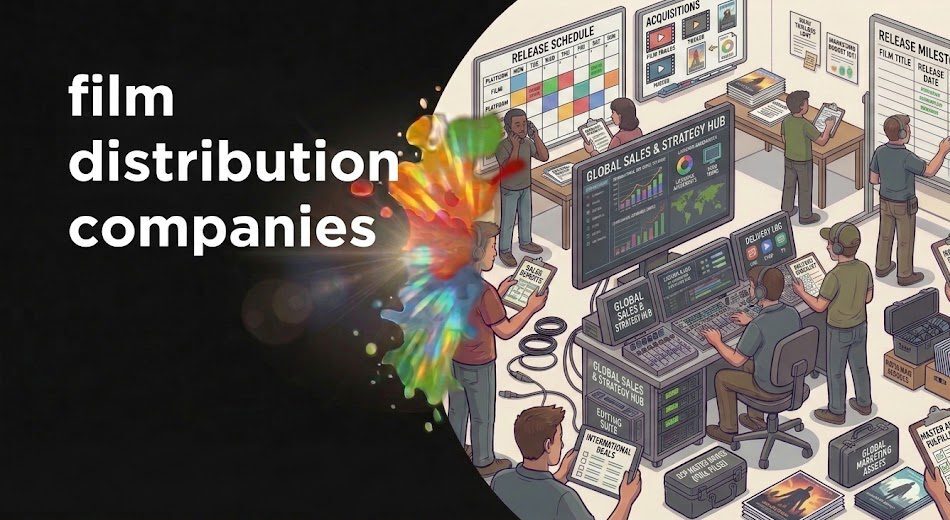
Your documentary just screened at a major festival. The audience was electrified. Now what? For most independent documentary filmmakers, the answer is painfully unclear—and the clock is already ticking. The window between festival buzz and actual distribution deals closes faster than most producers expect, often before they’ve identified the right partners to even pitch.
Here’s the hard truth: the wrong distributor isn’t just a bad deal. It’s a dead end. A specialty documentary distributor with genuine theatrical relationships is a completely different animal from a digital aggregator that’ll dump your film on Amazon Prime and collect their 15% without breaking a sweat. You need to know who’s who before you’re sitting across the table from them.
This guide maps out the top film distribution companies for documentary filmmakers—from the streaming giants reshaping acquisitions to specialist boutiques who move carefully curated titles, plus three Sovereign Hub distributors in MENA, APAC, and LATAM that most Western producers overlook entirely. Vitrina’s intelligence platform—tracking 159,223 projects and 140,000+ companies globally—gives you the data to approach these conversations like an insider, not an outsider hoping for a lucky break.
Ask VIQI: Which Documentary Distributors Are Actively Acquiring Right Now?
VIQI is Vitrina’s AI assistant—trained on 1.6 million titles, 360,000 companies, and 5 million entertainment professionals. Ask it who’s buying in your genre today.
✓ Included with 200 free credits | ✓ No credit card needed
Why Documentary Distribution Is Harder Than You Think
Phil Hunt (Founder & CEO, Head Gear Films), who has financed over 550 films in his career, put it bluntly in a Vitrina LeaderSpeak interview: the whole industry has become much harder in terms of getting movies off the ground—and getting movies sold. That’s not just feature drama. Documentaries feel the squeeze even more acutely because their minimum guarantees (MGs) from territorial distributors have eroded significantly since the streaming era collapsed traditional pay-one and pay-two windows.
The documentary market isn’t broken—but it’s bifurcated. At the top, Netflix and Max are paying seven figures for the right true crime, social justice, or access-driven project. Below that tier? A much messier landscape. But that landscape is navigable if you know your options going in. So let’s get into them.
Phil Hunt (Founder & CEO, Head Gear Films) discusses why the independent film distribution landscape has shifted—and what filmmakers need to know today:
How We Ranked These Documentary Distributors
Each distributor here was evaluated on four criteria that actually matter to your recoupment timeline and creative control: acquisition appetite (are they actively buying?), deal structure transparency (do MGs reflect real theatrical and streaming value?), territory reach (domestic vs. international vs. both), and documentary-specific track record (do they understand the difference between a festival darling and a commercial release?). Producers seeking a comprehensive guide to finding documentary distributors will recognize these as the criteria that separate good relationships from costly mistakes.
And yes—we’ve deliberately included 3 Sovereign Hub distributors in the final group. The Fragmentation Paradox is real: 600,000+ companies operate in this industry globally, and most Western filmmakers only ever engage the 0.1% they already know about. That’s margin left on the table.
1–4: The Streaming Giants Reshaping Documentary Acquisitions
1. Netflix Documentary Division
Netflix remains the most coveted acquisition target for documentary filmmakers globally. The platform acquired over 40 original documentary titles in 2024 alone, spanning true crime, nature, social justice, and sports access docs. Their deal structure typically involves worldwide rights buyouts—which means no territorial presales possible once they’re involved. Financially, MGs range from $1M to $10M+ depending on subject, talent, and festival heat.
The catch? You need a sales agent with an existing Netflix relationship or a project that’s already generating festival buzz. Cold submissions don’t get greenlighted here. But if you’re at Sundance, IDFA, or Sheffield with a completed film that fits their slate, you’re in a realistic conversation.
Best for: High-profile, access-driven, or celebrity-attached documentaries with global appeal. According to Variety, Netflix has been increasingly commissioning from independent production companies rather than relying purely on in-house development.
2. Max / HBO Documentary Films
HBO Documentary Films (now operating under the Max umbrella post-WBD reorganization) has a well-earned reputation as the prestige documentary home. They’ve backed projects like Icarus and multiple Peabody-winning series that other streamers wouldn’t touch. Their appetite for longer-form, in-depth documentary work sets them apart—they’re not chasing 90-minute buzzy biopics exclusively. They want depth.
Deal structures here tend to favor documentary series over single features, and their commissioning process is slower. But the recoupment opportunity for a multi-part series licensed across 90+ territories is substantially better than most theatrical routes. This is one worth playing a long game on.
3. Apple TV+ Documentary
Apple TV+ entered the documentary space aggressively after 2020 and hasn’t slowed down. They’re particularly drawn to sports access docs, music artist films, and tech/business narratives—which makes sense given their brand DNA. Their budgets are generous, their global distribution footprint reaches 100+ countries, and they’re willing to co-finance development if the project aligns with their identity.
But here’s what producers often miss: Apple wants brand alignment, not just good storytelling. Your pitch needs to answer “why does this feel like an Apple film?” before they’ll move forward.
4. Amazon Prime Video
Amazon Prime Video has become a more selective acquirer for documentaries since the MGM merger, consolidating their focus on projects with clear subscriber-acquisition potential. They’re still buying—but the volume-acquisition strategy of 2018-2021 is over. What they’re looking for now: proven franchises, follow-up films to breakout hits, and co-production arrangements that let them lock territories early.
Track Which Distributors Are Buying Docs Right Now
Trusted by Netflix, Warner Bros, and Paramount. Join 140,000+ companies tracking live acquisition activity and deal flow across the global entertainment supply chain.
✓ 200 free credits | ✓ No credit card required | ✓ Full platform access
5–7: Specialist Indie Distributors with Real Documentary DNA
5. IFC Films
IFC Films has been one of the most active documentary distributors in the US for over two decades. Their hybrid theatrical/VOD model—day-and-date releasing—was controversial when it launched and is now standard industry practice. For documentary filmmakers, that means your film can build theatrical credibility in New York and Los Angeles while simultaneously reaching a national audience digitally. No waiting 90 days for the P&A to recoup before anyone streams it.
MGs from IFC are typically modest ($50K-$500K range) but their marketing infrastructure for niche documentary titles is genuinely strong. They know how to reach the audience that buys tickets to see a film about immigration policy or environmental collapse. As our guide to distributing independent films covers in detail, the hybrid release model IFC pioneered has fundamentally changed recoupment timelines for indie docs.
6. Dogwoof
Dogwoof is the UK’s premier documentary-only distributor and international sales agent. Full stop. They don’t distribute dramas, they don’t do comedies—they do one thing and they do it with exceptional focus. Their slate has included some of the most-awarded documentaries of the past decade, and their international sales operation means they’re actively pitching your film into broadcasters and streamers across Europe, Australasia, and North America simultaneously.
For documentary filmmakers based in Europe or targeting BAFTA-eligible releases, Dogwoof should be your first call. Their commissioning team attends every major festival where docs premiere—IDFA, Sheffield, HotDocs, Tribeca. Don’t wait for them to find you. Submit early.
7. Doc & Film International
Paris-based Doc & Film International is one of Europe’s most respected documentary sales agents, regularly representing titles at Cannes Marché du Film, IDFA, and Berlinale’s EFM. Their strength is the European broadcaster market—Arte, ZDF, BBC, RTE—which still pays meaningful license fees for quality documentary content. For filmmakers with co-production structures involving French or German broadcasters (which often carry 35-40% soft money from Canal+ or ARD/ZDF), having Doc & Film as your sales agent de-risks the capital stack considerably.
As reported by Screen International, the European documentary co-production market has shown resilience despite broader industry headwinds, with French-backed productions maintaining strong international sales performance.
8–10: Sovereign Hub Distributors Expanding the Acquisition Map
Most documentary filmmakers pitch their entire distribution strategy around North America and Western Europe. That’s leaving real money—and real audiences—behind. The rise of Sovereign Content Hubs across MENA, APAC, and LATAM has created a new class of distributors with government-backed capital, growing middle-class audiences, and genuine appetite for international documentary content. Here are three you should know.
8. OSN (Orbit Showtime Network) — MENA
OSN is the premium pay-TV and streaming platform covering 23 countries across the Middle East and North Africa. Formed from the 2008 merger of Orbit Network and Showtime, OSN now operates both a traditional linear service and OSN Plus—their strategic streaming focus. Rolla Karam (Senior Vice President, Content Acquisition at OSN) notes the platform’s content mix is roughly 90% Western content, which means quality international documentaries have genuine acquisition pathways here.
OSN’s core market is Saudi Arabia and the GCC, with Egypt as a major secondary territory. If your documentary has human rights, sports, or cultural themes that resonate in the Gulf, this is a distribution conversation worth having. The region’s 60%+ under-30 population represents an audience that streaming platforms are actively fighting over. For producers building a festival-to-distribution strategy with MENA ambitions, OSN is the premium gateway.
9. Globo International — LATAM
Globo International, the distribution arm of Brazil’s Grupo Globo, is expanding its international content acquisition strategy aggressively—including documentary and factual content that speaks to Latin American audiences. With Brazil alone representing 215 million potential viewers and streaming penetration growing at double-digit rates, Globo’s licensing reach across LATAM is a genuinely significant distribution opportunity. They’re not just a regional player; they’re building toward a global content export and import strategy simultaneously.
10. CJ ENM — South Korea/APAC
CJ ENM, South Korea’s dominant entertainment conglomerate behind the Mnet and tvN networks, has become one of Asia-Pacific’s most sophisticated content acquirers. Post-Parasite and Squid Game, the global appetite for Korean-distributed or Korean-adjacent content has created real leverage for CJ ENM in international co-production and acquisition conversations. Their documentary and factual arm is newer but growing—particularly for social, culinary, and environmental subject matter. South Korea’s Vision 2030-adjacent content investment policies and APAC broadcaster relationships make CJ ENM a valuable APAC distribution partner that most Western documentary filmmakers haven’t yet added to their outreach list.

Your AI Assistant, Agent, and Analyst for the Business of Entertainment
VIQI AI helps you plan content acquisitions, raise production financing, and find and connect with the right partners worldwide.
- Find active co-producers and financiers for scripted projects
- Find equity and gap financing companies in North America
- Find top film financiers in Europe
- Find production houses that can co-produce or finance unscripted series
- I am looking for production partners for a YA drama set in Brazil
- I am looking for producers with proven track record in mid-budget features
- I am looking for Turkish distributors with successful international sales
- I am looking for OTT platforms actively acquiring finished series for the LATAM region
- I am seeking localization companies offer subtitling services in multiple Asian languages
- I am seeking partners in animation production for children's content
- I am seeking USA based post-production companies with sound facilities
- I am seeking VFX partners to composite background images and AI generated content
- Show me recent drama projects available for pre-buy
- Show me Japanese Anime Distributors
- Show me true-crime buyers from Asia
- Show me documentary pre-buyers
- List the top commissioners at the BBC
- List the post-production and VFX decision-makers at Netflix
- List the development leaders at Sony Pictures
- List the scripted programming heads at HBO
- Who is backing animation projects in Europe right now
- Who is Netflix’s top production partners for Sports Docs
- Who is Commissioning factual content in the NORDICS
- Who is acquiring unscripted formats for the North American market
How to Use Vitrina to Find the Right Distribution Partner Faster
Here’s the problem you’re probably already experiencing: you know these companies exist, but you don’t know who at each company is actively acquiring your genre of content right now. That’s the Fragmentation Paradox in action—information exists, but it’s locked inside relationship networks and trade publications you’d need a subscription and six weeks of reading to navigate.
Vitrina’s intelligence platform changes that. The platform tracks 159,223 projects across their entire lifecycle—from development through distribution—so you can see in real time which distributors are acquiring which types of documentaries, what territories they’re buying for, and who the decision-maker is. That’s not six-month-old information from Variety. That’s now.
And if you’d rather have Vitrina’s team do the outreach for you? Vitrina Concierge has connected a LA-based producer to Netflix UK, Fifth Season, and Fox Entertainment within 48 hours. That’s the kind of timeline that turns a good documentary into a distributed one before the buzz fades. Our full guide on mastering documentary distribution with Vitrina walks through the exact process.
Need a Distribution Partner for Your Documentary? We’ll Find Them.
Vitrina Concierge is your Virtual Agent. We don’t give you a list—we make warm introductions directly to decision-makers actively seeking your type of content.
- LA producer → Netflix UK, Fifth Season, Fox Entertainment (48 hours)
- Korean studio → Netflix Adult Animation (week one)
- Middle Eastern studio → Legendary Pictures (direct access)
Frequently Asked Questions
What are the best film distribution companies for documentary filmmakers?
The best film distribution companies for documentary filmmakers depend on your film’s budget, subject, and territory ambitions. For prestige global reach, Netflix and Max/HBO Documentary Films are the benchmark. For specialist indie distribution in the US, IFC Films is the most active buyer. UK-focused filmmakers should target Dogwoof. European sales routes run through Doc & Film International in Paris. And don’t overlook sovereign hub distributors like OSN (MENA), Globo International (LATAM), and CJ ENM (APAC)—these markets are growing fast.
How do documentary filmmakers find distribution without a sales agent?
It’s harder without a sales agent—but not impossible. Your best strategy is to combine strong festival placement (IDFA, HotDocs, Sundance, Sheffield) with direct outreach to acquisition executives at specialist distributors. Platforms like Vitrina let you identify the specific executive handling documentary acquisitions at each company, filter by territory, and track their recent buying patterns. Warm introductions through Vitrina’s Concierge service have placed documentaries at major streamers in 48 hours without a traditional sales agent in the chain.
What’s the difference between a documentary distributor and a sales agent?
A sales agent handles international territory licensing—they pitch your film to distributors in specific countries and negotiate minimum guarantees (MGs) on your behalf. Their commission is typically 10-15%. A distributor licenses the film for a specific territory and handles theatrical release, VOD, streaming, and broadcast placement in that market. You’ll often need both—a sales agent for international territories and a domestic distributor for your home market. Dogwoof functions as both for UK documentaries. Doc & Film International handles European sales and connects with French and German broadcast licensees.
How much do documentary distribution deals typically pay?
It varies enormously. Netflix and Apple TV+ pay the highest MGs—often $1M to $10M+ for a worldwide rights acquisition on a high-profile documentary. Specialist distributors like IFC Films typically offer $50K to $500K for US rights depending on the film. European broadcaster deals for a single territory might be €20K to €150K. The model matters too—a full rights buyout from a streamer means higher upfront cash but zero backend. A theatrical distribution deal with a smaller company might mean lower MGs but participation in ancillary revenue if the film overperforms.
Is Netflix good for documentary filmmakers?
Netflix is the best-paying documentary distributor in the world—but the deal structure comes with trade-offs. Their worldwide rights buyouts eliminate your ability to presell territories or retain any backend revenue from ancillary markets. You’re trading maximum upfront security for long-term IP participation. For filmmakers whose primary goal is audience reach and recoupment certainty, Netflix is exceptional. If you’re building a franchise around IP or want meaningful backend participation, a multi-territory presale strategy with a specialist sales agent might deliver better long-term ROI—particularly for series-format documentaries.
What film markets are best for documentary distribution deals?
The five most productive markets for documentary distribution deals are: IDFA (Amsterdam, November)—the world’s largest documentary festival and market; HotDocs (Toronto, April)—North America’s premier documentary market; Sheffield DocFest (June)—the UK hub for commissioning and acquisitions; Cannes Marché du Film (May)—the broadest international reach; and Sundance Film Festival (January)—where the most high-profile US acquisitions happen annually. Get your sales materials together 6-8 weeks before any market. Decision-makers commit to meetings well before the market opens.
How do MENA distributors like OSN approach documentary acquisitions?
OSN, which covers 23 countries across the Middle East and North Africa, acquires content primarily for premium pay-TV and their OSN Plus streaming app. Their content mix is roughly 90% Western content, making them genuinely receptive to international documentaries with human interest, sports, social, or cultural themes. Their core acquisition strategy focuses on Saudi Arabia and the GCC, with Egypt as a major secondary territory. For documentary filmmakers, MENA licensing through OSN typically covers multi-territory bundles rather than individual country deals, which can simplify negotiations considerably.
What should I look for in a documentary distribution agreement?
Focus on five key elements: territory scope (which countries are included and excluded), rights duration (standard is 15-20 years—push for 10 if possible), MG payment structure (typically 10% on signature, 90% on delivery), P&A commitments (what theatrical marketing spend is the distributor contractually required to provide), and backend participation (after recoupment, what percentage flows back to the filmmaker). Never sign a distribution agreement without an entertainment lawyer reviewing the recoupment waterfall. The language around “distribution expenses” is where deals that look good become deals that never pay out.
Conclusion: Know the Market Before You Need It
The documentary distribution landscape has never been more complex—or more full of opportunity. Streaming has reshaped the acquisition market completely, creating enormous upside for projects that can reach the right buyers at the right moment. But as Phil Hunt from Head Gear Films makes clear: the whole industry has become much harder in terms of getting movies sold. That’s doubly true if you’re approaching distributors cold, without intelligence on who’s actually buying what.
Key Takeaways:
- The streaming tier is highly competitive: Netflix, Max, and Apple TV+ pay the highest MGs ($1M-$10M+) but require festival heat, talent attachment, or existing relationships to even enter conversations.
- Specialist distributors offer better creative alignment: IFC Films, Dogwoof, and Doc & Film International understand documentary audiences in ways generalist streamers don’t—and their hybrid release models can build long-term reputation for your film.
- Sovereign Hub distributors are underutilized: OSN (23 MENA countries), Globo International (Brazil/LATAM), and CJ ENM (South Korea/APAC) represent significant territory licensing opportunities that most Western filmmakers miss entirely.
- Timing is everything: Get your distribution materials ready 6-8 weeks before any market. Relationships close deals—and deals close before most filmmakers realize the window has opened.
- Intelligence accelerates everything: Vitrina tracks 159,223 projects and 140,000+ companies globally, giving documentary filmmakers real-time acquisition intelligence instead of outdated trade press snapshots.
The producers who close distribution deals aren’t necessarily the ones with the best films. They’re the ones who showed up prepared, knew who was buying, and moved before the buzz faded. That intelligence gap is exactly what Vitrina was built to close.
Find Your Documentary’s Distribution Partner in 48 Hours
Trusted by Netflix, Warner Bros, and Paramount. Join 140,000+ companies using Vitrina to track live acquisition deals and connect with the right buyers.
✓ 200 free credits | ✓ No credit card required
Ask VIQI: Who’s Actively Buying Documentaries in My Genre?
Get instant intelligence from Vitrina’s AI assistant trained on 1.6 million titles and 360,000 companies.