About Innovation Hub
 Global Content Pulse (Webinars)


 Global Production Financing
(Webinars)
Global Production Financing
(Webinars)  LeaderSpeak Podcast
  Global Entertainment Digest (Newsletter)
  About Vitrina
 About VIQI
 Our Story
 Our Solutions 🔥
 Film+TV Projects Tracker 🚀
 Case Studies
 Our Profile
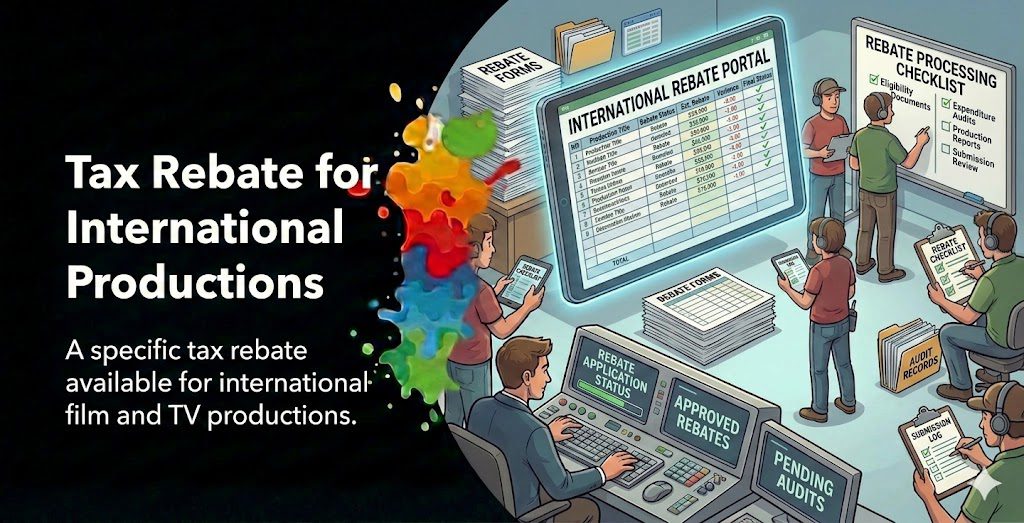
The tax rebate for international productions landscape just went through its most turbulent single year of change since the post-COVID production surge. In 2026: Qatar launched a 40–50% rebate with a cross-border Arab-country spend clause that’s unlike anything in the Gulf before it. New Zealand removed its ATL compensation cap entirely and dropped the live-action minimum to NZ$4 million.
British Columbia jumped from 28% to 36–38% on its foreign service credit. California more than doubled its fund to $750 million. Georgia reinstated a standalone post-production credit at 20%. Ireland launched Europe’s first unscripted TV tax credit. Denmark opened a new 25% program. Hungary locked its 30% rebate through 2030 with a first-come-first-served registration cap.
That’s not an incremental update. That’s a structural reshaping of where your production budget can go and what it earns when it gets there. And here’s what it means practically: the producers walking into greenlight meetings right now with the strongest capital stacks aren’t the ones with the best relationships. They’re the ones who modeled five or more jurisdictions before they locked their location—and built incentive strategy into the financing foundation rather than treating it as a line-producer afterthought.
This is your complete 2026 update. What changed, what launched, what to stack, and what’s actually bankable versus what just looks good on paper.
💡 Vitrina Analyst Note
Our analysts note that 2026 reshaped the international production incentive map fundamentally, with Qatar launching at 40 to 50%, BC jumping from 28% to 36 to 38%, and California doubling its fund to $750 million. From our study on Vitrina, producers capturing the most value model five or more jurisdictions before locking their location decision.
Table of Contents
- What Changed in 2026: The Quick-Reference Rate Table
- UK 2026: IFTC at 39.75% Net + VFX at 29.25% — The World’s Most Versatile Program
- Gulf Sovereign Hubs: Qatar’s QSPI Enters, Abu Dhabi Holds 50%
- North America 2026: California $750M, Georgia’s New Post Credit, BC Jumps to 36%
- Europe 2026: Denmark Launches, Ireland Adds Unscripted, Hungary Locks Through 2030
- APAC 2026: New Zealand Removes ATL Cap, Australia Holds 30%
- The Best 2026 Stacking Plays
- Bankability vs. Rate: What Gap Lenders Actually Advance Against
- Frequently Asked Questions
- Conclusion & Key Takeaways
What Changed in 2026: The Quick-Reference Rate Table
A tax rebate for international productions is a government cash return—typically 20–53% of qualifying local expenditure—paid after you spend, audit, and confirm. Before we go territory by territory, here’s the 2026 change table: what moved, what launched, what held.
Phil Hunt—Founder & CEO of Head Gear Films, which has financed 550+ movies over 25 years and currently closes 35–40 films per year (more than most studios)—puts the current lending context clearly: the industry is in a “big crunch” where it’s harder than ever to get movies off the ground and sold. That’s the environment your incentive strategy has to work in. Rate matters. But bankability matters more. We’ll get to that. First, the key 2026 changes in detail.
Phil Hunt (Founder & CEO, Head Gear Films) on the current financing crunch and what lenders look for in a capital stack today:

UK 2026: IFTC at 39.75% Net + VFX at 29.25% — Still the World’s Most Versatile Incentive Stack
The UK isn’t just one program in 2026. It’s a tiered system—and knowing which tier your project falls into is the difference between capturing £3M+ on a £10M film and leaving it on the table.
IFTC: 53% Gross / 39.75% Net for Indie Films Under £15M
The Independent Film Tax Credit (IFTC) is the landmark UK incentive of the post-2024 era. Gross credit rate: 53%. Net effective rate after 25% UK corporation tax: 39.75% on up to 80% of core expenditure. For a £10M indie, that’s a potential £3.18M cash return—one of the highest effective rates for independent film anywhere globally.
Qualification is accessible. You need one of: a UK lead writer, a UK lead director, or official UK co-production status. Principal photography must have started on or after April 1, 2024. The BFI cultural test still applies—but most narratively-driven features filming substantially in the UK pass without significant restructuring.
One constraint worth planning around: you can’t combine the IFTC with the VFX uplift. So if your indie production is also VFX-heavy, model both routes. For most narrative features, IFTC wins. For effects-driven productions—even under £15M—the standard AVEC plus VFX uplift may deliver more. But don’t guess. The difference on a £12M effects picture can be several hundred thousand pounds in either direction.
Major stakeholders including PACT and the BFI are lobbying for a P&A support measure in the 2026 legislative cycle—which would help smaller IFTC-qualifying films compete at theatrical release against studio blockbusters. That’s still pending, but worth monitoring for productions planning 2027 theatrical windows. For the full UK program mechanics, our guide to UK tax credits for film, TV and video games covers every tier in depth.
UK VFX: 29.25% Net — Cap Removed, 100% of VFX Qualifying Spend Now Eligible
Effective April 2025, qualifying UK VFX costs receive a gross 39% credit (net 29.25% after corporation tax)—and critically, VFX expenditure is now exempt from the 80% cap that applies to all other production costs. You can claim the full VFX incentive on 100% of your qualifying UK VFX spend, uncapped. According to Screen International, this has already pulled major studio VFX budgets back from Canada and Australia toward London—where Framestore, DNEG, ILM London, and MPC provide infrastructure that competes with any market globally.
And the standard AVEC at 25% gross / 25.5% net remains the most bankable incentive in the world for gap financing purposes. UK audit predictability, HMRC payment timing (approximately 8 weeks from submission to receipt), and program certainty going back decades mean lenders advance against it at the highest rates of any program globally. That processing speed and predictability is a real cost when you compare against newer Gulf programs—factor it into your stack modeling.
Track Which Jurisdictions Are Actively Greenlighting International Co-Productions Right Now
Trusted by Netflix, Warner Bros, and Paramount. Join 140,000+ companies tracking incentive deal flow, commissioning decisions, and co-production activity across 40+ territories in real time.
✓ 200 free credits | ✓ No credit card required | ✓ Full platform access
Gulf Sovereign Hubs in 2026: Qatar’s QSPI Changes the Regional Map
For the first time, the Gulf has three serious production incentive programs competing for the same international spend. That’s not a minor development. It means cross-border Gulf deal structures that didn’t exist 18 months ago are now financially viable.
Qatar QSPI: 40–50%, Cross-Border Arab Spend Clause — Applications Open Q2 2026
Unveiled during the inaugural Doha Film Festival’s Industry Days in November 2025, the Qatar Screen Production Incentive (QSPI) is immediately one of the most strategically interesting programs in the world—not just because of the rate, but because of the cross-border mechanics.
The structure: a 40% base cash rebate on qualifying Qatari production expenditure. A further 10% uplift is available for productions that hire Qatari talent, invest in local crew training, or promote Qatari culture—reaching 50% total. Applications are administered by the Film Committee at Media City Qatar, with the portal opening in Q2 2026.
But here’s what makes the QSPI structurally different from every other Gulf program: up to 25% of total qualifying expenditure incurred in neighbouring Arab countries can also be rebated under the Qatari program. A shoot splitting between Qatar and Saudi Arabia, Qatar and Jordan, or Qatar and Egypt—Qatar’s rebate applies to that cross-border portion as well. According to Deadline, launch partnerships include Neon, Sony Pictures, and Miramax. This isn’t a theoretical program. It’s operational at launch with studio-level commitment. Our guide to NEOM and Gulf production incentives covers the full Saudi landscape that QSPI now sits alongside.
Abu Dhabi: 50% Holds — Still the Highest Headline Rate Globally
Abu Dhabi’s 50% cash rebate hasn’t moved in 2026—because it doesn’t need to. Combined with 0% taxation for 50 years in free zones, a minimum qualifying spend of just $70,000 with one shooting day, and world-class infrastructure in Dubai and Abu Dhabi, it remains the most accessible high-rate program on earth. Qatar’s entry creates genuine competition now at the Gulf level, which should push both programs toward improved service delivery for international crews. But the Abu Dhabi rate and accessibility haven’t been touched.
Saudi Arabia: 40% + $1B Annual Allocation + Film AlUla at Scale
Saudi Arabia’s 40% cash rebate on qualifying in-Kingdom spend continues to be backed by the most generously capitalized production program on earth—$1B allocated annually to entertainment infrastructure through Vision 2030. The Cultural Development Fund has deployed $62.4M+ to film projects, with a SAR 1B ($266M) target flowing to film by 2030. Film AlUla hosted over 1,500 production days in 2024 alone. Saudi national film output hit 35 releases in 2024, with local content share growing 10% year-on-year.
Requirements remain: GCAM script approval, minimum 5 shooting days in-Kingdom, and either a locally registered production company or a co-production agreement. But with 65+ registered production companies, 17 active studios, and a growing trained local crew base, practical barriers have dropped substantially. Producers who engaged Saudi for location shoots in 2022–2023 are now doing multi-episode series. That trajectory is real.
North America 2026: California’s $750M Era, Georgia’s Post Credit, BC’s Rate Jump
The US state map shifted meaningfully. California’s expansion changed the calculus for productions routing purely on incentive terms. But—as always—the details matter more than the headline.
California Program 4.0: $750M Fund, 35% Credit, Animations Now Eligible
California’s annual production incentive fund jumped from $330M to $750M—a more-than-doubling that’s already secured $1.4B in projected production spending from early program commitments including The Mandalorian & Grogu and Heat 2. The credit is 35% refundable with uplifts of 5–10% for projects outside the LA production zone. Animated films and series (minimum $1M per episode) and TV series of 20+ minutes are now eligible for the first time. It’s still lottery-based and competitive. But with $750M in the pool, your odds improved substantially. Model it early and apply on day one of your production window.
Georgia 2026: 30% Production Credit Holds + Standalone Post-Production Credit Reinstated
Georgia’s 30% transferable tax credit with an additional 10% for the promotional logo and no annual program cap remains the volume play for US production—$4.2B in production spend in 2024. But the January 1, 2026 reinstatement of a dedicated post-production tax credit at 20%—with an additional 10% bonus if the project was filmed in Georgia—creates a new stacking dynamic. Minimum post spend is $500K. The annual post credit cap is $10M, so first-mover advantage matters. Productions that shoot and post in Georgia can now claim 30% production + 20% post simultaneously.
One practical note: Georgia’s transferable credit requires a qualified Georgia CPA for audit prep, and the Georgia Department of Revenue challenges spend classifications aggressively—particularly ATL costs. Credits are issued after the entire project is complete and audited. On episodic series with multiple seasons, you won’t see S1 credits until S1 is fully delivered. Plan your cash flow accordingly. The independent film financing guide on Vitrina covers how to structure your capital stack around deferred incentive receipt.
Stop Guessing Who’s Financing. Get Targeted Outreach.
Stop searching and start getting funded. We identify the exact decision-makers currently backing projects like yours, turning raw data into risk-aligned capital partnerships.
Major Studios
Scouting early stage projects, IP, and Regional partners for global studio pipelines.
IP Owners & Leads
Connecting creative leads with qualified financiers and major streaming platforms.
Streamers
Securing high-value pre-buy content and discovering early-stage global IP for platforms.
Indie Producers
Bridging the gap for indie filmmakers to reach executive production partners and capital.
Global Financing Ecosystems
Mapping complex markets and pairing projects with disciplined, risk-aligned capital across global territories worldwide.
British Columbia: 36–38% Foreign Service Credit — Reclaiming “Hollywood North”
BC’s Motion Picture Production Services Tax Credit (PSTC) jumped from 28% to 36% as the new base rate—and 38% for productions with qualifying expenditures above a specified threshold. That’s the most aggressive single-year rate increase in Canadian history. Combined with Canada’s federal CPTC at 25%, effective stacking rates can approach 40%+ on qualifying Canadian content for international productions. Vancouver’s crew depth, English-language workflow, and infrastructure advantages don’t exist anywhere else at this price point.
Illinois: Up to 35%, Extended to 2038 Under SB 1911
Illinois’ newly signed SB 1911 transforms the state’s film incentive into one of North America’s most competitive. The credit now reaches 35% for in-state labor and vendor spending, with a 30% credit on non-resident salaries up to $500K. The program extends through December 31, 2038—one of the longest sunset windows of any US incentive. The loan-out withholding rate sits at 4.95%. For Chicago-based or Midwest productions, this fundamentally changes the equation.
New York: $100M Independent Film Credit Now Open + Production Plus Enhancement
The New York State Independent Film Production Tax Credit Program opened for applications on January 12, 2026—30% refundable credit with uplifts for diversity hiring and qualified counties. The existing above-the-line individual salary cap was removed, and the Production Plus enhancement took effect allowing companies with multiple NY productions to access an additional 5–10% on qualified expenses. Stack the indie credit with Production Plus and the effective rate for a multi-show slate approaches 40–50%. New Mexico’s funding cap increased to $130M for fiscal 2025-26. Texas adds stackable uplifts to a potential 31% effective rate effective September 1, 2026.
Europe 2026: Denmark Launches, Ireland Adds Unscripted, Hungary Locks Through 2030
European incentive competition hit new intensity in 2026. Three programs launched or materially changed—and the Fragmentation Paradox means producers who don’t track these changes are making location decisions on stale data.
Denmark: New 25% Program, €17M Annual Fund — Launching 2026
Denmark joins the European incentive table with a new 25% tax incentive for international film and TV productions, backed by a €17M ($17.5M) annual allocation. It’s not the highest rate in Europe—but Denmark’s production infrastructure, English-language capabilities, and proximity to Sweden’s established production ecosystem make it worth modeling for Scandinavian-set projects. Our guide to Denmark’s production incentives covers the full program structure and qualification requirements as they solidify.
Ireland: Unscripted TV Credit (Section 487A) Now Live — Europe’s First
On January 5, 2026, Tánaiste Simon Harris and Minister Patrick O’Donovan formally launched the Unscripted Production Corporation Tax Credit (Section 487A)—the first-of-its-kind dedicated incentive for unscripted television in Europe. The credit is 20% on eligible expenditures covering up to 80% of costs, with a €15M per-project cap. Ireland’s existing Section 481 structure (32% base, 40% for films under €20M) remains extended through December 2028. Ireland’s Digital Games Tax Credit was also formally extended through December 2031. For productions spanning scripted and unscripted formats, Ireland now offers the most comprehensive incentive portfolio of any European territory. No other market has a dedicated unscripted credit—that’s a competitive gap Dublin’s program fills entirely alone.
Hungary: 30% Locked Through 2030 + Cross-Border Spend Eligibility
On December 23, 2025, Hungary solidified its 30% film tax rebate through 2030. A 2026 registration cap of HUF 140 billion (~$426M) was implemented on a first-come-first-served basis—with a payout collection account capped at HUF 70 billion (~$213M), lower than 2025’s HUF 81 billion. Projects outside the initial cap enter a queue for the next allocation cycle. But here’s what most producers miss: up to 25% of qualifying production spend incurred outside Hungary (in the UK for post-production, for example) still qualifies for the Hungarian credit. On a $10M production with $2.5M in UK post, you earn $3.75M in Hungarian credit on $12.5M total. Plus the UK AVEC on the UK portion. That’s legitimate cross-border stacking with no treaty required.
France: 30% TRIP Preserved Despite Budget Pressure + Finland’s 25–40% Stack Emerging
Following significant lobbying pressure, the French government rejected a proposed bill that would have reduced the tax credit cap for domestic feature films. The international TRIP (30%, rising to 40% if French VFX exceeds €2M) remains unaffected. And Finland is positioning itself as a new cost-effective European hub—a 25% national cash rebate that stacks with regional grants from Lapland or Tampere to reach as high as 40% total. Not a mainstream choice yet. But for the right Scandinavian-set production, it’s worth the conversation. Spain’s Canary Islands remain at 45–50%—still the highest headline rate in continental Europe. Greece’s 40% program with €105M allocated is holding with improved sustainability revisions. Finland’s stack is emerging as worth watching for 2027 slates.
Find the Financiers Backing Your Genre
Stop searching and start getting funded. We identify the exact decision-makers currently backing projects like yours, turning raw data into risk-aligned capital partnerships.
APAC 2026: New Zealand’s ATL Cap Removed Is the Story, Australia Holds 30%
Asia-Pacific had one transformative change in 2026. Don’t underestimate it.
New Zealand: ATL Cap Gone, Minimum Spend Drops to NZ$4M — The Underrated Move of 2026
Effective January 1, 2026, New Zealand’s International Screen Production Rebate (NZSPR) removed the above-the-line compensation cap entirely. Lead cast fees. Director fees. Now fully qualifying—with no restriction. And the minimum live-action feature spend threshold dropped from NZ$15M to NZ$4M, opening the program to mid-budget international productions that simply couldn’t clear the previous entry bar.
The qualifying threshold for the additional 5% uplift (reaching 25% total) was simultaneously reduced to NZ$20M—meaning standalone VFX and post-production projects can now access it. The Lord of the Rings, Avatar, and Mulan legacy built crew depth at Weta FX and Park Road Post that simply doesn’t exist elsewhere at this price point. Remove the ATL cap, bring in the minimum spend, and Wellington becomes a genuine conversation for star-driven international features that previously routed elsewhere.
Australia: 30% Location Offset Holds — Stack Queensland’s 15% Regional Incentive
Australia’s 30% Location Offset (increased from 16.5% in July 2024) is holding steady in 2026. Stack Queensland’s 15% regional incentive, New South Wales at 10%, or South Australia at 10%, and you’re approaching 40–45% effective rates on qualifying spend. The PDV Offset at 30% remains active for VFX-heavy and post-production-focused projects. Our Australia film financing guide covers how to work with the relevant bodies to structure and pre-approve Australian incentive claims. Japan’s 50% cash rebate with a $6.7M cap is unchanged—still the highest rate in APAC for mid-budget productions that fit within the envelope.
Need Co-Production Partners in Your 2026 Target Territory? We’ll Find Them—Warm Introductions, Not Lists.
Vitrina Concierge is your Virtual Agent. We make warm introductions directly to decision-makers actively seeking your type of content in your target jurisdiction.
- Korean animation studio → Netflix Adult Animation (week one)
- LA producer → Netflix UK, Fifth Season, Fox Entertainment (48 hours)
- Middle Eastern studio → Legendary Pictures (direct access)
The Best 2026 Stacking Plays: How to Layer Multiple Programs
The Fragmentation Paradox of 2026: more incentive programs exist than at any point in production history—and the producers capturing the most value are the ones who understand cross-border mechanics, not just individual program rates. Here are the strongest stacking configurations right now.
Stack 1: Hungary + UK Cross-Border Spend
Shoot principal photography in Hungary at 30% on all qualifying spend, including up to 25% of total budget incurred in the UK. Post in the UK, where those costs earn the UK AVEC at 25.5% net. On a $15M production: roughly $11.25M in Hungarian-qualifying spend earns $3.375M Hungarian credit. UK post at $3.75M earns an additional ~$956K UK AVEC. Total: approximately $4.33M on a $15M budget—a blended 28.9% effective rate without a formal co-production treaty. That’s one of the cleanest cross-border stacks in Europe right now.
Stack 2: BC + Canadian Federal (The North American Volume Play)
Canada’s federal CPTC at 25% stacks directly on BC’s PSTC at 36–38% for foreign productions. On resident labour and local spend, effective rates exceed 40%. Add the new 2% bonus for major foreign projects over $200M and you’re at the ceiling of what any single North American jurisdiction offers. BC’s program bankability is high—established legal structures, experienced audit firms, and predictable payment timing mean lenders advance against it without friction. For co-production opportunities specifically, our co-production guide covers Canada’s 60+ bilateral treaty network—the largest in the world—that unlocks full national film status (and incentive access) in each partner country simultaneously.
Stack 3: Qatar QSPI + Neighbouring Arab Country Spend
This is the newest and most underexplored 2026 play. Qatar’s QSPI allows up to 25% of total qualifying expenditure incurred in neighbouring Arab countries to be rebated under the Qatari program. Structure a Gulf-region shoot splitting between Qatar and Saudi Arabia—or Qatar and Jordan—and a meaningful portion of that external spend becomes eligible for Qatar’s rebate on top of whatever the host territory’s own program provides. It’s a cross-border mechanism with no precedent in the Gulf, and it opens co-production structures that simply weren’t financeable 12 months ago.
Stack 4: Georgia 30% Production + 20% Post-Production (Jan 2026)
The reinstated Georgia post-production credit creates a new stacking opportunity that didn’t exist last year. Shoot and post in Georgia, and you can now claim 30% transferable production credit + 20% standalone post credit with an additional 10% bonus on the post credit for in-state-shot projects. The $10M annual cap on the post credit means you need to move fast—first-come, first-served registration matters. On a $20M production with $4M in post: production credit generates $6M, post credit generates $1.2M ($4M × 30% with bonus)—a total of $7.2M in transferable credits, 36% of the full budget.

Your AI Assistant, Agent, and Analyst for the Business of Entertainment
VIQI AI helps you plan content acquisitions, raise production financing, and find and connect with the right partners worldwide.
- Find active co-producers and financiers for scripted projects
- Find equity and gap financing companies in North America
- Find top film financiers in Europe
- Find production houses that can co-produce or finance unscripted series
- I am looking for production partners for a YA drama set in Brazil
- I am looking for producers with proven track record in mid-budget features
- I am looking for Turkish distributors with successful international sales
- I am looking for OTT platforms actively acquiring finished series for the LATAM region
- I am seeking localization companies offer subtitling services in multiple Asian languages
- I am seeking partners in animation production for children's content
- I am seeking USA based post-production companies with sound facilities
- I am seeking VFX partners to composite background images and AI generated content
- Show me recent drama projects available for pre-buy
- Show me Japanese Anime Distributors
- Show me true-crime buyers from Asia
- Show me documentary pre-buyers
- List the top commissioners at the BBC
- List the post-production and VFX decision-makers at Netflix
- List the development leaders at Sony Pictures
- List the scripted programming heads at HBO
- Who is backing animation projects in Europe right now
- Who is Netflix’s top production partners for Sports Docs
- Who is Commissioning factual content in the NORDICS
- Who is acquiring unscripted formats for the North American market
Bankability vs. Rate: What Gap Lenders Actually Advance Against in 2026
A 50% rebate that your gap lender won’t advance against is worth less than a 25% program they’ll fund at 90 cents on the dollar. In 2026’s tighter lending environment—which Phil Hunt describes plainly as an industry “big crunch” where getting movies off the ground is harder than it’s ever been—lenders are more selective, not less, about which programs they’ll advance against. Understanding the bankability hierarchy is as important as understanding the rate table.
- Tier 1 — Full bankability, 80–90% advance: UK AVEC/IFTC, Georgia transferable credit, Canadian federal + provincial stacked credits, Australia Location Offset. Decades of audit history, established legal structures, predictable payment timing. Lenders advance against these without friction.
- Tier 2 — High bankability with project-specific assessment: New Zealand NZSPR (2026 enhanced program—track record still building post-ATL change), Ireland Section 481, New York refundable credits, New Mexico refundable credit, Illinois (SB 1911 new but strong state backing). Lenders advance case-by-case based on project profile.
- Tier 3 — Emerging bankability, specialist lenders required: Abu Dhabi 50%, Saudi Arabia 40%, Colombia 35–40%. The rates are real. But traditional banks often aren’t comfortable yet—expect to work with specialist entertainment lenders, and expect the advance percentage to sit closer to 70–80% rather than 90%.
- Tier 4 — Watch closely, don’t build your stack around gap advances yet: Qatar QSPI (opens Q2 2026—no audit track record), Denmark (launching 2026—no history with lenders yet). Plan for these programs in your soft money calculation, but don’t depend on a gap advance against them for your production cash flow.
The rebate loan mechanics haven’t changed: specialist lenders advance 80–90% of confirmed incentive value at 3–5% annual interest until the rebate pays out. On a 40% gross rebate with a 4% annual cost and a 10-month timeline, your effective net is closer to 36–37%. Still transformative—but model it correctly in your financing plan, not as a best-case scenario. The full guide to film financing mechanics covers rebate loan structuring in detail, including which lenders are actively deploying against which territories in 2026.
Frequently Asked Questions
What is the highest tax rebate for international productions in 2026?
Three programs reach 50%: Abu Dhabi (UAE), Japan (with a $6.7M cap), and Qatar’s new QSPI with the talent uplift. Spain’s Canary Islands reach 45–50% within Europe. The UK’s IFTC at 39.75% net often delivers more real capital than higher-rate programs because gap lenders advance against it at 90 cents on the dollar within predictable timelines. Rate and bankability are different variables—and both matter for your financing plan.
What are the biggest new tax rebate programs launching in 2026?
Three programs are new in 2026: Qatar’s QSPI (40–50%, applications open Q2 2026 with cross-border Arab spend clause), Denmark’s national incentive (25%, €17M annual fund), and Ireland’s Unscripted Production Corporation Tax Credit, Section 487A (20%, €15M cap, launched January 5, 2026—Europe’s first dedicated unscripted TV credit). All three represent firsts in their respective markets and should be modeled for any production with a 2026–2027 shooting window in those territories.
How did New Zealand change its international production rebate for 2026?
Effective January 1, 2026, New Zealand’s NZSPR removed the above-the-line compensation cap entirely—meaning lead cast and director fees now qualify without restriction. The minimum live-action feature spend dropped from NZ$15M to NZ$4M. The qualifying threshold for the additional 5% uplift (to reach 25% total) was reduced to NZ$20M. These three changes make New Zealand genuinely competitive for star-driven international features that previously couldn’t qualify.
What is the UK’s IFTC and who qualifies in 2026?
The UK Independent Film Tax Credit is an enhanced Audio-Visual Expenditure Credit at 53% gross / 39.75% net for independent films with budgets up to £15M core expenditure. To qualify: the film needs a UK lead writer, a UK lead director, or official UK co-production status. Principal photography must have started on or after April 1, 2024. The IFTC can’t be combined with the VFX uplift—so productions must model which route delivers more value. Claims are submittable from April 2025 onward with HMRC payment typically arriving within 8 weeks of submission.
Can I stack tax rebates from multiple countries in 2026?
Yes—and 2026 created new mechanics for doing it. Hungary allows up to 25% of total qualifying spend incurred outside Hungary to still count for the Hungarian credit, while those costs also earn the host territory’s own incentive. Qatar’s QSPI allows 25% of spend in neighbouring Arab countries to qualify for the Qatari rebate. Canada’s 60+ bilateral co-production treaties unlock full national film status—and incentive access—in each partner country simultaneously. Georgia’s new post-production credit stacks on top of its 30% production credit. Each stack requires legal review, but the mechanics are established and well-understood by entertainment lawyers in each territory.
How does a tax rebate interact with gap financing in 2026?
Confirm your incentive eligibility first, then present it to gap lenders as secured soft money in your capital stack. In 2026’s tighter lending environment, lenders assign bankability tiers to programs—UK AVEC, Georgia credits, and Canadian federal programs advance at 80–90% of face value with low friction. Newer Gulf programs like the QSPI may require specialist entertainment lenders rather than traditional banks. Rebate loans add 3–5% annual interest cost—on a 40% gross rebate with 10-month payout, your effective net is closer to 36–37%. Always model net, not gross.
What is Hungary’s new 2026 rebate cap and who should apply first?
Hungary solidified its 30% rebate through 2030 on December 23, 2025, with a 2026 registration cap of HUF 140 billion (~$426M) and a payout collection cap of HUF 70 billion (~$213M)—lower than 2025’s payout cap. Registration is first-come-first-served. Productions falling outside the initial cap enter a queue. HUF 21 billion (~$64M) is reserved for local Hungarian projects. If Hungary is in your capital stack, register at the earliest opportunity in your pre-production calendar—don’t wait for financing to fully close.
How does Vitrina help producers navigate the 2026 incentive landscape?
Vitrina maps 140,000+ active companies across the entertainment supply chain—including production services companies, line producers, and financiers in every major incentive territory. VIQI (Vitrina’s AI assistant) answers specific questions about 2026 incentive qualification, identifies verified local production service companies who’ve navigated specific programs, and surfaces active co-production partners by territory. The Concierge service makes direct warm introductions to decision-makers—a LA producer reached Netflix UK, Fifth Season, and Fox Entertainment in 48 hours.
Conclusion: 2026 Is the Year Incentive Strategy Became the Capital Stack
The 2026 incentive map is the most complex—and most opportunity-rich—in the history of international production finance. Qatar launching the QSPI with a cross-border Arab spend clause. New Zealand removing the ATL cap and cutting minimum spend by 73%. British Columbia jumping 8 percentage points. California doubling its fund. Georgia reinstating post-production credits. Ireland creating Europe’s first unscripted TV credit. Denmark entering the market for the first time. None of this is incremental. It’s structural.
But the Fragmentation Paradox gets worse, not better, as options multiply. More jurisdictions don’t mean simpler decisions—they mean the producers who do the work—who model 5+ territories before locking their location, who understand cross-border mechanics, who build lender relationships in each territory before they need them—will capture the full upside. Everyone else leaves 10–20% of their production budget on the table. Don’t be everyone else.
- Biggest 2026 new programs: Qatar QSPI (40–50%, Q2 2026), Denmark 25% (€17M), Ireland Section 487A unscripted (20%, Jan 5, 2026)
- Biggest rate increases: BC PSTC 28%→36–38%, California $330M→$750M fund, NZ ATL cap removed + min. spend NZ$15M→NZ$4M, Illinois up to 35% extended to 2038
- New stacking mechanics: Georgia 30% production + 20% post, Hungary 30% with 25% cross-border UK spend, Qatar QSPI with 25% neighbouring Arab country spend
- Best bankable programs for gap advances: UK AVEC/IFTC, Georgia transferable credit, BC + Canadian federal—lenders advance at 80–90% with lowest friction
- Timing is non-negotiable: Hungary registration is first-come-first-served. NY’s indie credit opens January 12 and will deplete. Qatar QSPI opens Q2 2026. Apply before you finalize your location decision—not after.
Map Your 2026 Incentive Strategy Before Your Next Development Call
Trusted by Netflix, Warner Bros, Paramount, and Google TV. Track 400,000+ projects. Access 3 million verified executives. Ask VIQI strategic questions about your 2026 production market.
✓ 200 free credits | ✓ No credit card required | ✓ Cancel anytime
Need warm introductions to financiers or co-production partners in your target territory? Explore Concierge Service →
Find Film+TV Projects, Partners, and Deals – Fast.
VIQI matches you with the right financiers, producers, streamers, and buyers – globally.
Join Industry Briefings Trusted by Leaders

The New Deal Room: A 2026 Playbook for Global Content Licensing
How global content licensing is shifting beyond flat fees to flexible, deal-driven models.

Film & TV Production Financing: 2026 Trends
Production financing conditions are changing quickly. Understanding where money is moving and what buyers are backing is key to getting projects approved and funded in 2026.

Unreleased Film+TV Projects: Opportunities & Showcase
A curated view of unreleased Film and TV projects open for financing and collaboration

The Mid-Budget Comeback: Why Mid-Budget Films Is the Smartest Bet in the Room
Mid-budget films are attracting new capital. See why this segment is becoming one of the strongest bets in Film today.