About Innovation Hub
 Global Content Pulse (Webinars)


 Global Production Financing
(Webinars)
Global Production Financing
(Webinars)  LeaderSpeak Podcast
  Global Entertainment Digest (Newsletter)
  About Vitrina
 About VIQI
 Our Story
 Our Solutions 🔥
 Film+TV Projects Tracker 🚀
 Case Studies
 Our Profile
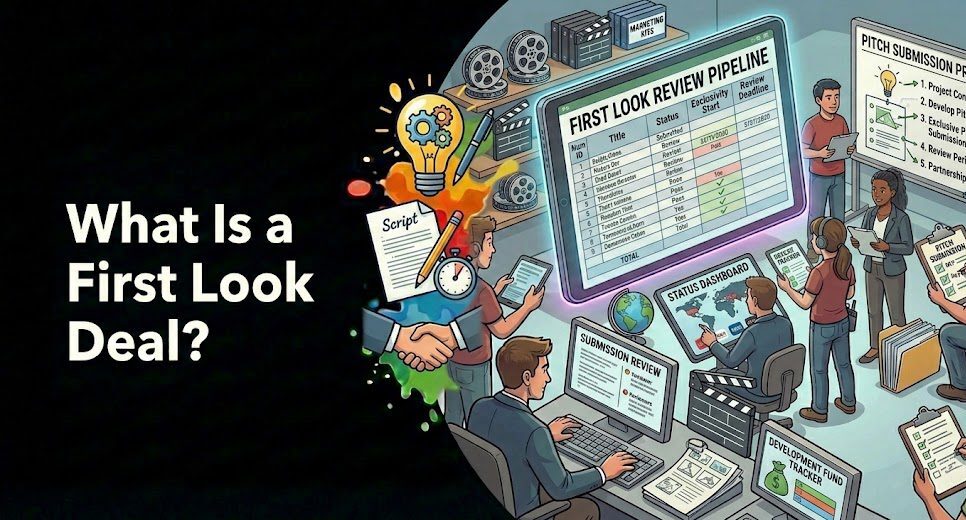
A first look deal is one of the most coveted—and most misunderstood—contracts in Hollywood. It’s the arrangement where a studio or streamer pays a producer, writer, or production company to give them the right to see and potentially develop new projects before anyone else does. Not exclusive. Not a full commission. Just first in line.
Here’s the thing: a first look deal isn’t really about the projects submitted. It’s about access to creative relationships—and the signal it sends to the rest of the market. When Netflix signs a first look with a showrunner, every other buyer immediately knows that talent is (temporarily) spoken for. When a producer’s first look at Warner Bros. Discovery expires, the room fills with competing offers before the ink dries on the termination notice.
Whether you’re a producer trying to land one, a writer evaluating whether to sign, or an executive trying to understand what your development slate actually looks like—this guide covers everything: the mechanics, the economics, the negotiating leverage, and how first look deals have evolved since the streaming era changed the rules. For context on how they sit within the broader development landscape, see Vitrina’s complete guide to development deals in film and TV.
Table of Contents
- What Is a First Look Deal — the Actual Definition
- How a First Look Deal Works: Step by Step
- Key Terms Inside Every First Look Deal
- First Look Deal vs. Overall Deal vs. Blind Script Deal
- What Studios and Streamers Actually Get
- What Producers and Writers Get — and Give Up
- First Look Deals in the Streaming Era: What’s Changed
- How to Land a First Look Deal in 2026
- Frequently Asked Questions
- Conclusion
What Is a First Look Deal — the Actual Definition
A first look deal is a contractual agreement between a studio, network, or streaming platform and a creative party—typically a producer, writer, director, or production company—in which the creative party commits to submitting new projects to that studio before taking them anywhere else. In exchange, the studio provides funding: a development fee, an overhead deal, or production office support. Sometimes all three.
Definition Box
First Look Deal: An agreement granting a studio the right to evaluate and potentially develop a producer’s or writer’s new projects before those projects are pitched to, or acquired by, any other buyer. The studio pays a fee for this right. It’s a right of first review—not a right of exclusivity on the projects themselves.
The name says it all. The studio gets to look first. If they pass, the producer can take the project elsewhere—usually after a defined window (commonly 30 to 60 days). If they bite, it moves into development under that studio’s banner. The creative party keeps their creative freedom; the studio keeps its pipeline warm. It’s a mutual hedge—and one of the foundational deal structures that keeps Hollywood’s development engine running.
But don’t confuse a first look with an output deal or a full exclusive. The studio isn’t buying everything you produce. And you’re not locked to a single buyer forever. The distinction matters—because how you negotiate one depends entirely on what you’re actually agreeing to.
Ask VIQI: Which Studios Are Actively Signing First Look Deals in Your Genre Right Now?
VIQI is Vitrina’s AI assistant—trained on 1.6 million titles, 360,000 companies, and 5 million entertainment professionals. Get deal intelligence before your competitors do.
✓ Included with 200 free credits | ✓ No credit card needed
How a First Look Deal Works: Step by Step
Let’s walk through the actual mechanics—because this is where most explainers go vague, and vague doesn’t help you negotiate.
Step 1: The deal is signed. A studio agrees to pay the producer a development fee—often structured as an annual overhead deal ranging from $250,000 to several million dollars depending on the producer’s track record. A-list showrunners with proven hit series command the top end; emerging producers with strong festival pedigree or one breakout credit are typically in the $300K–$700K range annually.
Step 2: The producer develops new material. While under the deal, the producer creates, options, or develops new project ideas. Scripts get written. IPs get optioned. Packages get assembled. All of this happens using the studio’s development infrastructure—which, depending on the deal, may include an office on the lot, a development executive assigned as a creative liaison, and a budget for script commissions.
Step 3: New projects go to the studio first. When a new project is ready to pitch, the studio gets an exclusive evaluation window—typically 30 days. During that window, they decide: develop it internally, acquire the pitch, or pass. This is the “first look” in practice. The clock starts. The studio reviews.
Step 4: Studio passes or picks up. If they pass, the producer is typically free to take the project elsewhere. Some deals include a “turnaround” provision—meaning the studio retains a right to match any offer the producer receives on the open market, or a right to recoup some development costs if the project gets made elsewhere. But if passed cleanly—the project walks out the door. If they pick it up, it enters the studio’s development slate and moves forward on their timeline, with their greenlight authority in play.
Step 5: The deal renews, expires, or gets upgraded. Most first look deals run 1–2 years with renewal options. A strong track record—projects developed, pilots greenlit, films produced under the deal—drives the renewal rate and fee up. A cold streak—everything passed, nothing greenlit—often means the deal doesn’t renew. That’s the performance dynamic studios use to manage their development overhead.

Your AI Assistant, Agent, and Analyst for the Business of Entertainment
VIQI AI helps you plan content acquisitions, raise production financing, and find and connect with the right partners worldwide.
- Find active co-producers and financiers for scripted projects
- Find equity and gap financing companies in North America
- Find top film financiers in Europe
- Find production houses that can co-produce or finance unscripted series
- I am looking for production partners for a YA drama set in Brazil
- I am looking for producers with proven track record in mid-budget features
- I am looking for Turkish distributors with successful international sales
- I am looking for OTT platforms actively acquiring finished series for the LATAM region
- I am seeking localization companies offer subtitling services in multiple Asian languages
- I am seeking partners in animation production for children's content
- I am seeking USA based post-production companies with sound facilities
- I am seeking VFX partners to composite background images and AI generated content
- Show me recent drama projects available for pre-buy
- Show me Japanese Anime Distributors
- Show me true-crime buyers from Asia
- Show me documentary pre-buyers
- List the top commissioners at the BBC
- List the post-production and VFX decision-makers at Netflix
- List the development leaders at Sony Pictures
- List the scripted programming heads at HBO
- Who is backing animation projects in Europe right now
- Who is Netflix’s top production partners for Sports Docs
- Who is Commissioning factual content in the NORDICS
- Who is acquiring unscripted formats for the North American market
Key Terms Inside Every First Look Deal
You’ll encounter these clauses in almost every first look negotiation. Know what they mean before you sign.
Overhead fee: The annual payment the studio makes to the producer, typically covering office space, staff, and a development budget. It’s the economic engine of the deal—and the primary negotiating lever. The overhead structure varies: some studios pay a flat fee, others pay a per-project development fee against which the overhead recoups.
First look period: The window in which the studio must respond to a submitted project. 30 days is standard for scripted projects; some deals give the studio 45 or 60 days. If they don’t respond within the period, the project is typically released. Negotiate this clause carefully—a 90-day window is a creative stranglehold.
Right of first refusal (ROFR): A stronger version than a first look—it gives the studio the right to match any competing offer before the producer can accept it. ROFR is generally more onerous for producers; first look is typically preferred from the talent side. But studios with leverage push for ROFR. Know which you’re agreeing to.
Turnaround: If the studio passes on a project and the producer takes it elsewhere, the turnaround clause may require the new buyer to reimburse the original studio for any development costs incurred. This is non-trivial—turnaround costs on a studio-developed script can reach $150,000–$500,000, which is a real deterrent for competing buyers.
Producer credit: First look deals typically guarantee the producer a producing credit (and associated producing fee) on any project that goes into production under the deal. The producing fee is separate from the overhead fee and is structured per-project.
IP ownership: This is the clause most producers underestimate. In many first look deals, IP developed using the studio’s overhead funding is owned—or co-owned—by the studio. Projects you bring in from outside (pre-existing IP, optioned material developed before the deal) are typically protected. But original IP developed on the studio’s dime during the deal term? Read the ownership clause very carefully.
Track Which Studios Are Greenlighting Projects Before It Hits the Trades
Trusted by Netflix, Warner Bros, Paramount, and Google TV. Join 140,000+ entertainment companies tracking development deals, first looks, and production greenlight activity in real time.
✓ 200 free credits | ✓ No credit card required | ✓ Full platform access
First Look Deal vs. Overall Deal vs. Blind Script Deal
These three deal types sit on a spectrum of exclusivity and financial commitment—and the differences are significant enough to determine your career trajectory.
| Deal Type | Exclusivity Level | Studio Commitment | Creative Freedom |
|---|---|---|---|
| First Look Deal | Low — studio sees projects first, can pass | Overhead fee + development support | High — free to shop elsewhere after pass |
| Overall Deal | High — all projects go to one studio | Larger overhead, staff, guaranteed fees | Limited — can’t pitch competitors |
| Blind Script Deal | Medium — writer commits to a specific number of scripts | Per-script fee, usually modest overhead | Medium — depends on contract specifics |
A first look deal is the lightest version of studio attachment. You keep maximum optionality—and the studio accepts the risk that you might develop your best idea and take it elsewhere after they pass. It’s the entry-level studio relationship for most mid-tier producers.
An overall deal is the heavyweight version. Think Shonda Rhimes signing with Netflix, Ryan Murphy moving from FX to Netflix, or Greg Berlanti’s long-running Warner Bros. TV deal. These are full-commitment structures where your entire creative output goes to one buyer—typically backed by $10M–$300M+ in total deal value for A-list talent. The studio gets everything; you get security, infrastructure, and a guaranteed income floor. The full breakdown is in Vitrina’s guide to overall deals.
A blind script deal sits between the two—it’s a specific commitment to write a defined number of scripts (usually 1–3) for a studio, without a specified project attached. The studio is essentially buying your writing output in advance, unseen. It’s called “blind” because neither party knows what the scripts will be when the deal is signed. Writers use blind deals to generate guaranteed income while retaining story control. Vitrina has a dedicated breakdown of how blind script deals work if that’s the structure you’re considering.
What Studios and Streamers Actually Get
Studios don’t sign first look deals out of generosity. There’s a hard-nosed business logic behind every one—and understanding it helps you negotiate from a position of knowledge, not guesswork.
Pipeline access. The development slate is everything. A studio without a robust pipeline of projects in various stages—pitch, script, pilot, series—is a studio that will be scrambling for content in 18 months. First look deals are pipeline insurance. By locking in relationships with 20–30 active producers and writers, a studio like Amazon or Disney can ensure a steady flow of new material without relying entirely on spec scripts and unsolicited pitches.
Relationship lock. In a competitive talent market, first look deals prevent competitors from accessing your creative relationships. When Netflix signed Ryan Murphy for an estimated $300 million, they didn’t just buy his projects—they bought five years in which FX couldn’t have him. That’s a competitive intelligence move as much as a content deal.
Brand association. A-list producer relationships signal quality to the market. When Amazon announces a first look deal with a Sundance breakout production company or an Emmy-winning showrunner, it tells the talent community: this platform invests in serious creative voices. That brand positioning matters for attracting future creative talent and press coverage. It’s marketing as much as deal-making.
Recoupment leverage. If a project developed under a first look deal eventually gets made at a competing studio after passing, the turnaround provision gives the originating studio a financial return on their development investment. It’s a hedge—the studio gets either the project or a cheque. Not bad for what is nominally just a “review right.”
What Producers and Writers Get — and Give Up
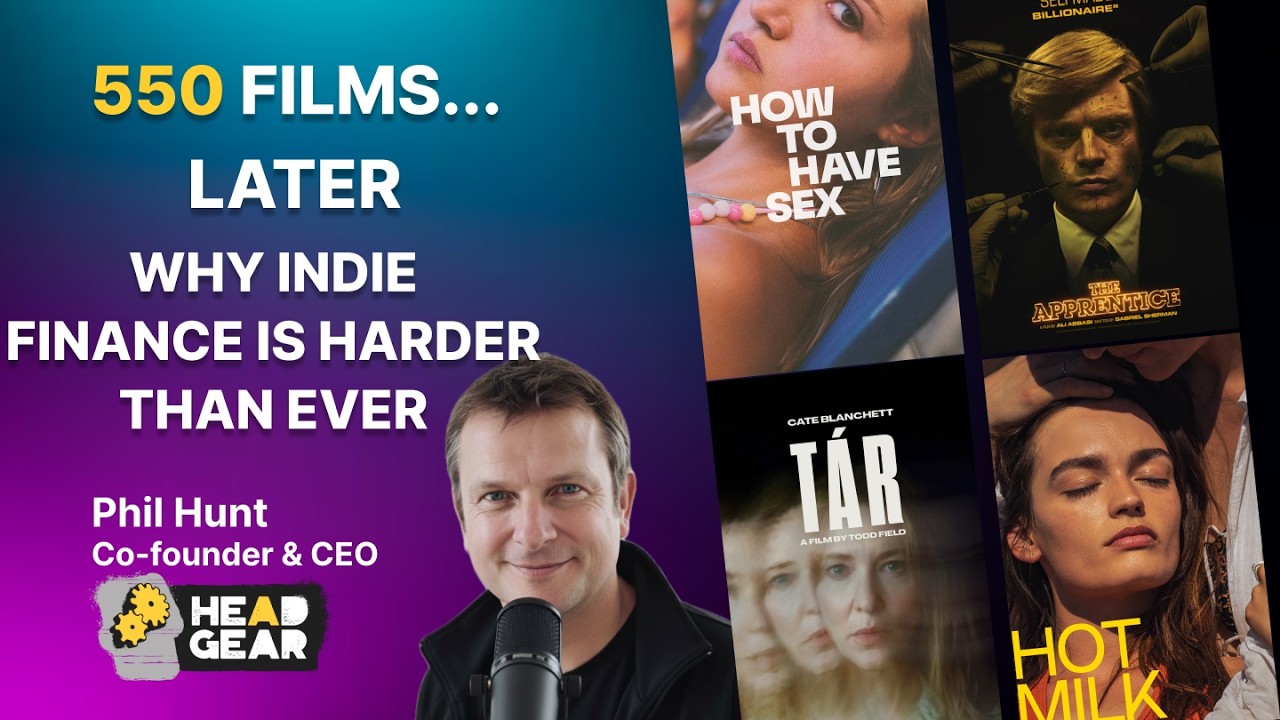
The benefits for the creative party are real—but so are the constraints. Phil Hunt, founder of Head Gear Films and one of the most prolifically credited producers in UK history at 550+ movies financed, makes this point clearly: being positioned at the center of the marketplace carousel means knowing exactly what deals structure creative relationships for maximum deal flow, not just maximum income.
What you get: A guaranteed development income—often enough to fund your overhead, staff, and ongoing development activity without relying on project-by-project fees. Development resources: script commissions, IP option budgets, sometimes a physical office and dedicated development executive. Credibility signal: a first look deal with a major studio is a public market statement that you’re operating at that level. And a clear first buyer—rather than having to cold-pitch dozens of buyers on every new idea.
What you give up: Speed. That 30–60 day review window means your best idea sits waiting while the market moves. If you develop something that would be perfect for a competing buyer and your first look studio passes, you’ve lost weeks—sometimes the timing window entirely. And if your deal includes aggressive IP ownership provisions, you may be giving up equity in your own intellectual property. The overhead fee can feel like a salary if you’re not careful—and a salaried creator is a constrained one.
The honest calculus: a first look deal is most valuable when your development pipeline is strong enough to keep the studio regularly reviewing new material—and when the relationship with the studio’s creative executives is collaborative enough to actually get projects to greenlight. A first look deal with a studio whose taste doesn’t align with yours is development purgatory. Everything gets passed. Nothing moves. And when the deal expires, you’ve spent 18 months building someone else’s optionality at the cost of your own. Read Vitrina’s analysis of how overall and first look deal structures benefit creators for the fuller picture.
Phil Hunt (Founder & CEO, Head Gear Films) on what studios actually look for when committing to a development relationship — and what “the market really wants” means in practice:
First Look Deals in the Streaming Era: What’s Changed
The streaming wars of 2019–2022 created a first look deal frenzy unlike anything the industry had seen before. Netflix, Amazon, Apple, and Disney+ were all simultaneously trying to build content pipelines from scratch—and the fastest way to do that was to lock in the relationships that had already produced the best content on competing platforms. The result: deal values inflated dramatically, terms got more generous to creators, and studios that hadn’t historically used first look structures began signing them aggressively.
But the hangover was real. By 2023, the post-COVID “revenge production” boom—as Phil Hunt described it—had generated overcapacity across the development slate. Netflix alone was reportedly carrying 400+ projects in development simultaneously, with greenlight rates that made the odds of any individual project reaching air feel slim. Studios began auditing their first look portfolios and culling deals that hadn’t produced results. The 2023 WGA and SAG-AFTRA strikes accelerated the reckoning: overhead deals were a significant cost target when production ground to a halt.
In 2026, the market has corrected significantly. What that means practically:
First, deal volumes are down. Studios are signing fewer first look deals, concentrating their development overhead on the creators with the most proven greenlight records. If you’re signing your first first look deal in 2026, it’s more selective than it was in 2021—and more meaningful for it.
Second, streaming platforms have become the primary signatories. Legacy studios still sign first look deals, but Netflix, Amazon, and Apple now dominate the landscape at the top end. This changes the calculus: streaming first looks often come with a narrower content mandate (the platform’s specific audience and genre preferences) compared to broad studio deals that covered film and TV across all distributors.
Third, the greenlight conversation has moved earlier. Streaming platforms often want the producer to come in with a more developed package before signing a first look—cast attachments, a script draft, viewership data from comparable titles. The era of paying overhead for speculative pitches is largely over. As Deadline has reported extensively, greenlight criteria at major streamers tightened markedly in 2025–2026. Variety noted that development overhead costs were a primary target in the post-strikes budget restructuring across studios.
Need Introductions to Studios Actively Signing First Look Deals? We’ll Make Them.
Vitrina Concierge is your Virtual Agent. We identify and directly connect you with development executives at the right platforms—before the window closes.
- Korean animation studio → Netflix Adult Animation (week one)
- LA producer → Netflix UK, Fifth Season, Fox Entertainment (48 hours)
- Middle Eastern studio → Legendary Pictures (direct access)
How to Land a First Look Deal in 2026
Let’s be direct: studios don’t sign first look deals with producers who’ve never made anything. You need either a breakout credit (a Sundance film, a festival hit, an episode on a well-regarded series) or a production company with a demonstrable track record—even if modest. But assuming you’re at that threshold, here’s what actually moves the needle in 2026.
Have a developed slate, not just a single idea. Studios signing first look deals in 2026 want to see that your development pipeline is robust enough to feed them multiple projects per year. Walking into a first look conversation with one pitch and three vague ideas isn’t compelling. Walking in with five fully developed pitches across different genres—with IP already optioned or scripts already in draft—shows you’re a development machine worth attaching to.
Match the platform’s content DNA. The worst first look deals are the ones where the producer and studio have fundamentally misaligned taste. Before pursuing a first look at any specific platform, understand their acquisition history, their current greenlight priorities, and which development executives are most aligned with your work. This isn’t research you can do from a Google search. It requires real-time intelligence on what’s getting greenlit, what’s in development, and where the white space is.
Don’t undersell IP ownership. If you’ve spent years building a strong IP library—optioned books, developed formats, original scripts you own outright—that’s your core negotiating asset. A studio signing a first look wants access to your creative relationships and pipeline. Make sure the deal structure reflects the value of what you’re bringing, not just what you’ll produce during the term. For a full understanding of how IP deals interlock with production structures, see Vitrina’s guide to IP and development deals.
Understand who’s actually in the market right now. The Data Deficit is real on both sides of this equation. Most producers are pitching first look conversations to studios they know—the 3 or 4 development relationships in their existing network. But studios signing first looks in 2026 aren’t only the ones you’ve met at MIPCOM. Tracking which platforms are actively building their development slates—who’s expanding, who’s contracting, who just got a new head of development with a mandate to bring in new relationships—requires real-time market intelligence that static trade press can’t provide six weeks after the fact. Vitrina tracks this activity across 140,000+ entertainment companies globally, surfacing active development deal flow before it hits the public record.
Frequently Asked Questions
What is a first look deal in Hollywood?
A first look deal is a contract in which a studio, network, or streaming platform pays a producer, writer, or production company for the right to evaluate new projects before they’re pitched to anyone else. In exchange, the studio typically provides an overhead fee (annual funding for office, staff, and development costs). If the studio passes on a project within the defined review window (usually 30 days), the producer is free to take it to competing buyers.
How much does a first look deal pay?
First look deal overhead fees range widely based on the producer’s or writer’s track record. Emerging producers with one strong credit typically earn $250,000–$500,000 annually. Mid-tier producers with multiple produced credits earn $500K–$2M. A-list showrunners with proven hit series can command overhead deals in the $2M–$5M+ range per year. The most famous overall deals (which are a more exclusive version) have reached $150M–$300M+ for talent like Shonda Rhimes and Ryan Murphy at Netflix.
What’s the difference between a first look deal and an overall deal?
A first look deal gives one studio the right to see your projects before others do—but if they pass, you can take the project anywhere. An overall deal is significantly more exclusive: all projects go to one studio, with no ability to pitch competitors. Overall deals pay more (often substantially more), but they constrain creative freedom more significantly. First look deals are the entry-level version of a studio attachment relationship; overall deals are reserved for the most commercially proven creative talent.
Who typically signs first look deals in the entertainment industry?
First look deals are most commonly signed with independent production companies, showrunners with at least one produced pilot or series, feature film producers with a festival or theatrical track record, and writers with at least one produced pilot or feature credit. Studios sign them with any creative entity whose track record suggests a reliable pipeline of pitchable projects. In the streaming era, Netflix, Amazon, Apple TV+, and Warner Bros. Discovery have been the most active signatories at the major platform level.
Can you pitch to other studios if you have a first look deal?
Yes—but only after the first look studio passes. Once you submit a project and the studio’s review period expires (or they explicitly pass), you’re typically free to take it to other buyers. Some deals include a right of first refusal, which allows the studio to match any competing offer before you accept it—that’s a more restrictive version. But a standard first look deal doesn’t prevent you from eventually pitching competitors; it just requires you to offer the project to your first look studio before you do.
What is turnaround in a first look deal?
Turnaround is the clause that governs what happens when a studio passes on a project that was developed using their funds. If the project subsequently gets made at a competing studio, the turnaround clause typically requires the new producer or studio to reimburse the original studio for development costs incurred—script fees, option payments, any overhead allocated to that project. Turnaround costs can run from $50,000 to $500,000+ depending on how much development work was done, and they can deter competing buyers from acquiring the project entirely.
Are first look deals still common in the streaming era?
Yes, but less common than during the peak streaming wars of 2019–2022. The post-COVID production boom created an unsustainable number of first look and overall deals, which studios began aggressively culling in 2023 as greenlight rates dropped and content budgets contracted. In 2026, first look deals still exist at all major studios and platforms—but the bar for who gets one is higher, the overhead fees are more performance-contingent, and the review timelines are often tighter. The best first look deals today are smaller in number, more carefully targeted, and more aligned to specific content needs.
How do first look deals affect IP ownership?
This varies significantly by deal structure, but it’s one of the most important clauses to scrutinise. IP that you develop using the studio’s overhead funding during the deal term is often owned—or co-owned—by the studio. IP you bring in from outside (pre-existing options, rights you own independently) is typically protected. Original concepts generated on the studio’s dime are the grey area. Producers should negotiate clear IP ownership provisions before signing, and ensure that any IP with franchise potential is protected regardless of where development funding comes from.
A First Look Deal Is a Relationship — Structure It Like One
The first look deal is one of Hollywood’s foundational deal structures—and it works best when both parties are genuinely aligned: the producer has a robust development pipeline, the studio has a clear content appetite, and the creative relationship is strong enough that projects actually reach greenlight. When those three things are true, a first look deal accelerates careers, builds IP libraries, and generates the kind of long-term studio partnerships that define a production company’s trajectory. When they’re not—it’s an expensive holding pattern for everyone involved.
Key Takeaways:
- Definition clarity matters: A first look deal grants one studio review rights before anyone else—not exclusivity. If they pass within the window (typically 30 days), you’re free to shop the project elsewhere.
- Know the deal spectrum: First look → Blind script → Overall deal. Each step up the ladder means more studio commitment and more creative constraint. Choose based on where you are in your career, not just the dollar amount on offer.
- Turnaround is a real cost: Development costs reimbursed under turnaround provisions can reach $50K–$500K+—enough to make your project unattractive to competing buyers. Negotiate this clause carefully before signing.
- The streaming era tightened standards: Post-2023, studios are signing fewer first looks at higher standards. The producers landing deals in 2026 have developed slates, proven greenlight relationships, and content that fits specific platform mandates.
- Intelligence drives deal positioning: Finding the right studio partner—one whose greenlight appetite matches your content—requires real-time market intelligence, not relationship networks that cover 0.1% of the buyer market. That’s where the Data Deficit costs producers deals they never even knew were available.
Find Studios Actively Signing First Look Deals in Your Genre
Trusted by Netflix, Warner Bros, Paramount, and Google TV. Join 140,000+ entertainment companies tracking greenlight activity, development deal flow, and studio mandates in real time.
✓ 200 free credits | ✓ No credit card required | ✓ Cancel anytime
Need direct introductions to development executives? Explore Concierge Service →
Find Film+TV Projects, Partners, and Deals – Fast.
VIQI matches you with the right financiers, producers, streamers, and buyers – globally.
Join Industry Briefings Trusted by Leaders
Film & TV Production Financing: 2026 Trends
Production financing conditions are changing quickly. Understanding where money is moving and what buyers are backing is key to getting projects approved and funded in 2026.
Unreleased Film+TV Projects: Opportunities & Showcase
A curated view of unreleased Film and TV projects open for financing and collaboration
The Mid-Budget Comeback: Why Mid-Budget Films Is the Smartest Bet in the Room
Mid-budget films are attracting new capital. See why this segment is becoming one of the strongest bets in Film today.
Franchise Fatigue vs. IP Dependency: What Studios Should Be Betting On Now
s franchise performance softens, where will the next generation of valuable IP come from? Join the briefing.