IHUB
IHUB
 Private Briefings (Webinars)


 LeaderSpeak Podcast
  Global Entertainment Digest (Newsletter)
  Premium Lists
 Membership Benefits
 About Vitrina
 Our Story
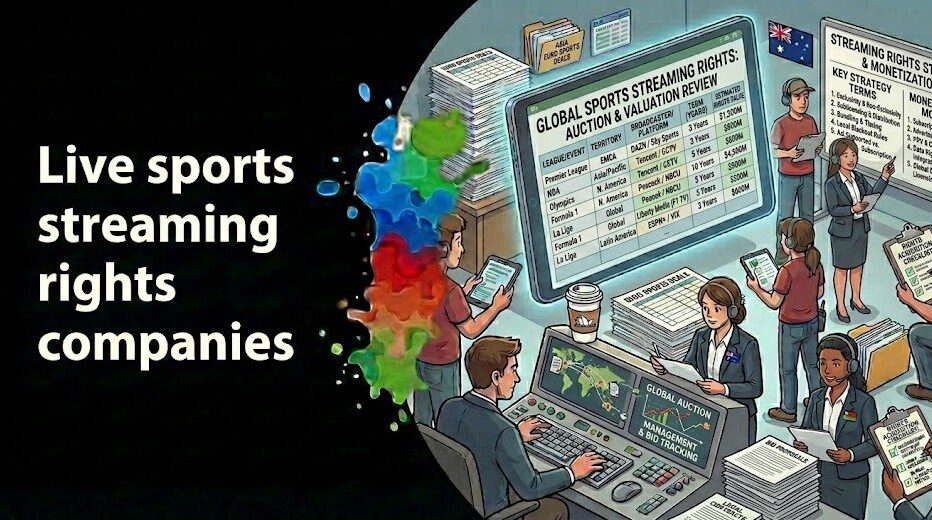
The live sports streaming rights companies reshaping this industry aren’t playing by old broadcast rules. They’re deploying capital at a scale that would have been unimaginable a decade ago—and the deals they’re signing right now determine who wins the subscription wars for the next five to ten years.
Here’s the thing: sports rights aren’t like a scripted drama. You can’t license a prestige series after the fact for pennies on the dollar. Live sports—NFL, IPL, Premier League, Formula 1—command the room-clearing moments that streaming platforms desperately need to justify their subscriber fees. And increasingly, the companies writing those checks aren’t traditional broadcasters.
They’re tech giants, sovereign-backed funds, and pure-play sports streamers who’ve decided that rights ownership is the fastest route to lock-in. If you’re working in content acquisition, distribution, or rights licensing—you need to know exactly who’s buying what, and why. So let’s get into it.
In This Article
- Why Sports Rights Are the Most Expensive Content Deals
- DAZN: The Pure-Play Sports Streaming Challenger
- ESPN+: Disney’s Dominant Rights Machine
- Amazon Prime Video: The Quiet Accumulator
- Apple TV+: Sovereign Spender, Zero Ads
- JioStar: How Cricket Rights Built 450 Million Subscribers
- Sky Sports and TNT Sports: The UK Duopoly
- What the Fragmentation Paradox Means for Your Strategy
- Frequently Asked Questions
Why Sports Rights Are the Most Expensive Content Deals You’ll Ever See
Rolla Karam, Senior Vice President of Content Acquisition at OSN—the premium pay-TV and streaming platform covering 23 countries across MENA—put it bluntly in a Vitrina LeaderSpeak interview: sports rights are “a beast by itself” requiring “a massive, massive budget.” She made a deliberate decision to keep OSN focused on entertainment rather than compete in sports acquisition. That candor tells you everything about the current market dynamic.
Sports rights differ from every other content category in one critical way—they create simultaneous, appointment viewing that nothing else replicates. A subscriber will cancel a drama service between seasons. They won’t cancel during the playoffs. That’s your churn hedge. And the platforms that control those rights have a structural advantage that scripted originals simply can’t match.
The capital required is eye-watering. NFL rights across all US broadcasters and streamers now total over $113 billion across the current deal cycle. The IPL cricket auction hit $6.2 billion for a five-year window. And the Premier League’s next UK rights cycle is expected to break previous records. So who’s actually at the table? Seven companies define the market right now.
As Vitrina tracks across its network of 300,000+ entertainment companies globally, the rights acquisition strategies of these platforms follow distinct patterns—and understanding those patterns is how you de-risk your own distribution and partnership decisions. For a broader look at how these platforms approach content buying, see Vitrina’s guide to live streaming companies powering the real-time content revolution.
Ask VIQI: Which Sports Streaming Platforms Are Actively Acquiring Rights in Your Territory?
VIQI is Vitrina’s AI assistant—trained on 1.6 million titles, 300,000+ companies, and 5 million entertainment professionals. Get real-time intelligence on who’s buying what, before it hits the trades.
✓ Included with 200 free credits | ✓ No credit card needed
DAZN: The Pure-Play Sports Streaming Challenger
DAZN—spun out of Perform Group in 2016 and now operating across more than 200 countries—built its entire model around one thesis: sports fans will pay a dedicated subscription fee if you aggregate the rights they actually care about. No films. No drama. Just sport, all the time.
The strategy has produced some of the most aggressive rights spending in the market. DAZN holds Serie A rights in Italy and has locked in boxing through deals with Matchroom Boxing and Golden Boy Promotions. The platform paid approximately $3 billion across its Serie A and Bundesliga portfolio at peak investment. But the model has also hit turbulence—subscriber growth didn’t scale fast enough to absorb those rights costs, triggering restructuring in 2022 and 2023.
What DAZN’s journey reveals is the brutal economics of pure-play sports streaming: rights costs are fixed, subscriber growth is variable, and the gap between the two determines your EBITDA. As reported by Sports Pro Media, DAZN has been selectively rationalising rights portfolios to improve unit economics—a strategy every sports rights buyer should study. The company is now pivoting toward a hybrid model that includes free, ad-supported tiers alongside premium subscriptions.
For acquisition executives, DAZN is a live case study in how rights fragmentation cuts both ways. They own enough to be relevant in multiple markets, but not enough in any single market to be truly dominant. That’s a tension every new entrant faces. To understand DAZN’s content acquisition approach in detail, Vitrina has covered their DAZN content acquisition strategy at length.

Your AI Assistant, Agent, and Analyst for the Business of Entertainment
VIQI AI helps you plan content acquisitions, raise production financing, and find and connect with the right partners worldwide.
- List the top commissioners at the BBC
- List the post-production and VFX decision-makers at Netflix
- List the development leaders at Sony Pictures
- List the scripted programming heads at HBO
- Find active co-producers and financiers for scripted projects
- Find equity and gap financing companies in North America
- Find top film financiers in Europe
- Find production houses that can co-produce or finance unscripted series
- Who is backing animation projects in Europe right now
- Who is Netflix’s top production partners for Sports Docs
- Who is Commissioning factual content in the NORDICS
- Who is acquiring unscripted formats for the North American market
- Show me recent drama projects available for pre-buy
- Show me Japanese Anime Distributors
- Show me true-crime buyers from Asia
- Show me documentary pre-buyers
- I am looking for production partners for a YA drama set in Brazil
- I am looking for producers with proven track record in mid-budget features
- I am looking for Turkish distributors with successful international sales
- I am looking for OTT platforms actively acquiring finished series for the LATAM region
- I am seeking localization companies offer subtitling services in multiple Asian languages
- I am seeking partners in animation production for children's content
- I am seeking USA based post-production companies with sound facilities
- I am seeking VFX partners to composite background images and AI generated content
ESPN+: Disney’s Dominant Rights Machine
ESPN+ operates differently from every other platform on this list. It doesn’t compete for sports fans from a standing start—it inherits decades of broadcast relationships and brand equity built by the linear ESPN network. And Disney has weaponised that inheritance to make ESPN+ the most rights-dense sports streaming product in the US market.
The numbers back that up. Disney’s ESPN-linked rights portfolio includes the NFL (Monday Night Football, with a deal worth roughly $2.7 billion per year), NHL (a seven-year deal worth $5.7 billion), SEC football, and a substantial chunk of MLB coverage. ESPN+ itself crossed 25 million subscribers and has been bundled strategically with Disney+ and Hulu—a capital stack play that makes churn management easier than any single-sport platform can achieve.
But Disney’s bigger play is the standalone ESPN streaming service—an “ESPN Flagship” product that’s expected to launch in 2025-26, aggregating all of ESPN’s rights into one direct-to-consumer offering. That’s a platform shift worth tracking. When the flagship launches, the rights landscape consolidates in Disney’s favour in a way that will pressure everyone else’s renewal negotiations. For a full breakdown, Vitrina has documented ESPN’s content acquisition strategy and what it means for rights holders globally.
Track Sports Rights Acquisition Deals Before They’re Public
Trusted by Netflix, Warner Bros, and Paramount. Join 140,000+ companies tracking the global entertainment supply chain—sports rights, distribution deals, and content partnerships included.
✓ 200 free credits | ✓ No credit card required | ✓ Full platform access
Amazon Prime Video: The Quiet Accumulator
Amazon doesn’t need sports rights to survive. That’s what makes them dangerous. Because they’re buying sports rights not to build a sports platform—they’re buying them to reduce churn on the broader Prime membership product. That’s a fundamentally different ROI calculation than DAZN’s, and it means Amazon can afford to overpay in ways a pure-play sports streamer simply can’t.
The Thursday Night Football deal is the headline: Amazon paid roughly $1 billion per year for exclusive NFL Thursday Night Football rights starting in 2022—a deal running through 2033. That’s 11 years of guaranteed NFL content that will sit inside a Prime subscription held by millions of US households who never opened a separate sports app. And in the UK, Amazon holds a package of Premier League matches, covering roughly 20 matches per season.
The recoupment model here is elegant. Amazon doesn’t need sports to drive direct subscription revenue—it needs sports to reduce Prime cancellations. If TNF keeps even 1 million subscribers who’d otherwise have cancelled their Prime membership, the ROI arithmetic works regardless of ad revenue. That’s a capital efficiency play that pure sports streamers can’t replicate. And it’s why Amazon keeps winning rights packages that look optically overpriced on a standalone media P&L.
Apple TV+: Sovereign Spender, Zero Ads
Apple TV+ brings a balance sheet into sports rights negotiations that no other bidder can match. Apple’s Services division—which includes Apple TV+—generated over $24 billion in revenue in a single quarter in 2024. Sports rights, for Apple, are essentially a marketing line item on a hardware company’s P&L. Nobody else operates from that position.
Their sports rights play has been measured but significant. Apple signed a landmark 10-year MLS Season Pass deal reportedly worth $2.5 billion, becoming the exclusive global home for Major League Soccer. And their Friday Night Baseball MLB deal—while modest in scope—gave them live rights experience and credibility before scaling up. The Apple sports model doesn’t need ads. It doesn’t need to maximise concurrent streams. It needs to make an Apple device look like the gateway to live sport for hundreds of millions of users globally.
Watch Apple in the next NFL cycle. Their cash position, global distribution, and device integration make them a credible dark-horse bidder for top-tier American sports rights. And unlike the DAZN model, Apple doesn’t need sports to be profitable in isolation—it needs sports to be useful. That strategic patience is its own kind of competitive advantage.
JioStar: How Cricket Rights Built 450 Million Subscribers
If you want to understand how a single sport can build a streaming empire, look at what cricket—specifically IPL—has done for JioStar in India. The platform, formed from the merger of JioCinema and Disney+ Hotstar, secured both digital and broadcast IPL rights in a deal that industry observers estimated at $6.2 billion for five years (2023–2027).
That’s not marketing spend. That’s infrastructure. Because when you own the IPL in India, you own appointment viewing for 1.4 billion people—a substantial portion of whom will register accounts, install apps, and accept ad breaks just to watch their team play. The subscriber data JioStar accumulated through IPL seasons has become an asset class in itself: behavioural data, regional preferences, device habits—all feeding content investment decisions far beyond cricket.
As Deadline has tracked extensively, the JioStar model is now being studied by Sovereign Content Hubs across MENA and APAC—particularly in Saudi Arabia, where the Public Investment Fund (PIF) has acquired stakes in multiple football clubs and is building a sports rights ecosystem around Vision 2030. The question isn’t whether that model works. The answer is sitting at 450 million registered users. Vitrina has covered the JioStar story in detail—see the analysis of how JioStar traded cricket rights for a South Indian empire.
Sky Sports and TNT Sports: The UK Duopoly
The UK sports rights market is where the old model and new model are still actively fighting for the same ground. Sky Sports—part of Comcast’s NBCUniversal—and TNT Sports (the rebrand of BT Sport following the joint venture with Warner Bros. Discovery) share the most valuable Premier League rights packages, Champions League coverage, and the bulk of top-tier UK sport.
Sky’s current Premier League package costs approximately £4.5 billion over a three-year cycle. TNT Sports holds the Champions League through 2027. Between them, they’ve maintained a duopoly that has resisted disruption better than most legacy broadcast markets globally. But the cracks are showing. Amazon’s Prime Video incursions into Premier League rights, plus Apple and Netflix circling, mean the next rights auction cycle—starting around 2028—will look very different from the current one.
Here’s what the UK duopoly tells you about global sports rights dynamics: incumbency only holds as long as your capital access outpaces challengers with different ROI requirements. Sky needs sports rights to drive satellite and streaming subscribers. Amazon needs them to reduce Prime churn. Those are incompatible motivations in a competitive auction—and the challenger with the lower return threshold wins every time. Sky knows this. Their strategic response—bundling Sky Sports with streaming access, NOW TV, and progressive pricing tiers—is a defensive play, not a growth play.
Find Sports Rights Partners Across 140,000+ Entertainment Companies
Vitrina’s Smart Pairing matches rights holders, distributors, and acquisition teams globally. Netflix, Warner Bros, and Paramount use Vitrina—and now you can too, with 200 free credits, no credit card required.
✓ 200 free credits | ✓ No commitment | ✓ Full platform access
What the Fragmentation Paradox Means for Your Sports Rights Strategy
There’s a pattern running through every company on this list that most acquisition executives don’t articulate explicitly. The Fragmentation Paradox that defines the broader entertainment supply chain has hit live sports rights with particular force. Rights that once lived under one or two broadcast roofs are now split across five, six, sometimes eight platforms—each holding a different window, a different territory, or a different match package.
Take English football as an example. The Premier League’s current UK cycle splits rights between Sky, TNT Sports, and Amazon. International rights then split further—beIN Sports in MENA, DAZN in multiple European markets, JioStar in India, Optus Sport in Australia. A single competition, distributed across a dozen platforms globally. That’s the Fragmentation Paradox in action: more distribution options, but exponentially more complexity in knowing who owns what, where, and when.
For rights holders, this creates two problems simultaneously. First: understanding who’s actually in the market and what they’ll pay. Second: identifying which platform in which territory is underserved and actively bidding. Both problems require real-time intelligence—not a trade report from six months ago. And this is exactly where Vitrina’s platform—tracking 1.6 million+ active projects and deal flows across the global supply chain—changes the calculus for rights strategies. See how global rights acquisition for streaming is evolving in 2026 across all content categories.
But there’s an opportunity embedded in the complexity, too. Rights holders who understand the Fragmentation Paradox can use it strategically—licensing the same sporting event to a free-to-air broadcaster, a premium streamer, and a FAST channel in different territories, stacking revenue across windows that didn’t exist five years ago. That’s Weaponized Distribution. And the companies doing it well—NFL Media, the Premier League commercial team, IPL’s BCCI—are generating rights revenues that would have seemed impossible in the linear era.
Frequently Asked Questions About Live Sports Streaming Rights
What are live sports streaming rights companies?
Live sports streaming rights companies are platforms and broadcasters that purchase the legal rights to stream sporting events in real time to viewers. These include pure-play sports platforms like DAZN, tech-giant streamers like Amazon Prime Video and Apple TV+, studio-owned services like ESPN+, and regional operators like JioStar. They acquire rights directly from sports leagues, federations, and governing bodies—typically through auction processes covering territory-specific windows across multiple years.
Which company holds the most live sports streaming rights globally?
By territory breadth, DAZN holds sports streaming rights across more than 200 countries, making it the widest-reaching platform globally. But by rights value and audience scale, ESPN+ (US), JioStar (India), and Sky Sports (UK) hold the most financially significant packages in their respective markets. There’s no single platform that dominates globally—sports rights are inherently territory-specific, which is why every major market has its own dominant player.
How do live sports streaming rights deals work?
Sports rights deals are typically negotiated between the rights holder (a league, federation, or event organiser) and platforms through a competitive tender or auction process. Rights are packaged by territory, exclusivity level, window (live, delayed, highlights), and term length. Deals can range from a single season to multi-decade arrangements. The platform then pays a fixed rights fee—regardless of viewer numbers—meaning all the performance risk sits with the buyer, not the seller.
Why are Netflix and Amazon now buying live sports rights?
Both Netflix and Amazon have entered live sports specifically to reduce subscriber churn. Sports creates appointment viewing—scheduled events that subscribers won’t miss, and won’t cancel their accounts to avoid missing. Netflix signed a deal worth approximately $5 billion over 10 years for WWE Raw, starting in 2025, and has broadcast NFL games on Christmas Day. Amazon holds Thursday Night Football in the US (~$1 billion per year) and Premier League matches in the UK. For both, the ROI calculus is membership retention, not direct sports revenue.
How does sports rights fragmentation affect distribution strategy?
Rights fragmentation means a single sporting event or league can now generate revenue across multiple platforms simultaneously in different territories—sky Sports for UK live, Amazon for UK midweek packages, DAZN for select European markets, JioStar for India, beIN for MENA, and so on. For rights holders, this creates layered revenue opportunities. For buyers, it creates intelligence challenges: knowing who’s holding which rights, what territory gaps exist, and where renewal windows are opening requires real-time data, not static trade databases.
What role do Sovereign Content Hubs play in sports rights?
Sovereign Content Hubs—government-backed production and distribution ecosystems in territories like Saudi Arabia, UAE, and India—are increasingly active in sports rights acquisition. Saudi Arabia’s Public Investment Fund (PIF) has acquired stakes in Premier League clubs, the LIV Golf series, WWE partnerships, and boxing promotions. The goal isn’t just content—it’s soft power, tourism, and economic diversification under programmes like Vision 2030. This capital has an ROI model that differs fundamentally from commercial media companies, allowing Saudi-backed entities to bid at prices that conventional broadcasters can’t match.
How can I track which sports streaming platforms are actively acquiring rights?
Vitrina’s platform tracks deal flow, acquisition activity, and rights movements across 300,000+ entertainment companies globally, including major sports streaming platforms. VIQI, Vitrina’s AI assistant, can surface real-time intelligence on which platforms are actively acquiring in specific territories or sport categories. This is significantly faster than waiting for trade press coverage—most major rights deals are tracked on Vitrina before they hit Deadline or Variety.
The Bottom Line: Sports Rights Are the New Currency of Streaming Survival
The seven live sports streaming rights companies covered here aren’t competitors in the traditional sense. They’re operating different businesses with different return requirements, different subscriber bases, and different strategic ambitions. DAZN needs sports to pay its own way. Amazon and Apple need sports to make everything else stickier. ESPN+ needs sports to transition a broadcast dynasty into a streaming future. And JioStar needed one sport—cricket—to build one of the world’s largest streaming platforms from near-zero in under three years.
What they share is this: they’re all accelerating into rights ownership at a pace that’s fragmenting the market faster than most acquisition professionals can track. And in that fragmentation lies both the risk and the opportunity—for rights holders, for distributors, and for every professional navigating the global entertainment supply chain.
Key Takeaways:
- Rights fragmentation is accelerating: A single sport is now licensed across 8–12 platforms globally, creating layered revenue opportunities and significant intelligence complexity for buyers and sellers alike.
- Non-media ROI changes bidding dynamics: Amazon and Apple bid with churn-reduction logic, not media P&L logic. That means they’ll consistently outbid pure-play sports streamers on marquee packages.
- Cricket proved the model at scale: JioStar’s IPL strategy—$6.2 billion in rights generating 450 million users—is the clearest proof that a single sport can build a streaming empire in an emerging market.
- Sovereign capital is entering the arena: Saudi Arabia’s PIF and UAE entities are acquiring sports IP and rights at prices driven by Vision 2030 economic targets, not entertainment ROI—a structural market distortion every rights negotiator needs to factor in.
- Real-time intelligence determines deal outcomes: In a fragmented rights market, knowing which platforms have open territory windows, active budgets, and expiring deals before they hit the trades is the difference between closing and missing.
Start Tracking Sports Rights Deals Across 159,223 Active Projects
Netflix, Warner Bros, and Paramount use Vitrina to track the global entertainment supply chain. Join 300,000+ companies—get 200 free credits to discover rights holders, distribution partners, and acquisition leads in your territory today.
✓ 200 free credits | ✓ No credit card required | ✓ Cancel anytime