IHUB
IHUB
 Private Briefings (Webinars)


 LeaderSpeak Podcast
  Global Entertainment Digest (Newsletter)
  Premium Lists
 Premium Reports
 Membership Benefits
 About Vitrina
 Our Story
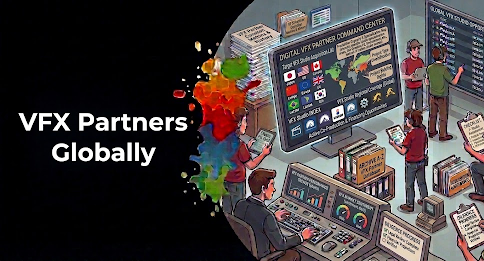
Studios source global VFX, post, and production partners through a structured 4-stage process: market mapping using intelligence platforms, qualification filtering (TPN, credits, capacity), competitive RFP, and due diligence. Key decision drivers are TPN certification status, verified credit lineage, jurisdiction tax incentives (25-40% of spend), and throughput capacity. Not creative reels alone.
The way studios source global VFX, post, and production partners has changed permanently. A decade ago, vendor sourcing ran on personal relationships: the executive who knew a post house in Prague, the producer with a contact at an animation studio in Seoul. That model collapsed as content volumes tripled and global pipelines stretched across dozens of countries simultaneously. Streaming platforms commissioned over 600 original series in 2024 alone, creating a vendor demand that no single hub could absorb.
COVID-19 accelerated what was already inevitable. Forced remote pipeline adoption permanently normalized cross-border vendor relationships. Studios that had never sent VFX work outside their domestic market discovered that a studio in Mumbai, Warsaw, or Ho Chi Minh City could deliver broadcast-quality output at a fraction of the legacy cost structure. Combine that with jurisdiction tax incentives that can offset 25-40% of qualifying spend, and how studios source VFX partners globally has become a discipline as rigorous as any other part of production finance.
Key Takeaways
- The global production services market exceeded $248 billion in 2024 (Ampere Analysis)
- The global VFX market reached $10.6 billion in 2024 (Precedence Research), growing at 8.3% CAGR through 2030 (Grand View Research)
- TPN-certified facilities: 900+ globally across 40+ countries (MPA, 2025)
- Tax incentives offset 25-40% of qualifying production and VFX spend, making jurisdiction a core financial decision
- Studios spend an average of 200-400 hours per production on vendor sourcing using traditional methods
- AI-driven platforms reduce vendor shortlisting from 200-400 hours to 20-40 hours, a reduction of up to 60%
$10.6B
Global VFX market (2024)
Grand View Research
900+
TPN-certified facilities globally
MPA, 2025
60%
Reduction in sourcing time
with intelligence platforms
Table of Contents
- Why Global Sourcing Has Become the Standard
- The Five Vendor Categories Studios Source Globally
- How the Vendor Evaluation Process Works
- The Four Critical Evaluation Criteria
- Emerging Production Hubs Reshaping Global Sourcing
- How AI and Intelligence Platforms Are Changing Vendor Discovery
- Tax Incentives by Region
- Common Sourcing Mistakes: And How to Avoid Them
- How Vitrina Maps the Global Production Ecosystem
- Conclusion
- Frequently Asked Questions
Vitrina Intelligence
Access verified VFX, post, and production vendor intelligence across 60+ countries, with TPN filters, VIQI scores, and tax incentive data.
Why Studios Source VFX and Production Partners Globally: The Three Forces
Three structural forces drove the shift to systematic global vendor sourcing. Streaming platforms commissioned over 600 original series in 2024, creating a throughput demand that no single production hub can absorb. Tax incentives can offset 25-40% of qualifying spend, making jurisdiction a multi-million dollar financial variable on any major production. And creative specialization has dispersed globally, meaning the best facility for your specific need may be in Belgium, South Korea, or South Africa.
Force 1: Volume Has Outgrown Any Single Hub
Hollywood, Pinewood, and the traditional post corridors of London can’t absorb the combined output demand of Netflix, Amazon, Apple TV+, Disney+, Peacock, and every regional streamer simultaneously active in the market. Work flows to wherever skilled teams and certified infrastructure exist. This is not a trend. It’s now the permanent architecture of global content production.
The global production services market exceeded $248 billion in 2024 (Ampere Analysis). That number reflects a supply chain distributed across every continent, not concentrated in a handful of ZIP codes. Productions that limit their vendor searches to domestic markets are competing for a constrained, premium-priced pool of capacity.
Force 2: Tax Incentives Changed the Economics
A VFX studio in London, Montreal, or Mumbai doesn’t just offer creative talent. It offers a financial structure that changes the net cost of production by 25-40%. Choosing a vendor is no longer a purely creative decision. It’s a budget decision. Studios that don’t model post-incentive costs alongside gross rates are making location decisions on incomplete data.
Canada stacks provincial and federal incentives to reach 25-45% on qualifying VFX spend. The UK introduced an enhanced VFX rate under AVEC in 2024, reaching up to 34%. Australia’s PDV offset goes to 40% for post, digital, and VFX work. These aren’t marginal adjustments. On a $50 million VFX budget, a 30% rebate is $15 million back to the production.
Force 3: Creative Specialization Has Gone Global
The best colour grading facility for a prestige drama may be in Belgium. The best creature animation rigging team may be in South Korea. The most cost-efficient in-between animation pipeline for a children’s series may be in the Philippines. Global sourcing is now a creative and financial necessity, not a cost-cutting exercise designed to degrade quality.
The Breaking Point: How COVID-19 Normalized Remote Pipelines
Before 2020, many studios had policy-level resistance to cross-border VFX pipelines. Remote rendering, distributed review sessions, and international delivery pipelines were viewed as risk factors. COVID-19 forced adoption of all three in a matter of weeks. The studios that adapted discovered that a well-run remote pipeline in a different time zone delivered output indistinguishable from an on-site team. That lesson did not reverse when offices reopened.
The permanent result is that cross-border vendor relationships are now operationally normal. The sourcing question has shifted from “can we work with a vendor in another country?” to “which country gives us the best combination of capability, capacity, certification, and cost?” That is a more complex question. It requires better data. And it’s why the sourcing process itself has had to professionalize.
Citation Capsule
The global production services market exceeded $248 billion in 2024, according to Ampere Analysis, reflecting a supply chain now distributed across every continent. Simultaneously, streaming platforms commissioned over 600 original series that year, creating throughput demand that no single production hub can absorb, driving systematic global vendor sourcing as standard procurement practice.
The Five Vendor Categories Studios Source Globally
Production, post, and VFX procurement covers five distinct vendor categories, each with its own sourcing logic, evaluation criteria, and regional supply dynamics. The global VFX market alone reached $10.6 billion in 2024 (Precedence Research), projected to grow at 8.3% CAGR through 2030, signaling sustained demand for specialized vendors across all five categories.
1. Visual Effects (VFX)
VFX vendors range from large-scale studios handling full episodic compositing and CG environments to boutique houses specializing in specific disciplines: creature animation, de-ageing, or simulation effects. The global qualified vendor pool for high-end episodic VFX work numbers in the hundreds, not thousands. Knowing where qualified capacity actually exists is the core sourcing challenge in this category.
Key global hubs include the UK (London, Manchester), Canada (Toronto, Vancouver), Australia (Sydney, Melbourne), India (Mumbai, Hyderabad, Bangalore), and South Korea (Seoul). Each hub has distinct strengths. London excels in creature work and photoreal environments. Mumbai’s studios have built deep pipelines for effects-heavy action sequences. South Korea leads in stylized CG and animation-adjacent VFX. Understanding regional specialization, not just geography, is how procurement teams build smarter long lists.
Evaluation nuances specific to VFX sourcing include render farm capacity (measured in render hours, not just headcount), software pipeline compatibility (Houdini, Nuke, Maya versions), and the vendor’s ability to work inside the production’s existing security protocols. A studio with strong creative output but an incompatible render pipeline creates integration costs that can erode the price advantage entirely.
2. Post-Production
Post houses handle editorial, colour grading, sound design, mixing, and final delivery. The sourcing challenge in post-production is that TPN certification requirements significantly narrow the available vendor pool. There are 900+ TPN-certified facilities globally (MPA, 2025), but that number drops sharply when filtered for specific capabilities, such as Dolby Atmos mixing with IMAX delivery specs alongside colour grading in HDR10+ and Dolby Vision simultaneously.
Sound post and picture post also split into distinct procurement tracks for larger productions. A facility optimized for theatrical colour grading may not have the ADR and loop group infrastructure needed for a prestige drama series. Sourcing teams should treat sound post and picture post as separate vendor categories with separate evaluation criteria, rather than assuming a single facility can handle both to the required level.
Post incentive structures have matured in ways that directly affect vendor selection. UK AVEC reaches 34% on qualifying post spend (a 15% year-on-year increase in UK production spend was recorded in 2025, per Entertainment Partners). Ireland’s Section 481 covers 32%. Germany’s DFFF goes to 25%. These aren’t theoretical. They’re being actively used by major studio productions to route post work to certified facilities in incentive-rich markets. The post vendor you choose and the jurisdiction where you complete that work are now inseparable decisions.
3. Animation
Animation outsourcing follows a tiered supply chain with distinct sourcing logic at each level. Key animation and character performance are typically kept in-house or at premium partner studios in the US, Japan, or South Korea. In-between animation, clean-up, background painting, and color fill flow to studios in South and Southeast Asia, where the combination of trained talent pools and lower cost structures has built a reliable offshore pipeline over 30 years.
The Philippines, Vietnam, and India dominate the in-between animation market globally. The Philippines alone is home to dozens of studios with decades of episodic TV animation experience for US and European broadcasters. Vietnam has emerged as a significant 3D animation center, with studios in Ho Chi Minh City increasingly taking on full episodic CG animation work, not just service work. India’s animation sector has expanded from traditional 2D outsourcing into full CG series production with streaming-level quality output.
Key evaluation nuances for animation sourcing include the ratio of lead animators to in-between animators on a vendor’s team (a proxy for quality risk), the studio’s experience with the specific pipeline (2D digital, 3D CG, or traditional cel), and their track record managing frame count delivery on episodic schedules where a single delayed episode can cascade into broadcast failures.
4. Localization and Dubbing
As platforms target simultaneous multi-language releases, localization vendors have moved from afterthought to strategic supply chain partner. Netflix has built a preferred vendor network across 30+ languages. Evaluating a localization vendor requires looking beyond language coverage to studio quality, voice cast depth, and episodic turnaround capacity. A vendor that can deliver English-to-Spanish dubbing for a single film but lacks the studio infrastructure to deliver weekly episodes simultaneously is not fit for streaming-scale production.
Regional evaluation differences matter significantly in this category. European dubbing markets (German, French, Italian, Spanish) have long-established dubbing traditions with deep voice artist pools and established quality norms. Southeast Asian and Middle Eastern markets are newer to streaming-quality dubbing and have smaller verified vendor pools. Sourcing teams working with regional streaming expansion need to build localization vendor pipelines earlier than the production calendar would suggest. Qualified vendors with streaming experience fill up fast.
5. Production Services
Production service companies in incentive-rich jurisdictions enable international productions to access local crew, facilities, and tax credits without establishing a domestic entity. They’re the production infrastructure layer that makes it financially viable to shoot in a market where you have no permanent operations. Eastern Europe (Czech Republic, Hungary, Romania), Spain, and New Zealand are the most established production services markets for international projects.
Evaluating a production service company goes beyond their credit list. Key questions include: do they have relationships with the specific local crew departments the production requires (costume, production design, stunt coordination)? Have they serviced productions of comparable budget scale? What is their track record navigating local labor regulations and union agreements on behalf of international productions? A production service company is essentially a local operating partner. The evaluation should be as rigorous as evaluating any key creative partner.
How the Vendor Evaluation Process Works
Mature procurement teams follow a four-stage structured evaluation framework rather than relying on referrals alone. Using traditional methods, this process consumes 200-400 hours per production before a shortlist is established. Intelligence platforms compress this to 20-40 hours by automating the qualification filter stage. Understanding who owns each stage, and where the process most commonly breaks down, is essential for production teams building or improving their sourcing workflow.
Stage 1: Market Mapping (2-3 Weeks)
Define the vendor category, required capabilities, target jurisdictions, and budget envelope. Use intelligence platforms and market databases to build a long list of 40-80 candidates meeting basic criteria. This stage is owned by the production executive or department head in partnership with the procurement team. The most common failure at this stage is building the long list from personal networks alone, which typically captures fewer than 10% of globally qualified vendors.
Effective market mapping requires defining criteria before building the list, not after. Productions that start with a list of familiar names and then try to filter it are working backwards. The correct approach: define what qualified looks like in terms of TPN status, jurisdiction, capacity, and credit type, then use those criteria to pull a list from a verified database. This produces a fundamentally different, more complete candidate set.
Stage 2: Qualification Filter (1-2 Weeks)
Screen the long list against non-negotiable criteria: TPN certification status, jurisdiction for incentive access, minimum capacity thresholds, and verified credits on comparable recent titles. This stage typically reduces 40-80 candidates to 10-15 qualified vendors. Procurement owns this stage. The most common failure here is skipping the TPN pre-check to save time, then discovering at the due diligence stage that a preferred vendor is not certified, wasting 2-3 weeks of evaluation investment.
Stage 3: RFP and Competitive Bid (3-4 Weeks)
Issue a Request for Proposal to shortlisted vendors with detailed technical specifications, delivery requirements, and timeline. Evaluate responses across price, capability, references, and infrastructure. Most productions run 2-3 bid rounds before selection. This stage is jointly owned by production and procurement, with finance involved in bid analysis. The most common failure here is issuing an RFP without sufficient technical specificity, resulting in incomparable bids that force a second round and add 2-3 weeks to the timeline.
Stage 4: Due Diligence and Contracting (2-3 Weeks)
Conduct facility assessments (often virtual), review insurance and compliance documentation, verify TPN status directly with MPA, and confirm key personnel availability. Contract terms cover deliverables, technical specifications, confidentiality, and penalty structures for late delivery. Legal owns this stage in partnership with production and finance. The most common failure is insufficient key personnel confirmation. A VFX supervisor or post producer who is verbally committed but not contractually locked can leave the project mid-production, triggering a renegotiation from a position of weakness.
Step-by-Step Sourcing Checklist
- Define vendor category, required specialization, and non-negotiable criteria (TPN, jurisdiction, capacity)
- Set budget envelope inclusive of post-incentive net cost modeling
- Run verified database query to build a long list of 40-80 candidates
- Apply qualification filter: TPN status, comparable credits, jurisdiction, capacity check
- Reduce to 10-15 qualified vendors and validate capacity availability
- Issue detailed RFP with technical specifications, delivery timeline, and format requirements
- Evaluate bids on price, pipeline, references, and infrastructure. Not showreel alone
- Shortlist 2-3 finalists for due diligence
- Conduct facility assessment (virtual or in-person), verify TPN directly with MPA
- Confirm key personnel contractually before finalizing contract terms
- Execute contract with deliverables, milestone dates, and penalty structure
What Are the Critical Criteria for Evaluating Global VFX and Post Vendors?
Four criteria determine whether a vendor makes the shortlist on every major production sourcing process. With 900+ TPN-certified facilities globally (MPA, 2025), the certified pool is large enough that no production should be accepting uncertified vendors for pre-release content. The table below maps each criterion to its evaluation method and business rationale.
| Criterion | What to Check | Why It Matters |
|---|---|---|
| TPN Certification | Current MPA TPN assessment status, expiry date | Hard requirement for Netflix, Amazon, Disney+, Apple TV+ |
| Credit Lineage | Verified credits on comparable titles in last 24 months | Proves real-world pipeline capability beyond showreels |
| Tax Incentive Access | Jurisdiction rebate rate and qualifying spend criteria | Can reduce net cost by 25-40%, changing the economics entirely |
| Throughput Capacity | Personnel count, render capacity, current pipeline load | Prevents delivery failures on long-cycle productions |
| Key Personnel Stability | Department head tenure (target: 2+ years at vendor), recent turnover rate | High turnover at VFX studios is a delivery risk signal; key person departures mid-production can trigger renegotiation |
Why Key Personnel Stability Is the Fifth Criterion Most Teams Miss
VFX studios are fundamentally talent businesses. The vendor you evaluate during the RFP process is not the vendor you get if the VFX supervisor, compositing lead, or CG supervisor has left in the six months since you contracted. Procurement teams that verify TPN status, credit history, and capacity but don’t ask about department head tenure are leaving a significant delivery risk unexamined.
The question to ask in due diligence is direct: “How long have your current department heads in [relevant discipline] been with the company?” Studios with high leadership turnover in the 12-24 months before your production will carry that instability into your project. Studios where the same leads have been running their departments for 3-5 years carry institutional knowledge that translates directly into smoother pipelines and better delivery performance. This is a factor that doesn’t appear in a showreel and isn’t tracked in most vendor databases. It should be.
From the Field
In tracking vendor performance across the Vitrina platform’s 140,000+ production companies, one consistent pattern emerges: studios with low department-head turnover deliver on schedule at significantly higher rates than studios with high turnover, even when both carry comparable credit histories and TPN certification. Stability at the lead level is a proxy for operational maturity that headcount and hardware specs alone don’t capture.
Which Emerging Production Hubs Are Reshaping Global Sourcing?
The traditional “Big Five” sourcing markets — UK, Canada, Australia, US, and New Zealand — no longer represent the full picture of qualified global production capacity. Eastern Europe, Southeast Asia, the Middle East, Africa, and South Korea have each developed distinct production and post capabilities that offer compelling combinations of cost efficiency, tax incentives, and specialized talent. Procurement teams limiting searches to the Big Five are structurally blind to 30-50% cost reduction opportunities on comparable work.
| Hub / Region | Core Specialty | Tax Incentive | Key Studios / Notes | Growth Driver |
|---|---|---|---|---|
| Czech Republic | Live-action service, period production design, costume | 20-25% rebate | Barrandov Studios, Prague; multiple HBO/Netflix productions serviced | Lower below-the-line costs vs. UK/Western Europe |
| Hungary | Large-scale live action, stunts, VFX pre-viz | Up to 30% cash rebate | Korda Studios; multiple Marvel and international features | Purpose-built studio infrastructure + strong incentive |
| Romania | Location services, production design, co-production | 20-25% rebate | Growing service sector; Transylvania locations popular for streaming | Architectural variety + cost efficiency |
| Philippines | 2D in-between animation, clean-up, background art | CITEM export incentives | 30+ years of US/EU TV animation outsourcing history | Deep trained talent pool; English-language workflow |
| Vietnam | 3D CG animation, CGI, episodic service work | Emerging incentive framework | Ho Chi Minh City studios handling full CG series | Cost arbitrage + improving 3D capability |
| Thailand | Location production, VFX compositing, post | 15-20% rebate | Growing streaming production hub for Asia-Pacific content | Regional streaming demand + infrastructure investment |
| Saudi Arabia / UAE | Location production, SVOD co-production mandates | Saudi Film Commission rebates; NEOM production zone | Netflix, Amazon co-production requirements for regional content | Government investment + streaming co-production mandates |
| Morocco | Location services, co-production treaties | 20-25% rebate | CLA Ouarzazate; major European and US productions | Desert/MENA locations + treaty access |
| South Africa | Location services, VFX, post-production | 25% SARS rebate on qualifying spend | Cape Town and Johannesburg studios; Amazon productions | Geographic diversity + improving VFX infrastructure |
| South Korea | VFX, stylized CG animation, K-drama pipeline | Up to 30% on qualifying VFX spend | Studio Dragon, Dexter Studios; global K-drama export machine | K-drama global streaming demand driving VFX pipeline growth |
The “Beyond the Big Five” Shift
Procurement teams that limit searches to UK, Canada, Australia, US, and New Zealand are missing cost-competitive studios in Poland, Vietnam, and South Africa where labor arbitrage combined with improving infrastructure and maturing TPN compliance creates a 30-50% cost reduction opportunity on comparable VFX work, without the quality tradeoffs that characterized offshore outsourcing in earlier cycles. The constraint is no longer capability. It’s visibility.
The Middle East: From Location Market to Production Ecosystem
Saudi Arabia and the UAE have moved beyond being backdrop markets for foreign productions. The Saudi Film Commission’s rebate program and the NEOM production zone represent deliberate infrastructure investment to position the Kingdom as a regional production hub. For major streamers building Arabic-language content pipelines, co-production structures with Saudi and UAE partners are increasingly a requirement, not an option, for accessing regional distribution and subsidy support.
For sourcing teams, this means building Middle Eastern vendor relationships before they’re needed, not in response to a co-production mandate. The verified vendor pool in Saudi Arabia and UAE is still developing. Teams that invest in mapping qualified local vendors now will have a structural advantage when co-production requirements become a standard contractual term for regional streaming deals, which industry analysts expect to normalize within 2-3 years.
How Are AI and Intelligence Platforms Changing Vendor Discovery?
Traditional vendor discovery relied on a combination of personal networks, festival attendance, cold outreach, and market directories. That process was slow, geographically biased, and structurally blind to vendors outside the buyer’s existing relationship map. Intelligence platforms have fundamentally changed this. Studios using verified databases now reduce shortlisting time by up to 60%, compressing a 200-400 hour process to 20-40 hours without sacrificing qualification rigor.
Shift 1: From Cold Outreach to Verified Databases
Festival directories and trade association listings provide a starting point, but they’re static, self-reported, and not validated against actual production data. A vendor that lists “VFX for streaming” in a trade directory may have completed two television commercials. A vendor that doesn’t have a premium directory listing may have 15 streaming credits in the past 24 months. Verified databases that cross-reference vendor claims against production credit data close this gap. The quality of the long list improves dramatically when it’s built from production evidence rather than vendor-authored profiles.
Shift 2: From Showreel Evaluation to Credit Intelligence
Showreels are marketing tools, not qualification evidence. Every VFX studio has a showreel of their best work, and most showreels look impressive. The question that matters for procurement is whether a vendor has completed work on comparable titles (similar budget range, similar complexity, similar delivery format) in the last 24 months. Verified credit lineage answers that question directly. Showreels don’t.
The shift from showreel-first to credit-intelligence-first evaluation is the most significant change in how sophisticated procurement teams assess vendors. It’s also the change hardest to make without a data platform. Manually verifying credits on 40-80 candidate vendors across multiple productions is exactly the kind of high-volume, repeatable research task that takes 200+ hours by hand and takes 20 minutes with a verified database query.
Shift 3: From Annual Market Cycles to Continuous Monitoring
Historically, vendor discovery happened at markets: Cannes, MIPCOM, AFM, NAB. Relationships were built in person, and the knowledge that came from those interactions lasted until the next market cycle. If a studio’s capacity situation changed in between, the buyer didn’t know until they were already in an RFP process. Real-time intelligence platforms allow procurement teams to monitor vendor pipeline load continuously. A vendor that had 20% available capacity in October may be at 95% in March. Knowing that before issuing an RFP saves 3-4 weeks of process time on a vendor who cannot actually take the work.
| Traditional Sourcing Method | Intelligence Platform Approach |
|---|---|
| Cold calls and outreach to known contacts | Verified contact database with decision-maker identification |
| Festival attendance for vendor discovery | Year-round market access with no geographic limitation |
| Demo reel and portfolio assessment | Verified credit lineage on comparable titles in last 24 months |
| Capacity estimates based on headcount | Live pipeline load indicators and recent delivery data |
| Manual TPN verification by email | Automated compliance filters applied at the long-list stage |
| Tax incentive research per project by finance team | Jurisdiction tax data mapped alongside vendor capacity |
| 200-400 hours per production for shortlisting | 20-40 hours per production, up to 60% reduction |
Original Data
Across production teams using Vitrina’s platform to source VFX and post vendors, the most commonly reported time saving is in the qualification filter stage, specifically in TPN verification and credit validation on comparable titles. These two tasks account for the majority of the 200-400 hour traditional sourcing burden, and they’re the two tasks most efficiently replaced by a verified, continuously updated vendor intelligence database tracking 140,000+ active production companies globally.
Vitrina Intelligence
Search 140,000+ verified vendors across 60+ countries. Filter by TPN status, credits, jurisdiction, and capacity in one platform.
Tax Incentives by Region: What Procurement Teams Need to Know
Tax incentives are now a primary driver of vendor location decisions, not a secondary benefit. Incentives offset 25-40% of qualifying spend in established markets, creating budget differentials that dwarf rate differences between vendors. Choosing a VFX studio in London versus Montreal versus Mumbai isn’t just a creative decision. It’s a decision worth millions on any major production budget. Below are the major production incentive markets for post-production and VFX work, updated with recently expanded programs in Germany, France, and Italy.
| Jurisdiction | VFX / Post Rebate | Scheme Name | Key Notes |
|---|---|---|---|
| UK | Up to 34% | AVEC (Audio-Visual Expenditure Credit) | Enhanced VFX rate introduced in 2024; minimum UK spend required |
| Ireland | Up to 32% | Section 481 | Strong post and animation sector; includes high-end TV drama |
| Canada (BC / Ontario) | 25-45% | BCPCTC + CPTC (stackable) | Provincial and federal credits stack; major VFX hub in Vancouver and Toronto |
| Australia | Up to 40% | PDV Offset | Post, digital and visual effects offset; rising production hub |
| Germany | Up to 25% | DFFF (Deutscher Filmförderfonds) | Expanded DFFF II for larger productions; growing post sector in Berlin and Munich |
| France | Up to 30% | CNC (TRIP) | Tax rebate for international productions; strong animation and post sector in Paris |
| Italy | Up to 40% | Italian Tax Credit | One of the most generous European incentives; growing interest from US productions |
| New Zealand | Up to 25% | SPIF | Established VFX ecosystem anchored by Weta FX; large productions eligible for top-up |
| India | Varies by state | State-level co-production and subsidy schemes | Cost advantage plus growing incentive structures; major animation and VFX outsource market |
| South Africa | 25% | SARS Foreign Film & TV Production Rebate | Location and service work qualifying; Cape Town VFX sector growing |
Citation Capsule
Tax incentives in established VFX markets offset 25-40% of qualifying production spend, making jurisdiction selection a direct budget variable on any major production. UK AVEC reaches 34%, Australia’s PDV offset reaches 40%, and Canada’s stackable provincial-federal credits reach 45% in some provinces. Italy’s 40% tax credit, one of the most competitive in Europe, has driven growing US studio interest in Italian post and VFX work.
What Are the Most Common Sourcing Mistakes Studios Make?
Even experienced production teams make systematic errors in vendor sourcing that add weeks to the procurement timeline, introduce delivery risk, or leave significant budget savings on the table. These five mistakes appear repeatedly across studios that rely on traditional sourcing methods rather than verified intelligence. Recognizing them, and building processes that prevent them, is one of the clearest efficiency gains available to any production procurement team.
Mistake 1: Evaluating on Showreel Alone
Every VFX studio shows their best work in a showreel. Evaluating vendors primarily on demo reels produces shortlists biased toward studios with strong marketing budgets, not necessarily the strongest production pipelines. The procurement question that matters is not “does this look impressive?” but “has this studio delivered comparable work on comparable titles in the last 24 months?” Verified credits answer the second question. Showreels don’t answer it at all.
Mistake 2: Ignoring Vendor Pipeline Load
A technically excellent studio with 95% of its capacity committed is a delivery risk regardless of its credit history. Studios operating near capacity consistently produce late deliveries, scope reductions, and key personnel redirects on lower-priority projects. Checking pipeline load (specifically, what percentage of a vendor’s current capacity is already committed) is a standard step that many procurement teams skip because traditional sourcing methods provide no mechanism for checking it. Intelligence platforms that track active production attachments solve this.
Mistake 3: Making Location Decisions on Gross Rate
Comparing VFX vendor bids by gross rate (before tax incentives) can mislead by 30% or more. A studio in London quoting $8 million may net to $5.3 million after a 34% AVEC rebate. A studio in Eastern Europe quoting $6 million with minimal incentives nets to $6 million. The $2 million gross advantage disappears on a net cost basis. Finance teams that don’t build post-incentive net cost models at the RFP evaluation stage are comparing numbers that don’t reflect actual budget impact.
Mistake 4: Skipping TPN Pre-Check
Discovering at the due diligence stage that a preferred vendor is not TPN-certified wastes 2-3 weeks of evaluation investment for that vendor. With 900+ certified facilities globally (MPA, 2025), there is no shortage of certified options. The correct process runs TPN status verification at Stage 2 (Qualification Filter), not Stage 4 (Due Diligence). Running it early eliminates unqualified vendors before significant evaluation resources are invested.
Mistake 5: Over-Relying on Personal Networks
Personal networks are not a vendor database. A procurement executive’s direct relationships cover a fraction of the globally qualified vendor pool, typically the vendors that work in familiar markets, at familiar price points, on familiar types of productions. Productions that source exclusively through personal relationships systematically miss vendors in emerging hubs, in new specializations, and at new price tiers. Verified databases tracking 140,000+ active production companies provide a baseline of market coverage that personal networks cannot replicate.
How Vitrina Maps the Global Production Ecosystem
Vitrina maps 140,000+ active production, post, VFX, animation, and localization companies globally, with verified credit histories, TPN compliance status, jurisdiction data, and contact information for key decision-makers. Traditional vendor sourcing consumes 200-400 hours per production before a shortlist is established. Vitrina’s platform reduces that to 20-40 hours by pre-qualifying vendors against TPN status, credit lineage, jurisdiction, and capacity before an RFP is issued.
The VIQI scoring system provides an objective, data-driven benchmark for comparing vendors across regions without relying on subjective referrals or marketing materials. VIQI integrates verified credits, security compliance, capacity indicators, and global readiness into a single comparable score, giving procurement teams a standardized evaluation framework for cross-regional shortlisting.
Project Tracker
Pre-announcement title intelligence
Track which vendors are currently attached to active productions in pre-announcement. A live signal of vendor capacity and competitive positioning across the global market.
VIQI AI
Natural language vendor queries
Query the vendor database in plain language: “Show me TPN-certified VFX studios in Canada with credits on streaming drama in the last 18 months.” Get ranked results with verified evidence.
Vitrina Concierge
Verified introductions to vendors
For productions that need a curated shortlist and direct introductions, Vitrina Concierge provides analyst-supported outreach to verified vendors matched to your specific production requirements.
Related Guides
Vitrina Intelligence Platform
Stop Sourcing Blind. Start Sourcing Smart.
Vitrina gives production executives and procurement teams a single platform to discover, evaluate, and shortlist the right production, post, and VFX partners globally, reducing sourcing time by up to 60%.
No credit card required • Free tier available • Premium plans from day one
Conclusion: Systematic Sourcing Is Now the Baseline, Not the Advantage
The global production ecosystem has matured to the point where systematic, data-driven vendor sourcing is no longer a competitive advantage. It’s a baseline requirement. The studios and streamers that still rely on personal networks and market attendance for vendor discovery are operating with structural blind spots. They miss cost-efficient studios in emerging hubs, miss TPN-certified capacity in new jurisdictions, and spend 200-400 hours per production on research that a verified intelligence platform can compress to 20-40 hours.
The four-stage sourcing process (market mapping, qualification filter, RFP, due diligence) is not complicated. But executing it well requires three things that traditional methods don’t reliably provide: verified credit lineage on comparable titles, real-time capacity signals, and TPN compliance data applied at the qualification stage rather than the due diligence stage. Get those three things right, and the rest of the process follows logically.
Emerging hubs in Eastern Europe, Southeast Asia, the Middle East, and Africa are not peripheral options for budget-constrained productions. They’re where the industry’s most efficient procurement teams are finding cost-competitive, technically qualified capacity that the traditional Big Five search misses entirely. South Korea’s VFX pipeline, Vietnam’s animation sector, Hungary’s live-action infrastructure: these are real production ecosystems with real credits on real streaming titles. Finding them requires a database, not a Rolodex.
The combination of verified vendor intelligence, tax incentive mapping, TPN compliance filtering, and real-time capacity monitoring is how the industry’s most efficient procurement teams are operating. Start building your global vendor shortlist on Vitrina.
Frequently Asked Questions
How long does vendor sourcing take for a major production?
Using traditional methods (personal networks, cold outreach, market attendance), vendor shortlisting for a major VFX-heavy production typically consumes 200-400 hours before a shortlist is established. AI-driven intelligence platforms with verified credit data and TPN filters reduce this to 20-40 hours. The full four-stage process from market mapping to contract runs 9-12 weeks on a major production. For more on optimizing the sourcing timeline, see the vendor database evaluation guide.
Is TPN certification mandatory for all VFX vendors?
TPN certification is not a legal requirement, but it functions as a practical hard requirement for any vendor handling pre-release content for Netflix, Amazon, Apple TV+, Disney+, and most major studios. Non-certified vendors are typically disqualified at the security review stage regardless of creative capability or price. With 900+ certified facilities globally across 40+ countries (MPA, 2025), the certified pool is large enough that studios have no compelling reason to accept non-certified vendors for premium content work.
What is the VIQI score and how is it used in vendor selection?
VIQI is Vitrina’s proprietary vendor intelligence index. It scores production, post, and VFX companies based on verified credit history, security compliance status, capacity indicators, and global delivery readiness. The score gives procurement teams an objective, data-driven benchmark for comparing vendors across regions and specializations without relying on showreels or subjective referrals. Explore the full methodology at vitrina.ai/viqi.
How do co-production structures affect vendor sourcing?
Co-production treaties between countries typically require a minimum percentage of qualifying local spend to access treaty benefits and associated incentives. A production structured as a UK-Australia co-production, for instance, must source a portion of crew, post, and VFX work from each territory. This directly constrains vendor selection. Certain vendors in non-treaty jurisdictions become ineligible regardless of quality and price. Co-production structures should be finalized before the vendor long list is built, not after, to avoid restarting the qualification filter with different parameters.
What is the difference between a VFX studio and a production service company?
A VFX studio creates visual effects: compositing, CGI, simulation, de-ageing, and digital environments. A production service company operates in a specific jurisdiction and provides the local infrastructure for international productions: crew hiring, facilities access, permit management, and tax credit application support. VFX studios are evaluated on creative and technical capability, TPN status, and render capacity. Production service companies are evaluated on local relationships, incentive access, crew depth, and their track record managing international productions through local compliance and labor requirements.
Which countries offer the best tax incentives for VFX work?
The most competitive VFX tax incentives in 2025 are: Australia’s PDV Offset (up to 40%), Italy’s tax credit (up to 40%), the UK’s AVEC with enhanced VFX rate (up to 34%), Canada’s stacked provincial-federal credits (25-45% depending on province), France’s TRIP scheme (up to 30%), and Hungary’s cash rebate (up to 30%). The “best” jurisdiction depends on where qualifying spend is incurred, minimum spend thresholds, and whether the production can structure qualifying work in the target jurisdiction. Net cost modeling, not gross rate comparison, is the correct basis for this decision.
How do studios evaluate vendor capacity before contracting?
Capacity evaluation should go beyond headcount. Effective capacity checks include: current pipeline load (what percentage of the team is already committed), recent delivery performance on comparable titles, render farm availability for VFX work, and key personnel confirmation: specifically whether the lead artists and supervisors who would staff your project are actually available. Intelligence platforms that track active production attachments provide a proxy for pipeline load that headcount figures alone don’t capture. A studio with 150 artists at 95% capacity is less available than a studio with 80 artists at 40% capacity.
What happens if a VFX vendor misses delivery deadlines?
Contract penalty structures for late VFX delivery typically include: per-diem delay fees, the right to bring additional vendors on at the original vendor’s cost, and in extreme cases, contract termination with recourse against deliverables-in-progress. The practical reality is that late delivery mid-production is extremely costly to remediate. Reassigning 800 VFX shots from one studio to another mid-pipeline is a multi-week process that can shift a production’s air date. Prevention through rigorous capacity checking before contracting is significantly less expensive than remediation. Contracts should also include milestone delivery dates, not just final delivery dates, to provide early warning signals.
How has AI changed the VFX vendor sourcing process?
AI has changed vendor sourcing primarily through two mechanisms. First, natural language database querying: platforms like Vitrina’s VIQI allow procurement teams to query vendor databases in plain English, returning ranked, verified results without requiring a data analyst intermediary. Second, pattern recognition in credit data: AI can identify vendors with comparable production profiles (budget range, format, complexity, jurisdiction) from a database of 140,000+ companies in seconds, where manual research would take days. What AI has not changed is the underlying evaluation criteria: TPN status, verified credits, capacity, and cost remain the decision variables. AI makes evaluating those variables faster and more comprehensive, not different.
Can small independent productions use Vitrina to find VFX and post vendors?
Yes. Vitrina offers a free tier with access to vendor discovery and basic credit data, alongside premium plans for production teams with larger sourcing requirements. Independent productions often benefit most from intelligence platforms because they don’t have the institutional vendor relationship networks that larger studios maintain. A first-time feature director sourcing post-production vendors doesn’t have a contact list, but they can use Vitrina to identify TPN-certified post houses in incentive-eligible jurisdictions with credits on comparable independent features, building a qualified shortlist in hours rather than weeks.

About the Author
Sandeep Nikanke
An analyst covering the global entertainment supply chain, from how media is made to how it reaches your screen. At Vitrina, Sandeep maps global vendor ecosystems, production workflows, rights structures, and platform strategies to help content buyers, studios, and distribution teams make faster, better-informed sourcing decisions.