IHUB
IHUB
 Private Briefings (Webinars)


 LeaderSpeak Podcast
  Global Entertainment Digest (Newsletter)
  Premium Lists
 Premium Reports
 Membership Benefits
 About Vitrina
 Our Story
Quick Answer
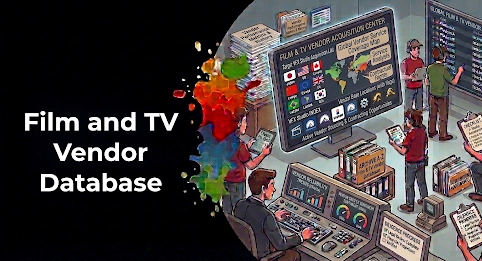
A film and TV vendor database is a supply-chain intelligence platform for sourcing post-production, VFX, localization, and production support partners globally. Unlike static directories, modern databases provide verified credits, TPN compliance filters, capacity data, and tax incentive mapping — reducing vendor sourcing time by up to 60%.
Trying to staff a global co-production using a static PDF or an outdated local directory is a recipe for missed deadlines and expensive re-bidding. The entertainment supply chain moves too fast for manual research — vendors rebrand, merge, change specialties, and gain or lose TPN certification on a rolling basis.
This guide breaks down exactly what separates a modern vendor database from a legacy directory — the features that actually matter for procurement teams, the compliance requirements that can derail a deal, and where Vitrina fits into the sourcing workflow.
Key Takeaways
- Static vendor lists decay within 90 days — modern databases update continuously against live production credits and certifications
- TPN (Trusted Partner Network) certification is a hard requirement for vendors handling pre-release content for major streamers — filtering by compliance status is non-negotiable
- Tax incentive mapping can identify net cost differences of 25–40% between vendors in different jurisdictions
- Verified credit lineage — not a showreel — is the most reliable signal of a vendor’s actual pipeline capability
- The VIQI Score provides a standardised benchmark for comparing vendors across capability, track record, and global readiness
Table of Contents
🔍
Vitrina Intelligence
Access 10,000+ verified production and VFX vendors globally — with TPN compliance, VIQI scores, and tax incentive mapping built in.
Key Takeaways.
- Data goes stale fast: A simple vendor list decays in a few months. Modern databases update live, tracking exactly what these companies are delivering right now.
- Global ecosystem mapping: You aren’t just comparing talent; you’re comparing tax rebates across different countries. You need real market intelligence to pull that off.
- No TPN, no deal: The big streamers absolutely mandate TPN (Trusted Partner Network) security. If a vendor isn’t certified, they’re probably out.
- AI does the heavy lifting: Why manually vet? Tools like VIQI AI can evaluate global vendors for you in a matter of minutes.
What is a Film and TV Vendor Database?
Answer: Think of it as a specialized search engine just for the entertainment supply chain. It helps studios track down, verify, and ultimately hire the right post-production, localization, and technical partners anywhere in the world. Good platforms sort these vendors by their actual recent credits, security specs, capacity, and available tax incentives.
For example, if you’re adapting Japanese IP for a massive global audience, you’re going to lean hard on proven localization vendors—just like you’d dig into the latest anime licensing trends to lock down the regional rights. You really can’t separate smart sourcing from successful execution.
Stop Sourcing in the Dark.
Search 140,000+ verified entertainment companies worldwide. See exactly who is producing, who is financing, and who is delivering top-tier projects right now.
Core Features of Modern Sourcing
A basic directory gives you a phone number and an email. That’s simply not enough anymore. You need actual, verifiable data. (We talk more about this in our breakdown on how major studios source post-production globally). When you’re evaluating a vetting platform, make sure your team is looking for these features:
| Feature | Legacy Directory | Modern Vendor Database |
|---|---|---|
| Data Freshness | Static; updated annually or less | Continuously updated against live credits and certifications |
| Credit Verification | Self-reported; no verification | Verified against distributed titles; linked to actual productions |
| Compliance Filters | Not available | TPN status, ISO certifications, infrastructure security level |
| Tax Incentive Mapping | Not available | Jurisdiction rebates mapped to vendor location; net cost modelling |
| Capacity Data | Generic service description | Personnel scale, render capacity, episodic throughput history |
| Sourcing Time | 200–400 hours per production | 60–80% reduction with verified, searchable data |
Credit Lineage & Competence.
It’s super easy for a vendor to throw “VFX Experts” on their homepage. A solid database goes beyond the fluff by mapping out their verifiable credits on recent titles so you can actually prove they scale.
Regional Tax Incentive Intelligence.
Financial strategy heavily dictates vendor selection nowadays. You absolutely need a platform that contextualizes a vendor’s location against active regional tax rebates to maximize your budget.
AI Procurement Trick
Don’t guess on vendor capacity. Save yourself the headache and use the VIQI AI Agent to figure out who’s delivering right now. Just tell VIQI: “Find me VFX vendors currently working on major Amazon original series.” It’s an incredible shortcut.
What a Modern Vendor Database Actually Looks Like
Vitrina gives procurement teams verified credits, TPN compliance filters, capacity data, and tax incentive mapping — not a static PDF.
- ✓ TPN-certified vendors filterable by service type and region
- ✓ Verified credits linked to actual distributed titles
- ✓ Tax incentive mapping by jurisdiction to model net costs
10K+
Verified vendors in database
60%
Reduction in sourcing time
Why Standard Directories Fail
How much time has your team wasted flipping through random PDFs or scattered union lists? Those old-school documents are usually out of date within a couple of months. Agencies rebrand, teams expand, and specialties shift entirely. Plus, relying on a localized union database leaves you totally blind to the rest of the global market—which is a brutal disadvantage when you’re orchestrating multi-region productions.
💡
TPN Compliance Can Make or Break Your Deal
Discovering a vendor isn’t TPN-certified at the compliance review stage is an expensive mistake — filter it out at the start.
Vitrina’s vendor database includes live TPN certification status for every vendor — so procurement teams can filter by compliance before shortlisting, not after contracts are in play.
Evaluating Security (TPN)
We all know that a pre-release content leak can destroy a project’s premiere. That’s exactly why the big SVOD platforms are so hardcore about physical and digital security protocols. A proper vendor database shouldn’t just show you past work—it needs to give you instant filters for Trusted Partner Network (TPN) compliance. If they aren’t secure, you shouldn’t be sending them your IP.
Vitrina Intelligence Platform
Upgrade Your Vendor Sourcing. Today.
Vitrina’s global vendor intelligence platform gives procurement teams everything needed to source the right partners faster — verified credits, TPN compliance, VIQI scores, and tax incentive data across 60+ countries.
No credit card required. • Free tier available • Premium plans from day one
Frequently Asked Questions.
Do indie producers need a vendor database?
Absolutely. While massive studios use them just to check capacity volume, indie producers use vendor intelligence to quickly find regional partners that can unlock co-production financing and essential tax credits.
Why is credit lineage more important than a showreel?
A fancy showreel just displays idealized, best-case-scenario frames. Lineage proves a vendor actually navigated real-world pipeline constraints, tight budgets, and strict delivery timelines on a comparable commercial production.
How does Vitrina’s VIQI AI help in vendor vetting?
VIQI acts as your very own vertical AI agent trained exclusively on supply-chain intelligence. It lets your team run natural language searches like “show me animation studios active with Apple TV+” and hands you instant, verified shortlists.
What role do regional tax incentives play in vendor selection?
They’re huge. Cross-border subsidies can radically drop your net project spend. A good sourcing strategy maps a vendor’s location straight against local rebates, marrying the creative choice directly to the financial one.
How can we avoid midway pipeline bottlenecks?
By keeping an eye on the absolute scale of a company’s concurrent deliveries rather than just looking at a single past award. Make sure the database evaluates their current rendering bandwidth and physical personnel counts before you sign anything.
Vitrina Intelligence Team
We map the global supply chain for film and TV. By tracking projects and companies worldwide, we empower executives to make data-backed procurement, financing, and content distribution decisions.

About the Author
Vitrina Editorial
The Vitrina editorial team focuses on the global entertainment ecosystem — turning complex supply-chain dynamics into practical intelligence for buyers, distributors, and production executives worldwide.