IHUB
IHUB
 Global Content Pulse (Webinars)


 Global Production Financing
(Webinars)
Global Production Financing
(Webinars)  LeaderSpeak Podcast
  Global Entertainment Digest (Newsletter)
  About Vitrina
 About VIQI
 Our Story
 Our Solutions 🔥
 Film+TV Projects Tracker 🚀
 Case Studies
 Our Profile

Published: |
Updated: |
10 min read
Filmmaking is the art and process of creating a motion picture, from the first spark of an idea all the way through to the moment an audience watches it on screen. It brings together storytelling, visual design, performance, sound, and technology into a single collaborative craft. And right now, it has never been more accessible.
The global film and video industry generated approximately $248 billion in revenue in 2024 (PwC Global Entertainment & Media Outlook, 2024). Meanwhile, the number of people who pick up a camera for the first time each year keeps climbing, powered by affordable digital tools, streaming platforms hungry for content, and online education. Whether you want to make short films with your phone or eventually direct a studio feature, understanding how filmmaking works is the essential first step.
This guide walks you through everything: what filmmaking actually is, the main departments and roles on a film set, the five stages of production, digital filmmaking basics, and how the industry is structured for aspiring professionals. No jargon, no gatekeeping.
Key Takeaways
- Filmmaking has five core stages: development, pre-production, production, post-production, and distribution. Skipping any one stage is the leading cause of budget overruns on independent films.
- The global film industry was worth approximately $248 billion in 2024 (PwC), with streaming now accounting for over 38% of total viewing time worldwide (Nielsen, 2025).
- Digital filmmaking has collapsed the cost barrier: a broadcast-quality short film can now be shot on equipment costing under $3,000.
- The U.S. Bureau of Labor Statistics projects a 10% growth in film and video editor jobs from 2023 to 2033, faster than the average for all occupations (BLS, 2024).
- Distribution is the stage most beginners underplan. Understanding it before you shoot changes every creative decision you make.
Quick Answer
Filmmaking has five core stages: development, pre-production, production, post-production, and distribution. Skipping any one stage is the leading cause of budget overruns on independent films The global film industry was worth approximately $248 billion in 2024 (PwC), with streaming now accounting for over 38% of total viewing time worldwide (Nielsen, 2025) Digital filmmaking has collapsed the cost barrier: a broadcast-quality short film can now be shot on equipment costing under $3,000
Filmmaking Is a Collaborative Process Spanning Story to Screen
Over 500,000 people search for “filmmaking” every month globally (Google Keyword Planner, 2025), making it one of the most searched creative disciplines online. That volume reflects a genuine hunger to understand the craft. At its core, filmmaking is the multi-stage process of capturing moving images and sound, then shaping them into a narrative or documentary experience that connects with viewers.
The term covers an enormous range of work. A student shooting a one-minute short on a smartphone is making a film. So is a director spending three years on a $200 million studio production. What unites them is the same creative and logistical pipeline: you need a story, a plan, footage, edited content, and an audience.
Filmmaking differs from videography in one important way. Videography typically captures events as they happen (weddings, conferences, live performances) with minimal scripting. Filmmaking involves intentional narrative construction, even if that narrative is observational documentary. The key is authorial intent: you are shaping reality, not just recording it.
Industry Insight: Most filmmaking guides separate “indie” from “studio” filmmaking as if they are entirely different crafts. In practice, the production pipeline is structurally identical. The differences are almost entirely in scale, not process. Understanding the full pipeline at a small scale gives you a transferable skill set that works at any budget level.
Citation: The global filmed entertainment market was valued at approximately $95.45 billion in 2023 and is projected to reach $169.73 billion by 2030, growing at a CAGR of 8.6% (Grand View Research, 2024). This sustained growth is driven by streaming platform expansion, increased regional content production, and growing demand from emerging markets in Asia-Pacific and Latin America.
Before you shoot a single frame, it helps to understand who actually produces and distributes films globally.
Turn Filmmaking Intelligence into Your Next Project
100,000+ M&E companies · 150+ countries · Free to start — no credit card needed
The Five Stages of Filmmaking Are Development, Pre-Production, Production, Post-Production, and Distribution
According to the British Film Institute (BFI, 2024), over 60% of independent film projects that fail financially do so because of poor pre-production planning, not poor execution on set. The five-stage model exists precisely to prevent that. Each stage builds on the previous one, and skipping steps creates downstream problems that cost far more to fix than they would have cost to prevent.
Key Stat
According to the British Film Institute (BFI, 2024), over 60% of independent film projects that fail financially do so because of poor pre-production planning, not poor execution on set. The five-stage model exists precisely to prevent that. Each stage builds on the previous one,
Stage 1: Development
This is where the idea becomes a plan. Development includes writing or acquiring a script, securing funding or financing commitments, attaching key talent (directors, lead actors), and confirming that the project is legally and financially viable. For studio films, development can take years and costs millions before a single frame is shot.
Stage 2: Pre-Production
Pre-production turns the approved plan into a shootable schedule. It covers casting, location scouting, production design (sets, costumes, props), hiring the crew, creating a shot list and storyboards, and building the production budget. A thorough pre-production period is the single biggest predictor of a smooth shoot.
Stage 3: Production (Principal Photography)
This is the actual filming. The crew captures every shot in the schedule, working within the daily page count the production manager sets. Production is the most expensive stage per day and the one most people picture when they think of “making a movie.”
Stage 4: Post-Production
Post-production is where the raw footage becomes a finished film. It includes picture editing, color grading, visual effects (VFX), sound design, music composition and licensing, and audio mixing. The U.S. BLS reports that film and video editor employment is projected to grow 10% from 2023 to 2033 (BLS Occupational Outlook Handbook, 2024), reflecting how central post-production has become to the modern pipeline.
Stage 5: Distribution
Distribution is how the finished film reaches its audience. This includes theatrical release, streaming platform licensing, broadcast TV sales, home video, and international rights deals. Most aspiring filmmakers underplan this stage, treating it as something to figure out after the film is done. That is a costly mistake. Distribution strategy should influence decisions made as early as pre-production.
Planning your first production?
Vitrina tracks 100,000+ production and distribution companies across 150+ countries. Find the right partners before you shoot.
Typical Budget Allocation by Filmmaking Stage (Independent Feature)
Source: BFI Independent Film Finance Report, 2024. Figures are illustrative averages; actual splits vary by project type.
Distribution is a world of its own.
Every Film Has a Crew: The Key Roles That Make a Film Work
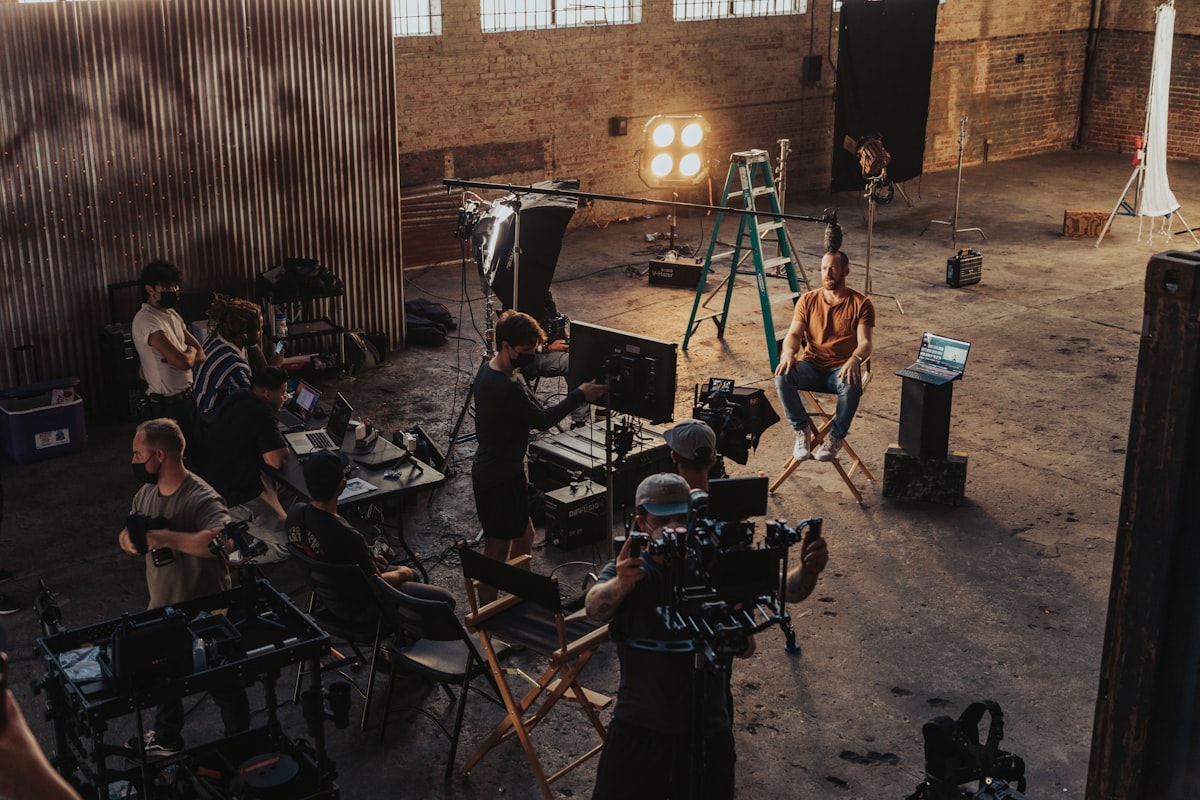
A major studio feature can employ hundreds of crew members, but even a student short film requires at least five to eight roles to function properly. According to the Motion Picture Association (MPA) Economic Contribution Report, 2023, the U.S. film and television industry directly supports 2.74 million jobs. Understanding who does what demystifies the set and helps aspiring filmmakers know which role fits their strengths.
Key Stat
A major studio feature can employ hundreds of crew members, but even a student short film requires at least five to eight roles to function properly. According to the Motion Picture Association (MPA) Economic Contribution Report, 2023, the U.S. film and television industry direct
Above-the-Line Roles
These are the creative principals who drive the project:
- Director – The creative authority on set. Responsible for translating the script into visual storytelling decisions.
- Producer – Controls the budget, schedule, and logistics. Often the one who gets the project financed.
- Screenwriter – Writes and revises the script. May or may not be present during production.
- Lead Cast (Actors) – The performers whose performances are the emotional center of the film.
Below-the-Line Roles
These crew members execute the technical and physical work of production:
- Director of Photography (DP / Cinematographer) – Designs the visual look and operates or supervises the camera department.
- Production Designer – Creates the physical world of the film: sets, locations, props, color palette.
- Sound Mixer – Captures clean audio on set. Audio problems in production are extremely expensive to fix in post.
- Gaffer – Head of the electrical and lighting department.
- Film Editor – Assembles and refines the film in post-production, working closely with the director.
- First Assistant Director (1st AD) – Manages the set schedule, keeps production on time, and maintains safety protocols.
Citation: The U.S. film and television industry directly and indirectly supports 2.74 million American jobs, contributing $279 billion to the U.S. economy annually (Motion Picture Association Economic Contribution Report, 2023). These jobs span every stage of the filmmaking pipeline, from development writers and location scouts through post-production facilities and theatrical marketing teams.
Digital Filmmaking Has Made Professional Quality Accessible to Everyone
Before digital cameras became standard in the early 2000s, shooting on 35mm film cost approximately $1,000 per minute of raw footage when processing and printing were included. Today, cameras like the Blackmagic Pocket Cinema Camera 6K or Sony FX3 deliver cinematic image quality at price points under $3,000. That shift has fundamentally changed who gets to make films.
Key Stat
Before digital cameras became standard in the early 2000s, shooting on 35mm film cost approximately $1,000 per minute of raw footage when processing and printing were included. Today, cameras like the Blackmagic Pocket Cinema Camera 6K or Sony FX3 deliver cinematic image quality
Digital filmmaking refers to capturing and editing motion pictures using digital rather than photochemical processes. The image is recorded to a memory card or hard drive, edited on a non-linear editing (NLE) system like DaVinci Resolve, Premiere Pro, or Final Cut Pro, and delivered as a digital file. This workflow is now standard at every budget level, from student shorts to blockbusters.
Industry Insight: The real revolution in digital filmmaking is not the camera itself, it is the democratization of color grading. DaVinci Resolve, which professional Hollywood colorists use on major studio films, is available as a free download. A student filmmaker in 2026 has access to the same color science toolset as the colorist on a Netflix original series. That would have been unthinkable in 2010.
The Essential Digital Filmmaking Toolkit
- Camera: Any modern mirrorless or dedicated cinema camera with manual controls and a LOG picture profile.
- Lenses: A set of fast prime lenses (f/1.8 or wider) gives you cinematic depth of field at a low cost.
- Audio recorder + microphone: A Zoom H5 field recorder and a Rode NTG shotgun microphone covers most situations.
- Lighting: Two or three LED panels with diffusion covers 90% of interior lighting scenarios for independent filmmakers.
- Editing software: DaVinci Resolve (free tier is genuinely professional), Premiere Pro (industry standard in post houses), or Final Cut Pro (Mac only).
- Storage: Redundant hard drives. Data loss is the silent killer of indie productions.
Global Streaming Share of Total Viewing Time by Region (2025)
Source: Nielsen Global Streaming Report, 2025. Figures represent streaming’s share of total video consumption including linear TV, SVOD, AVOD, and broadcast.
Filmmaking for Beginners Starts with Story, Not Camera Gear
A 2023 survey by the Sundance Institute found that the most common regret among first-time filmmakers was spending too much of their budget on equipment rather than story development. The camera does not tell the story. The screenplay, the performances, and the editing do.
Here is a practical starting sequence for anyone just beginning:
- Write a short script first. Start with a 3-5 page short film. Short enough to actually finish. Long enough to learn every stage of the pipeline.
- Storyboard your script. You do not need to be a skilled illustrator. Rough boxes with camera position notes are enough to plan your shoot.
- Build a shot list. Before any shooting day, document every shot you need: angle, lens size, movement, notes on action.
- Shoot with what you have. A modern smartphone shoots in 4K. The iPhone 15 Pro records in ProRes Log. Start now with what you own.
- Edit immediately after each shoot day. Reviewing footage while the day is fresh helps you identify gaps and improves your next shooting session.
- Finish the film. The most common beginner failure is an abandoned project. A finished, imperfect short teaches more than a half-shot masterpiece.
- Submit to festivals. Student and short film festivals exist specifically for new work. FilmFreeway connects filmmakers to thousands of festivals worldwide.
From the field: When Vitrina analyzed career trajectories of emerging M&E professionals who moved from hobbyist to professional work, the pattern was consistent. They finished projects. Filmmakers who shipped completed work, even rough work, entered the professional ecosystem measurably earlier than peers who spent the same time developing unfinished projects. The barrier to professional filmmaking has shifted from resources to completion discipline.

Citation: Streaming services released over 2,500 original scripted titles globally in 2023, up from 210 in 2009 (FX Research Peak TV Report, 2023). This surge in demand has opened significant opportunity for writers, directors, and producers who can deliver finished, platform-ready content, creating a genuine pipeline from independent short films to streaming commissions for skilled creators who understand the full production process.
Ready to find collaborators and crew?
Vitrina’s database covers production service companies, post-production facilities, equipment houses, and distribution partners across 150+ countries.
The Film Industry Is Structured Around Six Interconnected Segments
The global film industry is not a single monolith. It is an ecosystem of interconnected businesses, and understanding its structure helps you navigate it strategically. PwC’s Global Entertainment & Media Outlook 2025-2029 projects the filmed entertainment sector will exceed $105 billion by 2029, with streaming and digital distribution accounting for over 40% of that revenue.
The Six Segments
- Studios and Financiers – Major studios (Warner Bros., Universal, Disney, Sony, Paramount, Netflix) finance and distribute large-scale productions. Independents operate with private equity, tax incentives, pre-sales, and grants.
- Production Service Companies – These companies provide physical infrastructure: cameras, lighting, grip, and studio facilities on a for-hire basis. They are the engine behind the camera.
- Post-Production Facilities – Editing houses, VFX studios, color-grading suites, and sound mixing stages. Many are now fully cloud-based, which has changed location economics significantly.
- Distribution Companies – Sales agents, theatrical distributors, streaming platforms, and broadcast buyers who acquire rights and deliver films to audiences.
- Exhibition – Movie theaters, drive-ins, and specialty screening venues. Global box office recovered to $33.9 billion in 2023 (Comscore Global Box Office, 2024), approximately 79% of pre-pandemic 2019 levels.
- Support and Ancillary Services – Film commissions, talent agencies, entertainment lawyers, casting platforms, music licensing houses, and the growing infrastructure of AI-assisted production tools.
Global Box Office Revenue (USD Billions, 2019-2024)
Source: Comscore Global Box Office, 2024; MPA Theatrical Market Statistics Report, 2024.
Finding Your Place in the Industry Ecosystem Takes Research
One challenge every aspiring filmmaker faces is the same one experienced producers face: the industry is enormous, highly fragmented, and not particularly transparent about who does what. A student wanting to find a co-production partner in South Korea, a producer looking for a post-production facility with Dolby Atmos certification in Eastern Europe, or a first-time director trying to identify which sales agents work with debut features: all of them face the same discovery problem.
This is where platforms built specifically for the M&E industry become useful. Vitrina, for instance, tracks over 100,000 production, distribution, and service companies across 150+ countries, along with their capabilities, content types, and market positioning. Its VIQI (Vitrina Intelligence Query Interface) functions as an AI-powered search layer on top of that data, so you can ask questions in plain language and get structured results about who is active in a given market, what they produce, and how to reach them.
For a student or early-career filmmaker, that kind of industry intelligence was previously only available to people already inside the industry. Understanding who the players are, what deals are being made, and where content travels is no longer gatekept information.
Explore the global M&E industry database
Use VIQI, Vitrina’s AI search, to find production companies, co-production partners, distributors, and service providers worldwide. Free to start.
Frequently Asked Questions About Filmmaking
What is the difference between filmmaking and cinematography?
Filmmaking is the entire process of creating a film, from scriptwriting through distribution. Cinematography is one specific discipline within filmmaking: the visual capture of images using light, camera movement, and lens choices. A cinematographer (Director of Photography) is one member of the filmmaking team. According to the BLS (2024), there are approximately 38,000 camera operators and cinematographers employed in the U.S. alone, distinct from the broader category of film producers and directors.
How much does it cost to make a film?
Costs span an enormous range. A micro-budget short film can be completed for under $500 using existing equipment. The average cost of a major Hollywood studio film was approximately $107 million in 2023 (MPA Theatrical Market Statistics, 2023). Independent features typically fall between $100,000 and $2 million. Digital tools have dramatically reduced the minimum entry cost: professional post-production software is free (DaVinci Resolve), and smartphones now shoot broadcast-quality video.
What education do you need to become a filmmaker?
There is no required degree. Many professional filmmakers are self-taught or learned through short film production and on-set experience. That said, film school programs at institutions like NYU Tisch, USC School of Cinematic Arts, and AFI provide structured technical training, industry connections, and feedback environments. A 2024 survey by the Sundance Institute found that 47% of independent filmmakers whose work premiered at major festivals had no formal film education. What matters is a completed portfolio of work.
What is the difference between digital filmmaking and shooting on film?
Digital filmmaking captures images electronically on camera sensors and records to digital storage media. Celluloid (film) photography uses light-sensitive chemical emulsion on a physical strip. By 2026, over 99% of commercial productions shoot digitally. A small number of directors, including Christopher Nolan and Quentin Tarantino, actively prefer shooting on film for its texture and grain character. Kodak reported it sold the equivalent of over 6 million feet of film stock to professional productions in 2023, a niche but resilient market.
What is the best camera for beginner filmmakers?
The best camera for a beginner is the one you already own. Modern smartphones (iPhone 15 Pro, Samsung Galaxy S24 Ultra) shoot in 4K and support LOG color profiles suitable for professional color grading. If purchasing dedicated equipment, the Sony ZV-E10 (under $600) and Blackmagic Pocket Cinema Camera 4K (under $1,000 used) are widely recommended entry points. Invest in a good microphone and proper audio capture before upgrading the camera: sound quality is the faster path to professional-looking work.
How do aspiring filmmakers get their work distributed in 2026?
Short films primarily reach audiences through film festival circuits (Sundance, Tribeca, SXSW, and hundreds of regional festivals via FilmFreeway), followed by YouTube, Vimeo, and short-form streaming platforms. Feature films can self-distribute via platforms like Gumroad, Vimeo On Demand, or Filmhub, or seek a traditional distributor through sales agents. As of 2025, over 40 streaming platforms actively acquire independent content globally, creating more distribution pathways than at any previous point in the industry’s history.
Start Making Films Now
Filmmaking is one of the most technically and creatively demanding disciplines humans have invented. It is also more accessible than it has ever been. The gap between wanting to make films and actually making them has never been narrower. The tools are affordable, the education is freely available online, and the distribution infrastructure is open to anyone with a finished piece of work.
What has not changed is this: the industry rewards people who understand the full pipeline. Not just the camera, not just the edit, but the entire chain from story development through distribution strategy. That knowledge is what transforms a hobbyist into a professional.
The most useful next steps are concrete. Write a short script this week. Research which festivals accept work like yours. Spend time understanding how the production ecosystem in your market is structured. The industry is full of partners, collaborators, and opportunities. The challenge is finding them.
Sandeep Dhopate
M&E Industry Analyst, Vitrina
Sandeep Dhopate covers the global media and entertainment industry at Vitrina, where he tracks production, distribution, and technology trends across 150+ countries. His work focuses on making industry intelligence accessible to professionals at every career stage, from students entering the field through to studio executives making large-scale partnership decisions.
Sources & References
- PwC Global Entertainment & Media Outlook 2024-2028. PricewaterhouseCoopers. pwc.com
- Grand View Research. “Filmed Entertainment Market Size, Share & Trends Analysis Report, 2024.” grandviewresearch.com
- Motion Picture Association. “MPAA Economic Contribution Report 2023.” mpaa.org
- U.S. Bureau of Labor Statistics. “Occupational Outlook Handbook: Film and Video Editors and Camera Operators, 2024.” bls.gov
- British Film Institute. “BFI Industry Data & Insights: Independent Film Finance Report, 2024.” bfi.org.uk
- Nielsen. “Global Streaming Report 2025.” nielsen.com
- Comscore. “2023 Global Box Office Recap.” comscore.com
- FX Networks Research. “Peak TV Report 2023.” fxnetworks.com
- Sundance Institute. “Filmmaker Programs Research Survey, 2024.” sundance.org
- Google Keyword Planner. Monthly search volume data for “filmmaking,” 2025.
- MPA Theatrical Market Statistics Report 2023. Motion Picture Association.
- Kodak. Film Stocks Annual Production Report, 2023.