IHUB
IHUB
 Private Briefings (Webinars)


 LeaderSpeak Podcast
  Global Entertainment Digest (Newsletter)
  Premium Lists
 Membership Benefits
 About Vitrina
 Our Story
Quick Answer
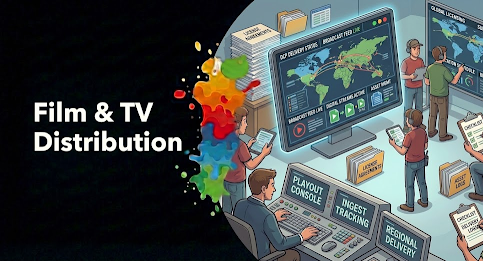
Film and TV distribution is the process of licensing, marketing, and delivering content to audiences through broadcast, streaming, theatrical, and digital channels. The global distribution market exceeded $90 billion in 2024 and is projected to reach $134 billion by 2030 — making distribution strategy one of the highest-leverage decisions a producer or rights holder can make.
For producers, studios, and rights holders, distribution is where creative work turns into revenue. Yet most content professionals have a far clearer understanding of production than they do of the distribution landscape — the deal structures, the window sequencing, the role of sales agents, and the difference between a minimum guarantee and a revenue share.
This guide breaks down every major dimension of film and TV distribution: how the market is structured, how deals are negotiated, how platforms and broadcasters differ in their approach, and how to build a territory strategy that maximises the commercial value of your content.
Key Takeaways
- The global film and TV distribution market exceeded $90 billion in 2024, projected to reach $134B by 2030 (Grand View Research)
- Distribution windows — theatrical → streaming → SVOD → AVOD → FAST — determine both revenue timing and total deal value
- Sales agents and distributors play fundamentally different roles: understanding which you need changes your deal economics
- Territory-by-territory licensing allows rights holders to maximise total revenue; bundled deals trade revenue upside for speed and certainty
- The major film markets (Cannes, AFM, Berlin, MIPCOM) remain the primary venues where distribution relationships are built and deals initiated
Table of Contents
- What Is Film and TV Distribution, and Why Does It Matter?
- What Does the Global Distribution Landscape Look Like Today?
- The Five Main Distribution Channels — And How Each Works
- Ancillary and Niche Distribution Channels
- How Distribution Windows Work — And Why Sequencing Matters
- TV Distribution: How the Market Works
- Distribution Deal Structures and Revenue Splits
- Sales Agents vs. Distributors: What’s the Difference?
- VOD Distributors: What They Do and How to Find One
- VOD Distribution Companies: Who the Major Players Are
- Documentary Distribution Trends 2026
- Film Marketing and Distribution: Coordinating Both
- Stock Footage Licensing: Global Multi-Market Considerations
- How Vitrina Helps Distribution Teams Find the Right Partners
- Frequently Asked Questions
🔍
Vitrina Intelligence
Map every active buyer across 60+ distribution territories — updated daily across broadcast, streaming, and theatrical.
What Is Film and TV Distribution, and Why Does It Matter?
Film and TV distribution is the process of licensing and delivering finished content to audiences through specific channels, territories, and timeframes. Theatrical and home entertainment distribution channels alone generated $93.7 billion in global revenue in 2023, according to the Motion Picture Association (MPA, 2024). Without distribution, even the most technically accomplished film has no path to recovering its production budget or reaching an audience.
Distribution is where the money flows back to investors, producers, and talent. Production gets the creative work done. Distribution turns that work into revenue. A film that wins Sundance but lands no distribution deal earns nothing. One that secures a well-structured deal with a major platform or theatrical chain can recover its budget many times over — and generate ongoing royalty income for years.
The discipline sits at the intersection of sales, contracts, logistics, and market intelligence. Rights must be carved correctly. Windows must be sequenced strategically. Territories require local marketing, sometimes local dubbing or subtitling, and often regulatory compliance. It’s a supply chain operation as much as a creative one — and teams that treat it as an afterthought consistently leave money on the table.
For the buy side of this equation — how platforms decide what to acquire before distribution discussions begin — see our complete guide to content acquisition for streamers and broadcasters.
What Does the Global Distribution Landscape Look Like Today?
The distribution landscape fractured significantly between 2019 and 2025. Netflix, Amazon, Disney+, and Apple TV+ collectively spent over $61 billion on content in 2023 (Variety, 2024). That spending reshaped traditional distribution hierarchies and created parallel tracks that didn’t exist a decade ago. Theatrical, broadcast, SVOD, AVOD, and FAST now operate as distinct but interconnected layers — and content owners who understand how each layer works can extract significantly more value from the same title.
The old model was linear: theatrical → home video → pay TV → free TV. That sequence still exists in some form, but it’s been compressed, reordered, and disrupted by streaming. A film released in 2026 might go theatrical for 30 days, then land on a streaming platform in an exclusive window, then move to AVOD, and then to FAST channels — all within 18 months. Each step requires a separate deal, a separate delivery, and separate marketing support.
The Shift of Power Toward Platforms
Streaming platforms have accumulated a structural advantage in distribution negotiations that traditional broadcasters don’t have: global reach with a single deal. A Netflix worldwide deal covers 190+ countries from a single contract. That’s why producers with globally appealing content often prefer a streaming deal over the complexity of territory-by-territory theatrical and broadcast licensing — even if the per-territory fee is lower. Simplicity has real economic value when distribution complexity costs money to manage.
The Five Main Distribution Channels — And How Each Works
Every content distribution strategy begins with a channel decision. Each channel has different economics, different audience reach, and different contractual requirements. Most major releases use a combination — the skill is in sequencing them correctly to maximize total revenue across the title’s commercial life.
1. Theatrical Distribution
Theatrical remains the prestige window for tentpole films and awards contenders. Major studio releases generate an average of 37% of their total lifetime revenue in the theatrical window (Box Office Mojo analysis, 2024). The theatrical window has compressed considerably — it now runs 17 to 45 days for major releases, down from the 90-day standard that held until 2021. That compression was accelerated by the pandemic and has not reversed meaningfully since.
Theatrical distribution is dominated by a small number of major studio distributors in each market. Independent films typically go through specialty distributors — A24, Neon, MUBI, Bleecker Street — who target the arthouse circuit and film festival audiences. The cost of theatrical distribution, including prints, advertising, and exhibitor revenue shares, can exceed the production budget of a mid-sized independent film.
2. Streaming (SVOD)
Subscription video on demand is now the dominant channel for most non-theatrical content. Netflix, Amazon Prime Video, Disney+, Apple TV+, Max, Peacock, and Paramount+ together command more than 1.5 billion active subscriber accounts globally (Ampere Analysis, 2025). SVOD deals are typically flat-fee licenses or minimum guarantees — the platform pays a fixed amount for rights in specific territories for a defined window, regardless of how many subscribers watch the content.
For content owners, SVOD offers speed and scale. A single deal with a major platform delivers global or multi-territory distribution in weeks. The trade-off is that SVOD platforms retain control over discoverability, marketing spend, and renewal decisions. A title buried in a platform’s catalog receives essentially zero marketing support and generates minimal additional value for the rights holder beyond the initial license fee.
3. Free Ad-Supported Streaming (FAST)
FAST is the fastest-growing distribution channel in 2024–2026. Platforms like Tubi, Pluto TV, Roku Channel, and Samsung TV Plus have collectively aggregated hundreds of millions of monthly active users — and they pay rights holders on a revenue-share basis tied to advertising income generated by the content. The global FAST market reached $6.8 billion in 2024 and is projected to exceed $12 billion by 2027 (Omdia, 2024).
FAST is particularly valuable for library content and catalog titles that have passed through their SVOD exclusivity window. Rather than sitting dormant, a title on a FAST channel continues generating advertising revenue — often small per-title, but meaningful across a large catalog. For rights holders with libraries of hundreds or thousands of titles, FAST represents a material new revenue stream.
4. Broadcast and Pay TV
Traditional broadcast and pay TV distribution has declined in reach but remains significant in revenue, particularly for sports, news, and premium drama in markets where streaming penetration is lower. Pay TV deals — HBO, Sky, Canal+, Showtime — often command higher per-title fees than streaming deals for equivalent content because pay TV operators use exclusive content to justify subscriber fees to a shrinking but still affluent subscriber base.
5. Home Entertainment (Transactional Video on Demand)
Electronic sell-through (EST) and rental via platforms like Apple TV, Amazon, Vudu, and Google Play generate transactional revenue outside of subscription models. A film available for digital rental at $4.99 and purchase at $14.99 can generate meaningful revenue in the window between theatrical and SVOD exclusivity — particularly for genre films with strong fan bases who want to own rather than stream.
Ancillary and Niche Distribution Channels
Beyond the five main channels, a set of ancillary markets provides incremental revenue and targeted audience access — individually smaller than theatrical or SVOD, but collectively meaningful for the right title, particularly documentaries, educational content, and library catalogs.
Educational Distribution
Educational distribution licenses films to schools, universities, libraries, and museums — a channel particularly suited to documentaries, films with historical or social-issue subject matter, literary adaptations, and foreign-language titles used for language instruction. Deals typically take the form of sales of DVDs or digital files bundled with public performance rights, or licenses for inclusion on educational streaming platforms. Specialized distributors focused specifically on the institutional and library market handle most of this channel.
Airline and Hospitality (Inflight Entertainment)
Airlines license films for inflight entertainment systems, typically curating a mix of recent theatrical releases and library titles for broad-appeal viewing. Hotels, cruise ships, and other closed-circuit hospitality venues license content on similar terms. These deals are usually structured as a per-screen or per-passenger fee rather than a box-office or subscriber-based split, and they tend to run alongside — not instead of — a title’s primary theatrical or streaming windows.
Physical Media
DVD and Blu-ray remain a declining but still commercially relevant channel, particularly for collector’s editions, special-interest titles, and regions where broadband access is less reliable. Some distributors continue to specialize specifically in physical media releases, and catalog titles with dedicated fan bases can sustain a physical media market long after their primary streaming or broadcast windows have closed.
For rights holders, the common thread across these niche channels is that they rarely justify a standalone go-to-market effort — they’re best pursued opportunistically, through a distributor or aggregator that already has relationships in the relevant vertical, once the title’s primary distribution windows are in place.
How Distribution Windows Work — And Why Sequencing Matters
A distribution window is a defined period during which content is available on a specific channel, often exclusively. The sequencing of windows determines how much total revenue a title generates across its commercial life. Get it right and each window builds on the last. Get it wrong and later windows cannibalize the value of earlier ones.
The standard window sequence for a wide-release theatrical film in 2026 runs: theatrical (17–45 days) → premium video on demand (PVOD, simultaneous or shortly after) → SVOD exclusivity (typically 18–24 months for a major platform deal) → SVOD non-exclusive → AVOD/FAST → free broadcast. Each transition requires a separate deal, separate delivery, and often separate marketing investment.
Day-and-Date and Simultaneous Release
During the pandemic, several studios experimented with simultaneous theatrical and streaming release — most notably Universal’s 2020 decision to release Trolls World Tour on premium VOD day-and-date with its planned theatrical run, a move that triggered a public renegotiation of the traditional theatrical window with major exhibitor chains. That experiment produced mixed commercial results — it accelerated streaming subscriber acquisition but damaged theatrical exhibitor relationships and compressed the overall revenue window. Most studios have pulled back from true day-and-date simultaneous release, though premium VOD (available for purchase on the day of theatrical release at a premium price) has become a mainstream option for mid-budget films.
Window Compression in Practice
The compression of theatrical windows has created a new dynamic in distribution negotiations. Streaming platforms are now willing to pay a premium to acquire films directly from production — bypassing theatrical entirely — in exchange for global rights from day one. For independent filmmakers without theatrical distribution secured, a direct-to-streaming deal often delivers more net revenue than a theatrical run with limited marketing support followed by a smaller streaming deal.
For anime and Asian content specifically, windowing works differently — simulcast releases, exclusive streaming windows, and regional broadcast rights interact in ways specific to that market. Our guide on how simulcast deals are structured across Japan, the US, and Southeast Asia covers that in full detail.
Stop Guessing on Distribution Partners
Vitrina shows which platforms and broadcasters are actively buying in your target territories right now.
- ✓ Real-time acquisition mandates by territory and genre
- ✓ Deal history and minimum guarantee intelligence
- ✓ Sales agent and distributor contact intelligence
500+
Active buyers tracked
60+
Territories mapped
TV Distribution: How the Market Works
TV distribution — licensing television series, documentary series, reality formats, and mini-series to broadcasters, cable networks, and streaming platforms — operates on fundamentally different economics than theatrical film distribution. Where film distribution is a short-window, high-intensity commercial event, TV distribution is a long-cycle rights business where the same episode can generate revenue across multiple platforms and territories over 10–15 years.
The TV Distribution Market in 2026
The global TV content licensing market exceeded $50 billion in 2025, driven by SVOD expansion in Southeast Asia and FAST channel growth in North America. Supply has kept pace with that demand: new scripted TV commissions across major markets reached a record high of over 2,000 titles in 2024 (Ampere Analysis), a volume that makes manual tracking of distribution-ready projects impractical without dedicated market intelligence tools. Three structural shifts define the current TV distribution market:
- SVOD platforms pulling back on acquisition: Netflix, Disney+, and Amazon are shifting TV distribution spend toward self-funded originals, reducing their acquisition volumes for third-party finished series by an estimated 20–30% year-on-year since 2023
- FAST as a primary TV distribution window: FAST channels — Pluto TV, Tubi, Samsung TV Plus — have become the default distribution channel for library TV series and catalog documentary content, with deal cycles 4–8x faster than traditional SVOD licensing
- Co-production replacing pure acquisition: US, UK, French, and German platforms are increasingly structuring international TV distribution as co-productions (sharing rights from the start) rather than acquiring finished content — giving distributors less flexibility but better per-territory rates
TV Distribution by Content Type
| Content Type | Primary TV Distribution Path | License Fee Range (per episode) | Key Market Events |
|---|---|---|---|
| Scripted drama (60 min) | SVOD exclusive → Free-to-air | $50k–$500k | MIPCOM, Cannes |
| Documentary series | SVOD → AVOD → FAST | $20k–$150k | Hot Docs, Sheffield DocFest, MIPCOM |
| Reality / format | Broadcast first → SVOD catch-up | Format fee + production licence | MIPTV, LA Screenings |
| Animation | SVOD + broadcaster co-production | $25k–$150k | Annecy, Kidscreen |
Distribution Deal Structures and Revenue Splits
Distribution deals come in three primary structures, and the choice between them determines how much revenue a content owner actually sees — not just in the headline number, but in how costs are deducted before the rights holder gets paid. Understanding the difference between gross and net definitions in distribution contracts is one of the highest-value skills in the industry.
| Deal Type | Structure | Revenue Split | Best For |
|---|---|---|---|
| Minimum Guarantee (MG) | Fixed upfront payment against future royalties | MG recouped first; overages split 50–70% to rights holder | Established titles with proven demand |
| Revenue Share | No advance; distributor retains 25–40% of receipts | 60–75% to rights holder after distributor fee | New IP with uncertain audience; lower risk for both parties |
| Output Deal | Multi-title commitment at fixed per-title MG | Negotiated per-title; volume discount for distributor | Studios with consistent output pipeline |
| First Look | Right to bid first on new projects; no obligation | Deal-by-deal; option fee offsets against MG | Relationship-based partnerships; emerging producers |
| All-Rights Buyout | Full transfer of all territory rights in perpetuity | Single lump-sum payment; no ongoing royalties | Catalogue acquisitions; platform originals |
Flat License Fee
The most common structure for streaming deals. The platform pays a fixed amount for rights in a defined territory and window — regardless of actual viewership. For the content owner, this means certainty: the fee is paid on delivery regardless of performance. For the platform, it means no upside-sharing with rights holders if the title dramatically outperforms expectations. Flat fees for an A-list drama series in a major territory range from $2–15 million per season.
Minimum Guarantee Against Revenue Share
Common in theatrical and some AVOD/FAST deals. The distributor pays a minimum guarantee (MG) upfront — effectively an advance against future revenue share. Once the MG is recouped from the content owner’s share of revenues, additional revenue flows through at the agreed percentage split. Revenue splits in theatrical distribution typically run 50/50 after the distributor recoups P&A (prints and advertising) costs — which can run $20–50 million for a wide theatrical release.
Pure Revenue Share
Common in FAST and AVOD distribution. The platform takes no upfront risk and pays no advance. Instead, the content owner receives a percentage — typically 30–50% — of advertising revenue generated by their content on the platform. The upside is that successful catalog content can generate ongoing revenue indefinitely. The downside is that the content owner carries all the demand risk: if the platform’s audience ignores the title, revenue is zero.
Mapping your distribution partners before Cannes or AFM? Vitrina tracks 300,000+ active companies across the global film and TV supply chain — including sales agents, distributors, and platforms actively acquiring in your genre and territory. Search the market at app.vitrina.ai →
Sales Agents vs. Distributors: What’s the Difference?
The terms “sales agent” and “distributor” are often used interchangeably in casual conversation, but they represent fundamentally different roles with different contractual relationships, cost structures, and incentives. Confusing the two is one of the most common mistakes independent producers make when structuring their first distribution deal.
Sales Agents
A sales agent represents a content owner and licenses rights to distributors in different territories on their behalf. The agent doesn’t distribute the content itself — it connects the rights holder to the distribution infrastructure in each market. Sales agents typically work on commission: 10–25% of the license fees they negotiate, deducted before the content owner is paid. They’re most valuable at international markets (Cannes, AFM, Berlin, MIPCOM), where they maintain ongoing relationships with buyers across dozens of territories.
Distributors
A distributor actually delivers content to audiences — via theatrical chains, streaming platforms, broadcast networks, or home entertainment. In most cases, a distributor acquires rights from the content owner (or from a sales agent acting on their behalf) and then manages the full delivery and marketing process in their territory. They take a larger cut than sales agents — typically 25–40% of revenues — because they’re carrying more operational risk and cost.
Direct-to-Platform
Increasingly, content owners with strong titles negotiate directly with streaming platforms, bypassing both sales agents and traditional distributors. This approach maximizes the content owner’s net revenue per deal — no commission to a sales agent, no distribution fee — but requires the internal infrastructure to manage deal negotiation, delivery, and rights tracking across multiple territories. For independent producers without that infrastructure, the commission cost of a sales agent is often worth it in reduced operational burden alone.
To understand how talent agencies intersect with distribution decisions — particularly for talent-driven projects where above-the-line package deals affect distribution leverage — see our guide to talent and literary agencies in film and TV.
VOD Distributors: What They Do and How to Find One
A VOD distributor is a company that licenses content from rights holders and distributes it across multiple video-on-demand platforms — Netflix, Amazon Prime Video, Tubi, Pluto TV, Apple TV, and others — managing technical delivery, platform relationships, and revenue collection on behalf of the content owner.
VOD distributors are distinct from theatrical distributors and traditional broadcasters. Their core value is platform access at scale: established vendor relationships with 50–500 platforms that an independent rights holder could not negotiate individually. For a first-time content owner, a VOD distributor can deliver distribution to dozens of platforms in a single deal that would otherwise take years of relationship-building to access directly.
How a VOD Distributor Works
- Rights acquisition: The VOD distributor licenses content from the rights holder for a defined territory, window, and platform set — either exclusive or non-exclusive
- Technical delivery: Handles transcoding, captioning, metadata tagging, and platform-specific technical specifications. Netflix’s delivery requirements alone run to 200+ pages of specification
- Platform submission: Submits content to platforms through existing vendor channels, bypassing the cold-submission rejection risk that independent rights holders face
- Revenue collection and reporting: Aggregates royalty statements from all platforms and provides consolidated reporting to the rights holder
- Commission: Typically charges 15–30% of net revenue, or a flat annual distribution fee ($500–$5,000 for self-serve aggregator platforms)
Types of VOD Distributors
- Full-service VOD distributors (The Orchard, Quiver Distribution, FilmHub): Handle all platforms, provide marketing support, negotiate deal terms. Best for content owners without existing platform relationships
- Aggregators (Distribber, Bitmax, DistroKid for video): Submit to platforms but provide minimal curation. Lower cost, but higher rejection rate on curated platforms
- Platform-direct programs (Amazon Direct Publishing, YouTube Partner Program): Rights holders submit without a distributor; revenue share is standard
- International VOD distributors: Territory-specific companies managing distribution in specific markets — Japan, Korea, Latin America — often with local platform relationships unavailable to US or European distributors
Vitrina maps active VOD distributor deal flow across territories, helping rights holders identify which distributors are currently placing content on which platforms — before signing a multi-year distribution agreement.
VOD Distribution Companies: Who the Major Players Are
The VOD distribution companies landscape splits into full-service distributors, digital aggregators, and platform-direct programs. Here are the most active players in 2026:
| Company | Type | Best For |
|---|---|---|
| The Orchard (Sony Music) | Full-service | Indie films and music-driven documentaries; strong SVOD and AVOD reach globally |
| Quiver Distribution | Full-service | Independent films seeking day-and-date theatrical + VOD releases in North America |
| Gravitas Ventures | Full-service | Genre features and documentaries; one of the most active vod distribution companies for indie horror, thriller, and non-fiction |
| FilmHub | Aggregator marketplace | Rights holders who want direct control; connects directly to 100+ AVOD and FAST platforms with transparent revenue reporting |
| FilmRise | Full-service + FAST | Strong on FAST channel placement; runs its own branded FAST channels (true crime, westerns, classic TV) |
| Samuel Goldwyn Films | Full-service | Prestige indie and foreign-language features targeting premium SVOD and theatrical VOD windows |
| Gunpowder & Sky | Full-service | Documentary and genre content; operates its own branded AVOD channels (ALTER, dust) giving content a platform home alongside third-party VOD placement |
| Bitmax / DistroKid Video | Self-serve aggregator | Low-cost entry point for rights holders who want broad platform delivery without revenue-share; limited curation support |
How to choose: Full-service VOD distribution companies are worth the 15–30% commission if you need platform relationships, marketing support, and consolidated reporting. Aggregators like FilmHub work better if you have an existing audience, the content is already performing on one platform, and you want to expand distribution without giving up revenue share long-term.
The Major Film and TV Markets — Where Deals Get Done
Film and TV distribution is a relationship business, and most meaningful deals originate at a handful of major annual markets. These events bring together buyers, sellers, sales agents, and financiers in a concentrated window where deal momentum can build faster than in months of email correspondence.
Cannes Marché du Film (May)
The world’s largest film market runs alongside the Cannes Film Festival each May, attracting 12,000+ industry professionals from 100+ countries. Both completed films and projects in development are sold here. The festival’s prestige creates a natural premium — a Palme d’Or win can multiply a film’s distribution value overnight. For international sales, Cannes is the single most important market event of the year.
American Film Market — AFM (November)
AFM in Santa Monica is the second-largest film market globally, with a focus on completed genre films, co-production deals, and US distribution. AFM attracts a more commercially focused buyer pool than Cannes, making it particularly effective for horror, action, and thriller content that might not fit the arthouse Cannes audience. AFM is also the home of the IFTA Film Finance Forum and the publication context for Jeff Ulin’s foundational industry text The Business of Media Distribution: Monetizing Film, TV and Video Content in an Online World — required reading for anyone structuring their first rights deal.
MIPCOM (October) and MIPFormats (April)
MIPCOM in Cannes is the dominant television content market, focused specifically on TV series, formats, and non-theatrical content. It’s where streaming platforms, broadcasters, and production companies negotiate series deals across genres. For scripted drama, reality, and documentary series, MIPCOM is the most important market event of the year.
Berlin International Film Festival — EFM (February)
The European Film Market at Berlinale is particularly strong for European arthouse and co-production deals. It attracts public broadcasters and art-cinema distributors who represent the premium European acquisition market for independent international films.
Sundance, TIFF, Tribeca, and SXSW: The North American Festival Circuit
Sundance remains the single most important acquisition market for English-language independent film in North America, with leading titles regularly selling for $1 million to $17 million-plus in licensing deals. TIFF (Toronto), Tribeca, and SXSW serve a similar function for international and genre content respectively. Festival selection is a high-value but low-probability path — of the 4,057 feature films submitted to Sundance 2024, only 104 (2.6%) were selected for official programming, and of those selected, roughly 55% received a distribution offer within 90 days of the festival (Sundance Institute Annual Report, 2024). That selectivity is why most sales agents treat direct distributor outreach as a parallel strategy rather than a fallback for films that don’t make festival cuts.
TIFFCOM and AnimeJapan (October / March)
For Asian content specifically, TIFFCOM (Tokyo International Film Festival Content Market) and AnimeJapan are where Japanese rights holders meet international buyers. JETRO facilitated 220 business meetings between 69 international buyer companies and Japanese content providers at AnimeJapan 2024 alone — reflecting the scale of international demand for Japanese content. Our guide on anime licensing for streamers and buyers covers how these markets work in detail.
💡
Before You Arrive at the Market
Know which buyers are attending, what they’re buying, and what deals closed at the last market — before you board the plane.
Vitrina tracks deal activity across Cannes, AFM, Berlin, MIPCOM and all major markets — so you walk in with a targeted shortlist, not a cold call list.
Building a Territory-by-Territory Distribution Strategy
No single distribution deal covers the world effectively. Even a Netflix worldwide deal, which appears comprehensive, leaves gaps — the platform’s marketing investment and discoverability algorithms favor certain markets over others, and content owners with globally appealing titles often do better by carving out specific territories for platform-direct deals while licensing remaining markets to regional distributors.
Tier the World by Commercial Value
The standard framework divides global territories into three commercial tiers. Tier 1 — US, UK, Canada, Australia, Germany, France — represents 60–70% of total content licensing revenue despite being a small share of the world’s population. Tier 2 — Latin America, Eastern Europe, Southeast Asia, Middle East — is growing fast and increasingly important for global platforms building subscriber bases. Tier 3 — remaining markets — is typically bundled in “rest of world” packages at a fraction of Tier 1 per-territory value.
Anchor Deals First, Then Build Out
Sophisticated content owners close their Tier 1 deals first and use them as proof of commercial validation when negotiating Tier 2 and 3 territories. A US streaming deal closed at a strong price signals to Latin American and Southeast Asian platforms that the content has been validated by the most competitive market in the world. That validation is worth real money in secondary market negotiations — it shifts leverage from the buyer to the seller.
Don’t Over-Bundle
Bundling too many territories into a single deal for convenience often means leaving money on the table. A sales agent or platform that acquires “Asia Pacific” as a bundle pays a blended rate that may dramatically undervalue rights in Japan or South Korea while overvaluing rights in smaller markets. Where the commercial case supports it, carving out high-value individual markets — Japan, Australia, Germany — produces better total returns than geographic bundles.
The China Quota System
China is the clearest example of a market that cannot be treated like any other territory in a bundled deal. China allows approximately 34 foreign films per year to receive a revenue-sharing release, typically a 25% share of box office for the foreign producer; additional titles may be admitted only under a flat-fee “buy-out” arrangement with no box-office upside. For Hollywood studios, China remains a critical but unpredictable market; for independent producers, breaking into Chinese distribution almost always requires a co-production structure or an established Chinese co-distributor relationship built over multiple projects rather than a single territory license.
Documentary Distribution Trends 2026
Documentary content has become one of the strongest-performing categories in global TV and film distribution, driven by lower production costs relative to scripted drama and high completion rates on streaming platforms. The documentary distribution landscape in 2026 is defined by five structural shifts:
1. AVOD and FAST Have Replaced SVOD as the Primary First Window
For independent documentaries without A-list talent attachments, AVOD platforms (Tubi, Pluto TV, Peacock Free) and FAST channels now offer faster deal cycles (4–8 weeks) and more predictable revenue than SVOD licensing (16–24 week sales cycles, high rejection rates). Rights holders report that the total revenue from an AVOD-first release over 24 months now frequently exceeds a single SVOD license fee for comparable content.
2. True Crime Remains the Highest-Value Documentary Genre
Netflix, Max, and Peacock have all increased acquisition budgets for true crime documentary series (3–6 episodes, 45-minute average runtime). Per-episode acquisition fees range from $60,000 to $200,000 for fully finished, rights-cleared English-language content with international subtitle rights included. International co-productions in the true crime category command premiums of 30–50% above single-territory licensing rates.
3. Music and Cultural Documentaries Are in Platform Demand
Following the commercial success of music documentary specials on Netflix and Apple TV+, all major SVOD platforms have active mandates for music, arts, and cultural documentary content through 2026. European public broadcasters — BBC, Arte, ZDF — are co-commissioning environmental and social-impact documentaries at a rate that gives rights holders both development financing and guaranteed distribution from a single deal.
4. Short-Form Documentary (Under 30 Minutes) Has New Distribution Windows
YouTube Premium, Snap Originals, and emerging FAST channels have opened a monetisation path for documentary short-form content that previously had no structured distribution. Per-episode fees are lower ($5,000–$20,000) but rights negotiations are simpler, deal cycles are faster, and the content builds audience for longer-form sequels.
5. The Documentary Film Market Is Global
Hot Docs (Toronto, April), Sheffield DocFest (UK, June), IDFA (Amsterdam, November), and the documentary market at MIPCOM are the four primary events where documentary distribution deals originate. Rights holders attending with sales representation report 2–4x more deal initiations than those approaching platforms directly. For catalogue documentary content, Vitrina’s platform maps active AVOD and FAST acquisition mandates by genre and territory — allowing rights holders to identify buyers before market attendance.
Film Marketing and Distribution: Coordinating Both for Maximum Revenue
Film marketing and distribution are inseparable disciplines — the distribution strategy determines which marketing assets need to be produced, and the marketing campaign determines how much revenue each distribution window generates. Productions that treat marketing as a post-distribution decision consistently underperform productions that plan both simultaneously from greenlight.
The Film Marketing and Distribution Timeline
- 12–18 months before release: Select distribution strategy (theatrical-first vs SVOD-first vs AVOD-first). Marketing assets produced to match the primary window’s specifications — a theatrical campaign and an SVOD campaign require fundamentally different creative approaches and budgets
- 6–12 months before: Sales agent or distributor appointed. Festival strategy finalised. Platform pitches begin with screener package and marketing deck showing audience comps and positioning
- 3–6 months before: Distribution deal signed. Platform-specific marketing deliverables agreed — key art formats, trailer edits, metadata standards, and any platform-specific promotional commitments
- 1–3 months before: Platform launches owned-channel marketing (email, in-app, social). PR push coordinated with distributor
- Post-release: Window opens for secondary platform distribution. AVOD and FAST pitches begin using performance data from primary window as proof of audience demand
The Business of Media Distribution: Key Framework
Jeff Ulin’s landmark reference The Business of Media Distribution: Monetizing Film, TV and Video Content in an Online World — presented in association with the American Film Market (AFM) and widely used in entertainment law and business programs — remains the definitive framework for understanding rights exploitation across theatrical, SVOD, AVOD, and emerging digital windows. Ulin’s core principle: every distribution strategy is ultimately a rights exploitation sequencing decision, and maximising total value requires ordering windows to build cumulative audience awareness rather than allowing later windows to cannibalize earlier ones.
Marketing Deliverables by Distribution Window
- Theatrical: 2.5-min theatrical trailer, one-sheet poster (27×40 inches), full press kit, EPK (electronic press kit) with B-roll and interview footage, MPAA rating certificate
- SVOD: 60–90 sec platform trailer, horizontal key art (16:9, min 2000px wide), vertical key art (9:16 for mobile browse), localised synopsis and title per territory (usually handled by platform), closed captions and subtitles in platform-specified languages
- AVOD and FAST: 30-sec spot cut for in-platform advertising, updated metadata with genre tags and content ratings per territory, promotional still images at platform-specified resolution
- International: Dubbed or subtitled versions per required territory, localised key art where culturally necessary, territory-specific synopsis approved by local distributor
Stock Footage Licensing: Distribution Considerations for Footage Libraries
Stock footage licensing operates as a distinct distribution channel within the broader film and TV rights market. Unlike feature film or series distribution — where rights are licensed to platforms for a defined window — stock footage licensing grants non-exclusive rights to use individual clips across multiple buyers simultaneously, generating revenue per clip rather than per title.
For production companies and studios with archive footage, stock footage licensing represents a meaningful secondary revenue stream from content that has already recouped its production cost. Key considerations for rights holders entering the stock footage licensing market:
Stock Footage Licensing Models
- Royalty-free licensing: Buyer pays a one-time fee for unlimited use within defined parameters (geography, medium, duration). The most common model on platforms like Shutterstock, Pond5, and Artlist
- Rights-managed licensing: Fee is calculated based on specific use — broadcast medium, geography, audience size, duration. Standard for archival news footage, historical footage, and celebrity-containing clips. Getty Images and AP Archive operate primarily on this model
- Editorial-only licensing: Footage cleared only for news, documentary, and educational use — not commercial advertising. Applies when underlying rights (music, talent likeness, clearances) are incomplete for commercial use
- Broadcast licensing: Footage licensed specifically for broadcast campaigns. For global multi-market broadcast campaigns, rights must be cleared territory by territory, and talent/music clearances must match the broadcast footprint
Key Considerations for Global Multi-Market Stock Footage Licensing
For rights holders supplying footage to broadcasters running global or multi-territory campaigns, three factors determine whether a clip can be cleared efficiently:
- Music clearance: Background music in footage requires sync and master use clearances from both the publisher and record label, in every territory where the footage will broadcast. This is the most common reason stock footage cannot be cleared for global use
- Talent and likeness rights: Identifiable individuals in footage require model releases or documentary clearances. SAG-AFTRA, Equity, and equivalent union agreements may impose additional residual obligations when footage is reused in broadcast contexts
- Chain of title: The submitting rights holder must demonstrate unambiguous ownership of all elements in the clip — particularly important for archival footage, newsreel material, and footage produced under co-production agreements where rights are split by territory
The major stock footage platforms for broadcast-quality material are Getty Images, AP Archive, Pond5 Pro, and Dissolve. For production companies distributing footage through these channels, metadata quality — accurate clip descriptions, searchable keywords, correctly tagged clearance status — is the primary driver of clip discovery and licensing volume.
How Vitrina Helps Distribution Teams Find the Right Partners
The global distribution market has 300,000+ active companies — production companies, sales agents, distributors, platforms, and broadcasters — operating across every territory and genre. Finding the right distribution partner for a specific title in a specific territory used to require years of market attendance, personal relationships, and expensive intermediaries. Vitrina changes that equation.
For content owners and producers, Vitrina maps the distribution landscape by territory, genre, and deal activity — identifying which distributors are actively acquiring in your content category, which markets specific platforms are currently programming for, and which sales agents have existing relationships with the buyers most relevant to your title. That intelligence turns a market trip from a general networking exercise into a targeted commercial sprint.
For distributors and sales agents, Vitrina’s supply chain data identifies which production companies have available titles at which stage of completion, which territories have open rights windows on high-demand catalog titles, and which competing distributors are active in the same markets — giving a real-time view of the competitive landscape before deal negotiations begin.
Vitrina’s VIQI AI lets distribution teams query the entire global supply chain in plain English — “find European sales agents actively representing Korean drama series” or “identify FAST platforms with active licensing programs for documentary content in Southeast Asia” — and receive qualified results immediately.
Vitrina’s Projects Tracker extends that intelligence earlier in the pipeline, flagging titles from development and financing through pre-production — well before they reach a festival or market — so distribution and acquisition teams can initiate pre-buy and co-production conversations ahead of the competition rather than waiting for a completed film to surface.
See who’s distributing what in your target market right now. Vitrina tracks active distribution deals, platform acquisition patterns, and sales agent relationships across 100+ territories. Explore free at app.vitrina.ai →
Vitrina Intelligence Platform
Turn Distribution From a Guessing Game Into a Data-Driven Process.
Vitrina connects producers, sales agents, and rights holders with active buyers across 60+ territories — with the deal intelligence to make every conversation count.
No credit card required • Free tier available • Premium plans from day one
Frequently Asked Questions About Film and TV Distribution
What is the difference between a sales agent and a distributor?
A sales agent represents the content owner and licenses rights to distributors in different territories, working on commission (typically 10–25% of license fees). A distributor actually delivers content to audiences — via theatrical chains, streaming platforms, or broadcast — and takes a larger cut (25–40%) because they carry operational costs and marketing risk. Some companies perform both functions, but the roles have meaningfully different incentive structures and contractual implications.
How long does a theatrical distribution window last in 2026?
Theatrical windows for major studio releases now run 17–45 days, down from the 90-day standard that held before 2021. Premium video on demand (PVOD) has become available simultaneously with or shortly after theatrical for many mid-budget films. Independent films with limited theatrical runs often move to streaming within 30–60 days of their theatrical debut. The compression is permanent — exhibitors have accepted it in exchange for continued access to major studio content.
What percentage does a distributor take from box office revenue?
Revenue splits in theatrical distribution typically run 50/50 between the distributor and the content owner after the distributor recoups prints and advertising (P&A) costs. P&A for a wide theatrical release can run $20–50 million, meaning a film may need to gross $40–100 million at the box office before the content owner sees any net revenue. This is why many independent films are structured as flat-fee streaming deals rather than theatrical — the economics are more predictable.
What is FAST distribution and how does it generate revenue?
FAST (Free Ad-Supported Streaming Television) delivers content to viewers at no charge, monetized through advertising. Rights holders receive a revenue share — typically 30–50% — of advertising income generated by their content on the platform. The global FAST market reached $6.8 billion in 2024 and is growing at double-digit rates annually (Omdia, 2024). FAST is particularly valuable for library and catalog content that has passed through its SVOD exclusivity window and would otherwise generate no ongoing revenue.
How do I find distribution partners for my film or series?
The traditional path is market attendance (Cannes, AFM, MIPCOM, Berlin) and sales agent relationships built over years. The faster path is using intelligence platforms like Vitrina to identify which distributors and platforms are actively acquiring in your genre, territory, and budget range — then approaching them with a targeted pitch before the market window opens. Teams that arrive at markets with pre-qualified target lists close deals faster and at better terms than teams that rely on cold outreach during the market itself.
What rights do I need to clear before distributing globally?
Global distribution requires cleared rights in every territory you intend to distribute — including SVOD, AVOD, FAST, theatrical, and home entertainment rights as applicable. Music rights (master recording and sync licenses) must be cleared for all distribution territories. Underlying rights (based-on book or article), talent contracts, and guild agreements must be compliant with each territory’s requirements. Chain-of-title documentation — proof that you own or control all rights being licensed — must be complete and verifiable before any legitimate distributor will close a deal.
What is a VOD distributor and how do they work?
A VOD distributor licenses content from rights holders and places it across multiple video-on-demand platforms — handling technical delivery, platform relationships, and revenue reporting. They earn 15–30% commission or a flat annual fee in exchange for platform access and delivery infrastructure that most independent rights holders cannot replicate directly.
What are the biggest documentary distribution trends in 2026?
AVOD platforms (Tubi, Pluto TV) have overtaken SVOD as the primary first window for independent documentaries. True crime leads acquisition volumes on major platforms. Music and environmental documentaries are high-demand for European public broadcasters. Short-form documentaries (under 30 minutes) now have structured distribution paths on FAST channels and YouTube Premium.
How does the TV distribution market work in 2026?
TV distribution operates on a window-based rights model: content is licensed territory by territory to broadcasters, SVOD platforms, and AVOD channels in sequence. The global TV distribution market exceeded $50 billion in 2025. MIPCOM (October, Cannes) is the dominant TV market event. AVOD and FAST channels are the fastest-growing TV distribution channels for library content.
The Bottom Line on Film and TV Distribution
Distribution is where the industry’s economics are won or lost. A well-produced film with poor distribution strategy recovers a fraction of its potential. A modestly produced title with smart windowing, the right sales agent, and well-timed market positioning can generate multiples of its production budget across its commercial life.
The fundamentals are straightforward: understand the five channels and how each monetizes differently. Sequence your windows to maximize total revenue, not just the first deal. Know whether a flat fee, minimum guarantee, or revenue share structure best fits your title’s risk profile. Choose between a sales agent, distributor, or direct-to-platform approach based on your internal capabilities, not just the headline terms.
And arrive at every market with intelligence — knowing which buyers are actively acquiring, which territories have open windows, and which deals your competitors have already closed. That preparation is what separates distribution teams that consistently close strong deals from those that leave value on the table.
For financing the production before distribution begins, see our complete guide to film and TV production financing. For the acquisition side — how buyers evaluate and purchase rights — see our content acquisition guide.

About the Author
Sandeep Nikanke
An analyst exploring the entertainment supply chain — from how media is made to how it reaches your screen. At Vitrina, Sandeep maps global acquisition workflows, rights structures, and platform strategies to help content buyers and distribution teams make faster, better-informed decisions.