IHUB
IHUB
 Private Briefings (Webinars)


 LeaderSpeak Podcast
  Global Entertainment Digest (Newsletter)
  About Vitrina
 About VIQI
 Our Story
 Our Solutions 🔥
 Film+TV Projects Tracker 🚀
Published on: June 2026 | ✍️ Santosh Abhyankar
The pivot: Tinder didn’t run a campaign to explain its Double Date feature. It turned the feature into a TikTok original — a branded entertainment model that skips advertising entirely and ships the product as content.
Why This Matters: This is a replicable branded entertainment template, not a one-off platform stunt. For production companies and platforms competing for brand commissions, the competitive set just expanded to include the brand’s own media agency, now operating as a format co-architect rather than a media buyer. Practitioners need to understand this model before a competitor’s brand client asks for it by name.
The Executive Verdict:
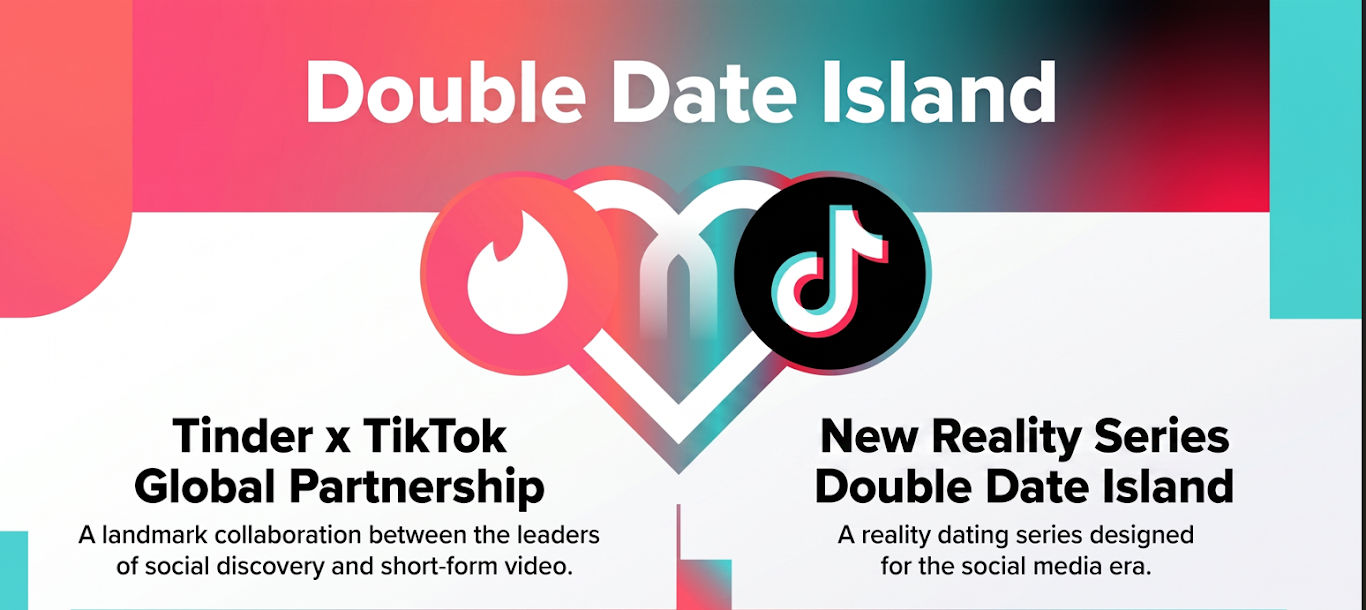
In June 2026, Tinder and TikTok announced a branded entertainment deal that breaks from how the category normally works. Most branded entertainment places a brand inside someone else’s content — a sponsorship, an integration, a placement. This deal does something structurally different: Double Date Island, a reality dating series, is Tinder’s Double Date product feature, dramatized directly, with no advertising layer translating one into the other.
The format is co-developed by ITV Studios’ Studio 55, produced by Cowshed Studios, and released exclusively through TikTok — bypassing broadcast and SVOD windows entirely. The detail that matters most for anyone tracking how this category evolves: OMD EMEA, Tinder’s media planning and buying agency, was integrated into format development rather than positioned downstream as a media buyer.
That’s the part of this deal most likely to repeat industry-wide, regardless of whether TikTok or any single platform remains the distribution channel of choice. For production companies and platforms competing for brand commissions, the competitive set just expanded to include the brand’s own media agency, now operating as a format co-architect rather than a media buyer.
⚡ Key Takeaways
- This deal defines a branded entertainment subcategory — product-to-format conversion — where the feature and the content are the same object, with no campaign step in between.
- OMD EMEA’s role signals a shift in media agency function from campaign execution to format-level brand integration, visible in the gap between their prior Say Goodbye to Hellos campaign and this development-stage involvement.
- TikTok’s positioning as “cultural stage” rather than discovery tool is the platform thesis Tinder bought into — native distribution where the audience already lives, not paid reach.
- The model is replicable by any consumer platform with a dramatizable feature and a young-adult audience large enough to justify original production.
- No financial terms are disclosed — production budget, platform revenue share, and agency compensation structure are all unknown, which limits any claim about this model’s actual cost-efficiency versus a traditional campaign.
Table of Contents
- Branded Entertainment Without a Campaign
- The Dealmakers Behind Double Date Island
- Why This Deal Is Structurally Different
- Supply Chain Impact: Production, Distribution, and Monetisation
- What to Watch Next
- Vitrina Perspective
Branded Entertainment Without a Campaign
In June 2026, the TikTok-Tinder partnership introduced a branded entertainment model built on a simple but unusual premise: skip the advertising campaign, ship the product feature as the show.
Deal Mechanics
The deal is a content distribution and co-development partnership, not a licensing deal, joint venture, or acquisition. Tinder retains the IP. Studio 55 (ITV Studios) co-develops the format. Cowshed Studios produces it on location. Zoo 55 (ITV Studios) distributes it. TikTok hosts it exclusively. No money changes hands for content rights in the conventional sense — TikTok isn’t buying a finished show, it’s hosting a brand-financed original.
Tinder commissions and finances the series, built directly around its existing Double Date feature, where pairs of friends match with other pairs. Studio 55 shapes the format at the development stage. Cowshed Studios executes production. Zoo 55 manages distribution logistics. TikTok provides the exclusive platform and creator-ecosystem amplification. OMD EMEA, Tinder’s regional media agency, sits inside the partnership structure rather than operating purely as a downstream media buyer.
The deal type is: content distribution and co-development partnership with development-stage agency integration. The absence of disclosed financial terms is itself a signal — the model’s cost-efficiency cannot yet be priced against a conventional campaign.
Volume and Territories
- Cast drawn from eight countries — the US, Brazil, Australia, the UK, France, Spain, Italy, and Germany
- Shoot location: Portugal
- Production budget: not publicly disclosed
- TikTok’s revenue-share or hosting arrangement: not publicly disclosed
- OMD’s compensation structure: not publicly disclosed
- Episode count or season length: not published
The series targets European young-adult audiences specifically, distributed through TikTok with access restricted to users 18 and over, given the dating format and adult participants. Where terms are undisclosed, that gap is part of the analysis, not a footnote to skip past.
Why This Deal Happened Now
Three pressures converge here. Tinder needs cultural relevance with an audience that increasingly treats dating apps as utilities rather than lifestyle brands. TikTok needs premium, scripted-adjacent content to support its shift from discovery feed to entertainment destination — a positioning TikTok’s Kris Boger states directly. ITV Studios needs digital-native commissions that don’t depend on broadcaster or SVOD budgets, which is exactly what Studio 55 exists to deliver. Each party solves a distinct problem through the same structure.
Legacy Branded Entertainment vs. the Feature-to-Format Model
| Dimension | Legacy Branded Entertainment | Feature-to-Format Model (This Deal) |
|---|---|---|
| Relationship between product and content | Brand sponsors or integrates into third-party content | Product feature is the content premise itself |
| Marketing layer | Campaign explains the feature, separate from content | No campaign — the format replaces the explanation |
| Distribution window | Broadcast or SVOD, often licensed to platform | Native social release, no licensing window |
| Agency role | Media buying and campaign execution | Format-level brand integration at development stage |
| Financial structure | Disclosed media spend, sponsorship fee | Undisclosed — no analyst estimate possible without more data |
The Dealmakers Behind Double Date Island
Tinder (Match Group)
Tinder operates as Match Group’s largest revenue brand. Match Group reported global revenue in the billions across its portfolio in its most recent fiscal year, with Tinder historically representing roughly half of total company revenue, per Match Group investor disclosures. Tinder does not break out standalone European revenue publicly.
Role in this deal: IP originator and sole financier of the format. Tinder owns the Double Date feature this series dramatizes and commissions the content built around it.
Strategic context: Tinder has faced sustained pressure on user growth and engagement across mature Western markets, prompting a pivot toward “social, dynamic spaces” rather than pure swipe-and-match mechanics — a pivot Paolo Lorenzoni names directly in his quote.
Specific impact: Tinder shifts a portion of its EMEA marketing budget from paid media toward owned-format production. The Double Date feature gains a media presence that doesn’t compete for ad inventory against other apps.
Power shift: Gains leverage. Tinder moves from media buyer competing for attention to content commissioner with exclusive placement.
TikTok (ByteDance)
TikTok’s global user base exceeds one billion monthly active users. ByteDance doesn’t disclose TikTok-specific European revenue, though IAB Europe places short-form video ad spend among the fastest-growing segments of European digital advertising.
Role in this deal: Exclusive distribution platform, providing creator ecosystem access, premium placement, and the entire release infrastructure.
Strategic context: TikTok has been building Business Solutions and creator monetisation infrastructure (PULSE) specifically to attract premium brand content beyond standard ad formats — this deal is a direct proof point of that strategy working.
Specific impact: TikTok secures a season of premium, multi-territory original content at zero production cost, reinforcing its “cultural stage” positioning against YouTube and Instagram for premium brand commissions.
Power shift: Gains leverage. TikTok converts itself from an advertising channel into a content destination without spending production capital.
ITV Studios — Studio 55 and Zoo 55
ITV Studios is one of the largest international production and distribution groups, with content sold across more than 50 countries. ITV plc’s most recent annual report shows ITV Studios as the group’s primary growth driver relative to broadcast.
Role in this deal: Studio 55 co-develops the format at the concept and structure level; Zoo 55 handles distribution logistics. Both are ITV Studios’ digital-native labels, distinct from ITV’s traditional broadcast commissioning arm.
Strategic context: Will Scougal’s quote — “exactly the kind of format Studio 55 was built to create” — confirms this isn’t opportunistic. Studio 55 exists specifically to produce digital-native, platform-first content for brand clients, positioning ITV Studios to win commissions that bypass broadcasters entirely.
Specific impact: ITV Studios secures a brand-financed commission that doesn’t require a broadcaster or platform license fee — a different and arguably more durable revenue model than traditional commissioning.
Power shift: Gains leverage relative to broadcast-dependent production peers, but remains dependent on the brand as financier rather than holding its own IP.
Cowshed Studios
A digital-first production company with prior credits including Sidemen XIX Inside and Foot Asylum presents Locked In — both creator-adjacent, platform-native formats.
Role in this deal: Production company executing the on-location shoot in Portugal.
Strategic context: Cowshed’s portfolio signals specialisation in exactly this format type: real participants, creator-economy adjacency, platform-native release.
Specific impact: Cowshed adds a major consumer brand client to a portfolio previously built on creator and retail-brand content — a credibility expansion.
Power shift: Gains leverage as a production partner capable of executing brand-commissioned format IP at this scale.
OMD EMEA
OMD operates as one of Omnicom Media Group’s primary global agency networks. Specific EMEA revenue is not separately disclosed.
Role in this deal: Tinder’s media planning and buying agency in EMEA, integrated into the partnership at the development stage rather than positioned purely downstream as a media buyer.
Strategic context: Natalie Bell’s quote explicitly links this deal to OMD’s prior Say Goodbye to Hellos campaign for Tinder — establishing a continuing client relationship rather than a one-off credit. That prior work was a conventional campaign. This is format development. The shift between the two, for the same client, in roughly the same period, is the signal worth tracking.
Specific impact: OMD’s function with this client moves from executing media plans against finished creative to shaping what the creative is before it exists. That changes the agency’s billable role and its claim on the value created.
Power shift: Gains leverage. An agency with a seat at the format table has a different commercial relationship with its client than one executing a media plan against content it didn’t help build — retention risk drops, scope of work expands.
Key Quotes from Named Individuals
Paolo Lorenzoni, VP Marketing EMEA, Tinder
“This partnership is a genuine milestone. Double Date Island on TikTok isn’t just a distribution deal, it’s a shared statement about how two platforms committed to authentic, social-first experiences can come together responsibly to move culture forward.” — Paolo Lorenzoni, VP Marketing EMEA, Tinder, ITV Press Centre, June 2026
His framing — “not just a distribution deal” — is the closest the release itself comes to naming the format-not-campaign distinction this analysis builds on.
Kris Boger, Regional General Manager UK/Ireland/Benelux, Business Solutions, TikTok
“We’re pleased to be the home for this season series, bringing a new creator-led entertainment format to young adults across Europe.” — Kris Boger, Regional GM, TikTok, ITV Press Centre, June 2026
Will Scougal, EVP Brand and Commercial Partnerships, ITV Studios
“Double Date Island is exactly the kind of format Studio 55 was built to create.” — Will Scougal, EVP Brand and Commercial Partnerships, ITV Studios, ITV Press Centre, June 2026
Natalie Bell, CEO EMEA, OMD
“Alongside the recently launched Say Goodbye to Hellos campaign, Double Date Island is another brilliant example of cultural marketing in action… we’ve worked together to reimagine how the brand connects with audiences through media and partnerships.” — Natalie Bell, CEO EMEA, OMD, ITV Press Centre, June 2026
Stakeholder Influence Table
| Stakeholder | Brings | Gains | Power Shift | Role |
|---|---|---|---|---|
| Tinder | IP, product feature, financing | Cultural relevance, owned media presence | Gains leverage — moves from media buyer to content commissioner | Initiator |
| TikTok | Distribution, creator ecosystem, scale | Premium content at zero production cost | Gains leverage — reinforces destination positioning | Strategic Enabler |
| ITV Studios (Studio 55/Zoo 55) | Production and development expertise | Brand-financed commission, new revenue model | Gains leverage relative to broadcast-dependent peers | Production Partner |
| OMD EMEA | Media strategy, now format integration | Expanded scope, deeper client entrenchment | Gains leverage — shifts from buyer to co-architect | Strategic Integrator |
Why This Branded Entertainment Deal Is Structurally Different
Precursor Analysis
The Double Date feature itself is the direct precursor — without an existing feature with a clear social mechanic, there’s no format to dramatize.
OMD’s Say Goodbye to Hellos campaign is the second precursor: a conventional campaign that established creative trust between Tinder and OMD before this deal asked OMD to do something structurally different.
Studio 55’s prior digital-native commissions — the release names Sidemen XIX Inside and Foot Asylum presents Locked In as comparable Cowshed credits — establish that this production model — creator-adjacent, platform-native, brand-financed — was proven before Tinder arrived as a client.
What Standard Practice Looks Like — and Where This Departs
Standard practice in branded entertainment is sponsorship or integration — a brand pays to appear inside content owned by someone else, or funds a campaign explaining a product separately from any content play.
The departure here: Tinder skips the explanation step entirely. The feature doesn’t get advertised. It gets cast. There’s no campaign asset whose job is “tell people what Double Date is” — the show does that job by existing.
The holy grail being abandoned is the advertising campaign as the default unit of brand storytelling. Tinder didn’t replace one campaign with a better campaign. It replaced the campaign with a format.
Historical Parallels — Including Failures
Red Bull’s media arm is the most-cited precedent for product-as-content, but Red Bull built that infrastructure over two decades, and the product itself — an energy drink — was never the literal subject of the content; extreme sports were. This deal is tighter: the feature is the show’s premise, not an adjacent lifestyle association.
A closer and less successful parallel is the wave of branded reality formats produced for YouTube in the late 2010s by consumer brands attempting similar product-to-content conversion — most failed to sustain beyond a single season because the brands lacked a production partner with Studio 55’s institutional format expertise, and lacked an agency integrated at the development stage rather than bolted on for promotion afterward. That absence is plausibly why those earlier efforts didn’t replicate.
The Contrarian Angle
The consensus read on this announcement — visible in how it was covered at Cannes Lions — treats it as a platform distribution story: TikTok wins premium content, Tinder wins reach. That reading is incomplete. It treats OMD as incidental and misses that this model’s replicability depends less on TikTok’s reach — rentable by any brand — and more on whether a brand’s agency relationship has matured enough to participate in format development. Reach is rentable. A development-stage agency relationship has to be built — as OMD built it with Tinder over the prior campaign cycle.
Total Addressable Market
The primary TAM is the European branded entertainment and digital content market. PwC’s E&M Outlook estimates European online video advertising at multiple billions of euros annually with continued growth through 2029, though PwC does not isolate a “branded format” sub-segment specifically, so no single sourced figure exists for this exact category.
The serviceable segment is consumer platforms with dramatizable features and EMEA marketing budgets large enough to finance original production — a narrow but growing segment as more apps adopt features-as-content logic. Growth trajectory is directionally upward, based on TikTok’s own stated strategy to court premium brand content, though no CAGR specific to this sub-category has been published. This is an analyst-estimated direction based on platform strategy statements, not a sourced market-sizing figure.
Pros and Cons
Pros:
- Attention without auction: Tinder captures audience attention without competing in paid media auctions. Benefit accrues to Tinder, realised this summer at launch.
- Premium content, zero production risk: TikTok adds premium content without production risk. Benefit accrues to TikTok, realised immediately upon successful viewership.
- Expanded agency scope: OMD expands its scope and billable relationship with a major client. Benefit accrues to OMD, realised over the contract renewal cycle.
Cons:
- Algorithm dependency: The format depends on TikTok’s algorithm and creator ecosystem for amplification. If TikTok deprioritises the content in feed distribution, the format underperforms regardless of production quality — risk borne by Tinder.
- Reputational exposure: Brand-financed content with real participants in a dating context carries reputational risk if cast experiences are negatively portrayed post-broadcast — risk borne by Tinder.
- Unverified economics: If production costs exceed the marketing value Tinder would have spent on a conventional campaign, the model doesn’t save money, it just relocates the spend — risk only triggered if internal ROI data were ever disclosed and proved unfavorable.
Competitive Landscape
Winner: TikTok. The specific advantage is securing premium, multi-territory original content that reinforces its “cultural stage” positioning without production capital outlay.
Industry reaction: If this format performs well through the summer, expect other dating and lifestyle apps with similarly dramatizable features to pursue comparable agency-development-stage partnerships with TikTok or competing short-form platforms — normalisation rather than retaliation, since no party here is positioned as harmed.
Supply Chain Impact: Production, Distribution, and Monetisation
Content Creation and Financing
This deal restructures who finances original format development. Tinder, a non-media company, is the sole financier — there’s no broadcaster commissioning fee, no platform license payment for the underlying IP. That shifts greenlighting power: the decision to make this show rested entirely with Tinder’s marketing function, not with a commissioning editor at a network.
OMD’s presence at the development stage means the agency holds informal influence over what gets greenlit, since they’re shaping brand fit before the format is locked. Third-party producers and co-financiers who do not hold relationships with either the venue operator or the distribution platform cannot include that window in their own recoupment models.
Production
Cowshed Studios executes a multi-territory casting and on-location shoot in Portugal — standard reality production mechanics, but financed and briefed by a brand marketing team rather than a broadcaster’s commissioning process. This shifts creative oversight: brand safety and product representation requirements likely run alongside, or ahead of, conventional narrative editorial judgment.
Distribution and Windowing
There’s no window here in the traditional sense — no theatrical, no linear premiere, no SVOD exclusivity period before wider release. The show launches direct-to-social, gated to 18+ TikTok users. This collapses the sequencing question that usually dominates distribution strategy — which window first, how long an exclusivity period — into a single decision: TikTok, exclusively, for the season.
Delivery Infrastructure and Rights
TikTok hosts the series but, based on available disclosures, does not appear to hold rights to it. The release describes a hosting and exclusive distribution arrangement rather than an originals acquisition. Unlike a traditional originals deal where the platform owns or co-owns the underlying IP, TikTok’s premium content library in this model is rented, not owned — a distinction that matters if TikTok ever wants to leverage past seasons for renewal negotiating power.
Monetisation Model
The model replaces two revenue lines simultaneously: the media licensing fee a broadcaster or SVOD platform would normally pay for finished content, and the ad spend Tinder would normally allocate to a campaign explaining the same feature. Both get replaced by Tinder’s direct production financing, with TikTok’s PULSE-style creator monetisation and ad infrastructure capturing the audience-side value instead of a conventional media buy.
The Friction Point: This deal resolves the lag between building a product feature and getting audiences to understand it — by making the explanation and the content the same artifact.
Supply Chain Disruption Map
| Stage | Disrupted? | Nature of Disruption | Severity |
|---|---|---|---|
| Content Creation & Financing | Yes | Non-media brand finances original IP directly, bypassing broadcaster/platform commissioning fees | High |
| Production | Partially | Standard production mechanics, but creative oversight now includes brand marketing function alongside editorial | Medium |
| Distribution & Windowing | Yes | No traditional window sequencing; single-platform, social-native exclusive release | High |
| Monetisation Model | Yes | Licensing fee and ad campaign spend both replaced by direct production financing plus platform ad infrastructure | High |
Ripple Effects Across the Industry
1. Agency compensation models may need to evolve. If OMD’s value is now partly tied to format development rather than media spend executed, a media-commission-based fee structure — the industry standard — doesn’t cleanly capture that contribution. Agencies doing this kind of work may push toward production-credit or IP-stake compensation instead.
2. Casting and participant duty-of-care standards face a different test. Reality formats financed by consumer brands, rather than broadcasters with established compliance departments, may need to import broadcast-standard participant welfare protocols from a production partner like Studio 55, since the brand financier has no established framework for this.
3. TikTok’s content library starts accumulating brand-financed IP it doesn’t own. Unlike traditional originals deals, TikTok hosts but doesn’t appear to hold rights to Double Date Island — meaning its “premium content” library is rented, not owned, a distinction that matters if TikTok ever wants to leverage past seasons for renewal negotiating power.
The Practitioner’s Playbook
How do I pitch a brand-financed original format instead of a traditional campaign?
Workflow 1: Identify a specific, demonstrable product feature with a clear social or behavioral mechanic — not a brand value or tagline — as the format’s premise.
Workflow 2: Bring your media agency into the format development conversation before pitching production partners, not after creative is locked.
Workflow 3: Approach a digital-native production label — the Studio 55 model — rather than a traditional broadcast commissioner, since the brief requires platform-native thinking from the start.
What rights does a platform actually get when it hosts brand-financed content exclusively?
Workflow 1: Confirm in writing whether the platform receives a content license, a hosting agreement, or no formal rights transfer at all — the difference determines whether the brand can pull or relicense the content later.
Workflow 2: Establish participant release and welfare documentation independent of the platform, since the platform is not the production’s compliance authority.
How should a media agency structure compensation for development-stage involvement in branded content?
Workflow 1: Separate media-buying commission structures from any development or creative-integration fee, since the two reflect different scopes of work.
Workflow 2: Document specific creative and format contributions during development to support future fee negotiations or credit claims.
What to Watch Next
30 Days
Tinder’s international casting call is open now; expect cast announcements and creator-led promotional content on TikTok ahead of the Portugal shoot, with specific casting reveal dates likely tied to TikTok’s own content calendar rather than a fixed date in the release.
90 Days
The premiere itself — expected this summer per the release — is the clearest verifiable trigger; viewership and engagement data on TikTok in the weeks following premiere will be the first real signal of whether the feature-to-format model actually performs.
A second trigger worth watching: whether other Match Group brands or competing dating apps announce comparable platform-native format deals before the season concludes, which would suggest the model is already being read internally as a template worth repeating.
1 Year
Near-term signal beyond the 90-day window is limited — no renewal terms, second-season options, or structural commitments have been disclosed. Watch for whether OMD’s compensation structure or scope of work with Tinder becomes public in any form (award submissions, agency case studies), which would be the first concrete evidence of how development-stage agency involvement gets priced.
Vitrina Perspective
Which Market Assumption Has Changed?
The assumption that brand marketing requires a campaign layer between a product feature and audience understanding. Before this deal, the default sequence was: build feature, then explain feature via advertising. This deal collapses that sequence into one step.
Who Holds Power Now That Didn’t Before?
OMD EMEA. An agency that previously executed media plans against content it didn’t shape now sits inside content development — a structurally different and more durable position with its client than a standard media-buying mandate provides.
What Should a Practitioner Monitor?
Whether your own media agency relationship includes any development-stage involvement, or strictly executes against finished creative — and if it’s the latter, ask why, given that this deal demonstrates the alternative is buildable.
The Vitrina AI Read
What’s actually moving in this deal isn’t platform reach — TikTok’s scale was never in question. What’s moving is where in the supply chain brand strategy gets decided, and the answer, increasingly, is earlier. Tinder didn’t buy an ad campaign and didn’t license a finished show; it financed a format from the same conversation where its media agency normally just buys placements. The pattern Vitrina AI tracks across the M&E supply chain is this: as more brand budget moves from media spend toward owned IP, the agencies holding that budget don’t get cut out — they move upstream, and the campaign becomes the thing that gets skipped, not the thing that gets bigger.
If there’s a genuine open question here, it’s economic: nobody has disclosed whether financing a format costs more or less than financing a comparable campaign at comparable reach, and until that data surfaces, the model’s replicability rests on cultural proof, not proven unit economics.
Frequently Asked Questions
What is the TikTok-Tinder Double Date Island partnership?
It’s a branded entertainment deal where Tinder finances an original reality dating series, Double Date Island, based directly on its Double Date product feature, with TikTok as the exclusive distribution platform across Europe. ITV Studios’ Studio 55 co-develops the format, Cowshed Studios produces it, and Zoo 55 distributes it. There’s no broadcaster or SVOD window — it releases direct-to-social, gated to users 18 and over.
What makes this different from typical branded entertainment?
Most branded entertainment places a brand inside someone else’s content. This deal makes the brand’s own product feature the content’s premise — there’s no separate advertising campaign explaining the feature, because the show does that job by existing. The product and the content are functionally the same object.
What role does OMD EMEA play in this deal?
OMD is Tinder’s media planning and buying agency in EMEA, but here it’s integrated into the format’s development rather than positioned purely downstream as a media buyer. This follows OMD’s prior Say Goodbye to Hellos campaign for Tinder, suggesting the agency relationship has expanded from campaign execution to format-level brand integration.
Is this branded entertainment model replicable for other brands?
Potentially, but it requires three things: a product feature with a clear, dramatizable social mechanic; a production partner with platform-native format expertise (the Studio 55 model); and a media agency mature enough in the client relationship to participate at the development stage rather than just buying placements after the fact.
What financial terms are known about this deal?
None are publicly disclosed. Production budget, TikTok’s revenue or hosting arrangement, and OMD’s compensation structure are all undisclosed. That gap matters — without it, the model’s actual cost-efficiency versus a traditional campaign can’t be verified.
Does TikTok own the rights to Double Date Island?
This isn’t disclosed in the release, and the deal structure suggests TikTok is hosting and exclusively distributing the content rather than acquiring ownership — a rented-content arrangement rather than a traditional originals deal, though this is an analyst inference rather than confirmed fact.
Who is the target audience for Double Date Island?
Young adult audiences across Europe, with cast drawn from the US, Brazil, Australia, UK, France, Spain, Italy, and Germany. Content is restricted to TikTok users 18 and over given the dating and adult-participant format.
Byline: Vitrina AI M&E Intelligence
Bio: Santosh Abhyankar is a Senior Industry Analyst at Vitrina AI specialising in branded content, distribution strategy, and supply chain dynamics across digital and social platforms. Vitrina AI provides supply chain intelligence and market analysis to media and entertainment companies globally.