About Innovation Hub
 Global Content Pulse (Webinars)


 Global Production Financing
(Webinars)
Global Production Financing
(Webinars)  LeaderSpeak Podcast
  Global Entertainment Digest (Newsletter)
  About Vitrina
 About VIQI
 Our Story
 Our Solutions 🔥
 Film+TV Projects Tracker 🚀
 Case Studies
 Our Profile

San Francisco, 18 June 2026| ✍️ Atul Phadnis, Founder & CEO, Vitrina. Atul has spent the last several years mapping the global entertainment supply chain — tracking deals, financing structures, and company strategy across 100+ markets in film and television.
The Fox-Roku deal is being reported as a streaming play. It isn’t. It is a supply-chain acquisition — and one of the most strategically complete moves any media company has made in years. What it means for streamers, studios, and financiers is not a footnote. It is the story.
Read It as a Supply-Chain Move, Not a Media Merger
Most of the coverage has framed this as a story about streaming scale, connected-TV advertising, and a legacy broadcaster catching up to the future. That framing is accurate. It also undersells what Fox actually did.
At Vitrina we map this industry as a chain. Content IP sits at the top, then production financing, then production and post, then licensing, then the streaming service, then the carriage layer delivering the signal, then the device in the living room — and wrapped around all of it, the measurement and ad-tech layer that knows what every household watches. Almost every company in entertainment lives on one or two of those links. The question worth asking of any major deal is not how much bigger it makes the buyer. It is how many links of the chain the buyer now owns, and which ones.
Fox just answered that question more decisively than any company has in years.
Fox Has Been Walking Down the Chain Since 2019
Run Fox through that lens and the strategy becomes obvious in hindsight. In 2019 the company reoriented around live news and sports. In 2020 it bought Tubi and built it into one of the most-watched free streaming services in the United States. Last year it took an equity stake in vertical-video company Holywater and invested in The Lighthouse creator campus. In January it signed Dhar Mann Studios for an initial slate of 40 vertical titles. Now it is paying roughly $22 billion for Roku, at $160 a share, in a deal expected to close in the first half of 2027. Every one of those moves pushed Fox a link further down the chain, toward the consumer.
Roku is the link that matters most, because Roku is not a service. It is the rail. Fox now owns the operating system, the home screen, the app layer, a device install base of more than 100 million households, and the automatic content recognition data that reports what those households watch across every app on the platform — not only the Fox ones. Tubi gave Fox a product to put on the shelf. Roku gives Fox the shelf. That is a different kind of asset, and there are very few of them left to buy.
If you are a streamer distributing on Roku today, your relationship with that platform just changed. You are no longer dealing with a neutral technology infrastructure provider. You are licensing shelf space from a content competitor.
Consolidation at the Top, Fragmentation at the Bottom
Pull the camera back and the shape of the whole industry comes into focus. At the top and middle of the chain — studios, streamers, the direct-to-consumer distribution layer — consolidation is accelerating. The Department of Justice cleared Paramount Skydance’s acquisition of Warner Bros. Discovery days before the Fox announcement. Disney has folded Hulu into Disney+. Fox now adds Roku. Ownership and distribution are collapsing into a small number of very large companies.
The creation layer is moving in the exact opposite direction. It is fragmenting and multiplying faster than anyone can index it. Creators now range from microseries studios and vertical-video apps to AI-native producers and individuals carrying audiences larger than most broadcast networks. Tubi has brought more than 16,000 episodes from over 200 creators onto the platform in under a year, including MrBeast and Rhett and Link’s Mythical. Fox has committed to more than 200 vertical titles through Holywater and another 40 through Dhar Mann. The number of people making content has exploded. The number of companies controlling how it reaches you has shrunk.
That divergence is the whole game right now. When creation fragments this hard, value stops sitting in the middle of the chain. It moves to the two ends — into owned IP and owned distribution. The companies sitting only in the middle, with a licensing window or a production service but no position at either end, are already feeling that pressure. It is structural, not cyclical.
IP and Distribution Are Now the Same Bet
This is where Fox reads the board more clearly than most. The company has been buying both ends deliberately.
Fox Entertainment Studios holds a first-look arrangement giving it first opportunity to adapt HarperCollins’s Avon catalog into original series and made-for-platform movies — a steady supply of proven IP with audiences already attached. The Tubi creator deals are the same instinct applied to digital IP: bring creators and their fanbases inside the building. Those are bets on owned content at the top of the chain.
Roku is the bet on owned distribution and the data sitting on top of it. The ACR data alone — knowing what 100 million households watch across every app on the platform — is a targeting and measurement asset that most streamers and advertisers currently pay third parties to approximate. Fox now owns it natively.
The two ends of the chain are worth more than everything between them, and Fox is assembling both. That is what the next decade gets fought over — not the size of a library or the reach of a single app, but control of IP at one end and control of the rail and the data at the other.
What This Means for Streamers, Studios, and Financiers
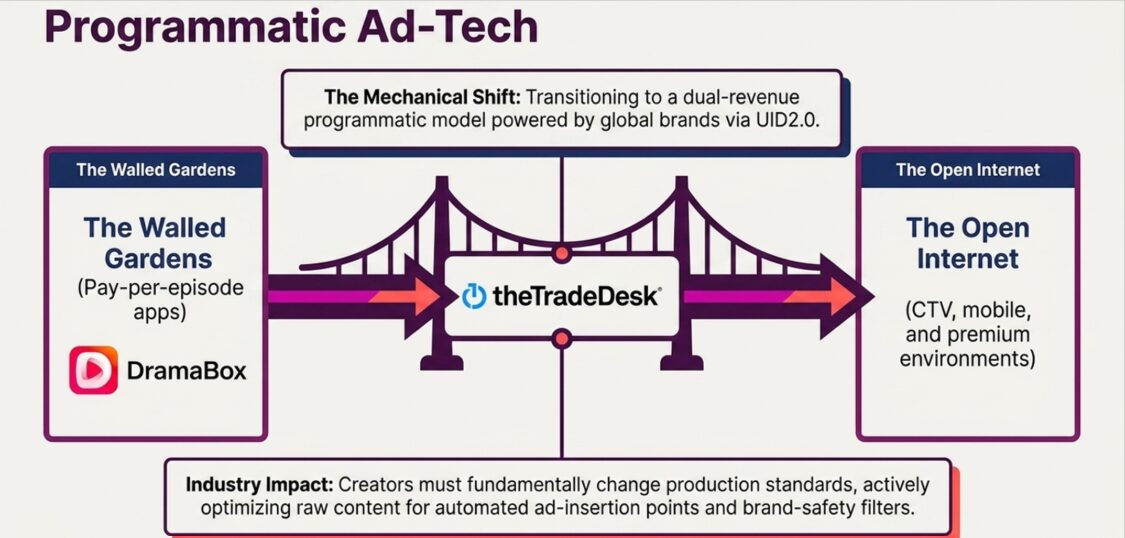
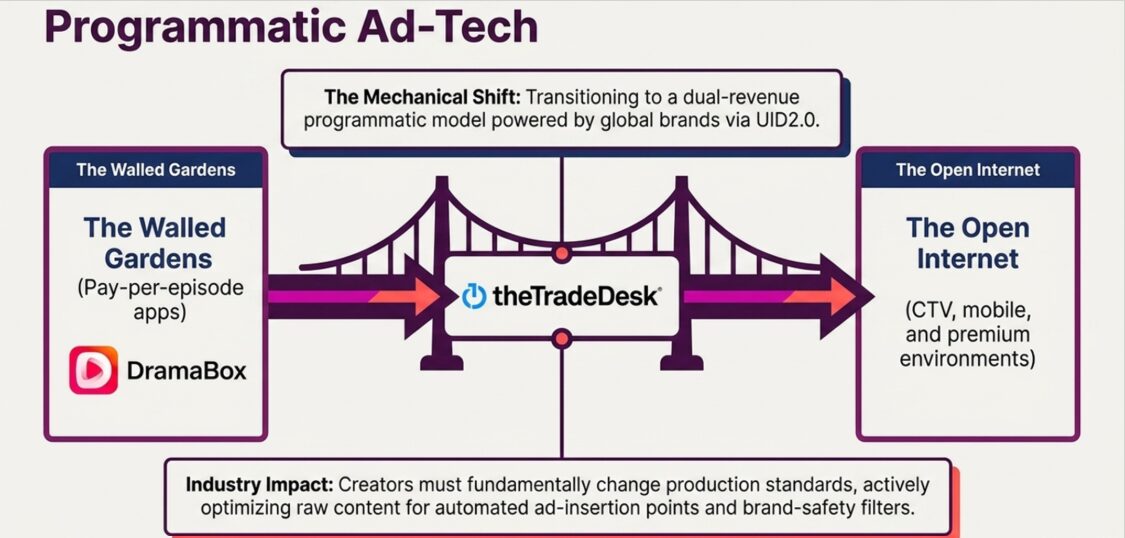
Expect a surge in “Private Marketplace” (PMP) deals where specific Fortune 500 brands test exclusive “takeovers” of trending DramaBox series. We anticipate case studies highlighting the “Attention Metric” of short-drama vs. standard pre-roll.
This is not a deal to monitor from the sidelines. Each part of the chain needs to be asking hard questions about its own position.
Streamers no longer have neutral distribution infrastructure to rely on as a baseline. More of the shelf is being owned by competitors. Commissioning strategy and platform mix decisions need to account for the fact that the platform carrying your content may increasingly prioritize its own. The window to negotiate distribution terms with independent infrastructure is narrowing.
Studios with output deals, licensing arrangements, or co-production structures tied to Roku-distributed platforms need to revisit those counterparty relationships. The entity on the other side of that deal is no longer a neutral technology company. It is a content competitor with direct access to 100 million households and the data to know exactly how your content performs against its own.
Financiers backing content need to be asking sharper questions about exit paths. As the distribution layer consolidates, the number of credible buyers for finished content contracts. IP with built-in audiences — creator-attached IP, franchise IP, format IP with a proven international track record — retains value. Content without an audience relationship becomes harder to place and harder to price.
The companies holding only the middle will feel the squeeze as content keeps flooding in. This is the moment to decide which link you are standing on — and whether one link will still be enough once both ends are owned.
This Is Vision, Not Opportunism
None of this reads as opportunism. Lachlan Murdoch called the Roku acquisition a “defining moment” for Fox and tied it directly to the strategy the company has been running since 2019. The discipline is in the details. Fox sold its Roku shares at $58 in 2020 to help fund Tubi, and is now buying the whole company at $160, while keeping its investment-grade balance sheet, buybacks, and dividends intact through the transaction. The board approved it unanimously. Anthony Wood, who spent two decades building Roku, called the combination “an extraordinary opportunity to accelerate our vision” — not an exit, a next chapter.
I have watched a lot of leaders respond to a fragmenting market by simply making more content. Fox decided to own the ground the content stands on. That is the more durable position. It is the kind of move that looks defensive today and looks visionary in five years.
At Vitrina we track exactly these positions across the global entertainment supply chain — who sits where, how companies connect to each other, and where the consolidation pressure builds next. Every executive on this chain should know which link they occupy. The two ends are no longer unclaimed.
Five Questions Executives Are Asking After This Deal
- If Fox-Roku closes, what happens to Roku’s existing carriage agreements with Netflix, Amazon, and other top-tier streamers — and who has the leverage to renegotiate?
- Which streamers are most exposed to losing neutral distribution access, and what does a credible alternative strategy look like before 2027?
- Is the Paramount Skydance-Warner Bros. Discovery combination a direct response to this kind of vertical integration — and does it actually create an equivalent position on the chain?
- For financiers backing independent content, which IP categories and rights structures hold their value as the buyer pool for finished content narrows?
- Who are the remaining neutral distribution assets — operating systems, device manufacturers, carriage platforms — that have not yet been absorbed into a content company’s strategy?