About Innovation Hub
 Global Content Pulse (Webinars)


 Global Production Financing
(Webinars)
Global Production Financing
(Webinars)  LeaderSpeak Podcast
  Global Entertainment Digest (Newsletter)
  About Vitrina
 About VIQI
 Our Story
 Our Solutions 🔥
 Film+TV Projects Tracker 🚀
 Case Studies
 Our Profile
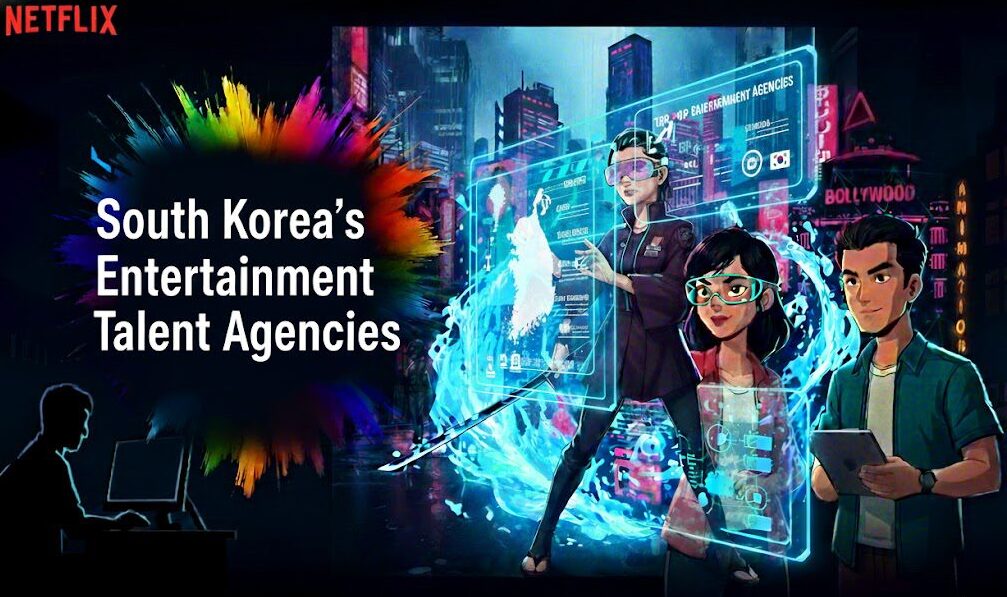
Here’s what most international producers get wrong about South Korean entertainment talent agencies: they treat them like talent boutiques. They’re not. They’re vertically integrated IP factories — each one a node in a content supply chain that stretches from Seoul to 150 countries, generating billions in EBITDA from music masters, brand licensing, platform technology, co-productions, and live events simultaneously. Getting your deals right in this market requires supply chain intelligence, not a contact list.
South Korea has established itself as one of the world’s premier Sovereign Content Hubs — an operational production ecosystem backed by government support via KOFIC, Netflix’s $2.5 billion content commitment, and a domestic industry generating global hits at a rate no other non-English-language market has matched. But the ecosystem is deeply fragmented. Hundreds of agencies — from multi-billion-dollar conglomerates to boutique actor management shops — operate in organizational silos that make vetting, partnering, and deal-making far more complex than the Hallyu Wave headlines suggest.
This guide maps South Korea’s talent agency landscape as a supply chain: where value is created, how IP flows between entities, what the contractual structures mean for international partnerships, and how to de-risk your Korean talent engagement before you sit down to negotiate.
💡 Vitrina Analyst Note
From our analysis, international producers entering Korea without supply chain intelligence lose 15 to 20% in margin before negotiations even begin. Korean agencies are IP platforms with complex subsidiary structures. This guide is essential reading for any producer who wants to close a Korean co production deal before the commissioning window closes and the opportunity disappears into the trades.
Table of Contents
- South Korea as a Sovereign Content Hub: The Supply Chain Context
- The Artist IP Monetization Model: How Korean Agencies Create Value
- The Big 4 as Supply Chain Nodes: HYBE, SM, JYP, YG
- K-Drama Actor Agencies: The Drama Production Supply Chain
- The Fragmentation Problem: Why Korean Agency Intelligence Is Hard
- How to De-Risk Korean Talent Partnerships: A Framework
- Co-Production Treaties and What They Mean for Your Deal Structure
- FAQ
- Conclusion
Ask VIQI: Which Korean Agencies Have Active Co-Production Mandates Right Now?
VIQI is Vitrina’s AI intelligence engine — trained on 1.6 million titles, 360,000 companies, and 5 million entertainment professionals. Get real-time supply chain intelligence on Korean agency deal activity, organizational structures, and international partnership history — before your first outreach call.
✔ 200 free credits included | ✔ No credit card required
South Korea as a Sovereign Content Hub: The Supply Chain Context
Before you can map Korean talent agencies as supply chain actors, you need to understand the structural context they operate within. South Korea isn’t a developing market looking for Hollywood validation. It’s a Tier 1 Sovereign Content Hub — a territory with government-backed capital, established infrastructure, local content quotas, and deliberate export ambition that has already proven global commercial viability at scale.
The evidence is unambiguous. Squid Game became Netflix’s most-watched series globally. Parasite won the Academy Award for Best Picture. BTS generated over $1 billion in projected 2026 revenue from albums, digital sales, and concert tours alone. Netflix’s $2.5 billion Korean content commitment isn’t a bet on an emerging market — it’s recoupment acceleration on a proven IP pipeline. And Disney Japan’s partnership with CJ ENM’s TVING in 2024 confirmed that Korean content has become a core acquisition priority for every major streamer operating in Asia-Pacific.
The Korean Film Council (KOFIC) provides structural scaffolding: co-production treaty support, content export programs, subsidized production incentives, and distribution partnerships that give Korean agencies advantages unavailable to independent producers in most territories. Australia maintains a formal co-production treaty with South Korea. Multiple European countries have bilateral agreements that enable incentive stacking for Korean partnerships. Understanding this government infrastructure isn’t background reading — it’s the foundation of every deal structure you’ll negotiate in this market.
But here’s what the Hallyu Wave narrative doesn’t tell you: the same density that makes Korea’s entertainment ecosystem so productive also makes it extraordinarily difficult to navigate from outside. For a full supply chain view of how Korean animation and IP sits within the broader APAC ecosystem, Vitrina’s guide on Korean animation and global IP acquisition maps the landscape with deal-level specificity.

Your AI Assistant, Agent, and Analyst for the Business of Entertainment
VIQI AI helps you plan content acquisitions, raise production financing, and find and connect with the right partners worldwide.
- Find active co-producers and financiers for scripted projects
- Find equity and gap financing companies in North America
- Find top film financiers in Europe
- Find production houses that can co-produce or finance unscripted series
- I am looking for production partners for a YA drama set in Brazil
- I am looking for producers with proven track record in mid-budget features
- I am looking for Turkish distributors with successful international sales
- I am looking for OTT platforms actively acquiring finished series for the LATAM region
- I am seeking localization companies offer subtitling services in multiple Asian languages
- I am seeking partners in animation production for children's content
- I am seeking USA based post-production companies with sound facilities
- I am seeking VFX partners to composite background images and AI generated content
- Show me recent drama projects available for pre-buy
- Show me Japanese Anime Distributors
- Show me true-crime buyers from Asia
- Show me documentary pre-buyers
- List the top commissioners at the BBC
- List the post-production and VFX decision-makers at Netflix
- List the development leaders at Sony Pictures
- List the scripted programming heads at HBO
- Who is backing animation projects in Europe right now
- Who is Netflix’s top production partners for Sports Docs
- Who is Commissioning factual content in the NORDICS
- Who is acquiring unscripted formats for the North American market
The Artist IP Monetization Model: How Korean Agencies Create Value
Korean entertainment agencies — particularly the Big 4 K-pop conglomerates — have built the most sophisticated artist IP monetization systems in the global entertainment industry. This isn’t talent management. It’s a multi-platform IP extraction machine that turns a single artist or group into a continuous, multi-stream revenue source with compounding recoupment.
The architecture works like this. An agency scouts a trainee — typically age 10–16 — and invests in 2–7 years of comprehensive training across singing, dance, performance, language, and visual presentation. That trainee accumulates development costs as debt against future earnings. Upon debut, the artist signs a KFTC-regulated contract capped at seven years. The agency then activates a parallel revenue stack across:
- Recorded music — album sales, digital streaming, master licensing
- Concerts and live events — HYBE staged 279 concerts across 53 cities in 2025, generating $537.5 million in concert revenue alone
- Merchandise and licensing — HYBE’s MD and IP licensing revenue surged 70% year-on-year in Q3 2025 to $121.4 million
- Brand partnerships — BLACKPINK members individually represent Dior, Prada, Saint Laurent, and Chanel
- Platform and fan technology — Weverse (HYBE’s global superfan platform) reached 11.6 million monthly active users in Q3 2025
- Content production — variety shows, documentaries, reality series, and drama adaptations built around artist IP
The critical supply chain insight is that this model creates an IP asset — not just a talent relationship. When an international producer approaches a Korean agency for co-production access, they’re not negotiating talent fees. They’re negotiating IP licensing terms with a company whose primary asset is the artist’s image rights, music catalog, and brand equity. The contractual complexity is correspondingly greater — and the approval chains are longer — than a typical Western talent booking.
For K-drama actor agencies, the model differs but is still IP-centric. Management Soop, Artist Company, BH Entertainment, and others don’t own music masters — but they do negotiate image rights, brand partnership exclusivities, and production participation deals that give them financial stakes in projects beyond simple commission structures. Actor-founded agencies like Artist Company (co-founded by Lee Jung-jae and Jung Woo-sung) take this further, developing original productions where agency and talent interests align directly.
The Big 4 as Supply Chain Nodes: HYBE, SM, JYP, YG
Map the Big 4 as supply chain nodes — not as monolithic companies — and their structural differences become strategically significant for deal-making.
HYBE — The Multi-Label IP Integration Platform
HYBE’s $1.86 billion in full-year 2025 revenue positions it as the largest K-pop enterprise globally — but the more operationally important number is the company’s explicit shift from a “management-focused” to a “label-centric IP integration” model, announced during their Q3 2025 earnings restructuring. What this means in practice: each subsidiary label — BigHit Music (BTS), PLEDIS (SEVENTEEN), Source Music (LE SSERAFIM), ADOR (NewJeans), KOZ (BOYNEXTDOOR) — operates as an independent IP node with its own licensing authority, marketing budget, and approval chain.
For international partners, this has one non-negotiable implication: the correct deal counterparty is always the subsidiary label, not HYBE Corp. A co-production or licensing discussion that starts at the holding company level will eventually be routed to the label — losing weeks or months in the process. HYBE’s multi-home, multi-genre strategy also extends to global markets: KATSEYE in the US (Geffen Records partnership), Santos Bravos and Musza in Latin America, and Korean-methodology IP development in entirely new territories. BTS returning as a complete seven-member group for the ARIRANG World Tour in March 2026 — 82 shows across 34 cities in 23 countries — creates the highest-value co-marketing window in Korean entertainment history.
SM Entertainment — The Kakao-Backed Catalog Powerhouse
SM’s 2023 ownership restructuring — Kakao and Kakao Entertainment acquiring a combined 39.87% stake — fundamentally changed SM’s supply chain positioning. Kakao’s digital infrastructure (Kakao TV, Kakao Webtoon, Kakao Entertainment) gives SM content distribution pathways unavailable to JYP and YG. SM also uniquely straddles both K-pop and K-drama through its KeyEast subsidiary (acquired 2018/2022), meaning a single conversation with SM’s corporate team can unlock access to both idol IP and veteran actor management relationships. SM’s 30th anniversary “SM 3.0” initiative signals strategic intent to evolve the catalog from music-first to “cultural content” — a deliberate broadening of IP licensing scope that creates new format and co-production opportunities for international partners.
JYP Entertainment — The Disciplined Operator
JYP has the cleanest financial profile of the Big 4 — consistently posting operating margins of 25–30% against HYBE’s 4–8% and YG’s 10–15%. Founded by J.Y. Park, JYP manages Stray Kids, TWICE, ITZY, NMIXX, and Day6, and recently debuted boy group KICKFLIP through a major television audition program. JYP’s 2026 strategic push into the Chinese market marks a significant directional shift from its previous US/global focus. For supply chain partners, JYP’s financial discipline translates into more predictable deal timelines and more straightforward IP ownership structures than the more complex holding architectures at HYBE and SM.
YG Entertainment — The High-Concentration IP Play
YG’s supply chain risk profile is the highest of the Big 4 — the company’s revenue is heavily concentrated around a small number of superstar acts (BLACKPINK, TREASURE, BABYMONSTER), meaning single-act activity cycles create significant revenue volatility. But that concentration also means YG’s top-tier IP is genuinely rare: BLACKPINK’s combined global brand endorsement portfolio with Dior, Prada, Saint Laurent, and Chanel has no equivalent in K-pop, and YG’s premium brand positioning creates IP licensing opportunities at price points the others can’t match. BLACKPINK’s full-group comeback in 2025 and continued international expansion into 2026 reopens the premium partnership window that’s been partially closed during individual member solo cycles.
Track Korean Agency Organizational Structures and Deal Flow in Real Time
Netflix, Warner Bros, Paramount, and Google TV use Vitrina to monitor supply chain intelligence across 140,000+ entertainment companies — including verified Korean agency profiles, subsidiary structures, co-production history, and executive contacts.
✔ 200 free credits | ✔ No credit card required | ✔ Full platform access
K-Drama Actor Agencies: The Drama Production Supply Chain
K-drama is a different supply chain from K-pop — and the agencies that power it operate on fundamentally different logic. Where K-pop agencies own master recordings and manage global fan platforms, K-drama actor agencies primarily negotiate talent access, project selection, and deal terms on behalf of individual actors. The financial stakes are different. The decision timelines are different. And the organizational structures — mostly boutique or mid-size shops rather than publicly listed conglomerates — mean you’re working directly with senior management rather than navigating corporate hierarchies.
But don’t mistake “smaller” for “less strategic.” Management Soop, a Kakao Entertainment subsidiary, manages Gong Yoo, Bae Suzy, Jeon Do-yeon, and Jung Yu-mi — a roster that between them has appeared in Goblin, Train to Busan, Doona!, and Crash Course in Romance. These aren’t just popular names — they’re actors with verified Netflix and global streaming performance data. Management Soop’s Kakao parentage also means its talent sits inside a digital distribution ecosystem that can accelerate content lifecycle across Korean platforms before international licensing.
Artist Company — co-founded by Lee Jung-jae and Jung Woo-sung — is the production-ambition play. Lee Jung-jae’s post-Squid Game profile gave Artist Company a direct Netflix relationship that most Korean agencies spend years trying to establish. But Artist Company’s real supply chain value is its willingness to develop original projects — not just represent talent for others’ productions. For international producers seeking Korean talent who can also co-produce, Artist Company is the natural starting conversation.
BH Entertainment carries Kim Go-eun, Park Hae-soo, Han Hyo-joo, and Park Bo-young — a roster with strong genre diversity across romance, thriller, and prestige drama. Their management philosophy emphasizes a curated approach: fewer clients, deeper investment per relationship. Saram Entertainment has built its reputation through close collaboration with top directors — meaning their talent tends to land in higher-quality projects than agencies operating purely on volume metrics. King Kong by Starship, the actor management arm of Starship Entertainment, adds an interesting structural element: dual K-pop/K-drama exposure under one parent company creates integrated opportunities for brands and platforms seeking both music and drama activations from a single commercial relationship. And iHQ (formerly SidusHQ) remains one of Korea’s most institutional agencies — decades of track record, deep broadcast relationships, and combined talent management with in-house production infrastructure.
The Fragmentation Problem: Why Korean Agency Intelligence Is Hard
Here’s the supply chain intelligence problem nobody talks about in the Hallyu coverage. South Korea’s entertainment ecosystem has hundreds of agencies — the Big 4, their dozens of subsidiary labels, the established mid-tier actor boutiques, and a long tail of smaller shops managing rising talent. They operate in organizational silos. IP ownership within multi-label structures isn’t publicly documented. Executive-level contacts change. Projects in development aren’t announced until they’re greenlit, by which time the key talent attachment windows have closed.
This is the Fragmentation Paradox at its most acute. The counterintuitive reality of abundant Korean supply — hundreds of agencies, thousands of artists, tens of thousands of projects — is that abundance creates information opacity, not clarity. International producers who lack real-time intelligence on which entity controls specific IP, which executives have co-production authority, and which agencies are actively in conversation with their target platforms will spend 3–6 months of deal cycle just mapping the landscape. That’s margin-killing delay in a market where platform commissioning windows run 6 weeks ahead of announcement.
The specific questions that separate informed from uninformed Korean market entry are granular ones. Which specific label within HYBE controls the IP for a target artist? What is the cross-border distribution track record of a particular actor agency — not its domestic reputation, but verified international platform performance? Are the key executives at a target agency actually attached to the specific project, or are they nominally associated while a junior team handles your outreach? And — critically — what are the standard deal terms that comparable agencies have accepted in comparable co-productions? Without benchmarks, you negotiate blind.
For a fuller framework on how to access Korean market intelligence systematically, Vitrina’s profile on CJ ENM’s vision for South Korea content production maps one of the country’s most important conglomerates in supply chain terms.
How to De-Risk Korean Talent Partnerships: A Framework
Smart Pairing — matching your project’s specific requirements to Korean agencies whose current deal priorities, talent availability, and organizational capabilities actually align — doesn’t happen through festival networking. It requires a structured de-risking process. Here’s the framework that reduces your Korean deal cycle from months to weeks.
Step 1: Identify the Correct Entity
Don’t approach HYBE. Approach BigHit Music — or whichever specific label controls the IP you need. Don’t approach SM Entertainment. Approach KeyEast for actor talent, or the relevant music label for idol IP. The holding company level is for regulatory compliance and corporate governance, not co-production deal-making. Mapping organizational structures to the decision-making level before your first outreach eliminates the single biggest deal-cycle extension in Korean market entry.
Step 2: Verify Cross-Border Distribution Track Record
Domestic Korean ratings and critical acclaim don’t translate directly to international streaming performance — and your platform partners will ask for verified data, not press clippings. Before you build a pitch deck around any Korean talent, verify that talent’s actual cross-border distribution history: which international platforms have commissioned or licensed their projects, what the viewing performance data shows (where available), and how comparable deals were structured. Management Soop and BH Entertainment have strong Netflix penetration. Artist Company has direct Disney+/Netflix relationships. But for dozens of other agencies, this data either doesn’t exist or hasn’t been systematically compiled.
Step 3: Understand IP Ownership Before Negotiating
This sounds obvious. It isn’t — not for Korean agencies. The Korean system generates IP that’s distributed across agency, label, artist, and in some cases platform entities simultaneously. Music master ownership differs from image rights ownership. Webtoon adaptation rights for a K-drama might sit with Kakao Webtoon rather than the actor agency. The specific rights you need for your co-production or licensing deal may be controlled by an entity you haven’t yet identified. Mapping this before negotiation — through verified intelligence rather than assumption — protects both your deal timeline and your legal position.
Step 4: Account for Contract Cycle Timing
Korean talent contracts are capped at seven years under KFTC regulations — and contract expirations are significant industry events. A group losing one or more members at contract expiry can materially affect the commercial value of any co-production built around that IP. Knowing where your target talent sits in their contract lifecycle isn’t gossip — it’s deal-level due diligence. Talent in the final year of their contract is either in negotiation (and potentially unavailable for new commitments) or actively seeking new arrangements (and potentially more accessible than usual). Track the timing.
Step 5: Price-Benchmark Before You Enter the Room
The Fragmentation Paradox costs international producers 15–20% in margin through information deficit — paying above-market rates simply because they lack the pricing intelligence to negotiate effectively. Korean agency fees, licensing rates, and production participation terms aren’t publicly available. But comparable deal terms from similar transactions are traceable through verified supply chain intelligence. Entering a Korean agency negotiation without market benchmarks is the entertainment equivalent of buying real estate without comparable sales data. The information exists — you just need the right tool to access it.
Co-Production Treaties and What They Mean for Your Deal Structure
Australia maintains a formal bilateral co-production treaty with South Korea — one of the most direct structural tools available to producers in both markets for stacking incentives and co-producing with Korean agencies. Under this treaty structure, a co-production qualifies for national film status in both countries, unlocking Australia’s 30% Location Offset (raised from 16.5% in July 2024) and relevant KOFIC support in Korea simultaneously. The financial recoupment implications are significant: a project structured as a Korea-Australia official co-production can access incentive pools from both territories, compressing the capital recovery timeline considerably.
Multiple European countries — including Germany, France, and the UK — have either formal treaties or memoranda of understanding with South Korea that facilitate official co-productions. The UK’s treaty with Australia (and Australia’s treaty with Korea) also opens trilateral co-production structures for projects with significant UK creative contribution. These stacked treaty configurations require careful financial and legal architecture — the minimum and maximum contribution percentages, personnel requirements, and shooting location ratios all need precise compliance — but the incentive mathematics can be compelling for the right project.
What international producers frequently overlook is that treaty access doesn’t automatically resolve the talent agency relationship. A project can be structured as an official Korea-Australia co-production and still face months of talent negotiation delay because the producer didn’t first identify the correct Korean agency entity or map the IP ownership architecture. Treaty structure and talent supply chain intelligence are separate tracks — both must be managed in parallel for the deal to close efficiently. Vitrina’s comprehensive guide to global content acquisition strategy and international regional rights in 2026 maps the full treaty and licensing landscape with deal-structure specificity.
Skip the Cold Outreach. Get a Warm Introduction to the Right Korean Agency Contact.
Vitrina Concierge is your Virtual Agent in the entertainment supply chain. We don’t hand you a directory — we make warm introductions directly to the decision-makers at Korean agencies, streamers, and co-production partners actively seeking your type of deal.
- LA producer → Netflix UK, Fifth Season, Fox Entertainment (48 hours)
- Korean animation studio → Netflix Adult Animation (week one)
- Middle Eastern studio → Legendary Pictures (direct access)
Frequently Asked Questions
How do South Korean entertainment talent agencies function as supply chain actors?
South Korean entertainment agencies — particularly the Big 4 K-pop conglomerates — function as vertically integrated IP platforms rather than traditional talent management firms. They scout talent, own music masters and image rights, operate fan platforms, manage global tours, produce merchandise, and develop adjacent content — all within a single organizational structure. Each agency is effectively a node in a global content supply chain that simultaneously generates revenue across recorded music, live events, licensing, brand partnerships, and original content production. Understanding this architecture is the starting point for any international co-production or licensing deal.
What is KOFIC and how does it affect Korean talent agency co-productions?
The Korean Film Council (KOFIC) is South Korea’s government body responsible for supporting domestic film production, distribution, and international co-production. It administers co-production treaties with multiple countries including Australia, provides production subsidies, manages content export programs, and facilitates international partnerships. For producers seeking Korean talent agency co-productions, KOFIC’s treaty framework directly affects deal structure: a project qualifying as an official co-production under a KOFIC-administered bilateral treaty gains access to Korean production incentives while also qualifying for the partner country’s incentives. This incentive stacking can materially improve project IRR.
Why is the multi-label system important for international deal-makers?
The multi-label system — pioneered by HYBE, adopted by JYP — separates each artist group’s IP management into distinct subsidiary labels with independent licensing authority. This means the holding company (HYBE Corp, JYP Entertainment) is not the correct deal counterparty for IP licensing or co-production discussions. The specific subsidiary label controlling the target artist’s IP is the correct entity — and each label has its own approval chain, deal precedents, and commercial priorities. Approaching the holding company first adds weeks or months of internal routing delay. Mapping subsidiary structures before outreach is not optional intelligence — it’s the foundational deal-cycle accelerator.
What is the Fragmentation Paradox and how does it affect Korean talent agency deals?
The Fragmentation Paradox describes how an abundance of suppliers — hundreds of Korean talent agencies across K-pop, K-drama, film, and variety entertainment — creates information opacity rather than market clarity. Organizational structures within multi-label conglomerates aren’t publicly documented. IP ownership splits between labels, holding companies, and artists aren’t disclosed. Executive contacts change. The result: international producers without real-time supply chain intelligence spend 3–6 months just mapping the Korean landscape before their first substantive deal conversation — losing margin to delay and to above-market pricing negotiated without benchmarks.
Which K-drama actor agencies have the strongest international streaming performance?
Management Soop has the deepest Netflix penetration among Korean actor agencies — its roster including Gong Yoo, Bae Suzy, and Jeon Do-yeon has consistent global streaming performance. Artist Company has direct Disney+ and Netflix relationships via Lee Jung-jae’s post-Squid Game profile. BH Entertainment’s roster — Kim Go-eun, Park Hae-soo, Han Hyo-joo — has strong cross-platform streaming records across Netflix, Disney+, and regional Asian platforms. Verifying specific cross-border distribution data for any agency beyond these leading names requires real-time intelligence infrastructure rather than trade press review.
What does Korea’s Sovereign Content Hub status mean for international co-producers in 2026?
Korea’s Sovereign Content Hub status means international co-producers are accessing a fully operational, government-backed production ecosystem — not an emerging market requiring heavy development infrastructure investment. Netflix’s $2.5 billion Korean content commitment, KOFIC’s bilateral co-production treaty network, and BTS’s full-group return in March 2026 create a supply chain environment with high deal velocity and proven global distribution. The strategic implication: producers who invest in Korean supply chain intelligence now — mapping agencies, organizational structures, treaty mechanisms, and pricing benchmarks — can close deals in weeks rather than months, and at better terms than competitors relying on relationship networks alone.
Conclusion: Treat Korean Agencies as Supply Chain Partners, Not Black Boxes
South Korea’s entertainment talent agencies are among the most sophisticated IP infrastructure companies in global entertainment. HYBE’s $1.86 billion in 2025 revenue — generated across concerts, recorded music, merchandise licensing, and fan platform technology simultaneously — is the evidence. Management Soop’s roster dominating Netflix Asia commissioning decisions is the evidence. CJ ENM’s TVING securing a Disney Japan partnership is the evidence. This ecosystem has cleared the proof-of-concept phase years ago.
Key Takeaways:
- Korean agencies are vertically integrated IP platforms — not talent boutiques. Treat them as supply chain partners with complex organizational architectures and multi-stream revenue mandates.
- The correct deal counterparty is always the subsidiary label — not the holding company. Identifying this before outreach compresses deal cycles by weeks or months.
- IP ownership in multi-label structures isn’t publicly documented. Verified intelligence is the only reliable method for mapping who controls what before you negotiate.
- The Fragmentation Paradox costs 15–20% in margin and 3–6 months in deal time for producers without real-time Korean supply chain intelligence. That’s a quantifiable competitive disadvantage.
- 2026 is structurally high-value — BTS’s full group return, BLACKPINK’s comeback, and Netflix’s continued $2.5B Korean investment create deal velocity across the entire ecosystem.
The producers and platforms closing Korean co-production deals this year won’t be the ones with the most impressive pitch decks. They’ll be the ones who walked into negotiations already knowing the organizational structure, the correct decision-maker, the IP ownership chain, and what comparable deals have looked like. That’s supply chain intelligence. And in Korea’s market — where platform windows run six weeks ahead of announcement and the best talent packages close before they hit the trades — it’s the only real competitive advantage.
Accelerate Your Korean Market Entry With Verified Supply Chain Intelligence
Trusted by Netflix, Warner Bros, Paramount, and Google TV. Track 400,000+ projects, 140,000+ companies, and 5 million entertainment professionals — including verified Korean agency subsidiary structures, deal history, executive contacts, and international co-production track records.
✔ 200 free credits | ✔ No credit card required | ✔ Cancel anytime
Need a warm introduction to a specific Korean agency or streaming executive? Explore Concierge Service →
Find Film+TV Projects, Partners, and Deals – Fast.
VIQI matches you with the right financiers, producers, streamers, and buyers – globally.
Producers Seeking Financing, Co-Pros, or Pre-Buys?
Vitrina Concierge helps producers reach the right financiers, commissioners, distributors, and co-production partners — with precision outreach, not cold pitching.
Join Industry Briefings Trusted by Leaders

The New Deal Room: A 2026 Playbook for Global Content Licensing
How global content licensing is shifting beyond flat fees to flexible, deal-driven models.

Film & TV Production Financing: 2026 Trends
Production financing conditions are changing quickly. Understanding where money is moving and what buyers are backing is key to getting projects approved and funded in 2026.

Unreleased Film+TV Projects: Opportunities & Showcase
A curated view of unreleased Film and TV projects open for financing and collaboration

The Mid-Budget Comeback: Why Mid-Budget Films Is the Smartest Bet in the Room
Mid-budget films are attracting new capital. See why this segment is becoming one of the strongest bets in Film today.